

Start hereA 2010 study reported that two one-minute "high-power" poses raised testosterone and feelings of power. A 2015 replication with 200 people found that only the feeling held. So what does build confidence?
Confidence grows mostly from doing: small successes, noticed and recorded, add up. Below: what psychologists mean by confidence, the four things that build it, which popular tricks hold up, and a four-week small-wins plan.
1. The short list
Succeeding at the real thing has the best support; poses and repeated phrases have the least.
| Method | What you do | How it holds up |
|---|---|---|
| Collect small wins | Succeed at a version of the hard thing, and get feedback on it | Holds up |
| Watch someone like you | Learn from a person a little ahead of you | Partly |
| Ask for specific feedback | Get facts on how you did, not only praise | Partly |
| Read nerves as energy | Treat a racing heart as your body getting ready | Partly, small effect |
| Power posing | Stand in an expansive pose before a challenge | Partly: the feeling, not the hormones |
| Repeat positive statements | Tell yourself “I am confident” | Still argued |
2. What confidence means
For confidence in a particular task, the closest term in psychology is self-efficacy: your belief that you can do a particular thing.
The APA Dictionary of Psychology defines self-efficacy as a person’s own sense of their capability to perform in a given setting or to reach the results they want. It credits the idea to the psychologist Albert Bandura. One of its two senses of self-confidence is close to this: the belief that you can successfully meet the demands of a task.
Self-esteem is broader: the same dictionary describes it as the degree to which the qualities in a person’s self-concept are seen as positive. In plain terms, self-efficacy is “I can give this talk”, while self-esteem is closer to “I’m all right as a person”. The dictionary defines them as separate ideas.
For example, a nurse can feel sure of herself on a busy ward and unsure at a party. Her confidence belongs to the task, not to her whole self.
Bandura’s four sources
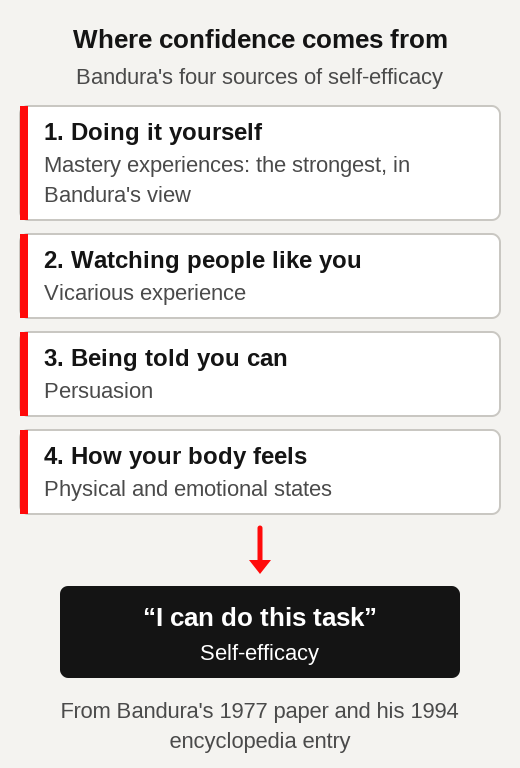
Bandura named four sources of this belief: doing it, watching others, being told, and how your body feels.
Bandura’s 1977 paper proposed that expectations of personal efficacy come from “4 principal sources of information”. It named them performance accomplishments, vicarious experience, verbal persuasion and physiological states.
In a 1994 encyclopedia entry he put them in plainer words. “The most effective way of creating a strong sense of efficacy is through mastery experiences,” he wrote. The others were seeing people like yourself succeed, being persuaded by others, and how you read your “somatic and emotional states”.
Confidence is not self-esteem
Raising self-esteem on its own has not been shown to lift school results; whether self-esteem shapes later life is argued.
A 2003 review found that the modest links between self-esteem and school performance did not show that high self-esteem leads to good performance. Instead, it said, high self-esteem is partly the result of good school performance. Efforts to boost pupils’ self-esteem had not been shown to improve academic performance, and might sometimes backfire.
A 2012 study that followed 1,824 people aged 16 to 97 for 12 years came to a different view. It found that self-esteem worked better as a cause of later life outcomes than as a result of them. It found medium-sized effects on how people’s moods and depression developed over the years, and no effect on their occupational status.
Our reading: for confidence in a task, work on the task. How you feel about yourself overall is a broader question, and the research on it is still argued.
3. What builds confidence
Each of Bandura’s four sources has been studied; in school studies, doing it yourself usually counts most.
Collect small wins
Holds up Succeeding at something raises your belief that you can do it again. In school studies, your own successes are typically the strongest source of confidence.
How sure: Moderate reviews agree that past success predicts later confidence, but most studies measure links, not causes.
A 2008 review of school studies found that mastery experience is typically the most influential source of self-efficacy. How strong each source is varied with things such as gender, ethnicity, academic ability and subject.
A 2013 meta-analysis of studies that followed the same people over time found that how well they had just done predicted their next level of confidence. That link held when the authors allowed for general trends over time.
Bandura added a caution. “If people experience only easy successes they come to expect quick results and are easily discouraged by failure,” he wrote. A resilient sense of efficacy, in his words, “requires experience in overcoming obstacles through perseverant effort”.
One finding points the other way. In a 2010 meta-analysis of 27 physical-activity programmes, with 5,501 people, the programmes raised confidence only a little overall. Programmes that used graded, step-by-step tasks were linked to lower levels of confidence; feedback did best. So a ladder of steps may need feedback beside it.
For example, if speaking up in meetings feels hard, ask one question in a small meeting this week. Add one comment the week after. Our stretch zone guide shows how to size a step that is hard but doable.
Watch someone like you
Partly Seeing someone like you succeed makes you more confident you can too. Watching a similar person succeed seems to help, though doing it yourself usually counts for more.
How sure: Limited one review of exercise programmes links it to higher confidence; in school studies, mastery usually counts for more.
In Bandura’s account, seeing people like yourself succeed through sustained effort raises your belief in your own ability. The likeness matters, he wrote: “The greater the assumed similarity the more persuasive are the models’ successes and failures.”
For example, watching a colleague who started a year before you give a short talk may help more than watching a famous speaker.
Ask for specific feedback
Partly Being told you can do it builds confidence. Encouragement alone does little; feedback on how you actually did seems to help more.
How sure: Limited one meta-analysis of exercise programmes, plus Bandura’s own account.
Bandura wrote that “it is more difficult to instill high beliefs of personal efficacy by social persuasion alone than to undermine it”. Unrealistic boosts in confidence, he added, are “quickly disconfirmed” by disappointing results.
In the 2010 meta-analysis, programmes that gave feedback on people’s past performance, or on others’ performance, produced the highest levels of confidence. Programmes that relied on persuasion were linked to lower levels.
For example, instead of asking “How did I do?”, ask “What is one thing I did well, and one thing to change?”
Read your nerves as energy
Partly Seeing a racing heart as readiness helps you perform. Reading nerves as energy gave a small boost in trials; it is not a cure for anxiety.
How sure: Moderate a 2024 meta-analysis of randomised trials found a small improvement, larger in some tasks.
Bandura wrote that “it is not the sheer intensity of emotional and physical reactions that is important but rather how they are perceived and interpreted”.
A 2024 meta-analysis of randomised trials found that teaching people to see stress as useful gave a small improvement in task performance. The effect tended to be larger for public performances than for written tests. Its authors call these methods promising but not “silver bullets”.
These trials measured performance and how stressed people felt, not confidence itself.
For example, before a presentation you might tell yourself “my body is getting ready”, instead of trying to force yourself to feel calm.
4. Popular confidence tricks, checked
Of these three popular ideas, none holds up in full, though self-talk aimed at the task may help in a different way.
Power posing
Partly Power posing: standing like a superhero changes your hormones and behaviour. The hormone and behaviour claims failed; the feeling replicated in that study.
How sure: Moderate a large replication found no hormone or behaviour effect, and the original first author no longer believes in it.
The 2010 study reported that holding two one-minute high-power poses, rather than low-power ones, raised testosterone, lowered cortisol and increased feelings of power and tolerance for risk. It had 42 participants.
A 2015 replication with 200 people ‘found no significant effect of power posing on hormonal levels or in any of the three behavioral tasks’. But it did find that people felt more powerful. The original study’s first author, Dana Carney, wrote in 2016: ‘I do not believe that “power pose” effects are real.’
Our reading: standing tall before a talk will not change your hormones. If it helps you feel steadier, that part did replicate in that study. Our cognitive biases page covers power posing among 14 famous findings.
“Just tell yourself you’re confident”
Still argued Repeating positive statements about yourself builds confidence. The evidence is mixed: a famous backfire finding did not replicate, and no reliable lift showed up either.
How sure: Unsettled one 2009 study found a backfire; two 2020 replications found no effect either way.
Repeating “I’m a lovable person” left people with low self-esteem feeling worse in a 2009 study, but two replications in 2020 found no such effect. Neither set of studies shows a reliable lift in mood from repeating a positive statement. Our affirmations page covers both sides.
Self-talk aimed at the task is a different matter. A 2011 meta-analysis of 32 sports studies found that self-talk improved performance by a moderate amount. Self-talk that told people what to do worked better than motivational self-talk on tasks needing fine control. It measured performance in sport, not confidence.
For example, a beginner at darts might say “elbow still” rather than “I’m a great player”.
“Confidence first, then success”
Still argued Build your confidence first and success will follow. Within a person, success seems to build confidence more than the other way round, but researchers still argue.
How sure: Unsettled a 2013 meta-analysis leans towards success first; Bandura and a colleague cited nine meta-analyses the other way.
A 1998 meta-analysis of 114 studies, with 21,616 people, found a moderate link between self-efficacy and performance at work. A link like this cannot show which comes first.
The 2013 meta-analysis, which pooled studies that followed people over time, concluded that self-efficacy “is primarily a product of past performance rather than the driving force affecting future performance”. Bandura and Edwin Locke argued in 2003 that evidence from nine meta-analyses shows self-efficacy beliefs do enhance motivation and performance.
Our reading: both camps agree that success raises confidence. So a small real attempt is a sensible place to start, rather than waiting to feel ready.
For example, if you are waiting to feel ready before you apply for a new role, one practice interview may move the feeling more than another week of waiting.
5. Confidence and competence
Partly A confident person is usually a competent one. Confidence and skill are linked, but confidence can be read as competence when it isn’t.
How sure: Limited the finding that overconfidence wins status comes from one team’s six studies.
A 2008 paper set out three ways researchers define overconfidence: overestimating your own performance, placing yourself above others, and being too sure of your beliefs. On hard tasks, people tended to overestimate their scores but thought they did worse than others; on easy tasks, the reverse.
A 2012 paper reported six studies; in three of them, overconfidence led to higher social status in groups. In another, overconfident people behaved in ways that made them appear competent to others.
The famous Dunning–Kruger pattern is part of this story. Our cognitive biases page covers it, with the verdict that the overestimation is real while its size and cause are disputed.
Calibration is how well your confidence matches how often you are right, and it can be trained. A 2015 meta-analysis of clinicians found their confidence was better calibrated with accuracy than previously assumed, though the link was small. In a two-year forecasting tournament, training in probability improved forecasters’ calibration.
For example, before each attempt in the plan below, write how sure you are that it will go well, from 0 to 100. After a few weeks, compare those numbers with how often it did.
6. When low confidence may be something more
If low confidence comes with lasting low mood or anxiety, talk to a doctor or a mental health professional.
The UK’s National Health Service (NHS) says that we all have times when we lack confidence and do not feel good about ourselves. It says that when low self-esteem becomes a long-term problem, it can harm our mental health and our day-to-day lives. It also notes that avoiding hard situations can feel safe in the short term, but in the longer term can reinforce doubts and fears.
The NHS describes social anxiety as “more than shyness”: a fear that does not go away and affects everyday activities, self-confidence, relationships and work or school life. For low self-esteem, it says that talking therapies like counselling or cognitive behavioural therapy (CBT) can help.
This page describes research. It is not a treatment plan. If fear or low mood is getting in the way of everyday life, that is worth talking over with a doctor or a mental health professional.
7. A four-week small-wins plan
This is our suggestion, not a tested programme. It uses only the parts above that hold up or partly hold up. It assumes one situation you want to feel surer in, and a few minutes most days.
| Week | Focus | What to do |
|---|---|---|
| 1 | Pick and shrink | Choose one situation. List five steps from easy to hard. Do the easiest step, and write it down. |
| 2 | Repeat and record | Do a step most days. Before each, write how sure you are from 0 to 100; after, write what happened. |
| 3 | Watch and ask | Watch someone a little ahead of you. Ask one person for specific feedback. Move up a step. |
| 4 | Look back | Compare your guesses with what happened. Count your wins. Pick the next situation. |
If it isn’t working
If the plan stalls, try one of these.
- Every step feels too big. Make it smaller, or bring in help, such as a friend or a teacher.
- You don’t feel any surer. Read your log instead of checking the feeling; it shows what you have done.
- Nerves stay strong or block daily life. See section 6 above.
Quick answers
What is the best way to build confidence?
The research points to doing. A 2008 review of school studies found that mastery experience, succeeding at the task yourself, is typically the most influential source of self-efficacy.
Does power posing work?
Not as first claimed. A 2015 replication with 200 people found no effect on hormones or behaviour, though people felt more powerful. The original study's first author wrote in 2016 that she does not believe the effects are real.
Do positive affirmations build confidence?
The evidence is mixed. In a 2009 study, repeating a positive statement left people with low self-esteem feeling worse. Two replications in 2020 found no such effect, and no reliable lift in mood either.
What is the difference between confidence and self-esteem?
Confidence in a task, which psychologists call self-efficacy, is the belief that you can do a particular thing. Self-esteem is broader, how positively you see your own qualities overall.
Is confidence the same as competence?
Not always. They are linked, but in a 2012 set of studies overconfidence led to higher status in groups, and overconfident people appeared competent to others.
Use this
Our suggestion, built from the parts above that hold up or partly hold up, over four weeks.
What is the smallest real step I could take today?
Quick quiz
Nothing is scored or saved. Recalling it once now is what makes it last.
1. What did Bandura call the most effective way to build a strong sense of efficacy?
Answer: Mastery experiences.Read it again ↑
2. What did the 2015 power-posing replication find?
Answer: People felt more powerful, but hormones and behaviour did not change.Read it again ↑
3. In a 2010 meta-analysis of exercise programmes, which technique went with the highest confidence?
Answer: Feedback on performance.Read it again ↑
How we checked this · Last checked October 2026
- For the studies and reviews we read the abstracts through PubMed, OpenAlex and APA PsycInfo, and for the definitions the APA Dictionary of Psychology.
- Bandura's 1994 words come from the text of his encyclopedia entry as the University of Kentucky hosted it, read in an Internet Archive copy.
- Our wording on power posing and on affirmations matches our cognitive biases and affirmations pages.
- The four-week plan is our suggestion. It has not been tested as a programme.
Sources
- American Psychological Association, APA Dictionary of Psychology: “self-efficacy”, “self-esteem”, “self-confidence” and “overconfidence”.Scholarly
- A. Bandura, “Self-efficacy: Toward a unifying theory of behavioral change”, Psychological Review 84(2), 1977 (abstract in APA PsycInfo).Primary
- A. Bandura, “Self-efficacy”, in V. S. Ramachandran (ed.), Encyclopedia of Human Behavior, vol. 4, pp. 71–81, Academic Press, 1994.Primary
- E. L. Usher and F. Pajares, “Sources of Self-Efficacy in School: Critical Review of the Literature and Future Directions”, Review of Educational Research 78(4), 2008.Scholarly
- T. Sitzmann and G. Yeo, “A Meta-Analytic Investigation of the Within-Person Self-Efficacy Domain”, Personnel Psychology 66(3), 2013.Scholarly
- S. Ashford, J. Edmunds and D. P. French, “What is the best way to change self-efficacy to promote lifestyle and recreational physical activity?”, British Journal of Health Psychology 15(2), 2010.Scholarly
- M. Bosshard and P. Gomez, “Effectiveness of stress arousal reappraisal and stress-is-enhancing mindset interventions on task performance outcomes”, Scientific Reports 14, 2024.Scholarly
- J. J. W. Liu and colleagues, “The efficacy of stress reappraisal interventions on stress responsivity”, PLoS One 14(2), 2019.Scholarly
- R. F. Baumeister and colleagues, “Does High Self-Esteem Cause Better Performance, Interpersonal Success, Happiness, or Healthier Lifestyles?”, Psychological Science in the Public Interest 4(1), 2003.Scholarly
- U. Orth, R. W. Robins and K. F. Widaman, “Life-span development of self-esteem and its effects on important life outcomes”, Journal of Personality and Social Psychology 102(6), 2012.Scholarly
- D. R. Carney, A. J. Cuddy and A. J. Yap, “Power posing: brief nonverbal displays affect neuroendocrine levels and risk tolerance”, Psychological Science 21(10), 2010.Scholarly
- E. Ranehill and colleagues, “Assessing the robustness of power posing”, Psychological Science 26(5), 2015; D. Carney, “My position on Power Poses” (statement hosted on her faculty page).Scholarly
- J. V. Wood, W. Q. E. Perunovic and J. W. Lee, “Positive self-statements: power for some, peril for others”, Psychological Science 20(7), 2009; M. K. Flynn and M. J. Bordieri, “On the failure to replicate past findings regarding positive affirmations and self-esteem”, Journal of Contextual Behavioral Science 16, 2020.Scholarly
- A. Hatzigeorgiadis and colleagues, “Self-Talk and Sports Performance: A Meta-Analysis”, Perspectives on Psychological Science 6(4), 2011.Scholarly
- A. D. Stajkovic and F. Luthans, “Self-efficacy and work-related performance: A meta-analysis”, Psychological Bulletin 124(2), 1998.Scholarly
- A. Bandura and E. A. Locke, “Negative self-efficacy and goal effects revisited”, Journal of Applied Psychology 88(1), 2003.Scholarly
- D. A. Moore and P. J. Healy, “The trouble with overconfidence”, Psychological Review 115(2), 2008.Scholarly
- C. Anderson, S. Brion, D. A. Moore and J. A. Kennedy, “A status-enhancement account of overconfidence”, Journal of Personality and Social Psychology 103(4), 2012.Scholarly
- D. J. Miller, E. S. Spengler and P. M. Spengler, “A meta-analysis of confidence and judgment accuracy in clinical decision making”, Journal of Counseling Psychology 62(4), 2015.Scholarly
- B. Mellers and colleagues, “Psychological strategies for winning a geopolitical forecasting tournament”, Psychological Science 25(5), 2014.Scholarly
- NHS, “Raising low self-esteem” and “Social anxiety (social phobia)”.Popular
Trust the record, not the feeling
Confidence in a task grows mostly from doing it and noticing what happened. So keep a written record of your attempts. The record shows what you've done, even on days you doubt it.
Get feedback that builds
- Say what you want feedback on. Our view: tell the person beforehand, so they watch for that part.
- Ask for facts, not a pep talk. In one review of exercise programmes, relying on persuasion went with lower confidence. Feedback on past performance did best.
- Write it down word for word. Our view: exact words are easier to act on than a memory of whether it went well.
- Give feedback the same way. When others ask you, say specifically what they did well and what to change.
- Know when it's more than nerves. Is fear or low mood getting in the way of everyday life? That's worth talking over with a doctor or a mental health professional.
This week: swap a pep line for a task cue
Pick a task you'll do this week. Write one short instruction to say before each try, like 'slow down'. The research here was on sport performance, so treat it as a try.
Help others practise
- Run mock interviews or practice talks for people preparing, with specific feedback after each run.
- Start a speaking-up practice club where members take one small step each week and keep a log.
- Teach a beginners' class in a skill you know, with an early win, then steps that take real effort.
Ideas to explore, not financial or business advice. No result is promised.
Keep going
- Find your stretch zoneHow to size a step that is hard but doable.
- Cognitive biases, checkedPower posing and the Dunning–Kruger pattern, with what held up.
- The science behind affirmationsBoth sides of the research on repeating positive statements.