

Start hereEarly modern scholars relied on letters that could take weeks to get from one European city to another. In 2025, fixed broadband networks carried an estimated 7.3 zettabytes of internet traffic. What do you do with that much?
More people can reach more information, and faster, than at any time before. That makes it more useful than ever, and easier to misuse. Below: the numbers behind that, what they change, and a few habits that help.
This page sits beside our guide to who to listen to and what to feed your mind. That page tells where “knowledge is power” comes from. In short, Francis Bacon’s Latin line of 1597 was about God. The exact form scientia potentia est is Thomas Hobbes’s, from 1668, where he adds that it is a small power.
1. How many people are online
About three in four people in the world now use the internet, and the number is still growing.
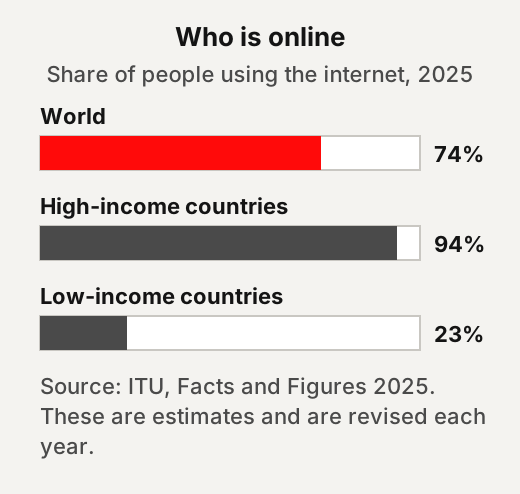
The International Telecommunication Union (ITU) estimates that about 6 billion people, about three-quarters of the world’s population, used the internet in 2025. That left about 2.2 billion people offline.
The gap between countries is wide. In high-income countries 94% of people use the internet, against 23% in low-income countries.
These are estimates, and they move. The ITU first put the number online in 2024 at 5.5 billion, then revised it to 5.8 billion. For example, picture 20 people chosen at random from the whole world. The ITU puts the share online at 74%, so about 15 of them would be online and about 5 would not.
2. How much information exists
Nobody counts it exactly. The careful figures are estimates, and they point the same way: up, and fast.
One careful count stops in 2007. A 2011 study in Science tracked 60 analog and digital technologies from 1986 to 2007. It estimated that in 2007 the world could store 2.9 × 10²⁰ bytes of compressed information. That is about 290 exabytes, or under a third of a zettabyte (our conversion).
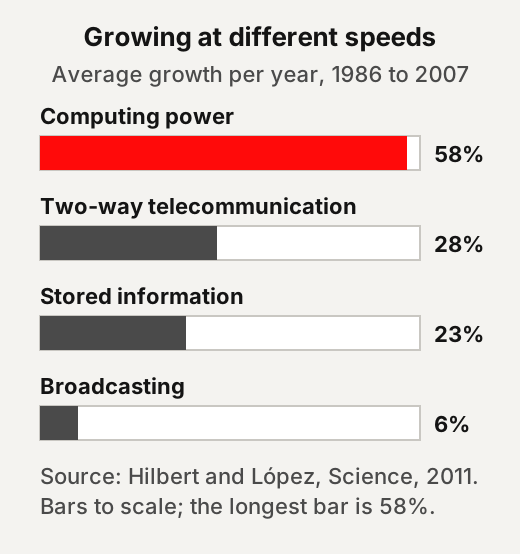
By 2007, 94% of that stored information was digital. Stored information grew by about 23% a year, two-way telecommunication by 28%, and computing power by 58%. Broadcasting grew far more slowly, at about 6% a year.
Later figures are mostly forecasts. A 2018 white paper by the market research firm IDC, sponsored by the storage maker Seagate, estimated the world’s data at 33 zettabytes in 2018. It forecast 175 zettabytes by 2025. Its count takes in data that is created, captured or replicated, so copies count too.
A zettabyte is a trillion gigabytes. For example, a phone that holds 128 gigabytes would need about 7.8 billion copies of itself to hold one zettabyte (our arithmetic). Treat these figures as signs of scale, not exact counts. The 175 was a forecast made in 2018, and we did not find a freely readable count that checks it.
3. How fast it moves
News that once took weeks to cross Europe now crosses the world in seconds, and more comes through feeds.
The amounts moving now are huge. In 2025, fixed broadband networks carried an estimated 7.3 zettabytes of internet traffic to users, and mobile networks about 1.5 zettabytes. Since 2021, mobile traffic has grown by an average of 19% a year.
How people find news is changing too. The Reuters Institute’s 2026 Digital News Report surveyed people online in 48 markets. On average, 54% used social media and video networks for online news, slightly ahead of news organisations’ own websites and apps, at 51%. It was the first time social media and video networks came out on top. 10% said they used AI chatbots for news each week, up from 7% a year earlier.
Our reading: news now often arrives inside a feed, next to everything else, rather than from a source you chose to visit.
4. What it changes
Plenty of information makes attention scarce, raises worry about what is false, and opens more doors.
Attention becomes the scarce part
When information is plentiful, the limit is your attention, not the supply.
Herbert Simon made the point in a 1971 essay: “a wealth of information creates a poverty of attention”. Our information-is-power page explains his argument.
Many people also step back from the news. In the 2026 report, 42% said they sometimes or often avoid the news, about the same as a year before. When the survey first asked, in 2017, the figure was 29%. The report links avoidance to falling interest in news, so it is not a direct measure of overload. The survey is done online, so it leans towards people who are online.
In practice, every alert or quick check is a small claim on attention you might want for something else.
More worry about what is false, and more bots
More information also brings more worry about what is false, and more traffic made by machines.
During a disease outbreak, there is a word for this: an infodemic. The World Health Organization uses infodemic for “too much information including false or misleading information in digital and physical environments during a disease outbreak”.
In the 2026 Digital News Report, 62% said they were concerned about fake news online, up 4 percentage points. Imperva, which sells bot protection, measured more than 53% of web traffic on its network as automated in 2025. That counts requests, not people, as our dead internet theory page explains.
Our reading: none of these figures says most of what you see is false. They say a quick check before you share is worth more than it used to be.
More open doors
The same flood carries a great deal of free, original material, if you know where to look.
Here are five places to start. The counts are as each site showed them on 27 October 2026.
- Project Gutenberg. It describes itself as “a library of 79,681 free eBooks”. It is a good place to read a classic in full before you quote it.
- The Wayback Machine. The Internet Archive’s Wayback Machine lets you search the history of more than 1 trillion web pages. Use it to see what a page said before it changed.
- PubMed. It “comprises more than 40 million citations for biomedical literature”. Use it to find the study behind a health headline.
- MIT OpenCourseWare. It offers free material from 2500+ MIT courses. It suits anyone who wants to work through university course material at their own pace.
- The ITU’s own data. The ITU offers its full dataset of internet estimates for download. It lets you check a figure about who is online at its source.
For example, before you share a line from an old book, find the passage on Project Gutenberg and read the page around it.
5. Things people often say
Three of these partly hold up, and one doesn’t.
“Information overload is a new problem”
Partly People have complained about too much to read for a very long time; the scale today is new. The complaint is ancient; today’s scale, a historian judges, is new in many ways.
According to the Harvard historian Ann Blair, scholars complained of information overload long before digital technology. The Roman writer Seneca put it plainly. In his essay on peace of mind he wrote Onerat discentem turba, non instruit. In our translation: the mass of books weighs the learner down instead of teaching him. He adds that it is far better to give yourself to a few authors than to wander through many (De tranquillitate animi 9.4, our translation).
How sure: Moderate a historian’s long study and the ancient text agree the complaint is old; she judges the scale new.
“More information always leads to better decisions”
Partly More information often helps, but researchers describe a point past which it can make things worse. Many researchers define information overload as the point where more information starts to make results worse.
A 2023 review of 87 studies, field reports and papers on information overload at work notes that there is no single agreed definition. Citing earlier work, it reports that the definitions share one thread: more information first goes with better performance or decisions, and past a certain amount with worse ones. The review found that the strength of the evidence for remedies is mixed.
For example, comparing three phones on price and battery life can help you choose. Comparing thirty phones on twenty features can leave you less sure than before.
A 2010 meta-analysis of 50 experiments on choosing among many options found almost no effect on average, with large differences between studies. So too many options sometimes makes choosing harder, but not reliably.
How sure: Limited the turning point comes from how researchers define overload; tests of choice overload and of remedies are mixed.
“False news spreads faster than true news”
Partly In one big study, false stories reached more people, but a reanalysis explains the result differently. On Twitter, false stories travelled further, but they may not spread in a different way.
Published in Science in 2018, one study looked at about 126,000 stories on Twitter from 2006 to 2017. It found that falsehood spread “farther, faster, deeper, and more broadly than the truth”. A 2021 reanalysis in PNAS found that the reported differences in how they spread can almost entirely be explained by the false-news cascades being larger.
Both studies are about Twitter, and about stories fact-checkers had checked. Our information-is-power page goes through both in more detail.
How sure: Moderate one very large study and one reanalysis agree on reach but not on the reason.
“Our attention span is now shorter than a goldfish’s”
Doesn't hold up No research has been found behind the famous figure. When the BBC traced the goldfish comparison, it found no study behind it.
The BBC statistics programme More or Less traced the figure in 2017, and the sources it led to could find no research behind it. What has been measured is narrower, such as how long office workers stay on one screen. Our information-is-power page covers that measure.
How sure: Moderate one careful trace by the BBC found no study behind the figure.
6. How to use it well
Spend attention on purpose, check before you share, and go back to the original.
- Check a source by leaving the page. Mike Caulfield set out the SIFT method in 2019: Stop, Investigate the source, find better coverage, trace claims to the original context. In a 2019 study of how experts judge websites, two Stanford researchers summed it up: “Fact checkers, in short, learned most about a site by leaving it”. Checking a source in other tabs like this is called lateral reading. Our SIFT guide walks through each move and how strong the evidence for it is.
- Read past the headline of a study. Our nine questions for reading a study cover the study type, its size and whether anyone repeated it.
- Watch your own side. A meta-analysis of 51 experiments found people rated identical information more favourably when it supported their political side. Our cognitive biases page covers this and other biases.
- Choose a few good sources. Our reading: Seneca’s advice still fits — give your attention to a few authors rather than wander through many. Our information-is-power page has a four-question filter for choosing them.
- Treat an AI answer as a starting point. Our page on critical thinking in the age of AI looks at what studies found about leaning on AI tools.
For example, before you share a striking chart, open a new tab, look up the organisation behind it, and find the original report.
Quick answers
How much information is there in the world?
Nobody counts it exactly. A 2011 study estimated the world could store 2.9 × 10²⁰ bytes of compressed information in 2007, about 290 exabytes. In a 2018 white paper sponsored by the storage maker Seagate, IDC forecast 175 zettabytes of data by 2025.
How many people use the internet?
The ITU estimates that about 6 billion people, about three-quarters of the world's population, used the internet in 2025. About 2.2 billion were offline.
Is information overload real?
Many researchers describe it as the point where more information starts to make decisions worse, though there is no single agreed definition. The complaint is old; the Roman writer Seneca wrote that the mass of books weighs the learner down.
Does false news spread faster than true news?
In a 2018 study of Twitter from 2006 to 2017, falsehood spread farther and faster than the truth. A 2021 reanalysis found that the differences can almost entirely be explained by the false-news cascades being larger.
Use this
Three habits for using plentiful information well, each from a source on this page.
Where did this come from, and what would I find one step further?
Quick quiz
Nothing is scored or saved. Recalling it once now is what makes it last.
1. About how many people used the internet in 2025, by the ITU's estimate?
Answer: About 6 billion.Read it again ↑
2. What did a 2021 reanalysis find about false news on Twitter?
Answer: The differences can almost entirely be explained by larger cascades.Read it again ↑
3. Where did the BBC's trace of the goldfish attention-span figure lead?
Answer: To sources that could find no research behind it.Read it again ↑
How we checked this · Last checked October 2026
- We read the ITU's Facts and Figures 2025 release and report pages, the Reuters Institute's 2026 executive summary, and the 2018 IDC white paper in full.
- For the research we read abstracts through PubMed, Europe PMC and open repositories, and the full text of the 2023 review of information overload.
- The figures for 2025 and 2026 are estimates and survey results; the ITU revises its estimates each year.
- We could not open IDC's later press releases, so the 175 zettabyte figure stands as a 2018 forecast.
- Our wording on false news, the goldfish figure and Herbert Simon matches our information-is-power page.
Sources
- International Telecommunication Union, “Facts and Figures 2025”, press release, 17 November 2025; report pages “Internet use” and “Internet traffic”.Primary
- M. Hilbert and P. López, “The World’s Technological Capacity to Store, Communicate, and Compute Information”, Science 332, 2011.Scholarly
- D. Reinsel, J. Gantz and J. Rydning, “The Digitization of the World – From Edge to Core”, IDC white paper sponsored by Seagate, November 2018.Popular
- Harvard Gazette, “Ye olde information overload”, December 2010, on Ann Blair’s Too Much to Know (Yale University Press, 2010).Popular
- Seneca, De tranquillitate animi 9.4, Latin text at The Latin Library.Primary
- Reuters Institute for the Study of Journalism, “Digital News Report 2026: executive summary”, 16 June 2026.Scholarly
- Oxford Essential Quotations, “Herbert A. Simon”, quoting “Designing Organizations for an Information-Rich World” (1971).Scholarly
- World Health Organization, “Infodemic”, health topic page.Primary
- Imperva, “Bad Bot Report 2026: Bots in the Agentic Age”, 29 April 2026.Popular
- M. Arnold, M. Goldschmitt and T. Rigotti, “Dealing with information overload: a comprehensive review”, Frontiers in Psychology 14, 2023.Scholarly
- B. Scheibehenne, R. Greifeneder and P. M. Todd, “Can There Ever Be Too Many Options? A Meta-Analytic Review of Choice Overload”, Journal of Consumer Research 37, 2010.Scholarly
- S. Vosoughi, D. Roy and S. Aral, “The spread of true and false news online”, Science 359, 2018.Scholarly
- J. L. Juul and J. Ugander, “Comparing information diffusion mechanisms by matching on cascade size”, PNAS 118, 2021.Scholarly
- Simon Maybin, “Busting the attention span myth”, BBC News, 10 March 2017.Popular
- M. Caulfield, “SIFT (The Four Moves)”, 19 June 2019.Primary
- S. Wineburg and S. McGrew, “Lateral Reading and the Nature of Expertise: Reading Less and Learning More When Evaluating Digital Information”, Teachers College Record, 2019 (accepted manuscript).Scholarly
- P. H. Ditto and colleagues, “At Least Bias Is Bipartisan: A Meta-Analytic Comparison of Partisan Bias in Liberals and Conservatives”, Perspectives on Psychological Science 14, 2019.Scholarly
- Project Gutenberg, Internet Archive Wayback Machine, PubMed and MIT OpenCourseWare, home and about pages, read 27 October 2026.Primary
- Francis Bacon, Meditationes Sacrae (1597), and Thomas Hobbes, Latin Leviathan (1668), as set out in our information-is-power page.Primary
The supply is not the limit
The ITU estimates that about 6 billion people used the internet in 2025, about three-quarters of the world. About 2.2 billion were offline. Herbert Simon argued in 1971 that "a wealth of information creates a poverty of attention". Our view: once you are online, the harder part is often your attention and your checking habits.
Read a big data figure
- Is it a count or a forecast? The 175 zettabytes was a forecast, made in 2018, for 2025. One careful count, a 2011 study in Science, stops in 2007.
- Who made it? It comes from a white paper by the research firm IDC, sponsored by the storage maker Seagate.
- What does it count? IDC's count takes in data that is created, captured or replicated, so copies count too.
- Is it an average? The Reuters Institute's 54% using social and video networks for online news is an average across 48 markets.
- Our suggestion. Treat a big figure as a sign of scale until you know who made it and what it counts.
This week: notice where your news comes from
Our suggestion: each time you read news this week, note how it reached you. Was it a feed, or a source you chose to visit? The Reuters Institute found that, on average across 48 markets, social and video networks were slightly ahead of news sites. At the end of the week, pick one source you would visit on purpose.
Before you repeat a famous claim
- Trace the number. When the BBC traced the goldfish figure in 2017, the sources it led to could find no research behind it.
- Look for the reanalysis. A 2018 study found false stories on Twitter travelled further. A 2021 reanalysis found the differences can almost entirely be explained by larger false-news cascades.
- Check the average. A 2010 meta-analysis of 50 experiments on choosing among many options found almost no effect on average. Results differed widely between studies.
- Check how old the complaint is. Seneca wrote that the mass of books weighs the learner down. As the Harvard Gazette sums up Ann Blair's view, today's challenges are unprecedented in many ways.
- Our suggestion. Before you repeat a striking claim, look for who traced it and who re-ran it.
Keep going
- Information is powerWho to listen to, four questions to ask before believing, and where "knowledge is power" began.
- The SIFT methodFour quick moves for checking a post, and what the research does and does not show.
- How to read a studyNine plain-language questions for reading any scientific study, with the sources behind each point.
- Cognitive biases, checkedWhat happened when scientists re-ran famous psychology studies, with a verdict on each.
- Critical thinking in the age of AIWhat critical thinking is, whether it can be taught, and what the AI studies found.
- The dead internet theoryIs the internet mostly bots and AI? Where the theory began, and what the figures count.
- GlossaryPlain meanings of zettabyte, information overload, lateral reading and infodemic, the terms used on this page.