

Start hereIn 1943 Abraham Maslow set out an order of human needs in the journal Psychological Review. He wrote that the order "is not nearly as rigid as we may have implied". So where did the famous pyramid come from?
Many rules that business and self-help books repeat began as something narrower. Maslow wrote that his order of needs was “not nearly as rigid” as it may sound. Nobody has found the famous Yale study of written goals. Below: 10 rules, where each one comes from, what the original says, and how to use the part that holds up.
The verdicts
1. The ten rules at a glance
Most of these rules hold a real idea, but the popular version is stronger, simpler or newer than the source.
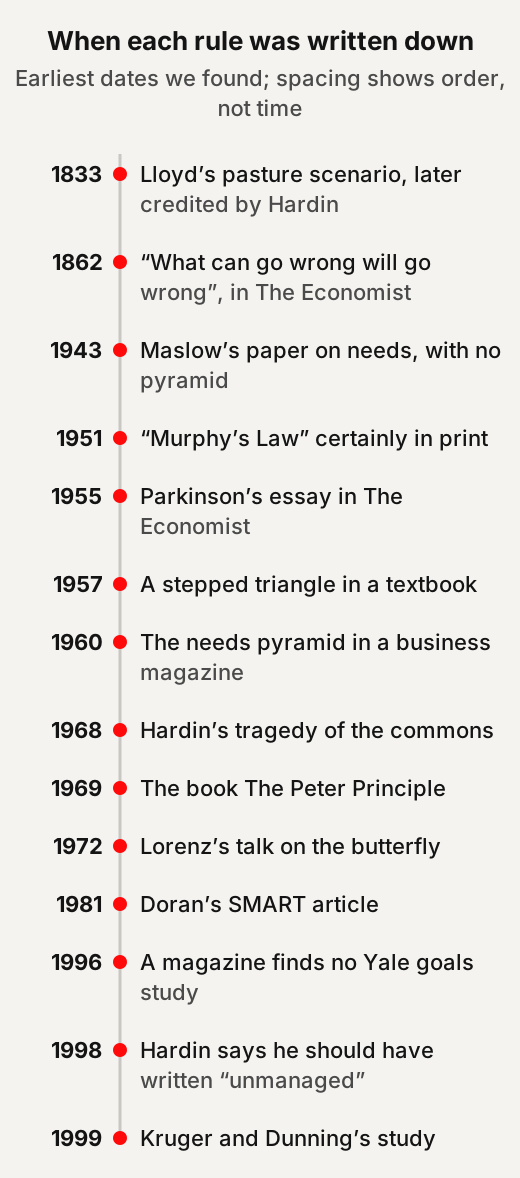
The dates are the earliest we found, not proof that nobody wrote these ideas down sooner.
| Rule | Popular version | What the source says | Verdict |
|---|---|---|---|
| Maslow’s needs | Meet each level before the next | Needs are partly met at the same time | Doesn’t hold up |
| The Peter principle | Everyone rises to incompetence | Every employee “tends to” rise to it | Partly |
| SMART goals | Every goal needs all five letters | Not every objective will have all five | Partly |
| The Yale goals study | The 3% with written goals got richer | No such study has been found | Doesn’t hold up |
| The butterfly effect | Small acts have big, predictable results | Small differences make the far future hard to predict | Doesn’t hold up |
| The tragedy of the commons | Shared things are always ruined | The author later said he should have written “unmanaged” | Partly |
| Murphy’s law | Coined by an engineer named Murphy | The saying is older; even the name’s link to him is in doubt | Partly |
| Parkinson’s law | Work expands to fill the time | A “commonplace observation”; his law was about staff | Partly |
| The 80/20 rule | A law Pareto discovered | Juran said he had applied the wrong name | Partly |
| The Dunning-Kruger effect | The least skilled are the most overconfident | Real overestimation; its size is argued | Still argued |
2. Rules about people at work
Two famous rules about people at work come from a 1943 paper and a 1969 book, and both grew simpler as they spread.
Maslow’s pyramid: “Meet each need before the next”
Doesn't hold up Maslow created the needs pyramid and said each level must be met before the next one. No pyramid has been found in his writing, and he said needs are partly met at the same time.
How sure: Strong his 1943 paper says it in plain words, and researchers who searched his writings found no pyramid.
In 1943 Abraham Maslow set out an order of human needs in the journal Psychological Review. He wrote that the order “is not nearly as rigid as we may have implied”. He warned that his wording “might give the false impression that a need must be satisfied 100 per cent before the next need emerges”.
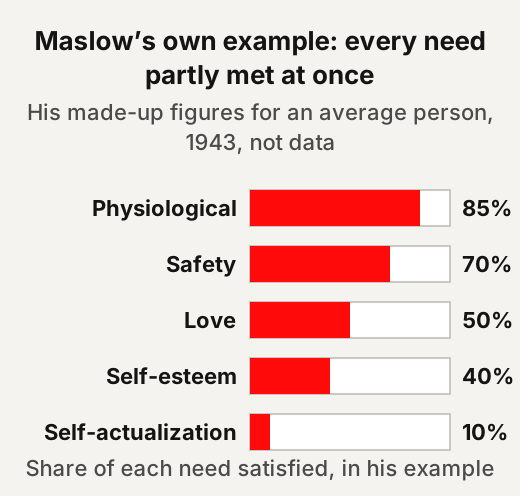
Instead, he wrote, most people are “partially satisfied in all their basic needs and partially unsatisfied in all their basic needs at the same time”. His example of an average person is satisfied perhaps 85 per cent in physiological needs, 70 in safety, 50 in love, 40 in self-esteem and 10 in self-actualization. He called these “arbitrary figures for the sake of illustration”. He also wrote that “reversals of the average order of the hierarchy are sometimes observed”.
Management researchers who traced the drawing found a stepped triangle in a 1957 management textbook. They traced the pyramid itself to a 1960 business-magazine article by a consulting psychologist, Charles McDermid. They say they examined all the published books and articles by Maslow they could identify, and his diaries. Their paper concludes that Maslow never created a pyramid to represent his hierarchy of needs. The interviewer passed on a second-hand report that Maslow sometimes showed a slide of the pyramid in class. The researchers say they found no trace of a pyramid in any of his writings.
Our reading: the hierarchy of needs is a rough order, not a staircase. For example, you do not have to settle every worry about safety before you put time into friendships or a new skill.
The Peter principle: “Everyone rises to their level of incompetence”
Partly Everyone at work rises to their level of incompetence. The 1969 book says every employee “tends to” rise to it, and one study found evidence that fits part of it.
How sure: Limited one team’s study of sales workers fits part of it; that does not show it holds everywhere.
The rule comes from the 1969 book The Peter Principle, by Laurence J. Peter and Raymond Hull. In the book’s own words, in a hierarchy every employee “tends to rise to his level of incompetence”. A summary from the National Bureau of Economic Research, a US research organisation, says the idea has been a source of “endless fascination, examination, and humor”.
A study of sales workers at 131 firms, published in 2019 in the Quarterly Journal of Economics, found “evidence consistent with the Peter Principle”. Its authors tested one version of it: that firms put current job performance first “at the expense of other observable characteristics that better predict managerial performance”. A 2018 working-paper version used 214 firms. Top sellers were more likely to be promoted, and their promotion went with falling sales among the people they then managed. The authors estimate that promoting people with lower management potential is costly.
Our reading: the useful part of the Peter principle is narrower than the slogan. Doing one job well is not proof of being good at the next one. For example, before you take or give a promotion, list what the new job asks for, such as coaching or planning, and look for signs of those skills.
3. Rules about goals
Both of these goal rules are linked to real tools, but one letter changed and one famous study has never been found.
SMART goals: “Every goal must be specific, measurable, attainable, relevant and time-bound”
Partly SMART stands for attainable and relevant, and every goal must meet all five letters. The 1981 original had different letters, and its author said not every objective will meet all five.
How sure: Strong we read the original article, and a university guide confirms the wording has changed since.
The acronym is usually traced to George T. Doran, the president of a management consultancy, writing in Management Review in November 1981. His letters stood for Specific, Measurable, Assignable, Realistic and Time-related. By “Assignable” he meant “specify who will do it”. A University of Florida guide notes that the wording of SMART goals “has evolved over time”. It lists Attainable and Relevant in their place.
Doran wrote that the acronym “doesn’t mean that every objective written will have all five criteria”. He added that the closer we get to the criteria “as a guideline, the smarter our objectives will be”. He also wrote that “it is the combination of the objective and its action plan that is really important”.
Our reading: the dropped letter is the useful one. For example, “fix the sign-up emails by Friday” gets clearer once it names who will do it. Our Veni Vidi Vici page gives the same five letters.
The Yale goals study: “The 3% who wrote their goals down got richer”
Doesn't hold up A study of Yale’s class of 1953 found that the 3% with written goals ended up richer than the rest. No such study has been found.
How sure: Strong a search of Yale’s alumni archives, a magazine investigation and a researcher’s literature review all found nothing.
In 1996 the magazine Fast Company described the story: the 3% with written goals had “accumulated more personal financial wealth than the other 97% of the class combined”. Another version, naming Yale or Harvard Business School, says they were earning “10 times” as much as those with no clear goals. The versions differ.
Fast Company reported that a Yale research associate, Beverly Waters, searched the alumni archives and “found no evidence that such a study had ever been conducted”. The class secretary told the magazine that he and his classmates never took part in a research study on personal goals. The researcher Gail Matthews writes that her literature reviews, and another researcher’s, found that “no such study had ever been done”.
Matthews then ran her own small study of writing goals down. It is in our guide to turning a big goal into today’s task. There we found it only as conference presentations and the university’s summary, not as a paper in a peer-reviewed journal.
For example, when a talk quotes a striking study, ask for the year, the authors and the journal before you repeat it.
4. Rules about systems and chance
These three come from weather research, a biologist’s essay on population and an engineering story, and each original is more careful than the slogan.
The butterfly effect: “Small actions have huge, predictable results”
Doesn't hold up The butterfly effect means a small act reliably causes a big, traceable result. Lorenz’s point was that tiny differences make the far future hard to predict, and a flap could just as well prevent a tornado.
How sure: Strong the 1972 talk survives in full, and it says this in plain words.
The meteorologist Edward Lorenz gave the talk at a meeting of the American Association for the Advancement of Science on 29 December 1972. Its title asked whether “the flap of a butterfly’s wings in Brazil” sets off “a tornado in Texas”. He wrote that if a flap can help cause a tornado, “it can equally well be instrumental in preventing a tornado”. Over the years, he proposed, tiny disturbances do not change how often tornadoes happen; at most they change the order in which weather events occur.
His real question was whether the atmosphere is “unstable with respect to perturbations of small amplitude”. If it is, he wrote, we cannot “accurately predict the occurrence of tornados at a sufficiently distant future time”. He ended by leaving his title question “unanswered for a few more years”.
Our reading: the butterfly effect is a lesson in humility about long-range forecasts, not proof that every small act is decisive. For example, a five-year plan can carry a few “if this happens, then we do that” branches instead of one fixed forecast.
The tragedy of the commons: “Anything shared will be ruined”
Partly Shared resources are always overused and ruined. Its author later said he should have written “unmanaged”, and Elinor Ostrom found that many users manage shared resources well.
How sure: Strong the author’s own correction and decades of field studies agree that how a resource is managed changes the outcome.
In 1968 the biologist Garrett Hardin asked readers to “picture a pasture open to all”. He said the scenario was “first sketched” in an 1833 pamphlet by William Forster Lloyd. Each herder gets all the gain from one more animal, while the harm from overgrazing is shared by everyone. He concluded: “Freedom in a commons brings ruin to all”.
In 1998 he wrote that “the weightiest mistake” in that paper was leaving out the word “unmanaged”. A managed commons, he wrote, means “either socialism or the privatism of free enterprise”, and “either one may work; either one may fail”.
Elinor Ostrom shared the 2009 Nobel memorial prize in economic sciences “for her analysis of economic governance, especially the commons”. The Royal Swedish Academy of Sciences wrote that she “challenged the conventional wisdom that common property is poorly managed and should be either regulated by central authorities or privatized”. It said resource users often build their own ways of making and enforcing rules. In lab studies, she reported, isolated and anonymous people overharvested a shared resource, but simply letting them talk reduced it.
Ostrom called forests, water systems and fisheries common-pool resources: hard to keep people out of, and used up as each person takes a share. Our reading: shared things tend to fail when nobody sets and checks the rules. For example, a shared office fridge goes better with a few rules its users agree on, such as a weekly clear-out.
Murphy’s law: “An engineer named Murphy coined it in 1949”
Partly Murphy’s law was coined by an engineer named Murphy in 1949. The saying is much older, and even the link to Murphy’s name is in doubt.
How sure: Moderate a word historian traces the older versions, and a dictionary agrees; the Murphy story itself has never been confirmed.
In 1862 The Economist described a lawyer’s instinct that “what can go wrong will go wrong”. In an engineering paper of 1877–78, Alfred Holt wrote that “anything that can go wrong at sea generally does go wrong sooner or later”. In 1908 the stage magician Nevil Maskelyne wrote that “everything that can go wrong will go wrong”.
The usual story, as the word historian David Wilton tells it, is that in 1949 Captain Edward A. Murphy found a technician had wired some test sensors wrongly. The American Heritage Dictionary puts the experiments in 1941. Wilton places Murphy on the rocket-sled tests at Muroc that John Stapp supervised. The US Air Force museum says Stapp led the Muroc sled project, which ran more than 250 tests between April 1947 and June 1951. Our reading: 1949 fits that record and 1941 does not, though the museum’s page does not mention Murphy.
Wilton found that no researcher has turned up the press conference where the law was supposedly named. He calls a May 1951 paper “the first absolutely certain instance” of the name in print. In that paper a physicist said he had been told Murphy’s law by an architect, and Wilton reads this as a sign the name was already in use in 1949. He also notes that no use of the name before 1949 has been found, which gives some weight to the Murphy story. The American Heritage Dictionary says Murphy “may have spoken the axiom, but he did not invent it”.
Holt drew a practical lesson: “The human factor cannot be safely neglected in planning machinery”. Our reading: as a design rule, Murphy’s law says make the wrong way hard to do. For example, a plug that only fits one way round can’t be put in backwards.
5. Rules we look at more closely elsewhere
Three more rules are checked in depth on other pages, so each gets a short note here.
Parkinson’s law: “Work expands to fill the time available”
Partly Parkinson’s law says work expands to fill the time available. The sentence opens his 1955 essay, but he called it “a commonplace observation”; his law was about the number of officials.
How sure: Strong the 1955 essay can still be read.
It opens an essay in The Economist of 19 November 1955. His law is about staff: “the number of the officials and the quantity of the work to be done are not related to each other at all”. More in Older Than You Think, Part 2. For example, if a task keeps filling whatever time you give it, try setting an earlier finish and see whether the work still gets done.
The 80/20 rule: “A law Pareto discovered”
Partly The 80/20 rule is a law that Vilfredo Pareto discovered. Pareto studied how income was spread; the engineer Joseph Juran later said he had put Pareto’s name on the general rule by mistake.
How sure: Strong both men’s own words survive.
Vilfredo Pareto studied the unequal distribution of income in his Cours d’économie politique (1896–97) and fitted a curve to it. Juran wrote in 1974 that he had “mistakenly applied the wrong name to the principle”. It works as a rule of thumb, not a law of nature. See our mental models page. For example, list the tasks on your plate and ask which few would make the most difference, without expecting any fixed split.
The Dunning-Kruger effect: “The least skilled are the most overconfident”
Still argued The least skilled people are the most overconfident. The lowest scorers did overestimate themselves, but how big the effect is remains argued.
How sure: Unsettled one 2020 study finds the effect much smaller; a large 2021 replication supports part of it.
In the 1999 study, the lowest scorers on average put themselves around the 62nd percentile when they were in the 12th. A 2020 study argued it “may be much smaller than reported previously”. A 2021 replication with about 4,000 people in each of two studies found support for low performers being less able to judge whether their answers were right. That held in grammar and logical reasoning. The popular curve with a peak and a valley is not in the 1999 paper. Our cognitive biases page covers the debate. For example, before you rate your own skill at something new, check it against a short test or someone else’s feedback.
6. How to check a business rule yourself
Most of these checks take a few minutes and one original source.
- Write down the rule exactly as you heard it, with any number it carries.
- Find who first wrote it down, when, and where: a paper, a talk, a book or an essay.
- Read the sentences around it, and look for small words like “tends to”, “unmanaged” or “not nearly as rigid”.
- Ask what it was first about: weather forecasts, sales teams or managers’ objectives.
- Check how big any study behind it was, and whether anyone repeated it.
- Note what was added later, such as a drawing, new letters or a percentage.
- Keep the useful part, and drop the certainty the original never had.
For example, the pyramid took us two checks: Maslow’s own paper has no drawing, and the researchers who searched for the first pyramid found it in 1960.
Quick answers
Did Maslow create the pyramid of needs?
Maslow's 1943 paper has no pyramid. Management researchers who traced the drawing found a stepped triangle in a 1957 management textbook and the pyramid itself in a 1960 business-magazine article by Charles McDermid.
What did SMART originally stand for?
In George Doran's 1981 article, Specific, Measurable, Assignable, Realistic and Time-related. He wrote that the acronym "doesn't mean that every objective written will have all five criteria".
Is the Yale study about written goals real?
No such study has been found. A Yale research associate searched the alumni archives and "found no evidence that such a study had ever been conducted", Fast Company reported in 1996.
What did Lorenz mean by the butterfly effect?
That tiny differences can make the far future hard to predict. In his 1972 talk he wrote that if a flap can help cause a tornado, "it can equally well be instrumental in preventing a tornado".
What is the Peter principle?
The idea, from a 1969 book by Laurence J. Peter and Raymond Hull, that in a hierarchy every employee "tends to rise to his level of incompetence". A 2019 study of sales workers at 131 firms found evidence consistent with one version of it, in which firms promote their best current performers over people likely to manage better.
Use this
Before you live by a business rule, read the sentences around its first known version.
Does this rule say more than the person who first wrote it did?
Quick quiz
Nothing is scored or saved. Recalling it once now is what makes it last.
1. What did Maslow say about how far each need is met?
Answer: Most people are partly satisfied in all their needs at once.Read it again ↑
2. In Doran's 1981 SMART article, what did the A stand for?
Answer: Assignable.Read it again ↑
3. Which word did Hardin later say he should have added to his tragedy of the commons?
Answer: Unmanaged.Read it again ↑
How we checked this · Last checked October 2026
- We read the originals where we could reach them, including Maslow's 1943 paper, Doran's 1981 article, Lorenz's 1972 talk, Hardin's 1968 essay and his 1998 follow-up, and Ostrom's 2009 prize lecture.
- We read Doran's article and Lorenz's talk as page images of scans, and the 1969 Peter Principle wording through a search inside a library scan.
- For the Yale goals story we relied on the 1996 Fast Company investigation and Gail Matthews's research summary; for Murphy's law, on the word historian David Wilton and the American Heritage Dictionary.
- Parkinson's law, the 80/20 rule and the Dunning-Kruger effect use the same wording and sources as our reviewed pages on them.
- For the Peter principle we read the abstract of the published 2019 paper and the 2018 working paper; for the year of the Murphy sled tests, the word historian, the dictionary and the US Air Force museum's fact sheet disagree, and the page says so.
- Every date is the earliest we found. Older printings can still turn up.
Sources
People at work
- A. H. Maslow, “A Theory of Human Motivation”, Psychological Review 50 (1943), 370–396 (Classics in the History of Psychology).Primary
- S. B. Kaufman, “Who Created Maslow’s Iconic Pyramid?”, Scientific American blog, 23 April 2019 (interview with T. Bridgman, S. Cummings and J. Ballard).Popular
- T. Bridgman, S. Cummings and J. Ballard, “Who Built Maslow’s Pyramid?”, Academy of Management Learning & Education 18(1) (2019), 81–98.Scholarly
- APA Dictionary of Psychology, “Maslow’s motivational hierarchy”.Scholarly
- L. J. Peter and R. Hull, The Peter Principle (1969), Internet Archive scan.Primary
- A. Benson, D. Li and K. Shue, “Promotions and the Peter Principle”, Quarterly Journal of Economics 134(4) (2019), 2085–2134; earlier as NBER Working Paper 24343 (2018), and the NBER Digest summary “The Peter Principle Isn’t Just Real, It’s Costly” (2018).Scholarly
Goals
- G. T. Doran, “There’s a S.M.A.R.T. way to write management’s goals and objectives”, Management Review 70(11), November 1981, 35–36.Primary
- D. Farnsworth, J. L. Clark, H. Cothran and A. Wysocki, “Developing SMART Goals for Your Organization” (FE577), University of Florida IFAS Extension.Scholarly
- L. Tabak, “If Your Goal Is Success, Don’t Consult These Gurus”, Fast Company, 31 December 1996.Popular
- G. Matthews, “Goals Research Summary”, Dominican University of California (PDF).Primary
Systems and chance
- E. N. Lorenz, “Predictability: Does the Flap of a Butterfly’s Wings in Brazil Set Off a Tornado in Texas?”, talk at the AAAS 139th meeting, 29 December 1972 (MIT typescript, Internet Archive copy).Primary
- B. Popik, “Does the flap of a butterfly’s wings in Brazil set off a tornado in Texas?”, The Big Apple (quoting Lorenz, The Essence of Chaos, 1993).Popular
- G. Hardin, “The Tragedy of the Commons”, Science 162 (1968), 1243–1248, and “Extensions of ‘The Tragedy of the Commons’”, Science 280 (1998), 682–683 (texts at the Garrett Hardin Society).Primary
- The Nobel Prize, “Elinor Ostrom: Facts” and “Press release”, 12 October 2009.Scholarly
- E. Ostrom, “Beyond Markets and States: Polycentric Governance of Complex Economic Systems”, Prize Lecture, 8 December 2009 (also American Economic Review 100(3), 2010, 641–672).Primary
- D. Wilton, “Murphy’s Law”, Wordorigins.org, 14 January 2022.Popular
- National Museum of the US Air Force, “Northrop ‘Gee-Whizz’ Decelerator Sled”, fact sheet (Internet Archive copy, 28 November 2024).Scholarly
- The American Heritage Dictionary of the English Language, 5th edition, “Murphy’s Law”, “Peter Principle” and “butterfly effect”.Scholarly
Rules covered on other pages
- “Parkinson’s Law”, The Economist, 19 November 1955 (Internet Archive copy).Primary
- V. Pareto, Cours d’économie politique, vol. 2 (1897), Internet Archive scan.Primary
- J. M. Juran, “The Non-Pareto Principle; Mea Culpa” (1974).Primary
- J. Kruger and D. Dunning, “Unskilled and unaware of it”, Journal of Personality and Social Psychology 77(6) (1999).Scholarly
- G. E. Gignac and M. Zajenkowski, “The Dunning-Kruger effect is (mostly) a statistical artefact”, Intelligence (2020).Scholarly
- R. A. Jansen, A. N. Rafferty and T. L. Griffiths, “A rational model of the Dunning-Kruger effect supports insensitivity to evidence in low performers”, Nature Human Behaviour 5(6) (2021).Scholarly
Start with the rule you lean on most
Most of these rules hold a real idea. Our view: when a rule shapes a decision, its original, or its author's later correction, is often the steadier guide. Pick the one you quote most and try it on your own work.
This week: one hour you have been saving
Maslow wrote that most people are partly satisfied in all their basic needs at the same time. Our suggestion: pick one thing you have put off until life feels settled, like a friendship or a skill. Give it one hour this week.
Make your goal list clearer and sturdier
- Look for goals with no owner. Doran's A, Assignable, meant "specify who will do it". Our suggestion: on a shared list, mark each goal with no name beside it.
- Write the first action. Doran called the objective and its action plan together the important part. Our suggestion: add a first step under each goal.
- Use the letters as a guide. He wrote that not every objective will have all five, and the closer to them, the smarter. Our view: aim close, but do not force a letter that does not fit.
- Plan for the human slip. In an engineering paper, Alfred Holt wrote: "The human factor cannot be safely neglected in planning machinery." Our suggestion: ask where a tired person could get each step wrong.
Put source-checking to paid use
- Offer source checks for training slides and staff handbooks, tracing each business rule to its first known version.
- Write short explainers that set a famous rule beside its original wording, naming the source you read.
- Edit goal templates and checklists so their wording matches the sources they cite.
Ideas to explore, not financial or business advice. No result is promised.
Keep going
- From big goal to todayTurn a someday goal into a task you can do now, with a planner on the page.
- Pre-mortem worksheetBefore a big decision, ask how easy it is to undo and how it could fail. Then ask how such choices usually go, and what you would regret.
- Older Than You Think, Part 2Productivity rules, including Parkinson's law, and where they come from.
- Mental models, checkedCommon thinking tools, traced to where they come from.
- Cognitive biases, checkedFamous findings about how we think, and whether they held up, including the Dunning-Kruger debate.