Nihilism, Absurdism and Solipsism Explained: Where Each Word Comes From and What It Means
Nihilism says that something we count on, such as meaning, morals or knowledge, has no real basis.
Stoicism, Epicurus, Confucius, the Buddha, the existentialists and the famous lines people quote: what the texts actually say, and how to use the ideas in an ordinary week.
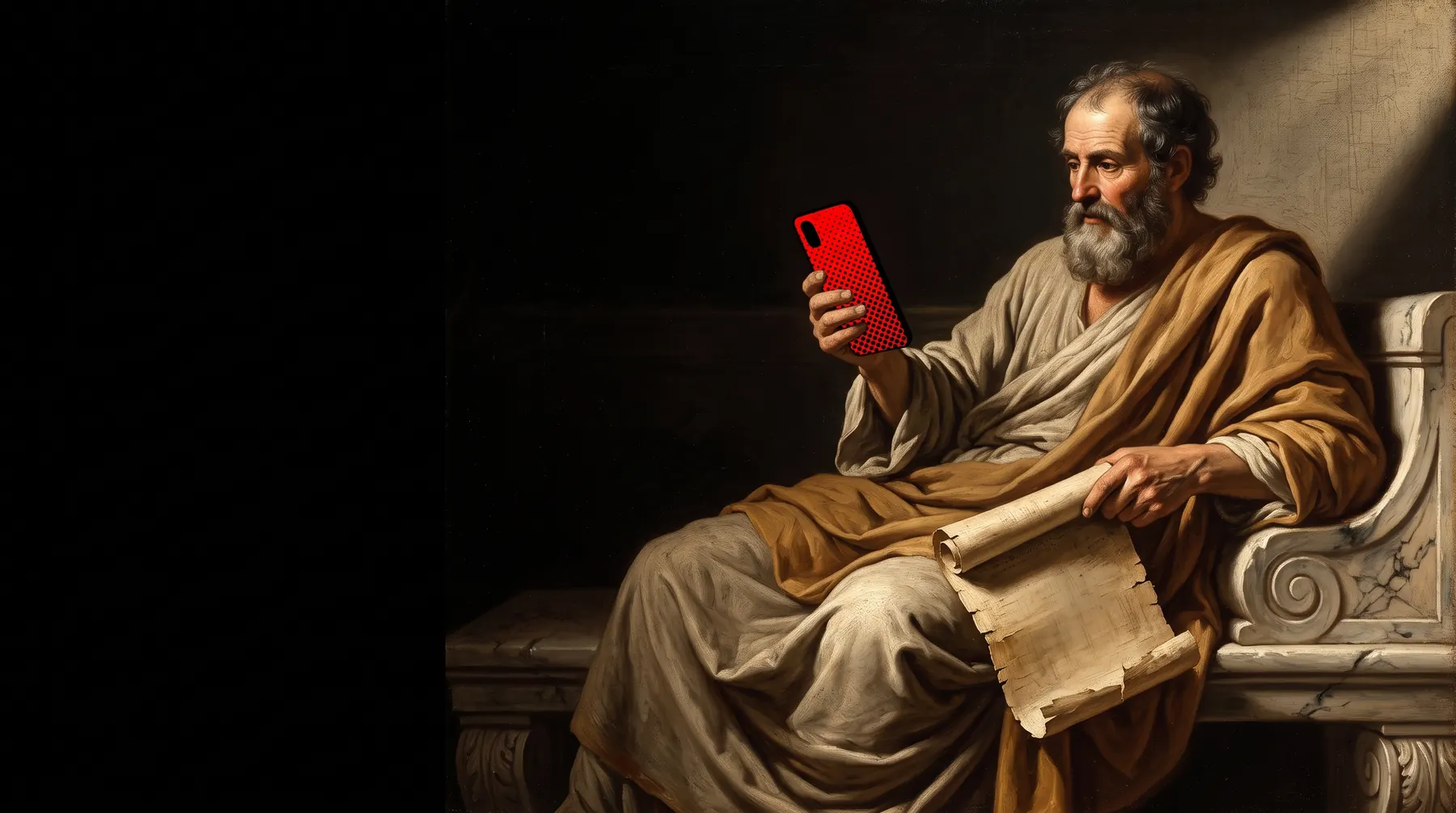
HACKS VITAE ARTWORK (AI-ASSISTED)
Philosophy began as a love of knowing, and Socrates, as Plato reports him, made it a daily habit of questioning with other people.
Read it →A quick map of the schools we have pages on. Each line comes from that page; follow the link for the sources.
Stoicism is an ancient Greek philosophy, founded in Athens around 300 BC, which holds that virtue alone is good and is enough for happiness.
Stoicism Life Hacks ∙ What is Stoicism? How can I be Stoic? →Epicurus did say pleasure is the goal of life, but he defined it as "the absence of pain in the body and of trouble in the soul", not feasting.
Epicurus: What He Actually Taught About Pleasure, Death and the Gods →The ancient Cynics attacked conventions and hypocrisy; the modern cynic distrusts everyone's motives.
Diogenes and the Cynics: The Famous Stories, Checked →"The unexamined life is not worth living" is genuine, and Socrates says it at his trial, explaining why he cannot simply stop questioning people.
Socrates, Plato and Aristotle Quotes, Checked: What They Actually Said →Confucius did not write the Analects. It is a collection of his sayings put together by later hands, and scholars disagree about how early.
Confucius Quotes, Checked: What the Analects Say and What They Don't →Wu wei does not mean doing nothing. The Stanford Encyclopedia describes it as used broadly as a contrast to action driven by self-serving desire; some translators render it "non-coercive" or "effortless" action.
Laozi and the Tao Te Ching: 9 Popular Claims, Checked →The traditional first teaching names suffering as a problem with a cause and a way out, and the Pali word is broader than pain.
Buddha Quotes, Checked: What the Early Texts Say and What They Don't →Existentialism was never a school the famous names all joined.
Existentialism, Checked: What Kierkegaard, Sartre and Camus Actually Wrote →Nihilism says that something we count on, such as meaning, morals or knowledge, has no real basis.
Nihilism, Absurdism and Solipsism Explained: Where Each Word Comes From and What It Means →Absurdism is Albert Camus's answer to the clash between our search for meaning and a world that gives no reply.
Nihilism, Absurdism and Solipsism Explained: Where Each Word Comes From and What It Means →Solipsism says only my own mind can be known to exist. It is studied more as a problem than held as a belief.
Nihilism, Absurdism and Solipsism Explained: Where Each Word Comes From and What It Means →Nihilism says that something we count on, such as meaning, morals or knowledge, has no real basis.
A thought experiment is an imagined situation used to test an idea. You follow what would happen, instead of running a real experiment.
A paradox is reasoning that looks sound at every step but reaches a conclusion that seems false.
Many famous lines change when you read the lines around them, which add a speaker, a moment or a condition.
Many famous teaching stories say something different in their oldest versions.
Many myths quoted as life lessons say more than the lesson they are used for.
Many famous lines read differently with the next sentence, which can add a condition, a speaker or a reply.
Some everyday sayings now mean nearly the opposite of what they first meant.
Many famous Shakespeare lines belong to a character with a purpose, and some use words that meant something else in his day.
Stoicism says only virtue is good, while Epicureanism makes pleasure the goal, meaning no pain in the body and no trouble in the soul.
Some famous sayings are halves of longer lines, and the missing half can change the meaning.
Letters from a Stoic is the English title of a selection from Seneca's 124 surviving letters to Lucilius, written in his last years, 62 to 65.
Meditations is a set of private notes that the Roman emperor Marcus Aurelius wrote to himself, in Greek, in the second century AD.
Emerson's 1841 essay Self-Reliance asks readers to trust their own thinking over custom, crowds and even their own past words.
The Art of War is a 13-chapter Chinese book on strategy, traditionally credited to Sun Tzu; who wrote it, and when, is debated.
The Enchiridion is a short handbook of the teaching of Epictetus, a once-enslaved Stoic teacher, put together, on the usual account, by his student Arrian.
The Prince is a short guide to how rulers, above all new ones, win, keep and lose power.
Several of the most shared "Buddha quotes" are not in the early Buddhist texts, including "The mind is everything".
Many famous "Confucius says" lines are not in the Analects, including "It does not matter how slowly you go" and "dig two graves".
Almost everything we know about Diogenes comes from anecdotes written down centuries after he died, mostly by Diogenes Laertius.
Epicurus did make pleasure the goal of life, but he defined it as "the absence of pain in the body and of trouble in the soul", not feasting.
Kierkegaard wrote about a "leap", but not a "leap of faith", and scholars disagree about whether the phrase is still a fair summary.
Several famous tags, such as in vino veritas and si vis pacem, para bellum, are not in the ancient texts we checked in that form, though each has an older, differently worded relative.
Nobody knows for certain who Laozi was, or whether he existed; even the earliest biography hedges with "some say".
"The ends justify the means" is not in The Prince; the nearest passage is practical advice built on how people judge rulers by the outcome, not a moral rule.
Several tools say less than their popular versions: Hume asked that "a reason should be given" for moving from is to ought.
Most famous Nietzsche lines are real but trimmed: "What does not kill me makes me stronger" is about "me".
Several famous lines are genuine: Socrates says "the unexamined life is not worth living" at his trial, in Plato's Apology.
Philippa Foot wrote the version everything descends from in 1967, in a paper about abortion; Judith Jarvis Thomson named it the trolley problem.
Of twenty-two famous quotations, two hold up as quoted, six have drifted, three come from stage or screen and eleven belong to somebody else.
Of fifteen famous lines, six belong to somebody else, two are genuine, six are real but trimmed or misquoted, and one is an origin story with no source.
Of twelve pieces of modern advice, nine are older than they look and three are much newer.
Six of the eight Stoic answers to common fears are in the texts; two popular ones are not Stoic.
Carpe diem comes from Horace, Odes 1.11, published around 23 BC, and the rest of the line changes its meaning: "trusting as little as possible in the next one".
Our reading: mindfulness asks you to notice a thought without judging it; Epictetus asks you to examine it.
These 18 lines, from Epictetus, Marcus Aurelius, Seneca and Zeno, each come with a named translation, book and section.
Media vita in morte sumus is Latin for "In the midst of life we are in death".
All three lines trace back to Watts's own work: two to books he wrote, one to a lecture recorded in 1971 and published after his death.
Gandhi's method was satyagraha: hold firmly to truth and love, disobey an unjust law openly, and accept the penalty.
Stoicism is an ancient Greek philosophy, founded in Athens around 300 BC, which holds that virtue alone is good and is enough for happiness.