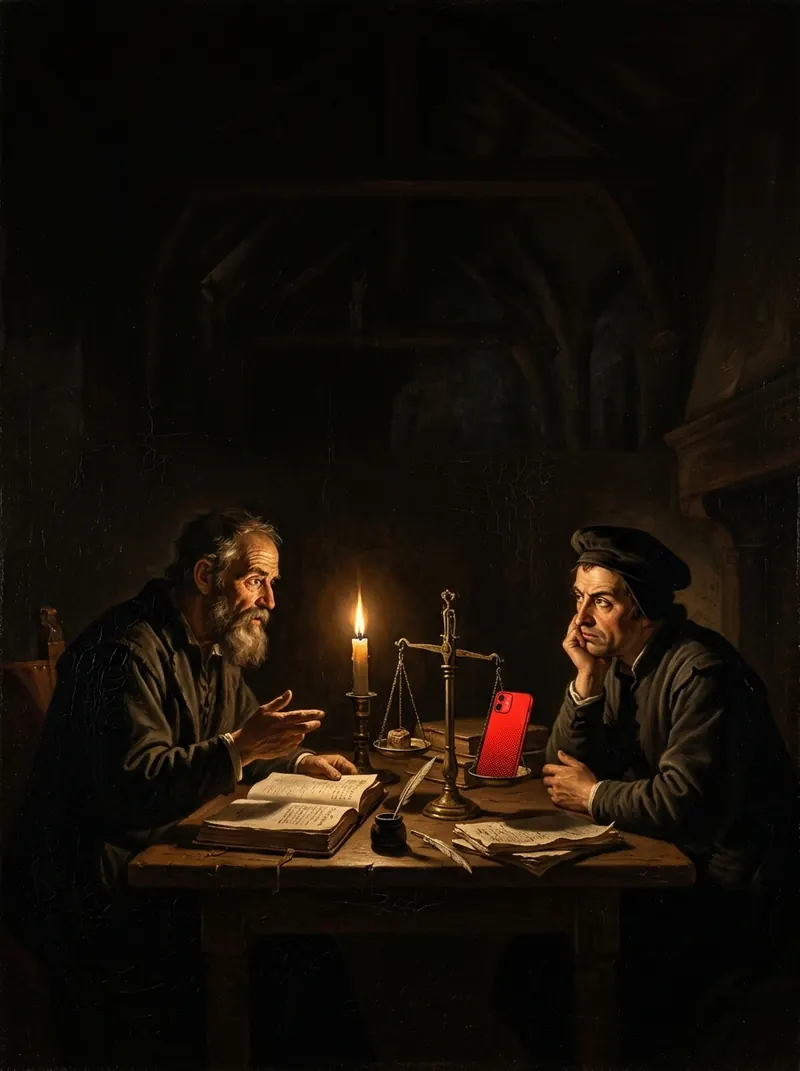
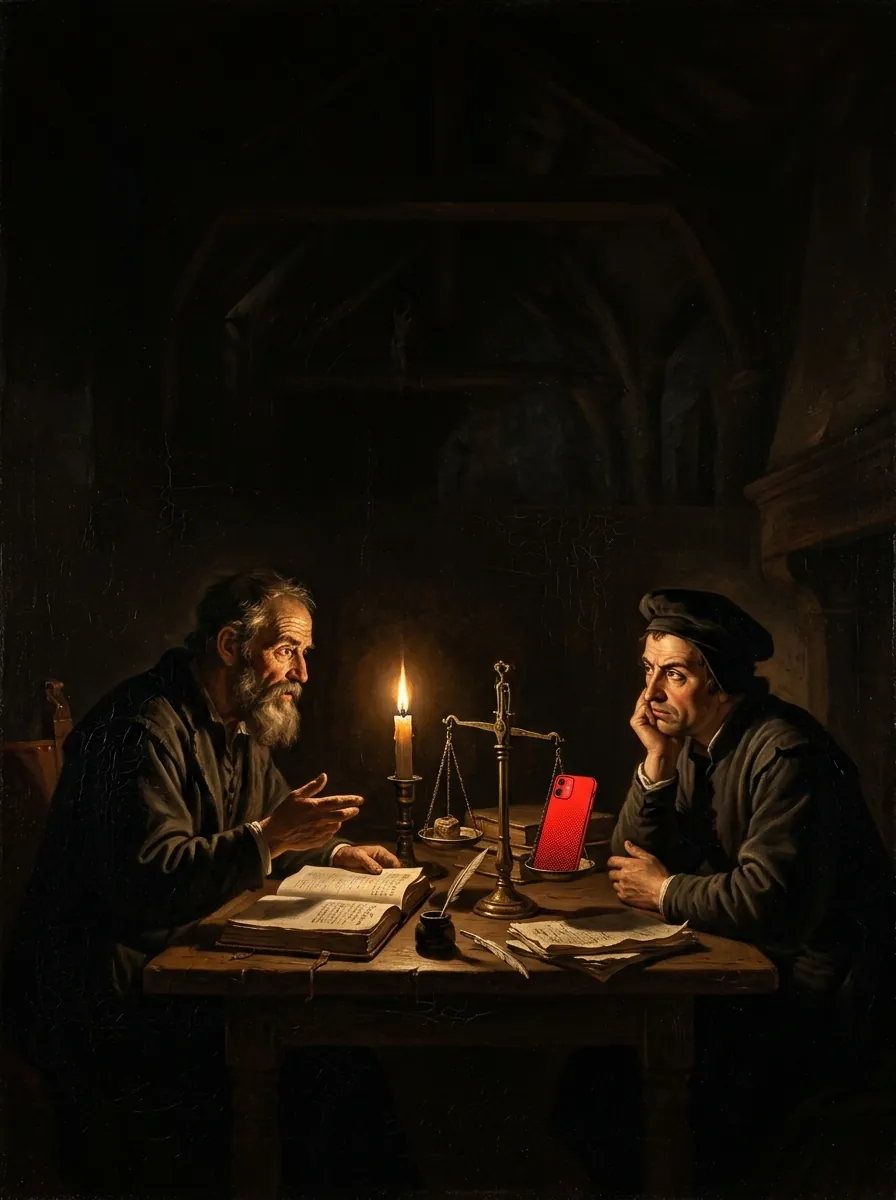
Four things about questions that test a belief.
The idea
This kind of questioning is called the Socratic method, after Socrates. We know it mainly from Plato's dialogues: written conversations in which Socrates questions people. It starts with what the other person really believes, and they answer with what they really think. There's no crowd to win over. In this kind of questioning, the person answering decides whether their view held up. Say a friend claims 'everyone is selfish deep down'. A first question might be: 'What would count as an unselfish act?' If they say 'giving to charity', the next might be: 'Even when giving makes the giver feel good?' Each answer shows a bit more of what they mean by 'selfish'.
Where does it usually lead? It often ends at a dead end, where the person seems unable to support what they first said. Picture a friend who started out sure, and now says, 'Hmm, I'm not sure I can defend that.' When it happens, the whole conversation tends to stop without a neat answer.
It wasn't always aimed at others. Socrates turned it on views he probably held himself, so it likely checked his own beliefs too. In Plato's dialogues, one man says Socrates is like a sea fish that numbs anyone who touches it. Socrates says he puzzles others because he is puzzled himself. Picture a teacher who asks the class a question she can't answer either, and says so. The question becomes something to work on together.
Can questions alone prove anything? People who study this disagree. One view says they can only show that someone is confused. Another reading: if a belief kept surviving careful questions, Socrates felt that gave him some grounds to keep it.
Want the research, names and dates? They are in Go deeper, at the end.
Pressing gently is how you learn what holds.
Picture it
Picture an old rope bridge. Before crossing, you press on each plank. You're not trying to break it. You're finding out which planks will hold your weight, and which ones only looked solid. A belief gets the same gentle pressure, one question at a time. A plank that holds is worth trusting a little more. One that gives way is better found before you're halfway across.
For a child: A boy says, 'All dogs bark.' His sister asks, 'What about the dog next door?' He thinks for a moment, then says, 'Okay, most dogs bark.' Nobody told him he was wrong. He found the gap himself, so the new version is his own. One honest question can make a belief more careful.
Four moves from a claim to a tested belief.
How it applies
It works like a short, friendly conversation, built on four moves. One asks what the person really believes. Another asks what else would follow. If a café is 'always busy', would it be busy even early on a rainy Monday? Another sets the answers side by side, to see where they clash. And one leaves the person answering to judge whether their view held up. The aim is to test a belief together, not to score a point. The same questions can be turned on your own beliefs. Seeing that your beliefs might be wrong is called intellectual humility.
At home, at work and in a book club.
Where you’ll see it
- At home: a teenager says school is pointless, and a parent asks, "Which part feels pointless?" The answer may be one subject, not school itself. That is a smaller, clearer thing to talk about.
- At work: a plan is called "obviously the right move", until someone asks what would show it was wrong. Nobody had thought about that sign, so nobody was watching for it.
- In a book club: someone calls a novel "boring", and another reader asks, "Boring where, exactly?" It turns out to be the middle chapters. The talk gets more interesting, not louder.
Signs it’s happening
- A question can already contain the answer it wants, like "Don't you think that's silly?"
- The question is asked for the people watching, not for the person in front of you.
- Listening stops once the hoped-for slip arrives.
Same claim, a fight or a test.
Before and after
A friend says, "Cheap things are always a waste of money."
"That's just snobbery." Now it's a fight about who's right. Both dig in, and the belief is never tested.
"Always? Is there anything cheap you've been glad you bought?" Maybe they think of a cheap umbrella that lasted years. A question lets a person test their own view.
On trial, he said questioning was worth living for.
A story from history: Socrates at his trial
- Socrates wrote no philosophy. Plato's Phaedo says that in prison he put some of Aesop's fables into verse. What we know of his methods comes mainly from people who knew him, such as Plato. Their accounts differ, so "Socrates said" usually means "Plato has Socrates say".
- Plato's Apology is his version of the speech Socrates gave at his trial. Here "apology" means a defence, not saying sorry.
- In it, Socrates compares himself with a man who thinks he is wise. Of that man he says: "for he knows nothing, and thinks that he knows; I neither know nor think that I know". Earlier he says, "I know that I have no wisdom, small or great".
- He says that talking daily about virtue, "examining myself and others", is "the greatest good of man".
- He is explaining why he cannot simply keep quiet and go to live in another city. Then comes the famous line: "the unexamined life is not worth living".
He questioned himself as well as others. Socrates told the difference between knowing something and only thinking he knew it. He kept asking, even when the answer was that he didn't know.
Quick check3 questions · nothing is saved
1. In this kind of questioning, who decides whether a view held up?
2. Where does it often end?
3. Why does Socrates say he cannot keep quiet and leave for another city?
One question worth keeping.
In one line
Good questions test a belief by its holder's own answers, and they can be turned on your beliefs too.
Which belief of yours would you least like to be questioned about, and why?
Go deeperThe research, names and dates
Where this comes from
In Plato's dialogues, one form of Socrates' questioning is what scholars call the elenchus. It has rules. The partner "must answer every question according to his own beliefs". And "the partner (not the audience if there is one) judges the outcome".
An elenchus "usually concludes in the discomfiture of the partner": he is left embarrassed and stuck, and now seems unable to support his first statement. Often the dialogue reaches aporia, "an impasse".
Socrates also applies it "to challenge views he probably held himself". In the Meno, in W. R. M. Lamb's translation, Meno says he is like "the flat torpedo sea-fish; for it benumbs anyone who approaches and touches it". Socrates answers, in Benjamin Jowett's translation: "I perplex others, not because I am clear, but because I am utterly perplexed myself."
Whether the method can prove anything is argued. Perhaps it "can do no more than convict a partner of confusion", as the scholar Hugh Benson has argued. On the scholar Gregory Vlastos's reading, Socrates keeps beliefs "that have been well tested and not refuted".
Philosophy for Children: two trials that disagree
| Compared | First trial (2015) | Second trial (2021) |
|---|---|---|
| Schools | 48, randomly assigned school by school | 75 used it and 123 did not |
| Pupils | Years 4 and 5, about one lesson weekly for a year | Year 6 |
| Reading and maths | About two months' extra progress | No evidence of improvement |
| How secure the finding is | Moderate | Very high: 5 out of 5 |
In Philosophy for Children, pupils discuss philosophical questions in groups. Not every school in the second trial delivered it fully. Two years in, 35 of the 75 were not running it at the expected level. In both trials, teachers reported other gains, such as pupils' confidence to speak or respect for others' opinions. The second trial was larger, and its main result is rated more secure.
More examples
Old sayings are good places to look. A maxim is a short statement of a general rule. It can hide an 'always' or a 'never' that a question can test.
- If someone says 'Money can't buy happiness', a testing question is 'What do you mean by happiness here?'
- If someone says 'Hard work always pays off', a testing question is 'Can you think of a time it didn't?'
- If someone says 'People never change', a testing question is 'Has anyone you know changed?'
What if…?
- Does studying philosophy make people better thinkers?
- A 2024 review by Michael Prinzing and Michael Vazquez looked at philosophers. On average, they were better at logical reasoning, more reflective and more open-minded than others. But it found "an absence of evidence" that studying philosophy caused this. Their 2025 study used records from over half a million US undergraduates. After allowing for starting differences, philosophy majors still outperformed all other majors on reasoning tests. The authors call this "the strongest evidence to date". It is one team's analysis of US records, not a randomised trial.
- Did Socrates say "I know that I know nothing"?
- Not in those words. In Plato's Apology he says "I know that I have no wisdom, small or great". Among the craftsmen, he says "I knew nothing at all, as I may say". His point is that he does not think he knows what he does not know. A tidy version, "He knew nothing, and knew that he knew nothing", appears in Benjamin Jowett's own introduction to his translation.
- Where does all this questioning start?
- In Plato's Theaetetus, Socrates says that "wonder is the feeling of a philosopher, and philosophy begins in wonder". Aristotle says much the same in his Metaphysics. The well-known version, "wisdom begins in wonder", swaps the word philosophy for wisdom.
Words you may meet
- intellectual humility
- How far a person recognises that their beliefs might be wrong. Glossary →
- maxim
- A short statement of a general rule, principle or truth. Glossary →