
Start hereIf-then plans proved effective across 642 tests. Yet two researchers argue that putting things off is often less about time than about how a task feels. So is the problem the plan or the feeling?
Motivation vs Discipline
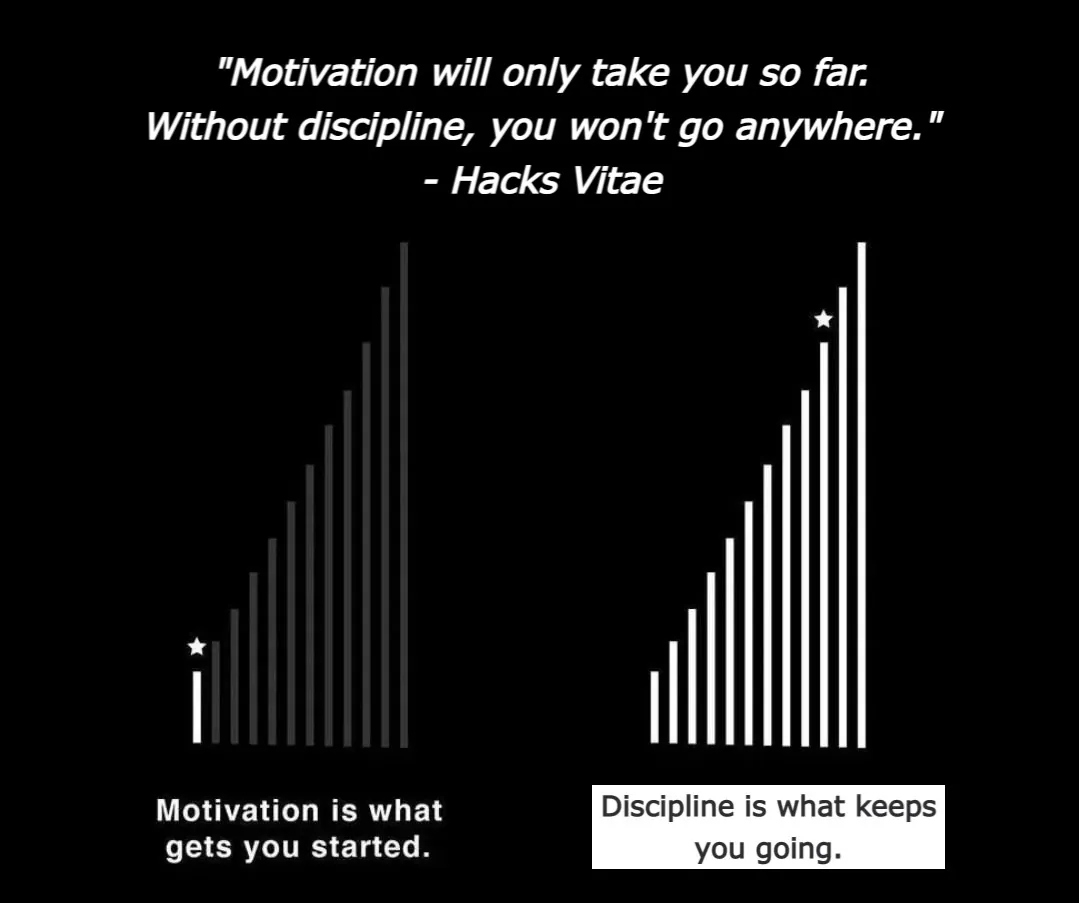
Motivation is why you act and how much you want to. Discipline is sticking to a plan when the wanting runs low.
Motivation picks the goal and gets you started. Discipline carries you through the ordinary days when you don’t feel like it. Most goals need both.
“Motivation is what drives you. Discipline is what keeps you.” A common saying of uncertain origin, repeated in several versions.
What is Motivation?
The APA Dictionary of Psychology gives two senses that matter here. Motivation is “the impetus that gives purpose or direction to behavior”. It is also a person’s willingness to put physical or mental effort into pursuing a goal or outcome.
The dictionary separates internal motivating forces from external factors, such as rewards or punishments.
What is Discipline?
The same dictionary defines self-discipline in two ways. One is “the control of one’s impulses and desires, forgoing immediate satisfaction in favor of long-term goals”. The other is “resolute adherence to a regimen or course of action in order to achieve one’s goals”.
Put side by side: motivation is about wanting to do something, discipline about doing it whether or not you want to at that moment. Much of what follows is about making the right action easier, so it depends less on how you feel.
| Motivation | The impetus that gives purpose or direction to behaviour |
| Discipline | Resolute adherence to a course of action to achieve your goals |
How to Cultivate Motivation and Discipline for Success
Five steps, each with research behind it. The research itself is in the next two sections.
1. Pick a goal you endorse
Our reading of self-determination theory (see below): a goal you endorse is likely to be easier to keep going than one you pursue only for rewards or under pressure. Check it against three questions. Is it a goal you chose? Can you see progress? Is anyone else involved or aware?
One way to find the why: write the goal down. Then ask why that matters, four or five times. Stop when the answer is something you care about, not something you think you should say.
Common mistake: spending a long time comparing methods for a goal you are not sure you want.
2. Write one if-then plan
An if-then plan decides in advance when, where and how you will act. The psychologist Peter Gollwitzer calls these plans implementation intentions. Instead of “I will study more”, you decide: “If it is 7 p.m. on a weekday, then I will sit at my desk and open the textbook.”
Common mistake: a plan with no time or place in it. “More” is not a when or a where.
3. Repeat it in the same context
In habit research, a habit is a behaviour that has become automatic in a particular context. So do the same thing at the same point in your day, such as after breakfast.
Expect weeks or months, not days. The habit study described below found a wide range, so there is no fixed number of days. It varies a great deal, and it can take a long time.
Common mistake: treating one missed day as failure. In the same study, “Missing one opportunity to perform the behaviour did not materially affect the habit formation process.” The risk is letting one miss become a new pattern.
The Stoic teacher Epictetus made a similar point about practice: “if you would make any thing a habit, do it” (Discourses 2.18, trans. George Long).
4. Make progress small and visible
Specific goals tell you whether you have hit them. Visible progress matters too.
- Start smaller than you think you should. Five minutes still counts, and it is the version you are most likely to do on a bad day.
- Track it where you can see it. A row of marks is evidence of progress.
- Finish one thing before starting three.
Common mistake: waiting for a big result before counting anything as progress.
5. Tell someone
Telling someone your goal, and arranging regular check-ins, brings in the relatedness part of self-determination theory (see below). It also creates a small outside reason to keep going on days when the inner one is weak.
Why motivation runs out, and what to build instead
Motivation rises and falls, so a plan that only works on high-motivation days will stall. Research gives some reasons why the steps above help.
Self-determination theory, developed by Edward Deci and Richard Ryan, looks at the type of motivation, not just the amount. Its own summary notes that people are often moved by outside factors, and just as often from within.
The theory contrasts two kinds:
- Autonomous motivation: doing something because you value it or find it interesting.
- Controlled motivation: doing it because of rewards, pressure or fear of what others will think.
In a 2000 paper, Ryan and Deci set out three basic psychological needs. In their account, meeting these needs brings more self-motivation and better mental health. Thwarting them brings less motivation and lower well-being.
The three needs are:
- Autonomy — a sense that you chose this, or at least endorse it.
- Competence — a sense that you can do it and are getting better.
- Relatedness — a sense of connection to other people.
Self-determination theory argues that support for autonomy, competence and relatedness fosters better performance, persistence and creativity. That suggests a goal you don’t endorse will be harder to keep going.
If-then plans
A 2006 meta-analysis by Gollwitzer and Paschal Sheeran pooled 94 independent tests. It found that these plans had a positive effect of medium-to-large size on reaching goals. They helped people start, stay on track despite distractions, and drop failing courses of action.
A 2024 update by Sheeran, Olivia Listrom and Gollwitzer pooled 642 tests. It found the plans effective for thinking, emotional and behavioural outcomes, with effect sizes from d = .27 to .66 depending on the outcome. Effects were larger when plans took an if-then form, when people were highly motivated to pursue the goal, and when plans were rehearsed.
Habits in a fixed context
In a 2010 study, Phillippa Lally and colleagues had 96 volunteers choose an eating, drinking or physical activity behaviour. Each carried it out daily in the same context, such as after breakfast, for 12 weeks. The time participants took to reach 95% of their peak automaticity ranged from 18 to 254 days.
Visible progress
Teresa Amabile and Steven Kramer analysed the diaries of knowledge workers. They found that nothing did more for a positive inner work life than making progress in meaningful work. By inner work life they mean the mix of emotions, motivations and perceptions that is critical to performance.
They call this finding the progress principle.
Ryan and Deci, 2000
Procrastination is often an emotion problem, not a time problem
Putting things off is often less about time than about how a task feels. The psychologists Fuschia Sirois and Tim Pychyl see procrastination as a failure of self-regulation. They argue it “has a great deal to do with short-term mood repair and emotion regulation”.
It tends to happen with tasks that feel aversive: unpleasant to face. You put the task off because putting it off makes you feel better now, and the cost lands on your future self.
That helps explain why a better calendar often doesn’t fix it. The problem is how the task feels, not where it sits in the week.
What follows from it:
-
Name the feeling. Bored, anxious, resentful, afraid of doing it badly? Knowing which one you are avoiding can tell you what to change about the task.
-
Forgive the last time. In a 2010 study, Michael Wohl, Tim Pychyl and Shannon Bennett followed first-year psychology students at Carleton University. Students who reported more self-forgiveness for procrastinating before their first midterm procrastinated less before the second. This was a correlation, not an experiment, but it fits the mood-repair idea: self-blame is one more bad feeling to avoid.
-
Shrink the first step until it is not worth avoiding: open the document, write one rough sentence.
-
Use an if-then plan for the moment you usually put it off.
-
Work in short timed blocks. Francesco Cirillo’s Pomodoro Technique is built around a timer. Its official site says the full method also includes daily planning, managing interruptions and estimating effort.
-
Remove the friction that comes just before the avoidance: the phone in another room, one window open.
When it is not motivation — it is energy
Sometimes low energy is not a motivation problem at all. Tiredness has ordinary causes. The NHS lists not getting enough sleep, an unhealthy diet and lack of exercise, stress, and depression among the common ones.
When it may not be about motivation at all. Depression, an underactive thyroid, anaemia, sleep apnoea, diabetes and some medicines can all cause tiredness, and a better goal-setting method will not fix any of them. The NHS says to see a GP if:
- you have felt tired for a few weeks and are not sure why;
- the tiredness is affecting your daily life;
- it comes with other symptoms, such as weight loss or mood changes.
A productivity system is the wrong tool for that. This page is not medical advice.
What setbacks can teach
Setbacks do not always come with an upside. Stories that say every closed door hides an open one are built from the cases where it did. People whose setbacks simply cost them years are rarely the ones telling the story.
A hard thing is not automatically a gift, and telling someone in the middle of one that it is can be cruel.
What holds up better is narrower, and still useful:
- Rejection is information about fit, and sometimes about the other side. It is only sometimes about you.
- Losing a role you were comfortable in removes the reason not to move. For some people that is the push they needed. For others it is just a bad year. Both happen.
- Encouraging other people costs little, and it is the one item on this list with no obvious downside.
Take the lesson if there is one. You don’t have to be grateful for the thing that hurt.
Motivation vs Discipline Quotes
These four can be traced to their original documents:
- “Discipline is the soul of an army. It makes small numbers formidable; procures success to the weak, and esteem to all.” — George Washington, Instructions to Company Captains, 29 July 1757
- “Generally then if you would make any thing a habit, do it; if you would not make it a habit, do not do it, but accustom yourself to do something else in place of it.” — Epictetus, Discourses 2.18, trans. George Long
- “Hold every hour in your grasp. Lay hold of to-day’s task, and you will not need to depend so much upon to-morrow’s.” — Seneca, Letters to Lucilius 1.2, trans. Richard M. Gummere
- “No longer talk at all about the kind of man that a good man ought to be, but be such.” — Marcus Aurelius, Meditations 10.16, trans. George Long
Many popular lines on this subject, credited to speakers, coaches and athletes, are left out because we couldn’t trace them to a dated source.
Quick answers
What is the difference between motivation and discipline?
Motivation is why you act and how much you want to. Discipline is sticking to a plan when the wanting runs low. The APA Dictionary of Psychology defines self-discipline as forgoing immediate satisfaction in favour of long-term goals, or as resolute adherence to a course of action.
Do you need both motivation and discipline?
Most goals need both: motivation to pick a goal and get started, discipline for the ordinary days when you don't feel like it.
How long does it take to form a habit?
There is no fixed number of days. In a 2010 study of 96 volunteers, the time participants took to reach 95% of their peak automaticity ranged from 18 to 254 days, and missing one opportunity did not materially affect the process.
Why do people procrastinate?
The psychologists Fuschia Sirois and Tim Pychyl argue that procrastination has a great deal to do with short-term mood repair. Putting off an aversive task feels better now, and the cost lands on your future self.
When is tiredness not a motivation problem?
Depression, an underactive thyroid, anaemia, sleep apnoea, diabetes and some medicines can all cause tiredness. The NHS says to see a GP if you have felt tired for a few weeks and are not sure why, if it is affecting your daily life, or if it comes with other symptoms such as weight loss or mood changes.
Use this
Make the right action easier, so it depends less on how you feel.
Is this a goal I chose, a plan with a when and a where, or a feeling I am avoiding?
Quick quiz
Nothing is scored or saved. Recalling it once now is what makes it last.
1. In self-determination theory, which three needs support lasting motivation?
Answer: Autonomy, competence and relatedness.Read it again ↑
2. In Lally's 2010 habit study, how long did people take to reach near-full automaticity?
Answer: Anywhere from 18 to 254 days.Read it again ↑
3. What do Sirois and Pychyl argue procrastination has a great deal to do with?
Answer: Short-term mood repair and emotion regulation.Read it again ↑
How we checked this · Last checked October 2026
- Definitions are from the APA Dictionary of Psychology.
- Study findings come mostly from the papers' abstracts: Ryan and Deci (2000), Gollwitzer and Sheeran (2006), Sheeran, Listrom and Gollwitzer (2024), Lally and colleagues (2010), Sirois and Pychyl (2013) and Wohl, Pychyl and Bennett (2010); the progress principle is from Amabile and Kramer's Harvard Business Review article.
- Lally's abstract does not say which group of participants the 18 to 254 day range covers, so the page does not narrow it.
- The four quotations were traced to their documents. Many popular lines on this subject could not be traced to a dated source and are left out; the motto at the top is a common saying of uncertain origin.
- The tiredness section follows the NHS page on tiredness and fatigue. This page is not medical advice.
Sources
- American Psychological Association, APA Dictionary of Psychology: motivation, self-discipline.Scholarly
- Ryan, R. M., & Deci, E. L. (2000). Self-determination theory and the facilitation of intrinsic motivation, social development, and well-being. American Psychologist, 55(1), 68–78. PubMed 11392867.Scholarly
- Deci, E. L., & Ryan, R. M. (2008). Self-determination theory: A macrotheory of human motivation, development, and health. Canadian Psychology, 49(3), 182–185. doi:10.1037/a0012801.Scholarly
- Center for Self-Determination Theory, The Theory.Popular
- Gollwitzer, P. M., & Sheeran, P. (2006). Implementation intentions and goal achievement: A meta-analysis of effects and processes. Advances in Experimental Social Psychology, 38, 69–119. doi:10.1016/S0065-2601(06)38002-1.Scholarly
- Sheeran, P., Listrom, O., & Gollwitzer, P. M. (2024). The when and how of planning: Meta-analysis of the scope and components of implementation intentions in 642 tests. European Review of Social Psychology. doi:10.1080/10463283.2024.2334563.Scholarly
- Lally, P., van Jaarsveld, C. H. M., Potts, H. W. W., & Wardle, J. (2010). How are habits formed: Modelling habit formation in the real world. European Journal of Social Psychology, 40(6), 998–1009. doi:10.1002/ejsp.674.Scholarly
- Amabile, T. M., & Kramer, S. J. (2011). The Power of Small Wins. Harvard Business Review.Popular
- Sirois, F., & Pychyl, T. (2013). Procrastination and the priority of short-term mood regulation: Consequences for future self. Social and Personality Psychology Compass, 7(2), 115–127. White Rose repository.Scholarly
- Wohl, M. J. A., Pychyl, T. A., & Bennett, S. H. (2010). I forgive myself, now I can study: How self-forgiveness for procrastinating can reduce future procrastination. Personality and Individual Differences, 48(7), 803–808. doi:10.1016/j.paid.2010.01.029.Scholarly
- The Pomodoro Technique, official site.Primary
- NHS, Tiredness and fatigue and Underactive thyroid: symptoms.Scholarly
- George Washington, Instructions to Company Captains, 29 July 1757, Founders Online, National Archives.Primary
- Epictetus, Discourses 2.18, trans. George Long, Wikisource.Primary
- Seneca, Letters to Lucilius 1, trans. Richard M. Gummere, Wikisource.Primary
- Marcus Aurelius, Meditations, trans. George Long, Project Gutenberg #15877, 10.16.Primary