Start hereIn his own account of the ride, Paul Revere says he "alarmed almost every House" on the way to Lexington. Nowhere does he say he shouted "The British are coming!" So where did the famous shout come from?
Many famous lines from founders, kings and generals were written down long after the moment, by someone else, or not by them at all. Below: ten lines, the oldest record we found for each, and what the real version can teach you.
The verdicts
1. What the record shows, at a glance
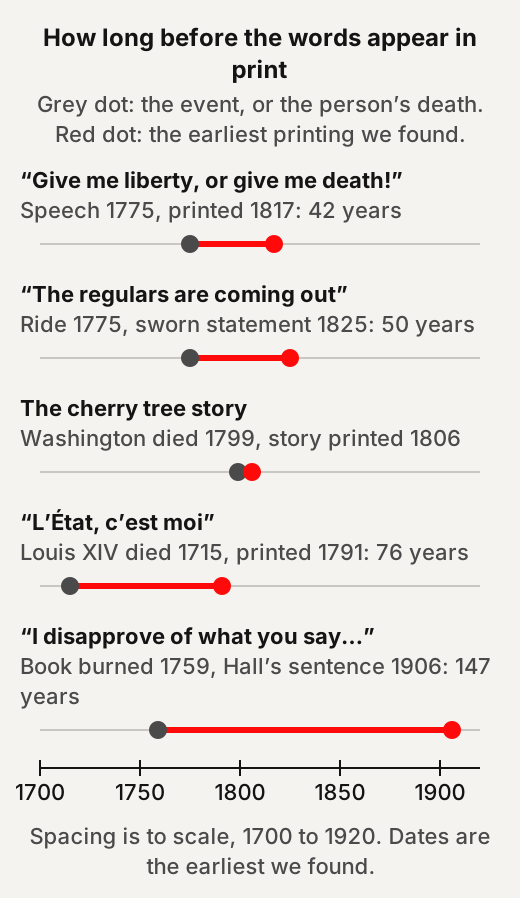
Five of these ten lines and stories first appear in print years or decades after the moment they describe.
| Line | Credited to | What the record shows |
|---|---|---|
| “I cannot tell a lie” | George Washington as a boy | A story first printed by a biographer, after his death |
| “Give me liberty, or give me death!” | Patrick Henry | Rebuilt by a biographer from memories, decades later |
| “The British are coming!” | Paul Revere | No account we found has him shouting it |
| “I disapprove of what you say…” | Voltaire | His biographer’s summary of his attitude |
| “L’État, c’est moi” | Louis XIV | First printed decades after he died, with no witness named |
| “Let them hate me, so long as they fear me” | Caligula | He repeated a line from an older play |
| “A nation of shopkeepers” | Napoleon | Already in Adam Smith’s book when Napoleon was a child |
| “Lions led by donkeys” | A German general in the First World War | In print decades before that war |
| “One small step for man” | Neil Armstrong | He meant “for a man”; the tape is unclear |
| “Nice guys finish last” | Leo Durocher | A short form of a dig at one team |
A misattribution is a line credited to the wrong person. With famous leaders, a second question matters as much: when was the line first written down, and by whom?
2. Stories written down years later
Three founding stories rest on accounts written down years or decades after the event.
“I cannot tell a lie”
Can't confirm Young George Washington told his father “I cannot tell a lie” about the cherry tree. The story has one source: a biography printed after Washington died, which credits an unnamed witness.
How sure: Moderate the old book and the National Park Service agree on its origin; Mount Vernon and Ferry Farm call it only a story.
The story comes from Mason Locke Weems, who wrote a popular life of Washington after Washington died in 1799. It first appeared in the book’s fifth edition, in 1806.
In the 1808 edition, Weems credits the story to “an aged lady, who was a distant relative”. In his telling, George answers: “I can’t tell a lie, Pa, you know I can’t tell a lie; I did cut it with my hatchet”. The hatchet “barked” the tree, though his father twice speaks of the tree as killed.
Asked whether it happened, the National Park Service answers “Nobody knows for sure”. The same page says the official answer from Ferry Farm, Washington’s childhood home, and from Mount Vernon is “no, it’s only a story”.
So the famous line is “can’t”, said to his father, in a story with one unnamed source, which the two Washington sites treat as only a story. For example, when a story about a famous person teaches a lesson very neatly, ask who first told it, and how long afterwards.
“Give me liberty, or give me death!”
Can't confirm Patrick Henry ended his 1775 speech with exactly these words. The speech is real, but its words were rebuilt decades later from people’s memories.
How sure: Strong the Library of Virginia says plainly that his exact words remain unknown.
Patrick Henry gave the speech to the Second Virginia Convention on 23 March 1775. It “was not recorded at the time of the convention or during his lifetime”.
William Wirt rebuilt the speech in his 1817 biography of Henry, using an account St. George Tucker sent him in an 1805 letter that has since been lost. In a footnote to the speech, Wirt quotes Tucker describing the audience “of which I was one”. Wirt’s version ends with “give me liberty, or give me death!” after the words “as for me”.
The Library of Virginia adds that, “by all accounts”, Wirt was a careful researcher who tried to corroborate his material. It also says that Henry’s “exact words remain unknown”.
So the line is Wirt’s version of what a witness remembered, written down decades later. For example, you can quote it as “in Wirt’s 1817 version”, which is honest and keeps the force of the line.
“The British are coming!”
Doesn't hold up Paul Revere rode through the night shouting “The British are coming!” No account we found has him shouting it, including his own.
How sure: Moderate his letter, his 1775 deposition and two 1825 accounts lack it, but we cannot rule out a record we did not find.
In his fullest account, a letter to Jeremy Belknap from around 1798, Revere says only that he “alarmed almost every House, till I got to Lexington”. His earlier deposition, from around 1775, says he “alarmed Mr. Adams and Col. Hancock”. The same letter uses “the British” more than once, as in “if the British went out by Water”.
The Paul Revere House museum has him telling a guard at Lexington that “the regulars are coming out”. That wording comes from a sworn statement made in 1825 by William Munroe, the sergeant on guard that night. In the same 1825 book, the historian’s own story gives Revere different words: “The British troops are on their march, and will soon be among you”.
Both versions were written down fifty years after the ride, and neither is the famous shout. The museum also says another rider, William Dawes, reached Lexington “carrying the same message as Revere”. Our reading: the warning travelled through more than one rider, not one famous shout. For example, when a warning really matters, sending it by two routes is the part worth copying.
3. Lines written by someone else
Two famous lines were written by later authors, and one of them said so herself.
“I disapprove of what you say, but I will defend to the death your right to say it”
Doesn't hold up Voltaire wrote “I disapprove of what you say, but I will defend to the death your right to say it”. The sentence is a 1906 summary of his attitude by his biographer, Evelyn Beatrice Hall.
How sure: Strong the 1906 book shows it as her summary, and, as Quote Investigator reports, Hall later said the words were her own.
In 1759 a book by the philosopher Helvétius was publicly burned. Hall published The Friends of Voltaire in 1906, under the name S. G. Tallentyre. She reports that, when he heard of the burning, Voltaire exclaimed “What a fuss about an omelette!”, and then sums up his stance herself. Her next sentence reads: “‘I disapprove of what you say, but I will defend to the death your right to say it,’ was his attitude now”.
Quote Investigator reports a 1939 letter by Hall about the version in her 1919 book. In it, she wrote that the phrase “is my own expression and should not have been put in inverted commas”.
So the line is one biographer’s description of how Voltaire acted, not his sentence. For example, credit the principle to Hall. Even the omelette remark reaches us only through her book, so quote it as “Hall reports”.
“L’État, c’est moi”
Can't confirm Louis XIV said “L’État, c’est moi” (“I am the state”). The earliest printing we found came 76 years after he died, and names no witness and no date.
How sure: Moderate the earliest printing we found is from 1791, but older French printings could still turn up.
Louis XIV died on 1 September 1715, after 72 years on the throne. The earliest printing we found is a footnote in a 1791 book on Rousseau by the writer Louis-Sébastien Mercier. In it, an unnamed magistrate’s speech mentions “the king and the state”, and the king, shocked, interrupts: “the state, that is me”. Mercier’s footnote names no magistrate and no date, and the quoted words in it are our translations of his French. The line appears again in an 1818 book by the writer Pierre-Édouard Lémontey, who says only that Louis “pronounced” it “one day” (our translation).
Voltaire’s history of the reign describes the young king coming to the Parlement in 1655 in hunting dress and heavy boots, whip in hand. Voltaire gives what he calls the king’s very words that day: an order to stop the Parlement’s meetings on his edicts. The famous line is not among them.
Our reading: a line that sums up a reputation this neatly may have been written later, by someone else. For example, when a slogan fits a ruler’s image perfectly, look for its oldest printing and check whether it names a witness.
4. Lines older than the person credited
Three lines were already on stage or in print before the famous name used them.
“Let them hate me, so long as they fear me”
Partly “Let them hate me, so long as they fear me” was Caligula’s own saying. Caligula often said it, but he was quoting a line from an older Roman tragedy.
How sure: Strong Suetonius reports it as a quotation, Cicero quotes it as a stage line, and Seneca as one written in Sulla’s time.
Suetonius writes that Caligula “often uttered the familiar line of the tragic poet: ‘Let them hate me, so they but fear me’”. His translator, J. C. Rolfe, traces the line to the Roman tragic poet Accius.
In On Duties, Cicero says the line would sound wrong from just men. But it draws applause when the character Atreus speaks it on stage, “for the sentiment is in keeping with the character”. Seneca quotes it too, as “oderint, dum metuant”, and says, in our translation, that you can tell it was written in the age of Sulla. Suetonius also reports that the emperor Tiberius used to say a different version: “Let them hate me, provided they respect my conduct”.
Later in the same work, Cicero gives his own view: “fear is but a poor safeguard of lasting power”. He adds that affection “may be trusted to keep it safe for ever”.
So the motto was a stage character’s line, and Cicero used it to argue for the opposite. For example, a boss who manages by fear is borrowing a line Cicero said fitted Atreus, not just men.
“England is a nation of shopkeepers”
Doesn't hold up Napoleon coined the phrase “a nation of shopkeepers”. The phrase is in Adam Smith’s The Wealth of Nations, printed in 1776, when Napoleon was six or seven.
How sure: Strong the 1776 first edition carries it; Napoleon’s own use is reported only later.
Napoleon was born on 15 August 1769. Adam Smith’s The Wealth of Nations first came out in 1776. In it, Smith wrote that founding an empire just to raise up customers “may at first sight appear a project fit only for a nation of shopkeepers”. He went on: “It is, however, a project altogether unfit for a nation of shopkeepers; but extremely fit for a nation that is governed by shopkeepers”.
Napoleon’s secretary Bourrienne wrote in his 1831 memoirs that Napoleon “used to call” England a nation of shopkeepers. The Fondation Napoléon notes that the line “does not appear in the standard compilations” of Napoleon’s sayings.
So Napoleon may have used the phrase, but he did not invent it. Our reading: Smith’s point was close to the opposite of a sneer at shops. Real shopkeepers, he argued, would not build an empire to win customers, but a government run by them might. For example, before you repeat a famous put-down, read the sentence after it.
“Lions led by donkeys”
Doesn't hold up A German general coined “lions led by donkeys” about British soldiers in the First World War. The phrase was in print decades before that war, about other wars.
How sure: Moderate a phrase dictionary and an 1871 French book show it early, but we did not open the 1855 newspaper.
A later history of the First World War credited the phrase to the German soldier Max Hoffmann, an attribution the Phrase Finder calls incorrect. The Phrase Finder quotes an American newspaper report from August 1855, on the Siege of Sevastopol. It speaks of “an army of lions led by donkeys”, as “the Russians say”.
In his 1871 book on the siege of Paris, the French writer Francisque Sarcey recalls a phrase from The Times. French troops, he says, had been told it all through the campaign: “You are lions led by donkeys”. That line is our translation of his French.
So the phrase moved from war to war, and from army to army. Our reading: a slogan that fits one war perfectly may be borrowed from an earlier one. For example, before you use a famous verdict on a war, look up when it was first printed, and about whom.
5. Lines heard or printed a little differently
Two modern lines are close to what was said, but the exact words are not settled.
“That’s one small step for man”
Still argued Armstrong said “one small step for man”, leaving out the “a”. He meant to say “for a man”, and studies of the recording have not settled whether the “a” is there.
How sure: Unsettled he said he spoke the “a”; audio analyses found no clear sign of it; a 2016 study calls the recording ambiguous.
Neil Armstrong spoke the line on the Moon on 21 July 1969 (UTC). After the mission he said he had meant to say “one small step for a man”, and believed he had. But he agreed that the “a” did not seem to be audible in the recordings.
In 2006 a journalist claimed to have found the “a” in the recording, but later analyses by people who work with audio did not support that. A 2016 study compared “for” and “for a” in everyday speech from 40 people near his Ohio hometown. It found that the two overlap a great deal, and that “substantial ambiguity exists in the original quote”. On timing alone, the authors found the recording slightly closer to “for” than to “for a”. But they add that he said the phrase quickly compared with the speech around it, which makes “for” more likely to be heard, and “could explain why he was adamant that he said for a”.
The Apollo Lunar Surface Journal prints the line as “one small step for (a) man”, to honour his intent. Our reading: the meaning was never in doubt; only one small word is. For example, writing “one small step for (a) man” shows both the recording and what he meant.
“Nice guys finish last”
Partly Leo Durocher said “Nice guys finish last”. He made a remark like it about one rival team in 1946; the four-word form came later, and he then used it himself.
How sure: Moderate dated 1946 newspaper copies on Barry Popik’s site show the remark, though they word it a little differently; we did not open the newspapers.
Durocher, managing the Brooklyn Dodgers, made the remark about the New York Giants at the Polo Grounds on 5 July 1946. The sportswriter Frank Graham described the scene in a column, reprinted on 8 July 1946. In it, Durocher waves at the Giants’ dugout and says “The nice guys are all over there”, then “In last place”.
In April 1948, “Nice Guys Finish Last” was the title of a magazine article under his name. He later used the same words as the title of his 1975 autobiography. In August 1946 a Cleveland columnist reported that the manager Connie Mack disagreed, saying he had won his pennants “with gentlemen”.
Our reading: the famous line began as a dig at one team in one season. In the same column he also says, “I never saw a nice guy who was any good when you needed him”. In the same rant he spoke about nice players in general, so it was his view of players, not a law of life. For example, if someone quotes it to you as a law of life, ask which team, and which season.
6. How to check a famous line yourself
Two questions sort out most of these: when was the line first written down, and by whom?
- Write down the exact words, and who they are credited to.
- Find the oldest printing you can, using a quotation dictionary or a site that gives dated examples.
- Count the years between that printing and the moment it describes.
- Ask who wrote it down: a witness, a biographer, a critic or a later writer.
- Check whether the line is older than the person credited: a play, an older book or a proverb.
- When you pass it on, say “as reported by” or “first printed in”, and “the earliest we found”.
A primary source is a record made at the time, or by someone who was there. For example, Revere’s own letter is a primary source, and so is Munroe’s statement, though he made it fifty years later.
We have checked more lines like these in Napoleon’s quotes, Julius Caesar’s quotes and quotes that change when you read the next sentence. More pages like this one are gathered on Quotes, sayings and stories, checked.
Quick answers
Did Paul Revere shout "The British are coming"?
No account we found has him shouting it, including his own letter about the ride. The museum line "the regulars are coming out" comes from a sworn statement made in 1825, fifty years later.
Did George Washington really say "I cannot tell a lie"?
Nobody can confirm it, and Mount Vernon and Ferry Farm call it "only a story", as the National Park Service reports. The cherry tree story first appeared in 1806, in the fifth edition of Mason Locke Weems's biography, after Washington died, and Weems credits it to an unnamed "aged lady".
Who really said "I disapprove of what you say, but I will defend to the death your right to say it"?
Evelyn Beatrice Hall wrote it, in her 1906 book The Friends of Voltaire, as a summary of his attitude. In a 1939 letter she said the phrase was her own, as Quote Investigator reports.
Did Neil Armstrong say "one small step for a man"?
He meant to, and believed he had, but agreed the "a" did not seem to be audible. A 2016 study found the recording ambiguous, so the question is still open.
Did Louis XIV say "L'État, c'est moi"?
We could not confirm it. The earliest printing we found is a 1791 book by Louis-Sébastien Mercier, 76 years after the king died, and it names no witness and no date.
Use this
Before you repeat a famous line, find when it was first written down, and by whom.
When was this line first written down, and by whom?
Quick quiz
Nothing is scored or saved. Recalling it once now is what makes it last.
1. Where does "I disapprove of what you say, but I will defend to the death your right to say it" come from?
Answer: A 1906 book about Voltaire's friends by Evelyn Beatrice Hall.Read it again ↑
2. Where did the line Caligula often said, "Let them hate me, so they but fear me", come from?
Answer: A line from an older Roman tragedy.Read it again ↑
3. Which 1776 book already has the phrase "a nation of shopkeepers"?
Answer: Adam Smith's The Wealth of Nations.Read it again ↑
How we checked this · Last checked October 2026
- We read the oldest versions we could reach: Weems's 1808 edition, Wirt's 1817 book, Revere's letter and his 1775 deposition, Phinney's 1825 history with Munroe's sworn statement, Hall's 1906 and 1919 books, Mercier's 1791 book, Lémontey's 1818 book, Voltaire's history of the reign, Suetonius, Cicero and Seneca, the 1776 first edition of The Wealth of Nations, Sarcey's 1871 book, the Apollo Lunar Surface Journal and the 2016 PLOS ONE study.
- Hall's 1939 letter rests on Quote Investigator's report of it; we did not open the 1943 journal that printed it.
- We did not open the 1855 newspaper behind "lions led by donkeys", or the 1946 newspapers behind Durocher's remark, which we read in Barry Popik's dated copies.
- Translations from French and Latin marked as ours are ours. Every date is the earliest we found; older printings can still turn up.
Sources
Stories written down later
- M. L. Weems, The Life of George Washington; with Curious Anecdotes, seventh edition (Philadelphia, 1808), pp. 11–14 (Internet Archive scan).Primary
- National Park Service, “George Washington and the Cherry Tree” (last updated 13 March 2018).Popular
- Library of Virginia, Document Bank of Virginia, “Give Me Liberty or Give Me Death, Patrick Henry Speech, 1775”.Scholarly
- W. Wirt, Sketches of the Life and Character of Patrick Henry (Philadelphia, 1817), pp. 122–123 (Internet Archive scan).Primary
- P. Revere, letter to Jeremy Belknap, about 1798, Massachusetts Historical Society (record; transcription); his deposition, about 1775 (record).Primary
- E. Phinney, History of the Battle at Lexington (Boston, 1825), p. 16 and appendix, statement No. 2 by William Munroe (Internet Archive scan).Primary
- Paul Revere House, “The Real Story of Paul Revere’s Ride”.Scholarly
Lines written by someone else
- E. B. Hall (as S. G. Tallentyre), The Friends of Voltaire (London, 1906), ch. VII (Project Gutenberg #56618).Primary
- E. B. Hall (as S. G. Tallentyre), Voltaire in His Letters (London, 1919) (Internet Archive scan).Primary
- Quote Investigator, “I Disapprove of What You Say, But I Will Defend to the Death Your Right to Say It” (1 June 2015, updated 11 March 2025).Popular
- L.-S. Mercier, De J. J. Rousseau considéré comme l’un des premiers auteurs de la Révolution, vol. 1 (Paris, 1791), p. 172, note (Internet Archive scan).Primary
- P.-É. Lémontey, Essai sur l’établissement monarchique de Louis XIV (Paris, 1818), p. 327 (Internet Archive scan).Primary
- Voltaire, Le Siècle de Louis XIV, chapter 25, Garnier edition (French Wikisource).Primary
- Château de Versailles, “Louis XIV”.Scholarly
Older lines
- Suetonius, Caligula 30.1 and Tiberius 59.2, trans. J. C. Rolfe (1914), LacusCurtius (Caligula; Tiberius).Primary
- Cicero, On Duties 1.97 and 2.23, trans. W. Miller (1913), LacusCurtius (book 1; book 2).Primary
- Seneca, On Anger 1.20.4, Latin text (The Latin Library).Primary
- A. Smith, An Inquiry into the Nature and Causes of the Wealth of Nations, first edition (London, 1776), vol. 2, p. 222 (Internet Archive scan).Primary
- Fondation Napoléon, “shopkeepers”, period glossary.Scholarly
- World History Encyclopedia, “Napoleon Bonaparte”.Popular
- Phrase Finder (G. Martin), “Lions led by donkeys”.Popular
- F. Sarcey, Le Siège de Paris (Paris, 1871), p. 55 (Internet Archive scan).Primary
Modern lines
- E. M. Jones, “One Small Step”, Apollo Lunar Surface Journal (last revised 3 May 2025).Primary
- M. M. Baese-Berk, L. C. Dilley, S. Schmidt, T. H. Morrill and M. A. Pitt, “Revisiting Neil Armstrong’s Moon-Landing Quote”, PLOS ONE 11(9), 2016.Scholarly
- B. Popik, “Nice guys finish last”, The Big Apple (23 November 2013; dated newspaper copies of 1946 and 1948).Popular
Keep the line, and keep its record
Our view: a famous name helps a line spread, but the name alone is not a source. The real version often teaches more than the famous one.
Build a quote file you can trust
- Keep one file. Our suggestion: keep one file of the lines you like to use, so each check is done once.
- Give each line four fields. The words, the name credited, the earliest printing you found with its year, and who wrote it down.
- Keep the record's own wording. Suetonius says Caligula "often uttered" the line. Keep wording like that, and who reported it.
- Note how sure you are. Our suggestion: add how sure you are, such as strong, moderate or unsettled, and why, as this page does.
- Have a sourced line ready. Our suggestion: when a line won't hold up as credited, find one in the record that does. On Duties quotes the stage line, and also gives Cicero's own: "fear is but a poor safeguard of lasting power".
This week: date the lines you already use
Our suggestion: list the famous lines in your talks, slides or bio. This week, look up two. Note the earliest year you found and who wrote it down, or that you could not tell.
Put line-checking to paid use
- Offer quote checks for speechwriters, authors and presenters before a famous line goes into a talk or book.
- Write short posts setting a famous line beside the earliest record you found, dated and sourced.
- Help a business credit a famous line correctly, with its writer and date, before it goes on a poster.
- Make "who really said it?" puzzles for newsletters or puzzle books, with a dated source behind every answer.
Ideas to explore, not financial or business advice. No result is promised.
Keep going
- Who really said it?Search the lines we have checked, with what we found and a link to each full check.
- How to spot a fake quoteWhy quotes get pinned on famous names, and how to trace a line to the earliest copy you can find.
- Did they really say that?Famous quotations traced back to the text they came from, each with a verdict.
- Quotes that get cut shortFamous sayings set beside the poems, plays and books they came from.
- GlossaryPlain meanings of terms used on our pages, including misattribution and primary source.