

Start hereIn a letter of 16 November 1858, Lincoln wrote "And this too shall pass away," never fear. In a speech in Milwaukee on 30 September 1859, he praised the same words, then added "And yet, let us hope, it is not quite true." The difference sits in the next sentence.
A famous line can sound complete on its own. Read the next sentence, though, and it often adds a condition, a speaker or a reply. Below are twelve famous lines, each set beside the sentences around it in the book, letter, play or speech it comes from.
Each verdict is on one claim about what the source says, never on whether the saying is wise. This is part 2 of a series. Part 1, Quotes That Get Cut Short, checks fifteen famous sayings against the original texts.
One famous line is covered on another page. Santayana’s line about those who “cannot remember the past” is about keeping what experience teaches, not about history lessons. Our page on why history matters reads it in full.
The verdicts
1. Lines with a condition attached
In each of these, a small word or the next clause limits the famous line.
1. “Power corrupts, and absolute power corrupts absolutely”
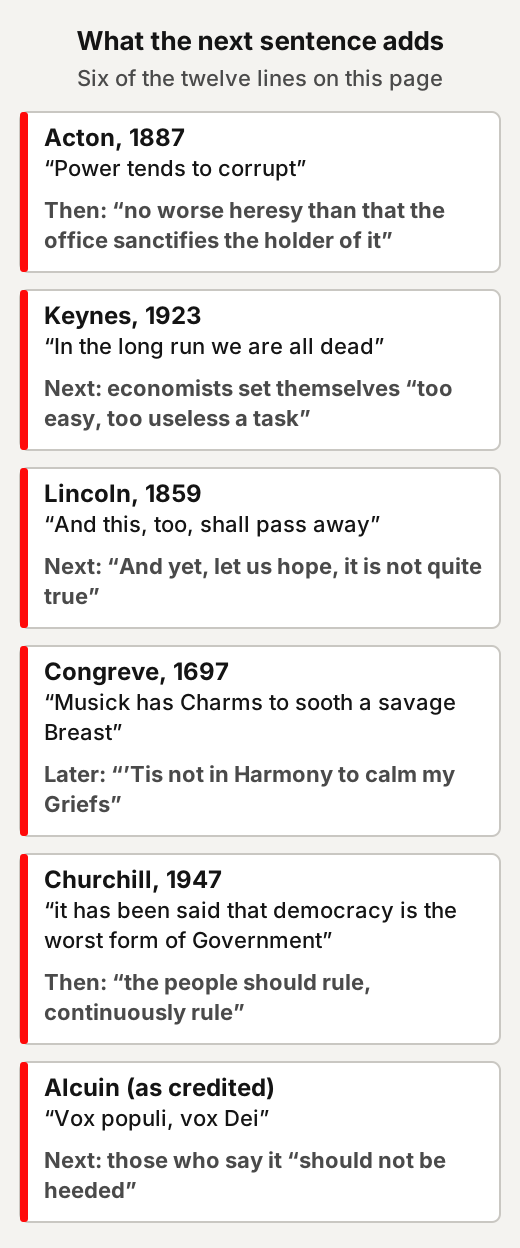
Partly Lord Acton wrote that power corrupts. He wrote that power “tends to” corrupt, in a letter arguing that the powerful should be judged more strictly.
How sure: Strong the letter is in print, and the sentences around the famous line say plainly what he meant.
Acton wrote the line in a letter of 5 April 1887 to the historian Mandell Creighton. A 1907 collection of his essays prints it as: “Power tends to corrupt, and absolute power corrupts absolutely”.
Just before the famous line, he says any presumption should run “against the holders of power, increasing as the power increases”. The sentences after it say that “Great men are almost always bad men”, and that there is “no worse heresy than that the office sanctifies the holder of it”.
Our reading: the line is a rule for judging people with power, not a forecast that power always ruins them. For example, if you hold power at work or at home, it can help to invite questions about your decisions rather than expect trust because of your role.
2. “The pen is mightier than the sword”
Partly The line says that words beat force. The line comes with a condition, “Beneath the rule of men entirely great”, and the pen in it belongs to a statesman.
How sure: Strong the 1839 printing of the play shows the whole scene, and the condition sits in the same sentence.
The line is from Edward Bulwer-Lytton’s play Richelieu; or, The Conspiracy, published in 1839. In Act II, Cardinal Richelieu wishes he were younger, tries to wield a two-handed sword and lets it fall: “You see a child could / Slay Richelieu, now”.
A few lines on he adds: “Take away the sword — / States can be saved without it!”.
Our reading: the pen here is a powerful minister’s pen, the orders and letters of a man who runs a state. In practice, writing carries the most weight when someone with the standing to act stands behind it.
3. “Man is a wolf to man”
Partly “Man is a wolf to man” is an old judgement on human nature. The words are old, but in the original they are about strangers, and Hobbes later limited the wolf to dealings between states.
How sure: Strong the Latin line and Hobbes’s dedication both say plainly whom they mean.
In Paul Nixon’s 1916 translation, a trader refuses to trust money to “a stranger”, saying: “Man is no man, but a wolf, to a stranger”. The clause the slogan drops, quom qualis sit non novit, means “when he does not know what sort he is” (our translation).
In the 1651 English edition of De Cive, Thomas Hobbes wrote that “both sayings are very true”. One is that man is “a kind of God” to man; the other, that man is a wolf to man. The first, he said, is true “if we compare Citizens amongst themselves; and the second, if we compare Cities”.
Our reading: in Plautus the line describes wariness of people we do not know yet. For example, a new neighbour or colleague can seem a threat mostly because they are still a stranger.
4. “Ars longa, vita brevis”
Doesn't hold up The saying means that art outlives the artist. In the original, the next sentence turns to the physician: the “art” is the doctor’s craft.
How sure: Strong the aphorism and the sentence after it are both about practising medicine.
The line opens the Aphorisms, a medical text credited to Hippocrates. In Francis Adams’s translation it reads: “Life is short, and Art long; the crisis fleeting; experience perilous, and decision difficult”. The next sentence says the physician “must not only be prepared to do what is right himself, but also to make the patient, the attendants, and externals cooperate”.
Our reading: the line is a craftsman’s warning that a skill takes longer to learn than a life allows, and that decisions still have to be made. In practice, it fits any slow skill: start early, decide even when you are unsure, and bring others in.
5. “Cui bono?” Who benefits?
Partly “Who benefits?” settles who did it. Cicero used it against a man he called wicked, and said that good men are not moved to crime by any gain.
How sure: Strong Cicero uses the question in two speeches, and he states its limit himself.
In his speech for Sextus Roscius, Cicero recalls a judge, Lucius Cassius, who “used constantly to ask at trials, ‘to whom it had been any advantage?’”. The reason, in C. D. Yonge’s translation: “no one attempts to proceed to crime without some hope of advantage”.
He says the maxim of Cassius “may well have influence in respect of these persons”. His next sentence sets the limit: “good men cannot be induced to commit crimes by any advantage whatever, wicked men often can by a very trifling one”.
Our reading: “Who benefits?” tells you where to look first, but it is not proof. For example, if a rumour helps one company, that is a reason to check where the rumour started, not proof that the company started it.
2. Lines the next sentence turns around
Here the famous line is real, but the sentence after it, or a line soon after, pushes the other way.
6. “In the long run we are all dead”
Doesn't hold up Keynes meant the future does not matter. His next sentence says economists set themselves “too easy, too useless a task” if all they offer in a storm is that it will pass.
How sure: Strong the passage is short, and the sentence after the famous one says whom he meant.
The line is from John Maynard Keynes’s A Tract on Monetary Reform, whose preface is dated October 1923. Keynes grants that a theory of money is “probably true” in the long run, then writes: “But this long run is a misleading guide to current affairs. In the long run we are all dead”.
The next sentence says economists set themselves “too easy, too useless a task” if, in stormy times, they can only say one thing. That one thing: “when the storm is long past the ocean is flat again”.
Our reading: advice has to work in the time people actually live through. For example, “it will all even out” may be true of a bad month at work, but it does not tell you what to do this week.
7. “This too shall pass”
Partly Lincoln used “this too shall pass” only as comfort. He did in an 1858 letter. In an 1859 speech he also called the words chastening “in the hour of pride”, then said he hoped they were “not quite true”.
How sure: Strong both the letter and the speech are in print, and the speech text gives his words in full.
In a speech in Milwaukee on 30 September 1859, he told of “an Eastern monarch” whose wise men gave him the words “And this, too, shall pass away”. He praised them: “How chastening in the hour of pride; how consoling in the depths of affliction!”.
Then he added: “And yet, let us hope, it is not quite true”. He hoped that by cultivating the physical world and the mind and morals, people could build a prosperity that “shall not pass away”.
The saying is older than Lincoln’s speech. An 1852 book of sayings, Polonius, tells of Solomon giving a sultan the motto “this also shall pass away”.
Our reading: the line works both ways, humbling good times as well as easing bad ones, and Lincoln’s own twist was to build something meant to last. For example, after a good result at work, it can be a nudge to keep improving rather than just wait for the next bad patch.
8. “Music has charms to soothe the savage beast”
Partly Congreve wrote that music soothes the savage beast. He wrote “breast”, and a few lines later the speaker says that music cannot calm her own grief.
How sure: Strong two copies of the 1697 printing show the same speech.
The line opens the first act of William Congreve’s tragedy The Mourning Bride (1697), spoken by Almeria, who is in mourning. The 1697 text reads: “Musick has Charms to sooth a savage Breast, / To soften Rocks, or bend a knotted Oak”.
A few lines later she asks: “What then am I? Am I more senseless grown / Than Trees, or Flint?”. And she answers: “‘Tis not in Harmony to calm my Griefs”.
Part 1 of this series looks at another line from the same play, “Hell hath no fury like a woman scorned”. Our reading: the speech is about the limits of comfort. In practice, what calms other people may not reach a deep grief, and that is worth knowing before offering it.
9. “Democracy is the worst form of government”
Partly Churchill called democracy the worst form of government. He said it was the worst “except all those other forms”, introduced it with “it has been said”, and went on to say the people should rule.
How sure: Strong the speech is recorded in Hansard, and an earlier use of the saying has been found.
Winston Churchill spoke in the House of Commons on 11 November 1947, in a debate on the Parliament Bill. Hansard records: “No one pretends that democracy is perfect or all-wise”.
He went on: “Indeed, it has been said that democracy is the worst form of Government except all those other forms that have been tried from time to time”. The sentence continues: “but there is the broad feeling in our country that the people should rule, continuously rule”.
Our reading: the line is praise by comparison, offered as a saying Churchill had heard. For example, when you weigh a flawed option, set it beside the real alternatives, not beside a perfect one.
3. Lines quoted to argue or to explain
These lines were quoted by someone who disagreed with them, or explained by someone else.
10. “Vox populi, vox Dei”
Doesn't hold up The oldest record of “the voice of the people is the voice of God” praises it. In the oldest record we found, a letter credited to Alcuin, the phrase is quoted in order to say it should not be heeded.
How sure: Moderate this is the earliest record we found, its date and writer are not certain, and it quotes people who already used the phrase.
The writer and translator Jeff Sypeck writes that the phrase was “first written down during the time of Charlemagne”, in a letter to Charlemagne that he credits to Alcuin. The letter is a list of short answers to questions, and the phrase is in the ninth. In Sypeck’s translation, that answer begins: “The people must be led according to divine laws, not followed”.
The standard edition of 1895 prints it as Alcuin’s answer to questions from King Charles, dated with a question mark to 798. A footnote records an earlier editor’s guess that the text is Einhard’s, from 817.
The next sentence reads: “Those who say ‘the voice of the people is the voice of God’ should not be heeded”. The letter gives its reason: “for the hubbub of the crowd is always rather close to madness”.
Whoever wrote it did not coin the phrase, since the letter quotes “those who say” it. The view of crowds is the writer’s own, and we describe it rather than take a side.
Our reading: how many people believe something and whether it is right are two separate questions. In practice, a popular post tells you what many people think, and checking it is still a separate step.
11. “Patriotism is the last refuge of a scoundrel”
Doesn't hold up Johnson meant that patriotism itself belongs to scoundrels. We know the remark from Boswell, and his next sentence says Johnson meant pretended patriotism.
How sure: Moderate the explanation is Boswell’s, not Johnson’s, though John Hawkins’s Life of Johnson describes the same contempt for “the pretences of patriots”.
James Boswell records that at a dinner on 7 April 1775, Johnson spoke “in a strong determined tone”. His words: “Patriotism is the last refuge of a scoundrel”.
Boswell’s next sentence begins: “But let it be considered, that he did not mean a real and generous love of our country”. It goes on: Johnson meant “that pretended patriotism which so many, in all ages and countries, have made a cloak for self-interest”.
Our reading: the warning is about people who use love of country as cover. For example, when a cause leans hard on loyalty, it can help to look at what it does as well as what it says.
12. “The only thing necessary for the triumph of evil is for good men to do nothing”
Doesn't hold up Edmund Burke wrote it. Burke and John Stuart Mill wrote similar lines; the earliest close match to the famous wording that Quote Investigator found is from 1916.
How sure: Strong Quote Investigator traced the saying, and both older texts can be read in full.
Quote Investigator found that Burke and Mill each wrote lines “loosely similar” to the saying “but unmistakably distinct”. Burke wrote in 1770: “When bad men combine, the good must associate; else they will fall, one by one, an unpitied sacrifice in a contemptible struggle”.
Then: “He is not a good man who, without a protest, allows wrong to be committed in his name, and with the means which he helps to supply”. It ends with the reason: “because he will not trouble himself to use his mind on the subject”.
Crediting the slogan to Burke is a misattribution, but both older lines are more practical than the slogan. Burke asks good people to organise; Mill asks them to take the trouble to inform themselves. For example, before you sign or share a petition, it helps to read what it would actually do.
4. How to check a quote’s next sentence yourself
Five quick checks, drawn from the twelve lines above.
-
Find the primary source. Look for the line in the book, letter, play or speech itself, not on a quotation site. Our guide to spotting a fake quote shows where to find old texts.
-
Read the whole sentence. Small words like “tends to”, “except” or “when” can limit the famous part, as they do for Acton, Churchill and Plautus.
-
Read one sentence before and one after. For Keynes, Lincoln and Mill, the next sentence changes what the famous line seems to say.
-
Check who is speaking, and to whom. A line in a play belongs to a character, like Congreve’s Almeria or Bulwer-Lytton’s Richelieu.
-
Watch for “it has been said”. Churchill and the Alcuin letter were both quoting a saying already in use, and Boswell, not Johnson, explains the patriotism line.
Part 1 of this series adds a few more checks for how a quote ends. For lines from films and TV, see our page on film and TV lines everyone remembers slightly wrong.
Quick answers
Who said "power corrupts, and absolute power corrupts absolutely"?
Lord Acton, in a letter of 5 April 1887 to the historian Mandell Creighton. His words were "Power tends to corrupt, and absolute power corrupts absolutely", in a letter arguing that the powerful should be judged more strictly.
What did Keynes mean by "in the long run we are all dead"?
He was criticising economists who only promise calm after a storm. His next sentence says economists set themselves "too easy, too useless a task" if, in stormy times, they can only say one thing.
Is it "savage beast" or "savage breast"?
Congreve wrote "breast". The 1697 text of The Mourning Bride reads "Musick has Charms to sooth a savage Breast", and a few lines later the speaker says that music cannot calm her own grief.
Did Edmund Burke say "the only thing necessary for the triumph of evil is for good men to do nothing"?
The line has not been traced to Burke. He and John Stuart Mill wrote similar ones, in 1770 and 1867, and the earliest close match Quote Investigator found is a speech of October 1916.
Who said "this too shall pass"?
It is an older saying. An 1852 book of sayings tells of Solomon giving a sultan the motto "this also shall pass away", and Lincoln used it in an 1858 letter and an 1859 speech.
Use this
Read the sentence before and the sentence after a famous line before you use it.
What does the next sentence say, and who is saying it?
Quick quiz
Nothing is scored or saved. Recalling it once now is what makes it last.
1. What did Acton write about power?
Answer: Power tends to corrupt.Read it again ↑
2. In Congreve's play, what does Almeria say music cannot do?
Answer: Calm her griefs.Read it again ↑
3. Why does the letter credited to Alcuin quote "vox populi, vox Dei"?
Answer: To say it should not be heeded.Read it again ↑
How we checked this · Last checked October 2026
- We read each line in a scan or transcription of the book, letter, play or speech it comes from, mostly through the Internet Archive, Project Gutenberg, The Latin Library and Hansard.
- Translations are credited where we quote them. The meaning of the dropped clause in the Plautus line is our own translation.
- The date of Acton's letter, 5 April 1887, is given by the historian Gertrude Himmelfarb, citing the manuscript, and by Liberty Fund's EconLog; the 1907 printing gives no date.
- The letter credited to Alcuin is the earliest record of vox populi, vox Dei that we found, read in Jeff Sypeck's translation and in the 1873 and 1895 Latin editions. The 1895 edition dates it, with a question mark, to 798 and records an earlier editor's guess that Einhard wrote it in 817. A search cannot prove there is no older one.
- Printings of Lincoln's 1859 speech differ in small words; we quote the National Park Service text and paraphrase the passage where printings differ.
- Each verdict is on one claim about what the source says, never on whether the saying is wise.
- Our wording on Santayana follows our Why history matters page, and part 1 of this series covers fifteen other sayings.
Sources
Texts
- Lord Acton, letter to Mandell Creighton, in J. N. Figgis and R. V. Laurence (eds), Historical Essays and Studies (London: Macmillan, 1907), Appendix, pp. 503–505 (archive.org scan); the letter’s date as given by Gertrude Himmelfarb, Lord Acton: A Study in Conscience and Politics (1952), in a note citing the manuscript (Open Library search inside), and by David Henderson, “The Acton-Creighton Correspondence”, EconLog, 25 January 2022.Primary
- Edward Bulwer-Lytton, Richelieu; or, The Conspiracy (London: Saunders and Otley, 1839), Act II, Scene II, p. 39 (archive.org scan).Primary
- Plautus, Asinaria, line 495, Latin text (The Latin Library); English translation by Paul Nixon, Loeb Classical Library, 1916 (Project Gutenberg #16564).Primary
- Thomas Hobbes, De Cive (English edition, 1651), Epistle Dedicatory (marxists.org transcription).Primary
- Hippocrates, Aphorisms, Section I, 1, translated by Francis Adams (Internet Classics Archive).Primary
- Cicero, Pro Roscio Amerino 84 and Pro Milone 32, Latin text (The Latin Library; The Latin Library); translated by C. D. Yonge, The Orations of Marcus Tullius Cicero, vol. 1 (archive.org scan) and vol. 3 (archive.org scan).Primary
- John Maynard Keynes, A Tract on Monetary Reform (London: Macmillan; preface dated October 1923), chapter III, p. 80 (archive.org scan).Primary
- Abraham Lincoln, letter to N. B. Judd, 16 November 1858, in The Papers and Writings of Abraham Lincoln, vol. 5 (Project Gutenberg #2657); address in Milwaukee, 30 September 1859, as given by the National Park Service, “Lincoln on America’s Future”.Primary
- Polonius: A Collection of Wise Saws and Modern Instances (London: William Pickering, 1852), “Solomon’s Seal” (archive.org scan).Primary
- William Congreve, The Mourning Bride, a Tragedy (London, 1697), Act I, Scene 1 (archive.org scan; second copy).Primary
- Winston Churchill, House of Commons, 11 November 1947, Parliament Bill, HC Deb vol 444 cc206–207 (Hansard).Primary
- Letter to Charlemagne credited to Alcuin, answer IX, Latin text in P. Jaffé, W. Wattenbach and E. Dümmler (eds), Monumenta Alcuiniana (Berlin, 1873), letter 253, pp. 807–808 (archive.org scan); E. Dümmler (ed.), Monumenta Germaniae Historica, Epistolae 4 (Epistolae Karolini aevi II), Berlin 1895, letter 132, pp. 198–199, with note 4 (dMGH); translation by Jeff Sypeck, “The music keeps them quiet; there is no other way”, Quid Plura?, 5 November 2008.Primary
- James Boswell, Life of Johnson, ed. G. B. Hill, vol. 2, entry for Friday 7 April 1775, with Hill’s note (Project Gutenberg #9072).Primary
- Edmund Burke, Thoughts on the Cause of the Present Discontents (1770) (Project Gutenberg #2173).Primary
- John Stuart Mill, Inaugural Address Delivered to the University of St. Andrews, Feb. 1st 1867, People’s Edition (London: Longmans, 1867), p. 36 (archive.org scan).Primary
- George Santayana, The Life of Reason, vol. 1, Reason in Common Sense (Project Gutenberg #15000).Primary
Quote histories
- Quote Investigator, “Democracy Is the Worst Form of Government Except For All Others Which Have Been Tried” (8 December 2023).
- Quote Investigator, “The Only Thing Necessary for the Triumph of Evil is that Good Men Do Nothing” (4 December 2010, updated 1 December 2024).
Treat a famous line as a start
A famous line can feel like the last word. Our view: treat it as the start of a point, not the end. The next sentence may add a condition, a speaker or a reply.
Use the full lines as decision checks
- Compare with the real options. Our suggestion: before you reject a flawed plan, list the real alternatives and test them the same way.
- Ask what helps now. Keynes faulted economists who only say the storm will pass. Our suggestion: when a plan's answer is to wait, add one step for this week.
- Treat "who benefits?" as a lead. In his speech for Milo, Cicero said gain often moves wicked men to crime, but not good men. Our view: treat the question as a place to look first, not proof.
- Keep counting and checking apart. Our suggestion: when a choice rests on how many people agree, look for one source that checks the claim.
This week: check a line you lean on
Our suggestion: pick one famous line you use, in a talk, a slide or an email signature. Find it in the original this week and read the sentence after it. Then ask whether the full passage still says what you use it to say.
Put context-checking to paid use
- Offer quote checking for speeches, slides and books, giving the source and the next sentence for each line.
- Make short posts or videos on one famous line and its next sentence, naming the source you read.
- Write context notes for quote collections, giving each line's speaker and the sentence that follows.
Ideas to explore, not financial or business advice. No result is promised.
Keep going
- Who really said it?Search the lines we have checked, each with what we found and its source.
- Quotes that get cut shortPart 1 of this series: famous sayings read against how they end in the original.
- How to spot a fake quoteChecks for invented quotes and sources, including ones made up by AI.
- Sayings that used to mean the oppositeCommon phrases whose meaning has shifted, and where the older versions turn up.
- Why history mattersSantayana's line about remembering the past, read in full.
Goes with: 4. How to check a quote’s next sentence yourself ↑