

Start hereIn Asch's line studies, three in four people went along with a wrong group at least once. Yet 63.2% of all the answers on those trials went against the group. Which is the real result?
These eight studies all happened. The versions people quote are simpler than what the records show. Below, for each one: the popular version, what the study did, what later work found, and what you can take from it.
The verdicts
1. The eight at a glance
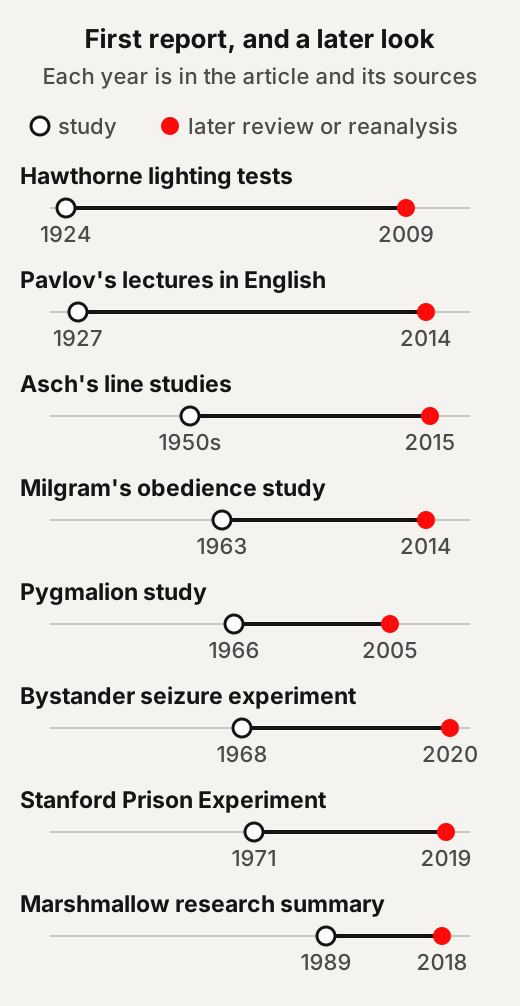
All eight studies happened; in each, the popular version leaves out part of the result.
| Study | The popular version | What we found |
|---|---|---|
| Stanford Prison Experiment, 1971 | Guards turned cruel on their own | Still argued |
| Milgram’s obedience studies, 1963 | Most people obey orders to hurt someone | Partly |
| Asch’s line studies, 1950s | Most people go along with the group | Partly |
| Bystander studies, from 1968 | Nobody helps when others are around | Partly |
| Hawthorne studies, 1924 to 1932 | Workers worked harder because they were watched | Partly |
| Pygmalion study, 1966 | Teachers’ expectations raise children’s IQ | Partly |
| Pavlov’s dogs | The dogs learned to drool at a bell | Partly |
| The marshmallow test | Waiting for a treat predicts success in life | Partly |
2. Roles and authority
The prison and shock studies show that the set-up shapes behaviour; why people acted so is still argued.
“Give people a guard’s role and they turn cruel on their own”
Still argued The Stanford Prison Experiment showed that ordinary people turn cruel when handed power, with nobody telling them to. Archive studies found the guards were briefed and encouraged; the original researchers reject that reading. The study was stopped early; the argument is about what caused the cruelty.
How sure: Unsettled two 2019 archive studies and the original researchers disagree; the archive evidence leans against “on their own”.
The study ran at Stanford University in 1971, and its official website says the planned two-week study was ended after only six days. Philip Zimbardo wrote there that “our guards became sadistic and our prisoners became depressed and showed signs of extreme stress”.
A 2019 study of the archives, with interviews of 15 participants, found that “the guards received precise instructions regarding the treatment of the prisoners”. It also found that the guards were not told they were subjects, and that data were collected in a biased and incomplete way. The study had drawn on a prison exercise that students in one of Zimbardo’s classes ran three months earlier.
A second 2019 archive study concluded that the experimenters “directly encouraged” the guards to adopt their roles and act tough. Researchers call cues like these demand characteristics: hints that tell participants what the experimenter expects.
Zimbardo and Craig Haney, two of the study’s authors, replied in 2020. They called it “a classic, dramatic demonstration” of what can happen when one group holds nearly total power over another in a dehumanizing place like a prison. They said they value engaged alternative views but reject those that are “ad hominem, misleading, inaccurate, and unscientific”. In a statement on the study’s website, replying to criticism published in 2018, Zimbardo wrote: “We did not give any formal or detailed instructions about how to be an effective guard”. He argued that because some guards remained “good guards” throughout, the “cruel guards chose to act on their own initiative”.
In a 2006 study made with the BBC, men were again split at random into prisoners and guards, and this time the guards “failed to identify with their role”. Zimbardo published a comment challenging that study’s validity.
Our reading: the guards’ behaviour can’t be separated from what they were told. We lean that way because two separate archive studies found instructions and encouragement. For example, when a team starts treating customers or newcomers badly, look first at the instructions, the targets and what the people in charge praise.
“Most ordinary people will obey an authority figure who tells them to hurt someone”
Partly In Milgram’s studies, most ordinary people obeyed orders to give painful shocks. The obedience held up, but how many obeyed depended heavily on the set-up, and why is argued over. Our Influence summary covers the debate in more depth.
How sure: Moderate data from 21 versions show obedience varied widely; why people went on is still argued.
In Stanley Milgram’s 1963 study, 26 of 40 participants gave what they believed was the highest shock. Across the 21 versions of the experiment in which obedience meant going to the maximum shock, 43.6% of 740 people did, so how many obey depends heavily on the set-up. A 2006 partial replication, stopped at 150 volts for ethical reasons, found obedience only slightly lower than Milgram’s.
A 2015 study of Milgram’s archive argues that participants went on because they identified with what they took to be a worthwhile scientific project. That account is at odds with Milgram’s own explanation. A 2020 re-analysis found that in 18 of 23 versions of the experiment, those who fully believed the shocks were real gave lower shocks on average.
Our reading: obedience rose and fell with the details of the situation. For example, before you follow an order you doubt, notice how the set-up steers you: who gives it, and how far you are from those it affects.
3. Groups
Group pressure is real, but in these studies most answers stayed independent and someone usually helped.
“Most people go along with the group, even when the group is plainly wrong”
Partly Asch’s line studies showed that most people conform to the group. Group pressure swayed just over a third of the answers; most answers stayed correct. Both halves of the result are real, but the second is often left out. Psychologists call going along with others in this way conformity.
How sure: Strong Asch’s own figures show both halves, and a review of 133 later studies found conformity in many countries.
Solomon Asch ran the studies at Swarthmore College in the 1950s. Each real participant sat with actors who, on most trials, all chose the wrong line.
Of the answers on those trials, 63.2% went against the wrong majority and 36.8% went along with it. A quarter of participants never went along, against 5% who always did. Three in four went along at least once, and 95% held out at least once.
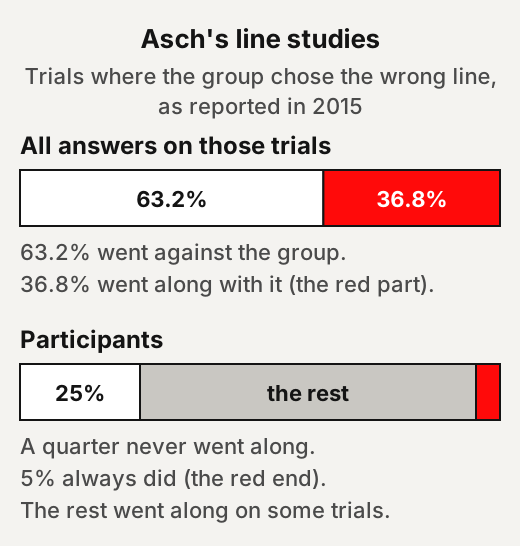
Many who went along said they had been certain all along that the group was wrong. A 2015 paper reported that most of the answers on the key trials were independent, correct ones.
A 1996 meta-analysis of 133 Asch-type studies from 17 countries found that conformity in the US had declined since the 1950s. Collectivist countries tended to show more conformity than individualist ones.
Our reading: the pull to agree is real, and so is the habit of holding your ground. For example, if you are the only one who sees a problem in a meeting, write your view down before the group speaks, so your own judgement is on record.
“Nobody helps when others are around”
Partly The bystander effect means that in a crowd, nobody helps. Each person is less likely to help when others are present, but in real public conflicts someone usually does. The bystander effect is real for each person; the “nobody helps” part does not hold up.
How sure: Strong a meta-analysis of over 7,700 people and footage of 219 real conflicts support both halves.
In a 1968 experiment by John Darley and Bibb Latané, people overheard what they thought was someone having a seizure. They believed they were alone, or with one or four others they could not see. Believing others were present made them slower to report it.
The idea is often told through the 1964 killing of Kitty Genovese in New York, with 38 neighbours said to have watched and done nothing. A 2007 study of the archive material found no evidence that there were 38 witnesses, that they saw the murder, or that they did nothing. Our Influence summary covers that story in full.
A meta-analysis confirmed that each individual is less likely to help when others are present, but found the effect weaker in dangerous emergencies. A 2020 study looked at CCTV footage of 219 public conflicts in the UK, the Netherlands and South Africa. It found that “in 9 of 10 public conflicts, at least 1 bystander” did something to help.
Our reading: each person tends to wait for someone else, yet a crowd usually holds a helper. For example, if you notice someone in trouble, don’t wait to see whether others act; they may be waiting too.
4. Being watched, and being expected
Being observed or expected to do well can change behaviour, but by less than the famous stories say.
“Workers worked harder just because they were being watched”
Partly At the Hawthorne plant, output rose whatever the lighting did, because the workers knew they were being studied. Being studied can change behaviour, but the famous lighting result is not what the recovered data show. The idea is now called the Hawthorne effect.
How sure: Moderate the recovered lighting data show no remarkable pattern; a 19-study review finds the effect exists but its size is unclear.
The Hawthorne effect is named after studies at Western Electric’s Hawthorne Works, run from 1924 to 1932. The first were lighting tests from 1924 to 1927 in three departments. The story usually told is that every change in light, even making the room dimmer, raised productivity.
The lighting data were never formally analysed and were thought to have been destroyed. In 2009 two researchers recovered and reanalysed them, and found the remarkable patterns described were “entirely fictional”. They did find “hints of more subtle” signs of a Hawthorne effect in the data.
Our reading: measuring something may change it a little. For example, if you start tracking your team’s response times, compare with a team you are not tracking before you credit a new tool.
“Teachers’ expectations make children smarter”
Partly Teachers who expect more from a child raise that child’s IQ. Expectation effects are real but usually small, and whether they change intelligence is unclear. A belief that helps bring itself about is called a self-fulfilling prophecy.
How sure: Moderate reviews covering decades of studies agree the effects are usually small and may fade.
In a 1966 study in 18 classrooms, teachers were told that about one in five of their pupils showed unusual potential; the children had been picked at random. Eight months later those children showed greater IQ gains than the rest, mainly among the younger children. Robert Rosenthal and Lenore Jacobson published the book Pygmalion in the Classroom in 1968.
A 2005 review of 35 years of research found that self-fulfilling prophecies in classrooms do occur, but are typically small and may fade rather than build up. It said whether they affect intelligence “remains unclear”. Powerful effects may occur among students from stigmatised groups. Teachers’ expectations may predict results mostly because they are accurate.
Our reading: expectations nudge more than they transform, and they matter most when people know each other least. For example, a new manager can wait until they have seen someone’s work before deciding what that person can do.
5. Learning and waiting
Conditioning and the marshmallow link are real; the bell is argued over, and the link is smaller than told.
“Pavlov trained his dogs to drool at a bell”
Partly Pavlov taught his dogs to salivate when a bell rang. The conditioning is real; his lectures name the metronome more than any other sound-maker, and a bell three times. This kind of learning is called classical conditioning.
How sure: Unsettled on the bell — accounts of his work disagree, and his 1927 lectures rarely name one; the conditioning itself is not in doubt.
Pavlov won the 1904 Nobel Prize for his work on the physiology of digestion. In the English edition of his lectures, translated by G. V. Anrep in 1927, a dog starts to salivate 9 seconds after a metronome begins to beat.
In our count of the 23 lectures, metronomes come up 163 times and buzzers 37 times; a bell comes up three times. Musical tones, made with tuning forks, organ pipes and other instruments, come up even more often. In one of the three bell mentions, an electric bell rung after feeding failed to create a conditioned reflex.
In 2014 his biographer Daniel Todes wrote that “Pavlov didn’t use a bell”. He says English speakers think he did partly because of a mistranslation of the Russian word zvonok, which he renders as buzzer. Todes adds that Pavlov’s term was “conditional”, not “conditioned”. Not everyone agrees: a 1997 article argued that Pavlov did use a bell, citing a 1906 report of one of his lectures in Science and a film made in his laboratory in 1925–26. So the sources differ: his biographer Daniel Todes says no bell, the lectures mention one a few times, and a 1997 article says he did.
Our reading: a learned cue keeps its pull only while it keeps being followed by what it signals. For example, if you want the kettle switching on to become your cue to start studying, follow it with study every time.
“Children who wait for a second marshmallow do better in life”
Partly How long a four-year-old waits for a treat predicts success later in life. The link is real but smaller; most of it goes once family background, early ability and home are counted. Psychologists call this kind of waiting delay of gratification.
How sure: Moderate one larger replication found a smaller link, which shrank further once family, early ability and home were counted.
A 2018 study, focusing on children whose mothers had not completed college, found the link with later achievement was ‘only half the size of those reported in the original studies and was reduced by two thirds’ once family background, early ability and the home environment were taken into account. Most of the achievement boost linked to waiting came from managing to wait at least 20 seconds. Links with behaviour at age 15 were much smaller and rarely statistically significant.
Our cognitive biases article puts this result beside 13 other famous findings. Our reading: one wait at age four says little on its own; family background, early ability and the home environment account for much of the link. For example, a child who eats the treat at once has not been set on a path.
6. How to check a famous study yourself
Six questions catch most of what changed in these eight stories.
- Find the original paper, not the retelling. The Hawthorne lighting story spread for decades before anyone reanalysed the data.
- Read the numbers, not the headline. In Asch’s studies, most answers went against the group.
- Ask what the participants were told. The Stanford guards’ instructions changed how the study reads.
- Look for a replication or a later review. The marshmallow and Pygmalion links both shrank in later work.
- Check whether the archives were reopened. Archive studies changed how the prison and shock studies are read.
- Check the words. One translated word may be part of why the bell stuck to Pavlov’s story.
A replication repeats a study to see whether the result holds. A meta-analysis pools many studies of the same question. Our guide to reading a study without a science degree has nine questions for any new finding.
Quick answers
Was the Stanford Prison Experiment real?
Yes. It ran at Stanford in 1971 and was stopped after six days. Two 2019 archive studies found the guards were given instructions and encouraged to act tough; the original researchers reject that reading, so it is still argued.
What did the Asch conformity experiment show?
Group pressure swayed 36.8% of the answers on the key trials, but 63.2% went against the wrong majority. A quarter of participants never went along, and 5% always did.
Did Pavlov use a bell?
Rarely, and accounts disagree. In the 1927 English edition of his lectures, metronomes come up 163 times, buzzers 37 times and a bell three times. His biographer Daniel Todes wrote that Pavlov didn't use a bell; a 1997 article argued that he did.
Is the Hawthorne effect real?
Taking part in research can change behaviour, but a 2014 review of 19 studies found little can be securely known about when or by how much. The famous lighting result did not show up when the original data were reanalysed in 2009.
Does the marshmallow test predict success?
Partly. A 2018 replication found the link with later achievement was half the size first reported, and it shrank by two thirds once family background, early ability and the home environment were taken into account.
Use this
Before you repeat a famous study, check what it did and what later work found.
Do I know what the study did, or only what people say it showed?
Quick quiz
Nothing is scored or saved. Recalling it once now is what makes it last.
1. In Asch's studies, what share of answers on the key trials went against the wrong majority?
Answer: 63.2%.Read it again ↑
2. What happened to the original Hawthorne lighting data?
Answer: They were thought destroyed, then recovered and reanalysed in 2009.Read it again ↑
3. Which sound-maker is named most often in Pavlov's 1927 lectures?
Answer: A metronome.Read it again ↑
How we checked this · Last checked October 2026
- We read the abstracts of the studies and reviews through PubMed, OpenAlex, Crossref and Europe PMC, the NBER summary of the Hawthorne reanalysis, Harvard's Baker Library pages on the Hawthorne studies and the study's official website.
- For Pavlov we read all 23 of his lectures in G. V. Anrep's 1927 translation and counted the sounds named; the count is ours.
- The Asch figures come from a 2015 British Psychological Society report of a published review; we could not open Asch's own 1950s papers.
- Our wording on Milgram, Kitty Genovese, the bystander effect and the marshmallow test matches our Influence summary and cognitive biases article.
- Researchers who disagree about a study are reported as a disagreement, with each side's own words.
Sources
Stanford Prison Experiment
- P. G. Zimbardo, “Stanford Prison Experiment”, official website.Primary
- T. Le Texier, “Debunking the Stanford Prison Experiment”, American Psychologist 74(7), 2019.Scholarly
- S. A. Haslam, S. D. Reicher and J. J. Van Bavel, “Rethinking the nature of cruelty: The role of identity leadership in the Stanford Prison Experiment”, American Psychologist 74(7), 2019.Scholarly
- P. G. Zimbardo and C. Haney, “Continuing to acknowledge the power of dehumanizing environments”, American Psychologist 75(3), 2020.Scholarly
- S. Reicher and S. A. Haslam, “Rethinking the psychology of tyranny: the BBC prison study”, British Journal of Social Psychology 45(1), 2006.Scholarly
- P. G. Zimbardo, “On rethinking the psychology of tyranny: the BBC prison study”, British Journal of Social Psychology 45(1), 2006.Scholarly
- P. G. Zimbardo, “Philip Zimbardo’s response to recent criticisms of the Stanford Prison Experiment”, Stanford Prison Experiment website, replying to criticism published in 2018.Primary
Milgram
- S. Milgram, “Behavioral study of obedience”, Journal of Abnormal and Social Psychology 67(4), 1963.Primary
- N. Haslam, S. Loughnan and G. Perry, “Meta-Milgram: an empirical synthesis of the obedience experiments”, PLoS ONE 9(4), 2014.Scholarly
- S. A. Haslam, S. D. Reicher, K. Millard and R. McDonald, “‘Happy to have been of service’: The Yale archive as a window into the engaged followership of participants in Milgram’s ‘obedience’ experiments”, British Journal of Social Psychology 54, 2015.Scholarly
- G. Perry, A. Brannigan, R. A. Wanner and H. Stam, “Credibility and Incredulity in Milgram’s Obedience Experiments: A Reanalysis of an Unpublished Test”, Social Psychology Quarterly 83, 2020.Scholarly
- J. M. Burger, “Replicating Milgram: would people still obey today?”, American Psychologist 64(1), 2009.Scholarly
Asch
- C. Jarrett, “Textbook coverage of this classic social psychology study has become increasingly biased”, Research Digest, British Psychological Society, 25 March 2015.Popular
- R. A. Griggs, “The Disappearance of Independence in Textbook Coverage of Asch’s Social Pressure Experiments”, Teaching of Psychology 42(2), 2015.Scholarly
- R. Bond and P. B. Smith, “Culture and conformity: A meta-analysis of studies using Asch’s line judgment task”, Psychological Bulletin 119(1), 1996.Scholarly
- A. Franzen, S. Mader and F. Farjam, “The power of social influence: A replication and extension of the Asch experiment”, PLOS ONE 18(11), 2023.Scholarly
Bystanders
- J. M. Darley and B. Latané, “Bystander intervention in emergencies: diffusion of responsibility”, Journal of Personality and Social Psychology 8(4), 1968.Primary
- R. Manning, M. Levine and A. Collins, “The Kitty Genovese murder and the social psychology of helping: the parable of the 38 witnesses”, American Psychologist 62(6), 2007.Scholarly
- P. Fischer and colleagues, “The bystander-effect: a meta-analytic review on bystander intervention in dangerous and non-dangerous emergencies”, Psychological Bulletin 137(4), 2011.Scholarly
- R. Philpot and colleagues, “Would I be helped? Cross-national CCTV footage shows that intervention is the norm in public conflicts”, American Psychologist 75(1), 2020.Scholarly
Hawthorne
- American Psychological Association, APA Dictionary of Psychology, “Hawthorne effect”.Scholarly
- Baker Library, Harvard Business School, “Illumination Studies and Relay Assembly Test Room” and “The Hawthorne Effect”, The Human Relations Movement.Scholarly
- S. D. Levitt and J. A. List, “Was there Really a Hawthorne Effect at the Hawthorne Plant? An Analysis of the Original Illumination Experiments”, NBER Working Paper 15016, 2009; American Economic Journal: Applied Economics 3(1), 2011.Scholarly
- J. McCambridge, J. Witton and D. R. Elbourne, “Systematic review of the Hawthorne effect: new concepts are needed to study research participation effects”, Journal of Clinical Epidemiology 67(3), 2014.Scholarly
Pygmalion
- R. Rosenthal and L. Jacobson, “Teachers’ expectancies: determinants of pupils’ IQ gains”, Psychological Reports 19(1), 1966.Primary
- R. Rosenthal and L. Jacobson, Pygmalion in the Classroom, Holt, Rinehart and Winston, 1968 (catalogue record).Primary
- S. W. Raudenbush, “Magnitude of teacher expectancy effects on pupil IQ as a function of the credibility of expectancy induction”, Journal of Educational Psychology 76(1), 1984.Scholarly
- L. Jussim and K. D. Harber, “Teacher expectations and self-fulfilling prophecies: knowns and unknowns, resolved and unresolved controversies”, Personality and Social Psychology Review 9(2), 2005.Scholarly
Pavlov
- The Nobel Prize in Physiology or Medicine 1904, “Ivan Pavlov”, NobelPrize.org.Primary
- I. P. Pavlov, Conditioned Reflexes (1927), translated by G. V. Anrep, lectures 2 and 4 (Classics in the History of Psychology).Primary
- D. P. Todes, “Ivan Pavlov: surprising facts”, OUPblog, 21 November 2014.Scholarly
- R. K. Thomas, “Correcting some Pavloviana regarding ‘Pavlov’s bell’ and Pavlov’s ‘mugging’”, American Journal of Psychology 110(1), 1997.Scholarly
Marshmallow test
- W. Mischel, Y. Shoda and M. I. Rodriguez, “Delay of gratification in children”, Science 244(4907), 1989.Primary
- T. W. Watts, G. J. Duncan and H. Quan, “Revisiting the Marshmallow Test: A Conceptual Replication Investigating Links Between Early Delay of Gratification and Later Outcomes”, Psychological Science 29(7), 2018.Scholarly
Definitions
- American Psychological Association, APA Dictionary of Psychology: “demand characteristics”, “conformity”, “bystander effect”, “self-fulfilling prophecy”, “classical conditioning”, “delay of gratification” and “replication”.Scholarly
Quote the study, not the slogan
All eight studies happened; the short versions leave part of each result out. Our view: you can still use them. Say what the study did and what later work found, and let your listener weigh it.
Tell the result with both halves
- Say what moved. Give the part that changed. In Asch's studies, a wrong majority swayed just over a third of answers on the key trials.
- Say what held. Give the part that didn't. Most of those answers stayed correct, and a quarter of participants never went along.
- Name the doubt. Our suggestion: add how sure the evidence is, and say so if a study is still argued over.
- Try it on the next study you quote. Our view: if you can only give one half, look it up before you repeat it.
This week: keep a study log
Our suggestion: each time you hear 'studies show' or a famous experiment this week, note it in one line. At the week's end, trace one to its original study. Write down what it did and what later work found.
Put source-finding to paid use
- Track a quoted study back to its original paper, as a research service for writers and podcasters.
- Check that the studies cited in a client's article or slides match what those studies found.
- Write explainers of a famous study and what later work found, with the sources linked.
Ideas to explore, not financial or business advice. No result is promised.
Keep going
- Who really said it?Type a quote or a claim and see what we found when we checked it.
- How to read a studyNine questions to ask of any new finding.
- Numbers that misleadStatistical traps, such as base rates and percentages versus percentage points, and how to spot them.
- Cognitive biases, checkedFamous findings, including the marshmallow test, and whether they held up.