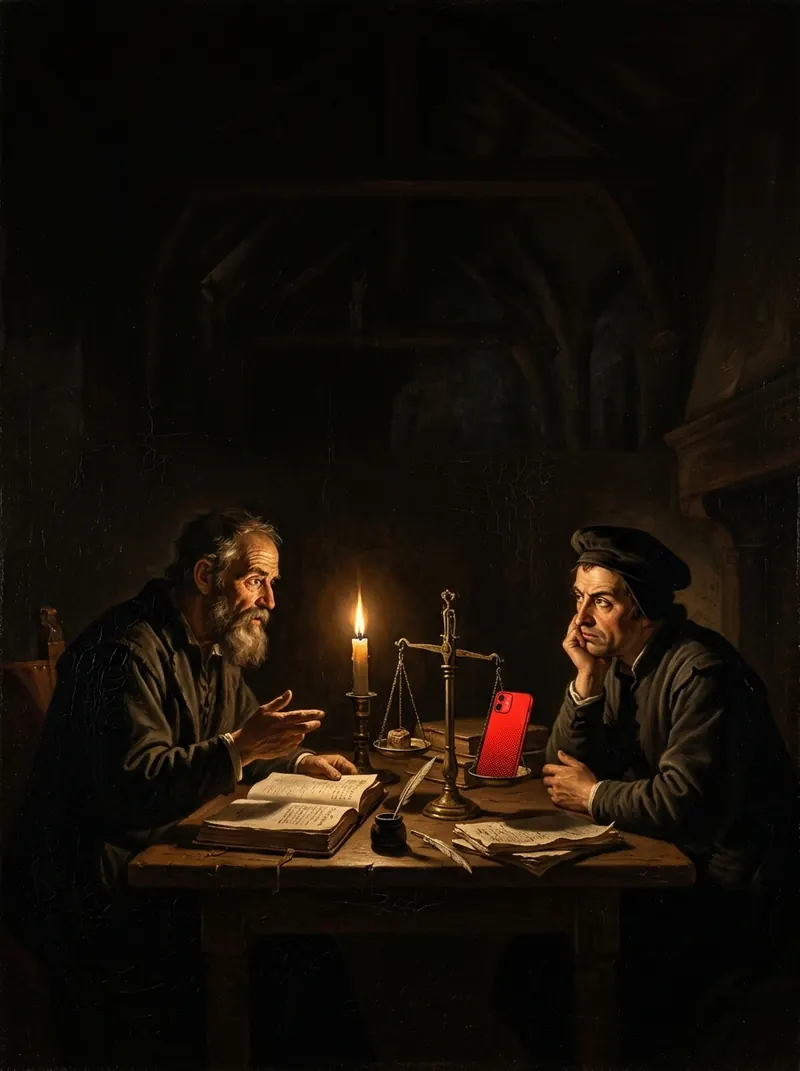
One kind gives certainty, two give something less.
The idea
"Every train on this line stops at the airport; this train is on this line; so it stops at the airport." That's deduction: a general rule applied to a case, the kind of argument the last lesson checked. If both reasons are true, the ending has to be true. "All my keys are on this ring; this key isn't on it; so it isn't mine" works the same way. Of the three kinds, deduction is the only one where true reasons make the ending certain. But it never checks its own starting points. If the rule is wrong, the neat ending can be wrong too.
"This café has always delivered within the hour, so it will tonight." That's induction: going from what you've seen to what you haven't. It makes the ending likely, never certain. A café that's always been on time can still have a bad night. More cases, and fairer ones, make it stronger; a handful makes it weak. A philosopher long ago named the catch: it assumes the future will be like the past. Learning from experience always leaves room for a surprise.
Abduction picks the explanation that fits the facts best. That's how the word is most often used today; its coiner used it a little differently, as Go deeper explains. A planet's orbit once strayed from the path that had been predicted. Two astronomers explained it with an unseen planet, and not long after, one was found. Closer to home: two friends of yours had a big fight, and then someone sees them jogging together. You guess they've made up. If you then hear they're old business partners with money to sort out, the guess may not fit any more. Your best explanation is only the top pick of the ones you thought of.
The three can work as a team. You guess (abduction), work out what should follow (deduction), then test it (induction). If the test fails, you go back and guess again. The thinker who coined the word "abduction" saw these as three phases of scientific method. He turns up in the story below.
Want the research, names and dates? They are in Go deeper, at the end.
Three jobs, three kinds of answer.
Picture it
Think of a mathematician, a weather forecaster and a detective. The mathematician works out what must follow from what's given. The forecaster goes from past patterns to tomorrow's likely weather. The detective picks the story that explains the clues. Trouble starts when one kind of answer passes for another, like a detective's hunch read out as a proof. Each is useful, but each gives a different kind of answer.
For a child: There are muddy paw prints across the kitchen floor, and the back door is open. "The dog got out!" you say. "Or the cat came in," says your brother. Your guess fitted. It just wasn't the only story.
What to ask before trusting where you landed.
How it applies
A conclusion can be no surer than the kind of reasoning behind it. Which kind of reasoning got there matters. A rule applied to a case, a pattern from past cases and an explanation for a fact promise different things. What each kind can give matters too. That is a certain ending (if the reasons are true), a likely one, or a fair guess. Say a friend expects a film to be good because the director's last three were. That's a pattern from past cases: likely, not certain. A guess raises two more questions. What else could explain the same facts? And what would you expect to see if the guess were wrong? That's where a test comes from.
In a meeting, in the kitchen, on the sofa.
Where you’ll see it
- In a meeting: "Customers loved our last two offers, so they'll love this one." That's a pattern, stretched to a new case.
- In the kitchen: the lights flicker whenever the kettle's on, so the kettle gets the blame. It fits, until they flicker with the kettle off.
- On the sofa: a TV detective reads a stranger's whole life from their shoes. On screen the guess is always right. Off screen, other stories fit too.
Signs it’s happening
- A good guess gets talked about as if it were proved.
- A rule drawn from a handful of cases gets applied to everything.
- Nobody has asked what else could explain the same facts.
Same dead car, two different next steps.
Before and after
The car won't start on a cold morning.
"The engine's finished." A big repair bill starts to look certain.
"If it's the battery, a jump start should get it going." If that fails, it's back to guessing. A guess you can test tells you more than one you simply believe.
A handful of beans and a canopy.
A story from history: Peirce's beans and the governor
- In 1878 the American philosopher Charles Sanders Peirce published an article called "Deduction, Induction, and Hypothesis".
- In it he pictured a room with bags of beans, and a handful of white beans on a table.
- In his story, he finds a bag that holds only white beans. He guesses that the handful came from that bag.
- He gave everyday cases too. Landing at a seaport in a Turkish province, he met a man on horseback. Four horsemen held a canopy over the rider's head, and Peirce inferred he was the governor.
- In that article he called this kind of guess "hypothesis". He warned that, as a rule, it is a weak kind of argument.
A fair guess is where checking starts, not where it ends. The beans and the governor were sensible guesses, and neither was a proof.
Quick check3 questions · nothing is saved
1. Which kind of reasoning makes its ending certain, if its reasons are true?
2. "Every summer here has been hot, so next summer will be too." Which kind is that?
3. In Peirce's bean story, what did he do with the handful of white beans?
One question worth keeping.
In one line
Deduction can make an ending certain, induction likely, and abduction a fair guess. Knowing which one you're using tells you how sure to be.
Which conclusion have you treated as certain lately that was really a good guess?
Go deeperThe research, names and dates
Where this comes from
Philosophers usually name three main kinds of inference (reasoning): deduction, induction and abduction. Only in deduction do true premises (starting reasons) guarantee a true conclusion. The ancient philosopher Aristotle's definition, in Robin Smith's translation, has a conclusion that "results of necessity" from what was supposed. The stock case: Socrates is a man; all men are mortal; so Socrates is mortal. For the American philosopher Charles Sanders Peirce, deduction was "merely the application of general rules to particular cases".
Aristotle saw induction as moving from the particular to the universal. Like abduction, it reaches past what its premises contain; philosophers call that ampliative. The philosopher David Hume posed the classic problem with induction in 1739, and a shorter version in 1748. Every inference from experience, he wrote, assumes "that the future will resemble the past". He never denied that people reason this way; his question was what justifies it.
The Stanford Encyclopedia of Philosophy gives an everyday case. Two friends you know had a terrible quarrel; then someone says they saw them jogging together. You conclude they've made up. That doesn't follow logically; you reach it because it would best explain what you heard. A case from astronomy: John Couch Adams and Urbain Leverrier studied Uranus's orbit, which departed from predictions. They explained the gap by proposing an undiscovered planet. Neptune was found not much later.
For Peirce, abduction was the step of forming a hypothesis worth testing. In its most common modern sense, inference to the best explanation, it is about judging which hypothesis to accept. Peirce's writings on abduction never refer to a best explanation. So the word has two related uses: Peirce's, for coming up with a guess, and today's, for choosing the best of the guesses you have.
Deduction vs induction
| Compared | Deduction | Induction |
|---|---|---|
| What it does | Applies a general rule to one case | Goes from cases seen to unseen ones |
| What it can give | An ending that must hold, if the premises are true | An ending that's likely, not certain |
| How it is judged | Valid or invalid, then sound or unsound | Strong or weak, then cogent or not |
Adapted from a table in our article on how arguments work. The third kind, abduction, offers a guess or chooses the explanation that fits. It is judged on how well it explains, compared with its rivals.
More examples
Some everyday conclusions, and the kind of reasoning behind each.
- If you hear “All the ferries stop in winter, and it’s winter, so there’s no ferry”, that’s deduction: only as good as its rule.
- If you hear “This shop has run out of bread every Sunday, so it will again”, that’s induction: likely, but open to a surprise.
- If you hear “The lights are off and the car has gone, so they’ve gone out”, that’s abduction: a fair guess among others.
What if…?
- What does a guess worth testing look like?
- Peirce gave a short pattern for it: "The surprising fact, C, is observed. But if A were true, C would be a matter of course. Hence, there is reason to suspect that A is true." Here C could be the puddle by the window, and A "rain came in".
- What if an explanation comes to mind easily?
- In experiments, people who could explain a possible event tended to overestimate how likely it was. One study found that in some situations people greatly overrated how probable simpler explanations were. The Stanford Encyclopedia points out that these studies were not about abduction directly.
- What if the three kinds blur together?
- They can. One encyclopedia article describes the many ways of telling deductive from inductive arguments as "a state of largely unacknowledged chaos". Its suggestion is to ask of an argument: does it prove its conclusion, only make it probable, or neither?
Words you may meet
- deduction
- Reasoning in which true premises guarantee a true conclusion. Glossary →
- induction
- Reasoning from what has been observed to what has not, which makes a conclusion likely but not certain. Glossary →
- abduction
- Reasoning to the explanation that would best account for the facts (its most common modern sense, also called inference to the best explanation). Peirce, who coined the term, used it for forming a hypothesis worth testing. Glossary →