Start here"All toasters are made of gold; everything made of gold is a time-travel device; so all toasters are time-travel devices" is a valid argument. An invalid argument can still end in a true conclusion. So what does a good argument need?
An argument, in the logic sense, is not a fight. It is a claim plus the reasons offered for it. This page shows how to find the two in everyday talk and how to tell whether the reasons work. It also covers the three ways of reasoning that logicians name: deduction, induction and abduction.
1. What an argument is
In logic, an argument is a set of reasons offered for a conclusion, not a quarrel. The word “argument” can mean a dispute or a fight, or it can be used in a more technical sense. In philosophy, an argument is a set of statements, called premises, offered as grounds for another statement, the conclusion.
So every argument has two parts: a claim you are asked to accept, and the reasons offered for it. Each part is something that can be true or false. On this page, “claim” and “conclusion” mean the same thing, and “reason” means the same as premise.
For example, “The last bus leaves at eleven, and it’s already quarter past, so we’ll need a taxi.” The claim is “we’ll need a taxi”. The reasons are the bus time and the clock.
Explanations look similar but are not usually counted as arguments. If someone asks why a metal expanded and you answer that it was heated, and all metals expand when heated, your reasons help them understand why it expanded rather than give them grounds to believe that it did.
Finding the claim and its reasons
Signal words help, but they are clues, not proof. Typical premise indicators include “because”, “since”, “for” and “as”; typical conclusion indicators include “therefore”, “thus”, “hence” and “so”. The same encyclopedia warns that these words do not always work this way.
In practice, ask two questions. What am I being asked to believe? What is offered as the reason? The answer to the first is the conclusion, even when it comes first in the sentence. For example, in “We should move the meeting online, since the trains are on strike”, the claim comes first and “since” marks the reason.
The reason nobody says out loud
An argument can leave a reason unspoken. Logicians call an argument with at least one part left unstated an enthymeme.
For example, “She’s a nurse, so she’ll know what to do” rests on an unspoken reason: that nurses know what to do in this situation. Our reading: saying the hidden reason out loud often shows where the real disagreement is. Filling in that gap fairly is what the principle of charity and steelmanning are about.
2. Valid and sound: two different questions
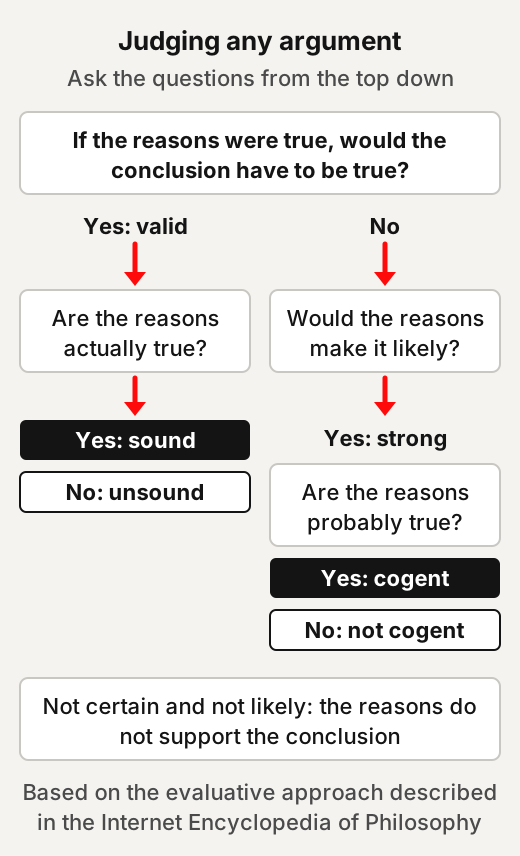
Valid asks whether the reasons would force the conclusion; sound asks whether they are also true. A deductive argument is valid if its form makes it impossible for the premises to be true and the conclusion false. It is sound if it is valid and all its premises are actually true.
So validity is about the shape of the reasoning; soundness adds the facts. A valid argument can still end in a false conclusion when one of its premises is false.
The encyclopedia’s example: all toasters are made of gold, everything made of gold is a time-travel device, so all toasters are time-travel devices. It is valid, because if the premises were true the conclusion would have to be, but it is not sound.
It works the other way too. Arguments that are invalid, or valid but unsound, can still have true conclusions. A weak argument does not make its conclusion false. It only means this argument does not show it. Our cheat sheet calls this the fallacy fallacy.
A quick test for a valid shape
Keep the shape, swap the words: true reasons with a false conclusion mean the shape is invalid. On the view most logicians hold, validity is decided by the argument’s form: words such as “all”, “and”, “not” and “some” that remain when the topic words are taken out. Aristotle showed forms were invalid by building counterexamples; in modern logic, a single instance of a form with true premises and a false conclusion is all it takes.
One of the encyclopedia’s examples: all basketballs are round; the Earth is round; therefore the Earth is a basketball. Its shape is “All A are F; X is F; so X is an A”. For example, the same shape turns up in “Good leaders are confident; he’s confident; so he’s a good leader”. The basketball version shows that the shape alone does not get you there.
Why a believable ending feels like a good argument
People tend to accept arguments whose conclusions they already believe, valid or not. Researchers call this belief bias. In one classic example, “All flowers have petals. All roses have petals. Therefore, all roses are flowers” is invalid, yet many people judge it valid because the conclusion fits what they know. Syllogisms with believable conclusions are accepted more often than syllogisms of exactly the same form with unbelievable ones. Researchers have proposed several competing theories of why this happens.
How sure: Strong found across three decades of syllogism studies; why it happens is still argued.
For example, before you agree with an argument, run the same steps toward a conclusion you dislike, and see whether they still feel convincing.
3. Three ways to reason
Deduction aims at a conclusion that must follow, induction at one that is likely, abduction at the best explanation. Philosophers normally count three major types of inference: deduction, induction and abduction. In deduction, true premises guarantee a true conclusion; in induction and abduction they do not. In those two, the conclusion goes beyond what is contained in the premises, which philosophers call ampliative.
| Deduction | Induction | Abduction | |
|---|---|---|---|
| What it does | Applies a rule to a case | Generalises from cases seen | Forms a hypothesis, or picks the best explanation |
| What it can give | A conclusion that must follow, if the premises are true | A likely conclusion | A best guess, open to a better one |
| How it is judged | Valid or invalid; sound or unsound | Strong or weak; cogent or not | How well it explains, against the rivals |
Deduction: the reasons force the conclusion
Deduction can give certainty, but only about what follows from your premises. Aristotle defined a deduction as speech in which, “certain things having been supposed, something different from those supposed results of necessity because of their being so”. His Greek word was sullogismos; in modern English, “syllogism” means an argument of one very specific form.
The textbook example: Socrates is a man; all men are mortal; therefore, Socrates is mortal. A three-line argument of this shape is a classic syllogism. Charles Sanders Peirce called deduction “merely the application of general rules to particular cases”.
For example, every ticket in this sale is non-refundable, and this ticket is from the sale, so it can’t be refunded. If both reasons are true, the conclusion is too. Deduction never checks its own starting points, so the real work is checking the premises.
Induction: from what you’ve seen to what you haven’t
Induction makes a conclusion likely, never certain. Inferences from the observed to the unobserved, or to general laws, are known as inductive inferences. Aristotle described induction as argument from the particular to the universal.
An encyclopedia example: most Greeks eat olives, Socrates is a Greek, so Socrates eats olives, which is likely but not guaranteed. Inductive arguments are judged strong or weak rather than valid or invalid, and a strong one with true premises may be called cogent.
David Hume set out the classic problem with induction in 1739, and gave a shorter version in 1748. He wrote that all inferences from experience suppose, “as their foundation, that the future will resemble the past”. Hume did not deny that we reason this way; he asked what justifies it. So induction is how we learn from experience, and it always leaves room for a surprise.
For example, the last ten buses on this route ran late at rush hour, so tomorrow’s probably will too. Our reading: more cases, and fairer ones, make that stronger. Too few cases is the hasty generalisation in our fallacies cheat sheet.
Abduction: the best explanation you can find
In its common modern sense, abduction picks the explanation that best fits the facts, and stays open to a better one. In that sense it is also called inference to the best explanation. An encyclopedia example: you know two friends had a terrible row, then hear they were seen jogging together, and you conclude they have made up. The conclusion does not follow logically; what leads you to it is that it would best explain what you heard.
The term “abduction” was coined by the American philosopher Charles Sanders Peirce. Around 1865 he began to hold that probable reasoning came in two distinct kinds: induction, and a second kind he called by several names, hypothesis, retroduction and abduction. He gave it a short pattern: “The surprising fact, C, is observed. But if A were true, C would be a matter of course. Hence, there is reason to suspect that A is true”. For Peirce, abduction was the step of forming a hypothesis worth testing. In its most common modern sense, inference to the best explanation, it is about judging which hypothesis to accept. Peirce’s writings on abduction never refer to a best explanation. So the word has two related uses: Peirce’s, for coming up with a guess, and today’s, for choosing the best of the guesses you have. The phrase “inference to the best explanation” is the title of a 1965 paper by the philosopher Gilbert Harman.
What it gives is a best guess that new facts can undo. If you learn that the two joggers are former business partners with money matters to discuss, “they made up” may no longer be the best explanation. The best explanation you thought of is only the best of those you considered, which may be what the philosopher Bas van Fraassen called “the best of a bad lot”.
Experimental studies have shown that when people can think of an explanation for a possible event, they tend to overestimate how likely it is. One study found that, in some situations, people tend to greatly overrate the probability of simpler explanations. The encyclopedia adds that these studies were not directly about abduction, but suggest that leaning on explanations may not always help.
How sure: Unsettled most philosophers agree abduction is common; its exact form and how far to trust it are still argued.
For example, the kitchen floor is wet and the dog’s bowl is tipped over, so the dog probably knocked it. Before settling, ask what else would explain it, and what you would expect to see if you were wrong. Simplicity is one of the qualities often used to judge the best explanation, alongside generality and fit with well-established theories. For where the “simplest is best” rule comes from, see Occam’s razor.
Peirce’s bag of beans: the three side by side
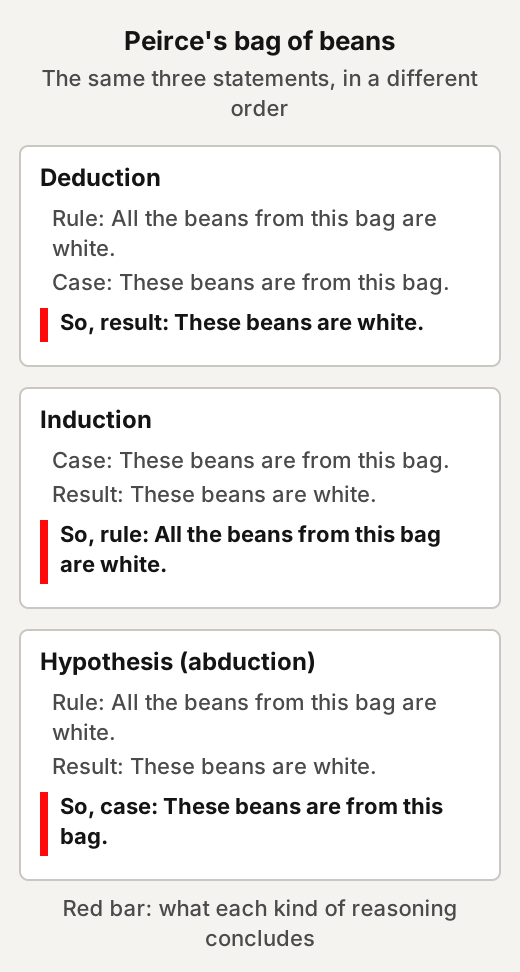
Peirce showed all three as the same three statements, put in a different order. In an 1878 article, “Deduction, Induction, and Hypothesis”, Peirce illustrated the three with bags of beans. The three statements are a rule (all the beans from this bag are white), a case (these beans are from this bag) and a result (these beans are white).
- Deduction: from the rule and the case, conclude the result.
- Induction: from the case and the result, conclude the rule. Peirce called induction “the inference of the rule from the case and result”.
- Hypothesis, his name for abduction in this article: from the rule and the result, conclude the case. He finds a handful of white beans on a table and a bag holding only white beans, and guesses that the handful came from that bag.
He gave everyday cases too. Landing at a seaport in a Turkish province, he met a man on horseback under a canopy held by four horsemen, and inferred he was the governor. He added that “as a general rule, hypothesis is a weak kind of argument”.
4. How the three work together
In Peirce’s account, you guess by abduction, work out what should follow by deduction, and test by induction. In his later work, Peirce treated abduction, deduction and induction as three phases of scientific method: making a conjecture, inferring what should follow, and testing. If the predicted results do not appear, the method loops back to abduction for a new hypothesis.
For example, your phone won’t charge. You guess the cable is faulty. If so, a different cable should work. You try another cable a few times. If the phone still won’t charge, you go back and guess again.
The line between the types is less tidy than it first looks. One encyclopedia article finds the many proposals for separating deductive from inductive arguments in “a state of largely unacknowledged chaos”. It suggests asking of any argument whether it proves its conclusion, only makes it probable, or does neither.
5. Easy mix-ups
Each of these is easy to slip into; each has a one-line fix.
- Mixing up “valid” and “true”. In logic, valid only means the conclusion would follow if the reasons were true.
- Thinking a flawed argument means a false conclusion. One cannot reject a conclusion simply because an argument for it is flawed.
- Taking “general to particular” as the test for deduction, and “particular to general” for induction. One encyclopedia article calls this rule “much too crude”. An argument made only of general statements, such as “All As are Bs; all Bs are Cs; so all As are Cs”, would count as neither.
- Trusting an argument because its conclusion is believable. That is belief bias, above.
- Taking the best explanation you can think of as true. It is only the best of the ones you considered.
- Treating an explanation as an argument. An explanation helps you understand why something is so; an argument offers reasons to believe that it is so.
Quick answers
What is the difference between deduction, induction and abduction?
In deduction, true premises guarantee a true conclusion. Induction reasons from what has been observed to what has not, so its conclusion is likely, not certain. Abduction picks the explanation that would best account for the facts.
What is the difference between a valid and a sound argument?
A valid argument has a form that makes it impossible for the premises to be true and the conclusion false. A sound argument is valid and its premises are all actually true.
Can a bad argument have a true conclusion?
Yes. Arguments that are invalid, or valid but unsound, can still have true conclusions, so finding a flaw in one argument does not show its conclusion is false.
Who coined the word "abduction"?
The American philosopher Charles Sanders Peirce coined the term. In an 1878 article he called this kind of reasoning hypothesis. He used the word for forming a hypothesis worth testing; today it most often means inference to the best explanation.
What is a premise?
A premise is one of the reasons offered in an argument. The statement the premises are offered for is the conclusion.
Use this
Our suggestion for the next argument you hear, built from the ideas above.
If these reasons were true, would the claim have to be true, be likely, or be one guess among others?
Quick quiz
Nothing is scored or saved. Recalling it once now is what makes it last.
1. An argument is valid, but one of its premises is false. What follows?
Answer: The conclusion may be false, and the argument is not sound.Read it again ↑
2. In Peirce's bag of beans, which kind of reasoning infers the rule from the case and the result?
Answer: Induction.Read it again ↑
3. What have reasoning studies found about arguments with believable conclusions?
Answer: People accept them more often, valid or not.Read it again ↑
How we checked this · Last checked November 2026
- Definitions come from the Internet Encyclopedia of Philosophy (Argument; Deductive and Inductive Arguments; Validity and Soundness) and the Stanford Encyclopedia of Philosophy (Aristotle's Logic; Abduction and its supplement on Peirce; Charles Sanders Peirce; The Problem of Induction), each read on the day.
- We read Peirce's 1878 article in the Wikisource transcription and Hume's Enquiry in the Project Gutenberg text.
- For belief bias we read the 2018 paper's full text and abstract; we did not open the older studies it builds on.
- Peirce's short pattern for abduction is quoted from the Stanford Encyclopedia, which gives it no date, so we give none.
- The experiments on explanations are as reported in the Stanford Encyclopedia; we did not open those studies.
- Everyday examples that start "For example" are ours and are not data.
Sources
- M. McKeon, “Argument”, Internet Encyclopedia of Philosophy.Scholarly
- T. Shanahan, “Deductive and Inductive Arguments”, Internet Encyclopedia of Philosophy.Scholarly
- “Validity and Soundness”, Internet Encyclopedia of Philosophy (author not named).Scholarly
- R. Smith, “Aristotle’s Logic”, Stanford Encyclopedia of Philosophy, revised 2022.Scholarly
- I. Douven, “Abduction” and its supplement “Peirce on Abduction”, Stanford Encyclopedia of Philosophy, revised 2025.Scholarly
- R. Burch, “Charles Sanders Peirce”, Stanford Encyclopedia of Philosophy, revised 2021.Scholarly
- L. Henderson, “The Problem of Induction”, Stanford Encyclopedia of Philosophy, revised 2022.Scholarly
- C. S. Peirce, “Deduction, Induction, and Hypothesis”, Popular Science Monthly 13, August 1878 (Wikisource transcription).Primary
- D. Hume, An Enquiry Concerning Human Understanding (1748), Section IV, Part II (Project Gutenberg).Primary
- G. Harman, “The Inference to the Best Explanation”, The Philosophical Review 74, 1965.Scholarly
- D. Trippas and colleagues, “Characterizing belief bias in syllogistic reasoning: A hierarchical Bayesian meta-analysis of ROC data”, Psychonomic Bulletin & Review 25(6), 2018.Scholarly