Start here"Be not afraid of greatness" sounds like encouragement. In Twelfth Night, it is a line from a forged letter, written to trick a pretentious steward into making a fool of himself. The difference is in who wrote it, and why.
Shakespeare wrote plays, so almost every famous line of his belongs to a character. Some of those characters are windbags, plotters or forgers, and some of the words have shifted in meaning since his day. Below are eleven famous lines, each read in its scene.
We read every line in the free Folger Shakespeare edition, which numbers each line, so you can check them yourself. Each verdict is on one claim about the line, never on whether the advice in it is good.
Some famous Shakespeare lines are covered on other pages. The Julius Caesar lines, from “Et tu, Brute?” to “There is a tide in the affairs of men”, are on our Julius Caesar quotes page. Falstaff’s line about discretion and the King John line behind “gild the lily” are in Quotes That Get Cut Short.
The verdicts
1. Lines that belong to a character
These lines are real, but the play gives them to someone whose purpose changes what they mean.
1. “Brevity is the soul of wit”
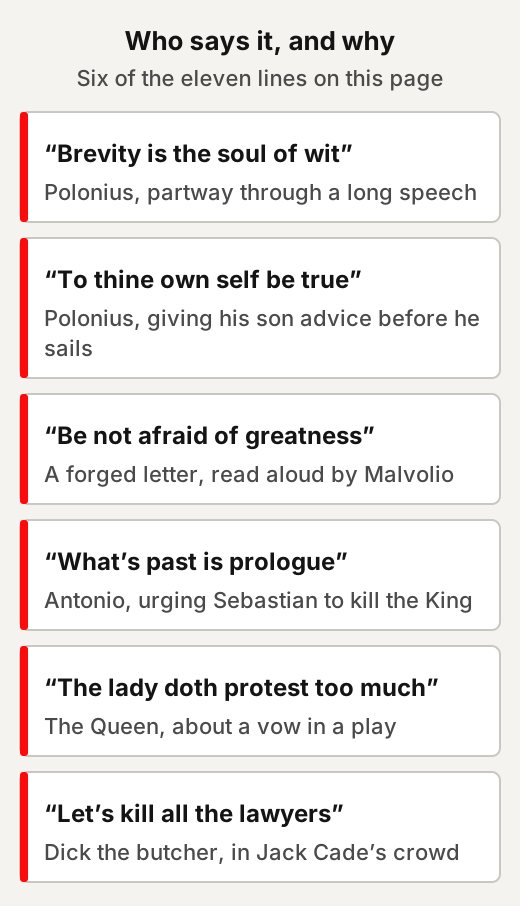
Partly The line is the play’s advice to keep things short. The words praise brevity, but Polonius says them partway through a long speech, and the Queen asks him to get to the point.
How sure: Strong the speech and the Queen’s reply sit a few lines apart in the same scene.
In Hamlet, Act 2, Scene 2, lines 97–99, Polonius tells the King and Queen: “brevity is the soul of wit, / And tediousness the limbs and outward flourishes, / I will be brief”. He then spends three more lines on what madness is, until the Queen says: “More matter with less art”. Polonius answers: “Madam, I swear I use no art at all”.
In Shakespeare’s English, “wit” could mean intelligence or good sense, not only humour. The Shakespeare’s Words glossary gives it as “intelligence, wisdom, good sense, mental ability”.
Our reading: the joke is on a man who announces he will be brief and is not. For example, if you open a meeting with “I’ll keep this short”, the promise only counts if the next part is short.
2. “To thine own self be true”
Partly It means “follow your own feelings, whatever anyone thinks”. The sentence goes on to say that being true to yourself means you cannot then be false to anyone else.
How sure: Strong the whole sentence is three lines long, and it gives its own reason.
In Hamlet, Act 1, Scene 3, Polonius gives his son Laertes “these few precepts” before Laertes sails. The list includes “Neither a borrower nor a lender be”. It ends at lines 84–86: “This above all: to thine own self be true, / And it must follow, as the night the day, / Thou canst not then be false to any man”.
In the next act, Polonius checks up on that same son. He sends a servant to Paris to ask about Laertes, telling him to put on his son “What forgeries you please”, though “none so rank / As may dishonor him”. He explains the method: “Your bait of falsehood take this carp of truth”.
Our reading: the full sentence ties being honest with yourself to being honest with others. In practice, if “being true to yourself” needs a lie to someone else, the full line argues against it.
3. “Be not afraid of greatness”
Doesn't hold up In the play, “Be not afraid of greatness” is sincere encouragement. It comes from a forged letter, written to trick a pretentious steward into making a fool of himself.
How sure: Strong the play shows the letter being planned, read aloud, and later owned up to.
The Folger Shakespeare Library describes Malvolio as the “pretentious steward” of the Countess Olivia. In Twelfth Night, Act 2, Scene 3, Maria plans to drop “some obscure epistles of love” where he will find them. She adds: “I can write very like my lady your niece”.
In Act 2, Scene 5, Malvolio reads the letter aloud: “be not afraid of greatness. / Some are born great, some achieve greatness, and / some have greatness thrust upon ‘em”. The same letter tells him to be “surly with servants”.
In the First Folio of 1623, the text the Folger edition is based on, the letter reads “become” where the Folger edition prints “born”, a change it credits to an earlier editor. When Malvolio and the Fool repeat the line later in the play, the word is “born”.
In the last scene, Fabian owns up: “Maria writ / The letter”. The Fool then quotes “some are born great” back at Malvolio, who leaves saying “I’ll be revenged on the whole pack of you”.
Our reading: the line is flattery, written to make a man embarrass himself. For example, when a message tells you exactly what you hoped to hear about yourself, it is worth asking who wrote it, and why.
4. “What’s past is prologue”
Partly “What’s past is prologue” means the past is only the warm-up for a better future. The words do say that the past sets up what comes next, but Antonio says them to talk Sebastian into killing his brother, the King.
How sure: Strong the line and the plan to kill come within a few dozen lines of the same scene.
In The Tempest, Act 2, Scene 1, Antonio tells Sebastian that they are destined “to perform an act / Whereof what’s past is prologue, what to come / In yours and my discharge”. Sebastian’s brother, the King of Naples, lies asleep nearby.
Antonio had already taken his own brother’s place; the Folger Shakespeare Library calls Prospero “a former duke of Milan who was displaced by his treacherous brother, Antonio”. Antonio offers to kill the King “with this obedient steel, three inches of it”. Sebastian agrees: “as thou got’st Milan, / I’ll come by Naples. Draw thy sword”.
A version of the line, “WHAT IS PAST IS PROLOGUE”, is inscribed on Robert Aitken’s statue Future outside the National Archives Building. The Archives’ own magazine, Prologue, took its title partly from that inscription.
Our reading: the same words can launch a fresh start or excuse a bad one. For example, “what’s past is prologue” suits a new job after a setback. It suits less well as “I already crossed one line, so the next is easier”.
5. “The first thing we do, let’s kill all the lawyers”
Fiction It is Shakespeare’s own view of lawyers. A character, Dick the butcher, says it in a crowd scene, and moments later Cade orders a clerk hanged for being able to write his name.
How sure: Strong the speaker and scene are in the text; the play does not say what Shakespeare thought of lawyers.
In Henry VI, Part 2, Jack Cade leads a rising against King Henry, in the Folger Shakespeare Library’s summary. In Act 4, Scene 2, Cade promises his followers “There shall be no / money”, and that they will “worship me their lord”. Dick the butcher replies: “The first thing we do, let’s kill all the lawyers”. Cade answers: “Nay, that I mean to do”.
Moments later they bring in a clerk who “can write and read”, and Cade orders: “Hang him with his pen / and inkhorn about his neck”. We leave the reading of the scene to you; the text shows who says the line and what the crowd does next.
Our reading: a line in a play is evidence of what the scene is about, not of the author’s views. In practice, if you quote a line from a play or a film to make a point, name the character too.
2. Lines where an old word changed the meaning
Here the line is quoted correctly, but one word meant something else in Shakespeare’s English.
6. “Wherefore art thou Romeo?”
Doesn't hold up Juliet is asking where Romeo is. “Wherefore” means “why”: she is asking why he has to be Romeo, a Montague.
How sure: Strong dictionaries agree on the word, and her next lines are all about his name.
In Romeo and Juliet, Act 2, Scene 2, Juliet speaks while Romeo listens unseen: “O Romeo, Romeo, wherefore art thou Romeo? / Deny thy father and refuse thy name”. She goes on: “‘Tis but thy name that is my enemy”, and then asks: “What’s in a name?”
The Shakespeare’s Words glossary gives “wherefore” as “why”. The American Heritage Dictionary gives “For what purpose or reason; why”.
Our reading: Juliet’s question is about labels, and why a family name should stand between two people. For example, before writing someone off for their team, school or town, her question still works: what is in the name?
7. “Methinks the lady doth protest too much”
Partly It means that someone who denies a thing too hard must be guilty of it. In the play, “protest” means to vow, and the lady is a character in a play promising never to remarry.
How sure: Strong the scene and two dictionaries agree on the older meaning of “protest”.
In Hamlet, Act 3, Scene 2, a Player Queen in a play staged at court vows: “If, once a widow, ever I be wife”. Hamlet asks his mother, “Madam, how like you this play?”, and she answers: “The lady doth protest too much, methinks”.
The Queen has remarried herself. In Act 1, the new King calls her “our sometime sister, now our queen”. The famous version also moves “methinks” from the end to the front.
The Shakespeare’s Words glossary gives “protest” as “make protestation, avow, affirm, proclaim”. The American Heritage Dictionary still lists “To promise or affirm earnestly, as after being doubted”.
Our reading: the Queen is reacting to an over-the-top promise, not a denial. In practice, a very big vow can be a sign that the speaker is less sure than they sound, and that is a different point from a loud denial.
8. “Hoist with his own petard”
Doesn't hold up A petard is something you get hung from. A petard was a small bomb, and “hoist” meant lifted, so the image is of a bomb-maker blown up by his own bomb.
How sure: Strong two dictionaries agree on both words, and the speech goes on to “blow them at the moon”.
In Hamlet, Act 3, Scene 4, Hamlet is about to be sent to England with “my two schoolfellows, / Whom I will trust as I will adders fanged”. He says: “For ‘tis the sport to have the enginer / Hoist with his own petard”. He adds that he will “delve one yard below their mines / And blow them at the moon”.
The American Heritage Dictionary defines a petard as “A small bell-shaped bomb used to breach a gate or wall”. It explains that “hoist” here is the past participle of “hoise”, an earlier form of the verb, so the phrase means “to be blown up with his own bomb”.
Our reading: the image is of a trap-maker caught in his own trap. For example, a rule written to trip up a rival that ends up blocking you is a petard.
9. “Lead on, Macduff”
Doesn't hold up Macbeth says “Lead on, Macduff”, inviting him to go first. He says “Lay on”, meaning strike, as he chooses to fight to the death rather than surrender.
How sure: Strong the play text reads “Lay on”, and a Shakespeare glossary gives the phrase as “inflict blows”.
In Macbeth, Act 5, Scene 8, Macbeth refuses to surrender to Macduff: “I will not yield / To kiss the ground before young Malcolm’s feet”. He goes on: “Before my body / I throw my warlike shield. Lay on, Macduff, / And damned be him that first cries ‘Hold! Enough!’” The stage directions have them exit fighting, and Macbeth is slain.
The Shakespeare’s Words glossary gives “lay on” as “inflict blows, beat soundly”.
Our reading: “Lead on” is a polite invitation, while “Lay on” is a challenge to fight. In practice, “lead on” is fine as everyday English for “after you”; it just is not Macbeth’s line.
3. Lines remembered a little differently
These two are quoted slightly wrong, and the real wording carries more of the scene.
10. “All that glitters is not gold”
Doesn't hold up Shakespeare coined the saying. His scroll says “glisters”, calls the saying something “Often have you heard”, and Chaucer wrote a version long before.
How sure: Strong the play itself marks the saying as old, and Chaucer’s poem has it in his own spelling.
In The Merchant of Venice, Portia tells the Prince of Morocco that one casket holds her picture: “If you choose that, then I am yours withal”. He opens the gold casket and finds “A carrion death within whose empty eye / There is a written scroll”. The scroll begins: “All that glisters is not gold— / Often have you heard that told”.
The Shakespeare’s Words glossary gives “glister” as “glitter, sparkle, gleam”. Chaucer’s poem The House of Fame has the line “Hit is not al gold, that glareth”, in W. W. Skeat’s edition. Skeat’s note calls it “A proverb which Chaucer took from Alanus de Insulis”. Skeat dates the poem to about 1383 or 1384, while Phrase Finder gives 1380.
Our reading: the prince chose the casket that looked best and lost. In practice, the shiniest option, such as a slick offer or a good-looking app, is worth a second look at what is inside.
11. “Alas, poor Yorick! I knew him well”
Doesn't hold up Hamlet says “Alas, poor Yorick, I knew him well”. He says “I knew him, Horatio”, and goes on to remember a jester who carried him on his back.
How sure: Strong the scene’s text gives the line in full, and “well” is not in it.
In Hamlet, Act 5, Scene 1, a gravedigger tells Hamlet that a skull “was, sir, Yorick’s skull, the / King’s jester”. Hamlet says: “Alas, poor / Yorick! I knew him, Horatio—a fellow of infinite / jest, of most excellent fancy”. He goes on: “He hath bore me on his / back a thousand times”.
Later in the speech he says that even a lady who paints her face “an inch / thick” must come to this.
Our reading: the misquote turns a fond memory of a jester into a line about knowing someone well. For example, before you put a famous line on a card or a slide, it is worth a quick look at the text.
4. How to read a Shakespeare quote yourself
Five quick checks, drawn from the eleven lines above.
-
Find the line in a numbered edition. The free Folger Shakespeare site gives act, scene and line numbers for every play.
-
Check who is speaking, and to whom. On this page alone, lines belong to a windbag, a plotter, a forged letter and a man in a crowd.
-
Read what happens next. The Queen’s “More matter with less art” and the clerk Cade sends to be hanged change how their lines land.
-
Look up the old words. “Wherefore”, “protest”, “lay on”, “petard” and “glister” all had senses that are easy to miss today.
-
Check which early printing a line comes from. Some lines appear only in a quarto, and the First Folio can read differently from a modern edition, like “become great” in the Twelfth Night letter.
For more checks on any famous quote, see our guide to spotting a fake quote.
Quick answers
What does "wherefore art thou Romeo" mean?
It means "why are you Romeo?", not "where are you?". Juliet is asking why he has to be Romeo, a Montague, and she goes on to say "'Tis but thy name that is my enemy".
Who says "brevity is the soul of wit"?
Polonius, in Hamlet, Act 2, Scene 2. He says it partway through a long speech to the King and Queen, and the Queen replies "More matter with less art".
What does "hoist with his own petard" mean?
A petard was a small bomb, and "hoist" meant lifted, so the phrase means to be blown up with your own bomb. Hamlet says it in Act 3, Scene 4.
Is it "lead on, Macduff" or "lay on, Macduff"?
Macbeth says "Lay on, Macduff". "Lay on" meant to strike, and he says it as he chooses to fight rather than surrender.
Did Shakespeare say "the first thing we do, let's kill all the lawyers"?
A character says it. In Henry VI, Part 2, Dick the butcher says it to the rebel Jack Cade, and the play does not say what Shakespeare thought of lawyers.
Use this
Before you quote Shakespeare, check who says the line, to whom, and what happens next.
Who says this line in the play, and what do they want?
Quick quiz
Nothing is scored or saved. Recalling it once now is what makes it last.
1. What does "wherefore" mean in "wherefore art thou Romeo?"
Answer: Why.Read it again ↑
2. Who writes the letter that says "Be not afraid of greatness"?
Answer: Maria.Read it again ↑
3. What was a petard?
Answer: A small bomb.Read it again ↑
How we checked this · Last checked October 2026
- We read each line in its scene in the free Folger Shakespeare online edition, which numbers every line; act and scene numbers on this page are Folger's.
- Word meanings come from the Shakespeare's Words glossary by David and Ben Crystal and from the American Heritage Dictionary.
- The First Folio reading "become" in Twelfth Night comes from the Folger edition's textual notes; we did not compare other modern editions.
- We did not read critics on what Shakespeare meant by these scenes. Each verdict is on one claim about the line, never on whether its advice is good.
- The Julius Caesar lines, Falstaff's line on discretion and "gild the lily" are on our other pages and are not repeated here.
Sources
The plays
- William Shakespeare, Hamlet, Act 1 Scene 2, Act 1 Scene 3, Act 2 Scenes 1 and 2, Act 3 Scenes 2 and 4, Act 5 Scene 1 (Folger Shakespeare), with the edition’s “An Introduction to This Text”.Primary
- William Shakespeare, Twelfth Night, Act 2 Scenes 3 and 5, Act 5 Scene 1, and textual notes (Folger Shakespeare; textual notes).Primary
- William Shakespeare, The Tempest, Act 2 Scene 1 (Folger Shakespeare).Primary
- William Shakespeare, Henry VI, Part 2, Act 4 Scene 2 (Folger Shakespeare).Primary
- William Shakespeare, Romeo and Juliet, Act 2 Scene 2 (Folger Shakespeare).Primary
- William Shakespeare, Macbeth, Act 5 Scene 8 (Folger Shakespeare).Primary
- William Shakespeare, The Merchant of Venice, Act 2 Scene 7 (Folger Shakespeare).Primary
- Geoffrey Chaucer, The House of Fame, Book I, line 272, in W. W. Skeat (ed.), The Complete Works of Geoffrey Chaucer, vol. 3, second edition (Clarendon Press, 1900), with Skeat’s introduction and his note to line 272 (Project Gutenberg #45027).Primary
Dictionaries and reference
- David Crystal and Ben Crystal, Shakespeare’s Words glossary, entries “glister”, “lay on”, “protest”, “wherefore”, “wit” (shakespeareswords.com).Scholarly
- The American Heritage Dictionary of the English Language, fifth edition, entries “petard”, “protest” and “wherefore”.Scholarly
- Folger Shakespeare Library, “Publishing Shakespeare”.Scholarly
- Phrase Finder, “All that glitters is not gold”.Popular
- US National Archives, “A Prologue to Prologue”, Prologue magazine, Winter 2017.Scholarly
The scene often says more than the slogan
Almost every famous Shakespeare line belongs to a character, and some are windbags, plotters or forgers. Our view: the scene is often more useful than the slogan. A line with its speaker and story gives you more to work with.
Put the play's version to work
- In a talk, tell the story too. Our suggestion: with "Be not afraid of greatness", mention the forged letter. Then the line makes a point about flattery.
- Quote the sentence, not the slogan. Our suggestion: add the next two lines to "to thine own self be true". They give its reason.
- Use old words in their old sense. Our suggestion: if you borrow "wherefore" or "petard", use them in their old sense, or explain the change.
- Share the reference with the quote. Our suggestion: write the act, scene, line and edition beside any quote you share, so others can check it.
This week: one line, its whole scene
Our suggestion: choose one Shakespeare line you already use, in a card, a toast or a bio. Read its whole scene on the free Folger site this week. Then write one sentence on what that line does there.
Turn context into paid work
- Offer a line check for speeches, toasts and slides, giving each quote its speaker, scene and line number.
- Write caption notes for quote prints and cards, saying who speaks each line and what is happening.
- Make short posts on one famous line in its scene, quoting only a line or two. Name the speaker and the edition you read.
- Write quiz questions for puzzle pages on old words such as "wherefore", "petard" and "glister".
Ideas to explore, not financial or business advice. No result is promised.
Keep going
- Who really said it?Search the lines we have checked, each with what we found and its source.
- Julius Caesar quotesThe Julius Caesar lines, from "Et tu, Brute?" to "There is a tide in the affairs of men".
- Quotes that get cut shortIncludes Falstaff on discretion and the King John line behind "gild the lily".
- Quotes that change with the next sentenceFamous lines read together with the sentence that follows them.
- GlossaryPlain meanings for terms like First Folio and quarto.