
Start hereIn the Apollo Flight Journal's transcript, Jack Swigert says "Okay, Houston", Jim Lovell echoes "Houston", and Swigert finishes "we've had a problem here". AFI lists the film's version at number 50, "Houston, we have a problem". So which famous lines have drifted, and in what ways?
Some lines from films and TV are so familiar that we stop hearing them. Then you check the scene, and a word has shifted, a hedge has gone, or the line was never said in that form. Below are eleven lines, each set beside what the film or the record says.
Each verdict is on one claim about the words, never on whether the film is good or the line is useful. Three famous film lines, “Play it again, Sam”, “Luke, I am your father” and “Elementary, my dear Watson”, are already checked on Did They Really Say That? Part 2, so they are not repeated here.
The verdicts
1. One word changed
In these five lines, the film and the scene are right, and a word or two has shifted.
1. “Toto, I don’t think we’re in Kansas anymore”
Partly In The Wizard of Oz, the line is “Toto, I don’t think we’re in Kansas anymore”. The film’s line is “Toto, I’ve a feeling we’re not in Kansas anymore”.
How sure: Strong the American Film Institute prints the line this way in its list of 100 movie quotes.
The American Film Institute (AFI) lists it at number 4 of its 100 movie quotes: “Toto, I’ve a feeling we’re not in Kansas anymore”. AFI lists Noel Langley, Florence Ryerson and Edgar Allan Woolf as the 1939 film’s writers.
Our reading: “I’ve a feeling” makes it a guess, said to a small dog in a place that suddenly looks strange. The remembered version sounds more certain than the film does. For example, when you quote someone’s first impression, keep their “I think” or “I’ve a feeling”, because it tells the listener how sure they were.
2. “We’re gonna need a bigger boat”
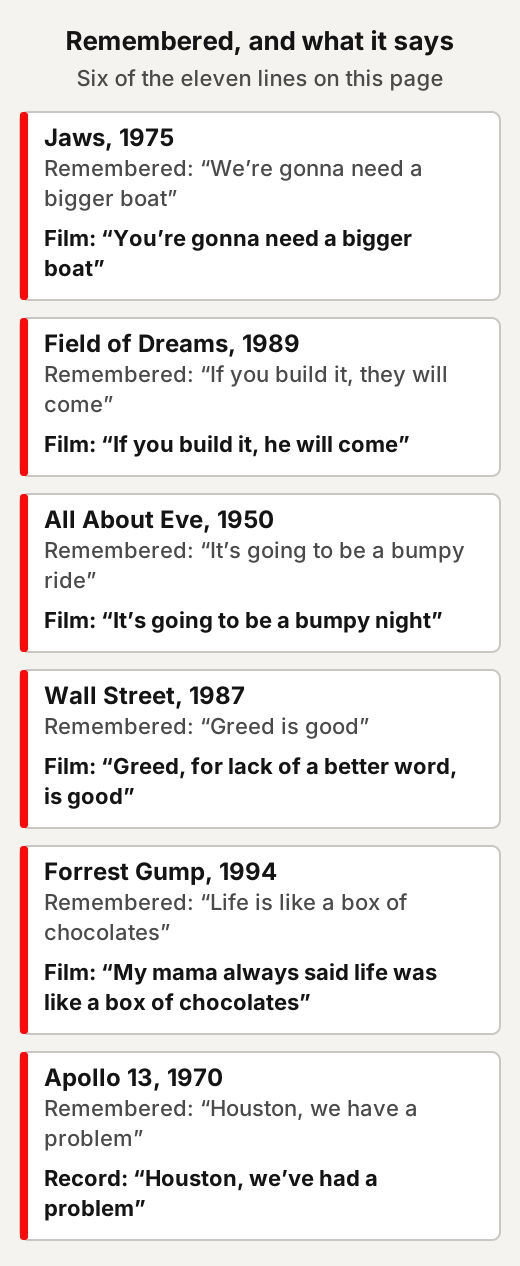
Partly In Jaws, the line is “We’re gonna need a bigger boat”. The film’s line is “You’re gonna need a bigger boat”, and it is said to the man who owns the boat.
How sure: Strong AFI prints the line, and its synopsis of the film says whom it is said to.
AFI lists the line from Jaws (1975) at number 35: “You’re gonna need a bigger boat”. In AFI’s synopsis, police chief Martin Brody charters the fisherman Quint’s boat, the Orca.
At sea, Brody is shovelling bait into the water when the shark breaks the surface. Brody “staggers into the cabin and tells Quint that he will need a bigger boat”.
Our reading: “You’re” is a warning to the man in charge that his plan is too small, and “we’re” turns it into a shared joke. For example, if a job at work looks bigger than the plan for it, the useful version is to say so plainly, and early, to whoever owns the plan.
3. “If you build it, they will come”
Partly In Field of Dreams, the voice says “If you build it, they will come”. The voice says “he will come”; the paying crowd is a separate idea later in the film.
How sure: Strong AFI prints the line, and its synopsis follows both threads to the end of the film.
AFI lists the line from Field of Dreams (1989) at number 39: “If you build it, he will come”. In AFI’s synopsis, Ray Kinsella hears a voice in his Iowa cornfield “whisper repeatedly” the line.
Later, his daughter Karin “announces that her father will not have to sell the farm because people will pay to watch the game”. Her uncle Mark “cannot see the players” at all. At the end, “One last player remains, and Ray realizes it is his father”.
Our reading: the voice promises one person, and the film is about a son and his father. The slogan “build it and they will come” borrows the words but not the story. For example, a new shop or website still needs people who know it exists; in the film, even the crowd idea comes with players one character cannot see.
4. “Fasten your seatbelts, it’s going to be a bumpy ride”
Partly In All About Eve, the line ends “a bumpy ride”. The film’s line ends “a bumpy night”.
How sure: Strong AFI prints the line with “night”.
AFI lists the line from All About Eve (1950) at number 9: “Fasten your seatbelts. It’s going to be a bumpy night”. AFI credits the writing and the direction to Joseph L. Mankiewicz.
Our reading: “ride” fits the seatbelt picture, which may be why it slips in, but the film’s word is “night”: the warning is about an evening, not a journey. For example, when your version of a line seems to make more sense than the original, treat that as a reason to check it.
5. “What we have here is a failure to communicate”
Partly In Cool Hand Luke, the line is “What we have here is a failure to communicate”. AFI prints the line as “What we’ve got here is failure to communicate”, with “got” and without the “a”.
How sure: Strong AFI prints the line in this form.
AFI lists the line from Cool Hand Luke (1967) at number 11: “What we’ve got here is failure to communicate”. In AFI’s synopsis, Luke is sentenced to 2 years of labor on a chain gang after a drunken spree in a small Southern town.
Our reading: the remembered version is tidier grammar than AFI’s printing. For example, if your copy of a line reads more smoothly than the original, the smoothing is probably yours, so check the source before you print it.
2. A hedge, a question or a speaker dropped
In these four lines the famous words are there, but something that changed their meaning has fallen away.
6. “Greed is good”
Partly Wall Street has the line “Greed is good”. The film’s line is “Greed, for lack of a better word, is good”, and the film ends with the young stockbroker Bud Fox at a courthouse, facing conviction.
How sure: Strong AFI prints the line, and its synopsis describes the speech and the ending.
AFI lists the line from Wall Street (1987) at number 57: “Greed, for lack of a better word, is good”. In AFI’s synopsis, the investor Gordon Gekko gives “a speech in praise of greed” at a stockholder meeting for a paper company.
The young stockbroker Bud Fox is later arrested for insider trading. He then records a conversation with Gekko “to be used in a larger investigation of Gekko”. The synopsis ends with Bud’s parents driving him “to the courthouse, where he faces conviction for his crimes”.
Our reading: “for lack of a better word” is the speaker reaching for a word to sell an idea. Quoting the three-word version keeps the persuasion and drops the story the film tells around it. For example, before you repeat a character’s speech as advice, check what the film shows happening to the people who follow it.
7. “Do you feel lucky, punk?”
Partly Dirty Harry has the line “Do you feel lucky, punk?” In the film, Harry tells the other man to ask himself the question, after admitting he has lost count of his shots.
How sure: Strong AFI prints the full line, and its synopsis describes the scene.
AFI lists the line from Dirty Harry (1971) at number 51: “You’ve got to ask yourself one question”. The question is “Do I feel lucky?”, and “Well, do ya, punk?” closes the line.
Our reading: the line is built on Harry admitting what he does not know, and it hands the gamble to the other man. The short version keeps the taunt and loses the doubt. For example, when you retell what someone said under pressure, keep the part where they admit what they were unsure of.
8. “We don’t need no stinking badges”
Partly The Treasure of the Sierra Madre has the line “We don’t need no stinking badges”. AFI prints the line as four short sentences, and it opens by echoing someone else’s word: “Badges?”
How sure: Strong AFI prints the full line.
AFI lists the line from The Treasure of the Sierra Madre (1948) at number 36. In AFI’s printing, “Badges? We ain’t got no badges!” opens the line. In AFI’s printing, “I don’t have to show you any stinking badges!” closes it.
AFI credits John Huston as writer and director.
Our reading: the remembered version squeezes several sentences into one slogan, and the “Badges?” at the start shows it is a reply to someone else. For example, when a line opens by repeating a word, look for the question it answers before you quote it.
9. “Life is like a box of chocolates”
Partly In Forrest Gump, the line is “Life is like a box of chocolates”. The film’s line credits the saying to the speaker’s mother, in the past tense: “My mama always said life was like a box of chocolates”.
How sure: Strong AFI prints the full line.
AFI lists the line from Forrest Gump (1994) at number 40: “My mama always said life was like a box of chocolates”. It goes on: “You never know what you’re gonna get”. AFI credits the writing to Eric Roth.
Our reading: the line is a saying passed down from a parent, not a new piece of wisdom. For example, when you quote a line someone was passing on, credit the person they got it from, as the film does.
3. Never said in that form
These two lines were not said in the words people remember.
10. “Houston, we have a problem”
Film line The Apollo 13 crew radioed “Houston, we have a problem”. The crew said “we’ve had a problem”; the present-tense line comes from the 1995 film Apollo 13.
How sure: Strong the flight transcript and NASA’s history article both give the crew’s words in the past tense, and the film’s line is on AFI’s list.
Apollo 13 launched on 11 April 1970. On the third day in space, the crew heard “a dull bang”, and a master alarm and an undervolt warning light came on.
In the Apollo Flight Journal’s transcript, Jack Swigert says “Okay, Houston”, Jim Lovell echoes “Houston”, and Swigert finishes “we’ve had a problem here”. When Mission Control asks them to say it again, Lovell replies: “Ah, Houston, we’ve had a problem. We’ve had a Main B Bus Undervolt”.
NASA’s history article prints the exchange slightly differently, with Swigert’s call in one piece, “Okay, Houston, we’ve had a problem here.”, and “here” in Lovell’s reply as well. Both versions are in the past tense.
AFI lists the film’s version at number 50: “Houston, we have a problem”. The journal’s editors report that the film’s writers admitted they “had to use the line expected by the viewers, instead of the historically accurate one, for the sake of drama”.
Our reading: quoting the film’s words as the crew’s is a kind of misattribution. The real call was in the past tense and specific: something had already happened, and Lovell named the warning light. For example, when you report a problem at work, say what has happened and the exact symptom you can see, as the crew did.
11. “Beam me up, Scotty”
Doesn't hold up Captain Kirk says “Beam me up, Scotty” in the original Star Trek series. The exact phrase was never said on the show, though Kirk came close.
How sure: Moderate a word historian and a Mental Floss article report only near misses on the show; we did not watch every episode ourselves.
The word historian David Wilton writes that the phrase “was never actually uttered on the series, although in a few instances it came close to being said”. He gives two near misses: Kirk says “Beam us up” in “The Gamesters of Triskelion” and “Scotty, beam us up fast” in “The Savage Curtain”.
He records the phrase in print by 1976, in a Houston Chronicle article of 19 June about a nostalgia convention. He quotes a 1978 campus slang entry, “all right, Spock, beam us up!”, and suggests that early uses may have varied before settling on one form.
A Mental Floss article of 8 September 2026 also says the line “has never been spoken in any episode”. It notes that the 1986 film Star Trek IV: The Voyage Home comes closer, with Kirk saying “Scotty, beam me up”.
Our reading: the catchphrase seems to have settled out of several near misses, and it now works as a joke in its own right. For example, it is fine to use it for fun; just leave off the quotation marks that would make it Kirk’s words.
4. How to check a film line yourself
Four quick checks, drawn from the eleven lines above.
Our reading: across these eleven lines, the remembered versions do the same few things. They tidy the grammar, drop hedges and attributions, and swap an odd word for one that fits the picture better. That is a pattern in these examples, not a finding about how memory works.
-
Find a primary source. For a film, that is the film itself or its script; for a real event, it is the record. AFI’s list and the Apollo Flight Journal’s transcript are good places to start, and our guide to spotting a fake quote shows where to look for older texts.
-
Compare word by word. Small words drift: “you’re” became “we’re”, “he” became “they”, and “night” became “ride”.
-
Keep the hedge and the speaker. “For lack of a better word”, “I’ve a feeling” and “My mama always said” tell you how the line was meant.
-
Keep the film apart from the history. The Apollo 13 line people quote is the film’s; the crew spoke in the past tense.
The same habits work for quotations outside film. Quotes That Get Cut Short applies them to famous sayings from books, plays and poems. See also our page on quotes that change when you read the next sentence.
Quick answers
Did the Apollo 13 astronauts say "Houston, we have a problem"?
Not in those words. In the Apollo Flight Journal's corrected transcript, Jack Swigert finishes "we've had a problem here", and Jim Lovell then says "Ah, Houston, we've had a problem." NASA's history article prints Lovell's reply with "here" as well. Both are in the past tense; the present-tense line comes from the 1995 film Apollo 13.
Is it "If you build it, he will come" or "they will come"?
It is "he". AFI lists the Field of Dreams line as "If you build it, he will come", and in AFI's synopsis Ray realises at the end that the last player is his father.
Did Captain Kirk ever say "Beam me up, Scotty"?
Not in those words on the original series, according to the word historian David Wilton. He lists near misses such as "Beam us up" and "Scotty, beam us up fast".
What is the real "Greed is good" line?
In Wall Street (1987), the line is "Greed, for lack of a better word, is good." In AFI's synopsis, Gordon Gekko gives "a speech in praise of greed" at a stockholder meeting.
Is it "bumpy ride" or "bumpy night"?
It is "night". AFI lists the line from All About Eve (1950) as "Fasten your seatbelts. It's going to be a bumpy night."
Use this
Check a film line against the film, the script or the record before you put it in quotation marks.
Is this the line as it was said, or the line as I remember it?
Quick quiz
Nothing is scored or saved. Recalling it once now is what makes it last.
1. In Jaws, who is told that he will need a bigger boat?
Answer: Quint, the boat's owner.Read it again ↑
2. What did the Apollo 13 crew radio?
Answer: Houston, we've had a problem.Read it again ↑
3. In Field of Dreams, what does the voice say?
Answer: If you build it, he will come.Read it again ↑
How we checked this · Last checked October 2026
- Each film line is quoted as the American Film Institute prints it in its list of 100 movie quotes, and scenes are described from the AFI Catalog synopses on the same page. We did not rewatch the films.
- Speakers are named only where AFI's synopsis names them, so the page does not say who speaks the Wizard of Oz, All About Eve, Cool Hand Luke or Sierra Madre lines.
- The Apollo 13 words come from the Apollo Flight Journal's corrected transcript. NASA's history article prints them slightly differently (Swigert's call in one piece, and 'here' in Lovell's reply); the page gives both.
- The Star Trek verdict rests on a word historian's check of the show and a Mental Floss article. We did not watch every episode ourselves, so it is marked Moderate.
- Film quotations are kept under fifteen words each; longer lines are quoted in parts.
- Each verdict is on one claim about the words, never on whether the film or the line is good.
Sources
Film lines and synopses
- American Film Institute, “AFI’s 100 Years…100 Movie Quotes”, with each film’s synopsis and credits from the AFI Catalog: The Wizard of Oz (1939), All About Eve (1950), Cool Hand Luke (1967), Jaws (1975), The Treasure of the Sierra Madre (1948), Field of Dreams (1989), Forrest Gump (1994), Apollo 13 (1995), Dirty Harry (1971), Wall Street (1987).Scholarly
The record
- Apollo Flight Journal, “Apollo 13, Day 3, part 2: ‘Houston, we’ve had a problem’”, corrected transcript and commentary by W. David Woods, Johannes Kemppanen, Alexander Turhanov, Lennox J. Waugh and William Smeaton (last updated 7 April 2026).Primary
- NASA, “Apollo 13” mission page; John Uri, “Houston, We’ve Had a Problem”, NASA History (13 April 2020).
Texts and word histories
- L. Frank Baum, The Wonderful Wizard of Oz (Chicago, 1900) (Project Gutenberg #55).Primary
- David Wilton, “beam me up, Scotty”, Wordorigins.org (24 October 2024).Popular
- Chris Wheatley, “Did Captain Kirk Ever Actually Say ‘Beam Me Up, Scotty’ in ‘Star Trek’?”, Mental Floss (8 September 2026).Popular
Small words carry the scene
In several of these lines, a small word shifted. That can change who is told, or how sure the speaker sounds. Our view: when you quote a film, give the small words a second look.
This week: note the lines you hear
Our suggestion: for one week, jot down each film or TV line you hear quoted, at work or online. Write it as you heard it. At the week's end, check a few in the film or show, its script or AFI's list. Mark any that shifted.
Quote a film line well in your own work
- Put the source beside the line. Our suggestion: add the film and its year in brackets, like Jaws (1975), so a reader can check it.
- Add who it was said to. Our view: a short note like "said to the boat's owner" shows whom the Jaws warning was for.
- Keep a checked-lines file. Our suggestion: save each line you check with where you found it, so you need not check it twice.
- Ask for a second read. Our suggestion: before a talk or post goes out, ask someone to read each quoted line against your notes.
Put line-checking to paid use
- Offer to check the quoted lines in speeches, slides or scripts, with the source for each one.
- Make short posts that set a remembered line beside the film's wording. Keep quotes short and credited, with no clips or stills.
- Write film-quote quiz rounds for quiz hosts or puzzle pages, with a source for every answer.
Ideas to explore, not financial or business advice. No result is promised.
Keep going
- Who really said it?Search the lines we have checked, each with what we found and its source.
- Did They Really Say That? Part 2Lines from film and fiction, like "Play it again, Sam", plus Einstein, Roosevelt and Ford.
- Quotes that get cut shortThe same checks, applied to famous sayings from books, plays and poems.
- How to spot a fake quoteWhere to look for older texts when a line's source is unclear.
- GlossaryPlain meanings of terms like misattribution and primary source.