
Start hereIn the prisoner's dilemma, each player is better off confessing, whatever the other does. Yet when both confess, each ends up worse off than if both had stayed silent. So how do people ever manage to cooperate?
Game theory studies choices that affect each other. One of its best-known puzzles: when each person makes the choice that is sensible for them, the group can still end up worse off. Below: what helps people cooperate anyway, and how well the theory fits real people.
1. What game theory is
Game theory looks at how people’s choices combine when each person’s result depends on what the others do.
The Stanford Encyclopedia of Philosophy describes it as the study of how interacting choices produce outcomes that “might have been intended by none of the agents”. It has been used to study cooperation and conflict among individuals, organisations and countries.
In plain words, you are in a game whenever your result depends on what someone else chooses, and theirs depends on you.
A player’s payoffs are meant to represent “everything that player cares about, which may be anything at all”. So a player’s payoff can include caring about other people, not only money.
In a zero-sum game, one player can only be made better off by making the other worse off. Most of the games below are not like that: both sides can gain together or lose together. Our mindsets page looks at zero-sum thinking as a belief.
For example, two cafés on one street each decide whether to cut prices, and each one’s takings depend on both choices.
2. When what’s smart for me is bad for us
A famous puzzle shows how choices that make sense for each person can leave everyone worse off.
The prisoner’s dilemma
In the prisoner’s dilemma, the move that is better for each player leaves both worse off.
In the encyclopedia’s version of the story, two suspects are held in separate cells, and whatever the other does, each is better off confessing than staying silent. But when both confess, each ends up worse off than if both had stayed silent.
That is the prisoner’s dilemma. Game theorists call staying silent cooperate and confessing defect.
A common view is that the puzzle shows a conflict between individual and group rationality. The entry on game theory adds that “the logic of the prisoners’ situation, not their psychology” traps them.
Our reading: when a group keeps landing in a bad spot, look at how the choices are set up before blaming the people.
For example, two flatmates each skip the washing-up because the other might skip it too, and both end up with a dirty kitchen.
Many people, one shared resource
The same pull appears when many people share something that anyone can use up.
The committee for the 2009 economics prize summed up the standard argument: “each user weighs private benefits against private costs, thereby neglecting the negative impact on others”. Researchers often call this problem the “tragedy of the commons”.
Researchers call shared resources such as forests or fisheries common-pool resources.
For example, a shared office fridge: one extra container hardly shows, but together everyone’s containers fill it.
The stag hunt: when the problem is trust
Sometimes working together pays most for everyone, and the hard part is trusting the others to show up.
In a game called the stag hunt, both cooperating and both holding back are stable outcomes. Its name comes from a passage in Rousseau’s Discourse on Inequality about two hunters who can catch a stag only together, while either can catch a hare alone. The encyclopedia says it may be a better model for situations where cooperation is hard but still possible.
In a stag hunt nobody is tempted to cheat; the risk is being the only one who turns up. Our reading: when a problem is about trust rather than temptation, reassurance may help more than rules.
For example, a study group works only if everyone comes. If you doubt the others will, studying alone feels safer.
3. How people cooperate anyway
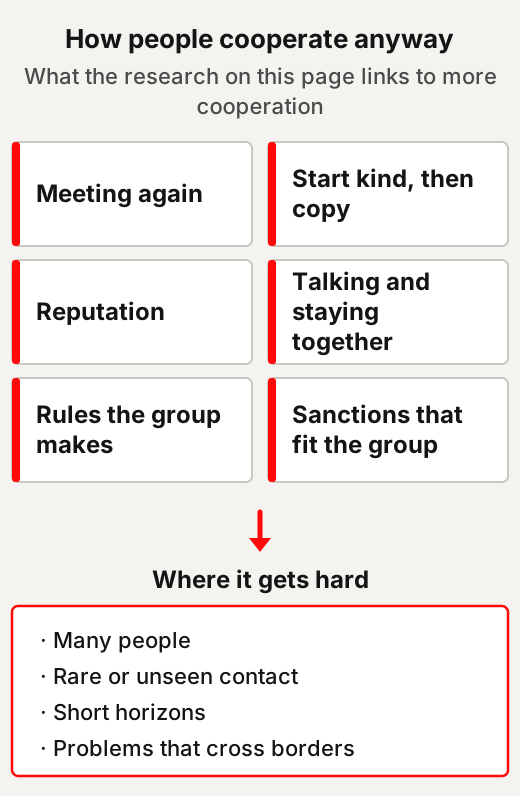
Research points to several things that make cooperation more likely: meeting again, reputation, talking, rules the group makes and sanctions that fit the group.
Meeting again
People cooperate more easily when they expect to deal with each other again.
The 2005 prize committee wrote that cooperation “may be easier to sustain in a long-term relationship than in a single encounter”. It credited Robert Aumann with the first full formal analysis of so-called infinitely repeated games. Game theorists call the chance that the game goes on “the shadow of the future”.
A 2018 survey of lab experiments found that cooperation is more likely when it can be supported as a stable outcome. It added that this “does not imply that most subjects will cooperate”. High cooperation appeared only when cooperating stayed safe despite uncertainty about what the other player would do.
How sure: Strong prize-winning theory, and a survey of many lab experiments agrees, with that limit.
For example, you might lend a ladder more readily to a neighbour you see every week than to someone passing through.
Start kind, then copy
A simple rule that starts kind and then copies the other side did well in famous computer tournaments.
Robert Axelrod’s tournaments, published in the early 1980s, pitted computer programs against each other in a game called the prisoner’s dilemma, and Tit for Tat scored highest in the first one, and won the second. It simply cooperates on the first round, then copies the other player’s previous move. Axelrod put its success down to four properties: it is nice, meaning never the first to defect; retaliatory, so hard to exploit; forgiving; and clear.
How sure: Unsettled it did well in a computer game, and less well in later tournaments.
Our page on kindness and boundaries looks at what this can mean day to day; its limits are in section 5 below.
Reputation
People tend to help those known to help others, even when they will not meet again.
In a 2000 experiment, donations went more often to people who had been generous to others in earlier rounds. In a 2002 study, the need to keep a good reputation kept contributions to a shared pot unexpectedly high. When no later reputation rounds were expected, contributions dropped quickly to zero.
How sure: Limited a few lab studies, with one researcher on both teams.
For example, a seller with years of good reviews has more to lose from one bad deal than a brand-new account.
Talking and staying together
Groups that can talk, and that keep the same members, tend to put more into a shared pot.
Researchers study this with a public goods game, in which each player can put money into a shared pot that is multiplied and then split among everyone.
A 2003 meta-analysis of 27 studies, covering 711 groups, found that communication and keeping the same group members over a session raised average contributions. A bigger return to the group from each contribution helped too.
In one public goods experiment, about a third of people’s plans were complete free-riding, while half showed conditional cooperation: giving more the more others gave. The authors say this can explain why people in repeated public goods experiments cooperate at first, and cooperation then declines to very low levels towards the final rounds.
Our reading: many people will chip in if they see others doing it, so making contributions visible may matter.
How sure: Moderate a 27-study meta-analysis supports it, but all the studies are lab games.
Rules the group makes
Communities often manage shared resources well with rules they make themselves, though not always.
Elinor Ostrom shared the 2009 economics prize “for her analysis of economic governance, especially the commons”. The prize committee wrote that she “challenged the conventional wisdom that common property is poorly managed and should be either regulated by central authorities or privatized”. From studies of user-managed fish stocks, pastures, woods, lakes and groundwater basins, she concluded that the outcomes are, more often than not, better than standard theories predict. The committee added that user management is not always better: in many cases privatization or public regulation works better.
Her eight design principles include users taking part in changing the rules, monitoring, sanctions that grow with how serious or repeated a breach is, and low-cost ways to settle conflicts.
A 2010 review of 91 studies, by researchers at Indiana University, found the principles “well supported empirically”. It added that they are incomplete, and that a “probabilistic, rather than deterministic” reading of them is warranted.
In a 2014 lab game, each group could use up a resource or leave some for the next group. The resource was almost always destroyed when each person decided alone, and consistently sustained when the group decided by vote. The vote helped only when it was binding for everyone.
How sure: Moderate a 91-study review supports the principles, but its authors call them incomplete.
For example, housemates who set fridge rules together, check them now and then, and start with a friendly reminder before anything stronger.
Sanctions that fit the group
Being able to punish free-riders helped cooperation in many lab groups, but in some places the benefit disappeared.
In a 2002 experiment, cooperation flourished when people could pay to punish defectors, and broke down when they could not. A 2008 study in 16 participant pools around the world found that some people also punished those who had contributed generously. In some pools this removed the benefit of punishment, and the authors concluded that punishment opportunities help only when “complemented by strong social norms of cooperation”. Punishing has a cost too: a 2008 study noted that in earlier experiments the costs of punishment outweighed the gains from cooperation. It found punishment “unambiguously beneficial” when the game ran for 50 rounds rather than 10.
Our reading: sanctions helped where cooperation was already expected.
How sure: Moderate lab studies in many countries agree on both the benefit and the limit.
Where it gets hard
Cooperation is harder with many people, rare or unseen contact, short horizons and problems that cross borders.
The 2005 prize committee wrote that cooperation is more difficult with many participants, infrequent contact or a short time horizon. It is also harder when a relationship is likely to be broken off, or when others’ actions cannot be clearly observed. In 2003, Dietz, Ostrom and Stern wrote that local arrangements run by stable communities, and shielded from outside forces, have sustained resources for centuries, but often fail when rapid change occurs. They named transboundary pollution, tropical deforestation and climate change as problems at larger scales.
In a 2008 lab game modelled on climate change, half the groups reached their target when the risk of losing their remaining money was high. When the risk was low, groups generally failed.
Our reading: the bigger and more anonymous the group, the more the ideas above have to be built on purpose.
How sure: Moderate prize-winning theory and field reviews agree; the climate game is a lab simulation.
4. How well it predicts real people
In lab games, people share more and punish unfairness more than a purely self-interested model predicts.
In the ultimatum game, one player proposes how to split a sum of money and the other accepts or rejects it; if the deal is rejected, neither gets anything. If each player cares only about the money, the solution game theory suggests is for the proposer to offer the smallest possible share and for the responder to accept it.
In the dictator game, one player simply decides how to split the money, and the other has no say. A meta-study of more than a hundred dictator-game experiments found that dictators gave about 28% of the pie on average, and more than a third gave nothing.
Our reading: in the ultimatum game, offers and rejections are both well above what a player who cares only about money would do.
A study of ultimatum, public goods and dictator games in 15 small-scale societies found that the standard self-interest model “fails in all of the societies studied”. It found more variation between groups than earlier research, and more generous play where market integration and the payoffs to cooperation in everyday life were higher. Ken Binmore has long argued that when people play games with non-relatives, they tend to learn over time to play the equilibrium that roughly matches their money payoffs. He points out that these data do not test that view, because the players had no long learning period with the games.
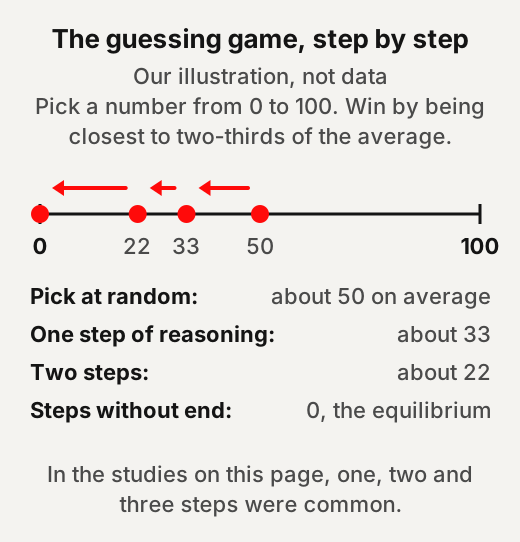
How far people think ahead has limits too. In the guessing game, players pick a number from 0 to 100, and the winner is the one closest to a fraction, such as two-thirds, of the average. Reasoning it through step by step leads to a single equilibrium in which everyone chooses 0. In newspaper and lab versions, one, two and three steps of reasoning were common in every sample, and the equilibrium choice was prominent only among newspaper readers and game theorists.
For example, if you expect others to pick at random around 50, two-thirds of that is about 33. If you expect them to think that too, you pick about 22.
In a 1992 centipede-game experiment, standard theory predicted the first player would take the larger pile at once, and this did not happen. The authors could explain the play if players believed there was a small chance that the other was an altruist.
Our reading: game theory is a good map of incentives and a weaker forecast of what one person will do the first time. Researchers disagree about how much the lab games test the theory itself.
How sure: Strong meta-analyses agree on the sharing; what it means for the theory is still argued.
5. Ideas about game theory you may have heard
Here is what the sources show on nine things people say about game theory.
Did John Nash invent game theory?
Its foundations came before him; his key contribution was a general idea of a stable outcome.
How sure: Strong the prize committee’s own summary sets out the order.
The prize committee traced methods for studying strategic interaction back to Auguste Cournot in 1838. It said the foundations for using game theory in economics came in a 1944 study by John von Neumann and Oskar Morgenstern. Nash’s most important contribution, it wrote, was a universal solution concept for any number of players, later called the Nash equilibrium.
In plain words, a Nash equilibrium is a set of choices in which nobody could do better by changing only their own choice. It is stable, not necessarily good. In a true prisoner’s dilemma, the cooperative outcome is not a Nash equilibrium.
Was game theory invented for nuclear war?
The maths is older, though the nuclear arms race was the backdrop to some of its famous work.
How sure: Strong the dates are well recorded.
The prize committee dates von Neumann’s minimax solution for two-person zero-sum games to 1928. After World War II, the RAND Corporation recruited mathematicians, including Merrill Flood and Melvin Dresher, to think about military tactics and strategy. In early 1950, Flood and Dresher had colleagues play a game with the structure of the prisoner’s dilemma. The prize committee placed Thomas Schelling’s book The Strategy of Conflict “against the backdrop of the nuclear arms race in the late 1950s”.
Does game theory assume everyone is selfish?
The theory lets payoffs stand for whatever people care about, though many applied models do assume self-interest.
How sure: Strong the standard reference on game theory says so directly.
The encyclopedia entry on game theory explains that payoffs can represent anything a player cares about. It adds that its prisoner’s dilemma example “does not show that selfishness is among the assumptions of game theory”. Many models do assume it: one 2000 study notes that under “the standard assumptions of rationality and selfishness”, there should have been no cooperation at all in its experiment.
Does game theory say you should always betray?
Standard theory predicts betrayal in a one-off prisoner’s dilemma, but not in many other games.
How sure: Strong theory and lab results agree that cooperation can be stable when play repeats with no set end.
The evidence is in section 3: cooperation can hold when people meet again, and in a stag hunt cooperating together is itself a stable outcome.
Does Tit for Tat always win?
It won both of Axelrod’s tournaments, but no strategy wins against every mix of opponents.
How sure: Strong both the early wins and the later losses are well documented, though what they show is still argued.
The encyclopedia notes that in a game like this “no strategy is ‘best’” in the sense of scoring highest against any group of competitors. Enthusiasm for Tit for Tat has been tempered by increasing skepticism, and its success may be partly due to features of Axelrod’s setup. In a later tournament that closely copied Axelrod’s, it finished fourteenth out of fifty strategies. In one of the tournaments held to mark the 20th anniversary of Axelrod’s book, the winner came from a team that submitted over half of the 223 strategies allowed.
Does the bar scene in A Beautiful Mind show a Nash equilibrium?
Game theorists point out that the plan in the scene is not one.
How sure: Strong it follows from the definition of a Nash equilibrium.
In the scene, John Nash explains to his friends how to direct their attention to women in a bar. Game theorists who have seen the film point out that the proposed solution is not a Nash equilibrium.
Our reading: in a Nash equilibrium no one could do better by changing only their own choice, and by that test the plan in the scene does not hold.
Did game theory prove Adam Smith wrong?
It shows self-interest can leave a group worse off, but Smith wrote frequently, not always.
How sure: Moderate Smith’s sentence says frequently, and the dilemma shows cases where self-interest fails, which that word allows.
In The Wealth of Nations, Smith wrote that a person pursuing his own interest “frequently promotes that of the society more effectually than when he really intends to promote it”. In the same passage he writes of being “led by an invisible hand”. The encyclopedia puts the dilemma this way: “A group whose members pursue rational self-interest may all end up worse off”.
Our reading: the dilemma limits a simple reading of Smith, and his own sentence already says frequently.
Does the prisoner’s dilemma explain climate change?
It is one possible model; climate talks can also fit other games.
How sure: Moderate one detailed analysis of climate talks, and the encyclopedia’s own example.
The encyclopedia gives limiting the use of fossil fuels to prevent climate change as an example of a many-person dilemma. A 2013 analysis looked at climate negotiations between two players, such as great powers or coalitions of states. It found that they may be characterised as a prisoner’s dilemma, a coordination game, chicken or other games, depending on the payoffs. It argued that scientific information on the severity of the risks points to a coordination game rather than a prisoner’s dilemma.
Do shared resources always get ruined?
Ostrom’s work found many communities managing shared resources well; very large problems are harder.
How sure: Strong prize-winning field studies and a 91-study review, with the limits in section 3.
The evidence is in “Rules the group makes” and “Where it gets hard” above.
6. A short history
Game theory grew out of economics and mathematics, and several of the people who built it shared economics prizes.
In the early 1900s, mathematicians such as Zermelo, Borel and von Neumann had begun to study games mathematically. The economist Oskar Morgenstern met von Neumann in 1939, and their plan led to Theory of Games and Economic Behavior in 1944. John Nash reported his results in his 1950 doctoral dissertation, Non-cooperative Games.
The prison story is due to Albert Tucker, who wanted to make Flood and Dresher’s game easier to follow for an audience of Stanford psychologists. The name “prisoner’s dilemma” is often credited to Tucker, but the earliest use of it in print that researchers have found is in a 1957 book by Luce and Raiffa.
Nash shared the 1994 economics prize with John Harsanyi and Reinhard Selten. Robert Aumann and Thomas Schelling shared it in 2005 “for having enhanced our understanding of conflict and cooperation through game-theory analysis”.
The prize’s formal name is the Sveriges Riksbank Prize in Economic Sciences in Memory of Alfred Nobel.
7. Putting it to use
A few ideas from game theory make handy thinking tools, as long as you remember that models simplify.
Sketch the game. Thomas Schelling noted that “considerable progress can be achieved simply by drawing a diagram” of the options open to the other side and to your own. It also reminds you that the other side faces a similar decision. For example, before a hard talk with a housemate, list what each of you could do.
Make meeting again visible. Cooperation tends to come easier with people you expect to deal with again. For example, plan the next project together before splitting today’s work.
Agree shared rules together. Ostrom’s principles point to letting the people affected help make the rules, keeping an eye on use, and starting sanctions small.
Look for the obvious meeting point. In classroom experiments, Schelling found that people trying to coordinate often reached what he called focal points, more often than theory predicted. The encyclopedia’s example: two people who must meet in a big city without contact might both go to its most prominent downtown plaza at noon. For example, friends who lose each other at a festival might try the main entrance.
Know what a commitment does. Schelling showed that a party can strengthen its position by openly worsening its own options. The prize committee’s popular summary calls this “literally to burn one’s bridges”. Our page on sayings from history looks at the famous story of burned boats and what its sources say.
For choices with no other players, see our page on deciding under uncertainty.
Quick answers
What is game theory in simple terms?
Game theory studies choices that affect each other, when each person's result depends on what the others do.
What is a Nash equilibrium?
A set of choices in which nobody could do better by changing only their own choice. It is stable, not necessarily good.
How do people cooperate if betraying pays?
The research we read points to meeting again, reputation, talking, rules the group makes and sanctions that fit the group.
Use this
Our suggestion: three ways to use these ideas the next time a choice involves other people.
Is this a one-off, or will we meet again?
Quick quiz
Nothing is scored or saved. Recalling it once now is what makes it last.
1. In the prisoner's dilemma, what happens when both players confess?
Answer: Each ends up worse off than if both had stayed silent.Read it again ↑
2. In the 2014 experiment on leaving a resource for the next group, when was it sustained?
Answer: When the group decided by a vote that bound everyone.Read it again ↑
3. In a 2004 meta-analysis of ultimatum games, what did proposers offer on average?
Answer: 40% of the pie.Read it again ↑
How we checked this · Last checked November 2026
- We read the two Stanford Encyclopedia of Philosophy entries in full, the Royal Swedish Academy of Sciences' prize press releases and popular information, and the abstracts of the studies through PubMed and EconPapers.
- Two studies were read in their working-paper versions because the journal versions are paywalled, the dictator-game meta-study and the guessing-game study. The conditional-cooperation figures come from the working-paper abstract of that study.
- Our wording on Tit for Tat matches our page on kindness and boundaries.