

Being kind and having limits can go together. This guide shares what research has found about kind and generous people, why some kinds of helping wear people out, and how to say no without being unkind.
Where a study exists, we say what it found and how sure it is. Where none does, we simply describe the idea. The examples and the “Try this” lines are our own suggestions, not research findings.
1. What “kind” means here
It helps to separate a kind trait, a kind feeling and a kind act. Keeping them apart makes the research easier to follow.
Agreeableness
Agreeableness is the personality trait that sounds closest to what people call being kind.
The APA Dictionary of Psychology describes agreeableness as the tendency to act in a cooperative, unselfish manner, one end of a dimension in the Big Five personality model. The other end is disagreeableness.
Our reading: it is a range, not a switch. Being high on it says how you tend to act, not whether you can set a limit.
Example: two colleagues are asked to cover a shift. One says yes at once; the other asks what it involves first. Both can be kind.
Try this: notice the last time you said yes straight away. Was it a choice, or a habit?
Empathy and compassion
Empathy means sharing someone’s feelings; compassion adds a wish to help.
Tania Singer and Olga Klimecki describe empathy as sharing the feelings of others, where one feels with someone but does not confuse oneself with the other. The APA dictionary describes compassion as a strong feeling of sympathy with another person’s sorrow or distress, usually with a desire to help or comfort them.
What the research found: In a 2014 lab study, training in empathy increased negative feelings when people watched videos of human suffering; compassion training afterwards reversed that increase and raised positive feelings. The authors suggest that training compassion may be a way to cope with empathic distress.
How sure: Limited one lab training study, with feelings measured while watching videos.
Example: a friend tells you about a hard week. Feeling their stress is empathy. Asking what would help is compassion.
Try this: next time someone shares bad news, ask “What would help right now?” before you take on the feeling yourself.
| Empathy | Sharing the feelings of others: one feels with someone but does not confuse oneself with the other. |
| Compassion | A strong feeling of sympathy with another person's sorrow or distress, usually with a desire to help or comfort them. |
Two words often used as one, in the definitions this page quotes.
2. What research found about kind acts
Kind acts tend to lift the person doing them, but how and why you help seems to matter.
Acts of kindness and wellbeing
Doing small kind things tends to give the doer a modest lift.
A 2018 meta-analysis of 27 studies, with 4,045 people in total, found that the overall effect of kindness on the wellbeing of the person being kind was small-to-medium. The authors found no sign of publication bias, and recommended that future research test more specific theories of kindness, such as kindness to different groups of people.
How sure: Moderate a meta-analysis of experiments, with an effect its authors call small-to-medium.
Example: you hold a door, message a friend who has gone quiet, or bring a colleague a coffee.
Try this: do one small kind thing today and notice how you feel an hour later.
Helping by choice, not under pressure
Help given by choice seems to do more good, for both people, than help that feels controlled.
In four studies published in 2010, Netta Weinstein and Richard Ryan compared helping out of autonomous motivation, by choice, with helping out of controlled motivation. Their findings support the idea that autonomous helping brings benefits for both the helper and the person helped.
Our reading: this is the research side of a kind “no”. A reluctant yes may help less than it seems, for you and for them.
How sure: Moderate four studies by one team, including experiments.
Example: helping a friend move house because you want to, compared with helping because you could not find a way to say no.
Try this: before saying yes, ask yourself: “Would I choose this if no one would mind either way?”
Caring for others while leaving yourself out
Researchers separate caring for others from caring for others at your own expense.
In four studies published in 1998, Heidi Fritz and Vicki Helgeson separated communion, a positive caring orientation toward others, from unmitigated communion, a focus on others to the exclusion of the self. Unmitigated communion, unlike communion, went with psychological distress, which the authors traced to relying on others for self-esteem, overinvolvement with others and neglect of the self.
Our reading: the everyday phrase “people-pleasing” sounds close to the second one. Caring is not the problem; leaving yourself out is.
How sure: Limited the studies measured links between traits and distress; links alone do not show cause.
If caring for others has left you worn out or low for weeks, a doctor or counsellor is a good person to talk to.
Example: you agree to every favour at work and at home, and your own plans keep slipping to “next week”.
Try this: write down one thing you want for yourself this week, and put it in your calendar first.
Helping fatigue at work
Going beyond your role to help at work can wear people out, more so with little support.
A 2015 study of 273 employees and their peers looked at people feeling worn out, tired or on edge because of organisational citizenship behaviour, and called it citizenship fatigue. Our reading: in everyday words, that means the extra things people do at work to help, beyond what the job asks.
The link between helping and fatigue was stronger when people felt their organisation gave them little support. Where teammates got on well and pressure to help was low, more helping went with less fatigue. Fatigue also went with less helping later on.
How sure: Limited one study of employees and their peers, measured at several points in time.
Example: the person who always stays late to fix other people’s problems starts to dread the next request.
Try this: if you are the go-to helper at work, notice which requests feel chosen and which feel expected.
| Communion | A positive caring orientation toward others. |
| Unmitigated communion | A focus on others to the exclusion of the self. Unlike communion, it went with psychological distress. |
The two kinds of caring that Fritz and Helgeson separated, as this page describes them.
3. Kind, without being easy to take advantage of
Kindness with clear limits shows up in places as different as game theory and the psychology dictionary.
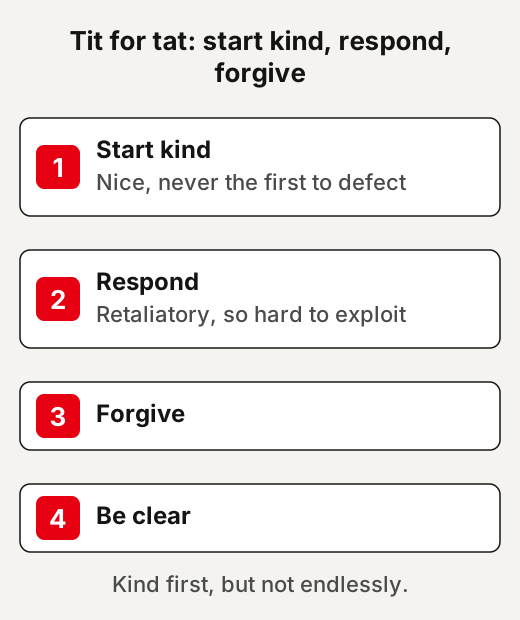
Tit for tat: start kind, respond, forgive
In a famous computer tournament, a simple strategy that started kind and then copied the other side did well.
Robert Axelrod’s tournaments, published in the early 1980s, pitted computer programs against each other in a game called the prisoner’s dilemma, and Tit for Tat scored highest in the first one, and won the second. It simply cooperates on the first round, then copies the other player’s previous move. A 1981 paper by Axelrod and W. D. Hamilton argued, from a model and the tournament results, that cooperation based on reciprocity can get started, thrive and resist invasion once established. Axelrod put its success down to four properties: it is nice, meaning never the first to defect; retaliatory, so hard to exploit; forgiving; and clear.
The encyclopedia also notes the limits. Enthusiasm for Tit for Tat has been tempered by increasing skepticism, and its success may be partly due to features of Axelrod’s setup. In a later tournament that closely copied Axelrod’s, it finished fourteenth out of fifty strategies.
How sure: Unsettled it did well in a computer game, and less well in later tournaments.
Our reading: a game is not a friendship, so take it as a picture of an idea, not a rule. The useful part is the mix: kind first, but not endlessly.
Example: a neighbour borrows your ladder and returns it broken. You still say hello, but next time you ask when you will get it back.
Try this: think of one relationship where you keep giving with nothing coming back. What would a clear, kind response look like?
Boundaries
A boundary is a limit you set on how far you take part in something.
Our reading: a boundary is about what you will do, not about controlling what others do.
Example: “I don’t answer work messages in the evening. I’ll reply first thing tomorrow.”
Try this: finish this line for one part of your life: “I’m happy to …, but not …”
If someone keeps crossing your limits in a way that frightens or controls you, findahelpline.com lists free, confidential helplines worldwide.
Assertiveness
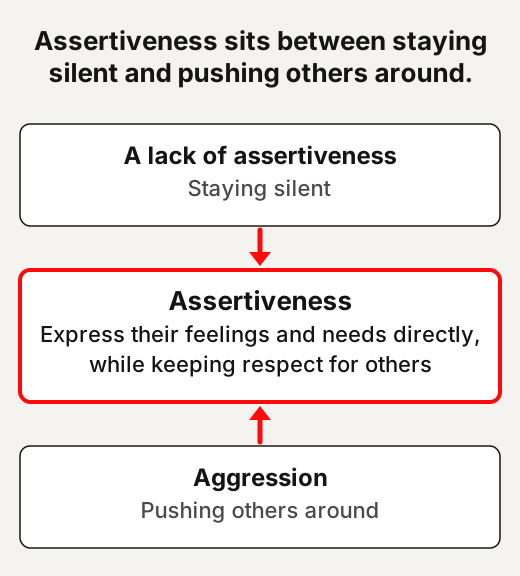
Assertiveness sits between staying silent and pushing others around.
The APA dictionary describes assertiveness as a style of communication in which people express their feelings and needs directly, while keeping respect for others. It adds that a lack of assertiveness may contribute to depression and anxiety, while maladaptive versions of it may come out as aggression.
Example: “I can’t take this on this week. I could help next Tuesday.”
Try this: say one need out loud today, in a single sentence that starts with “I”.
For building the confidence to do this, see our guide on how to build confidence.
| Boundary | A psychological demarcation that protects the integrity of a person or group, or helps them set realistic limits on taking part in a relationship or activity. |
| Assertiveness | A style of communication in which people express their feelings and needs directly, while keeping respect for others. |
From the APA dictionary entries this page quotes.
4. Saying no, kindly
Saying no often lands more softly than we expect. One team has studied this directly.
Declining an invitation
People tend to overestimate how much a polite “no” will upset the person who asked.
In studies published in 2024, Julian Givi and Colleen Kirk found that people who decline an invitation overestimate the negative reaction of the person who invited them. They expected more anger than there was, and expected the inviter to think they did not care or to stop inviting them. The authors say this happens partly because the person saying no expects the inviter to focus on the decline itself, more than on the thinking behind it.
How sure: Limited one team’s studies, about invitations to fun social activities.
Example: a friend invites you to a concert on a night you need to rest. You say: “Thank you for thinking of me. I can’t this time, but I’d love to come next time.”
Try this: next time you decline, keep it short and warm, and notice how the other person responds.
A kind no, in a few words
Our suggestion: a kind no has three parts, thanks, a clear no and, if you mean it, another option.
These are our own lines, not research:
- “Thanks for asking. I can’t this time.”
- “That sounds good, but I’m at my limit this week.”
- “I can’t do the whole thing. I could do this part.”
- “Let me check and get back to you tomorrow.”
Try this: pick one line and say it out loud once, so it feels familiar when you need it.
For cutting back commitments more widely, our Essentialism summary covers the book’s idea of a graceful no.
How the ideas fit together
Match the idea to what you notice in yourself. The questions are our own suggestions.
| If you notice… | Idea on this page | A question to ask |
|---|---|---|
| You say yes before thinking | Agreeableness | Is this a choice or a habit? |
| Someone’s pain becomes your own | Empathy and compassion | What would help them? |
| Helping feels heavy, not chosen | Helping by choice | Would I choose this freely? |
| Your own plans keep slipping | Unmitigated communion | What do I want this week? |
| Someone keeps taking | Tit for tat | What would a kind, clear response be? |
| You need a limit | Boundaries and assertiveness | What will I do, and not do? |
| You dread saying no | Declining an invitation | Is the other person likely to mind as much as I fear? |
If you worry that someone is using your kindness on purpose, our page on dark psychology describes the manipulation research.
Where to learn more
- How to build confidence: what the research supports, and a four-week plan.
- How to make friends as an adult: time, closeness and showing up.
- Essentialism summary: saying a graceful no and cutting back commitments.
- The Stanford Encyclopedia of Philosophy on the prisoner’s dilemma: the game behind Tit for Tat, and the debate since.
- The APA Dictionary of Psychology: free definitions of psychology terms.
- Find A Helpline: free, confidential helplines worldwide.
- Related idea guides: reading people and career moves people talk about.
Quick answers
Is being kind a weakness?
The studies we found point to how you help, more than whether you are kind. Four studies by one team support the idea that helping by choice benefits both helper and recipient, while caring for others at the cost of yourself went with distress.
What is the difference between empathy and compassion?
Empathy is sharing someone's feelings. Compassion, in the APA dictionary's words, is a strong feeling of sympathy with another person's distress, usually with a desire to help. In a 2014 lab study, compassion training reversed the rise in negative feelings that empathy training had caused.
What is a personal boundary?
The APA dictionary describes a boundary as a psychological demarcation that protects a person's integrity or helps them set realistic limits on taking part in a relationship or activity.
Will people be upset if I say no?
In one team's studies of declined invitations, less than people feared. People declining an invitation, in studies published in 2024, overestimated the inviter's anger and the chance of not being invited again.
Use this
Before you say yes, check whether it is a choice.
Is this a choice, or a habit?
Quick quiz
Nothing is scored or saved. Recalling it once now is what makes it last.
1. How does the APA dictionary describe assertiveness?
Answer: Expressing your feelings and needs directly, while keeping respect for others.Read it again ↑
2. In Fritz and Helgeson's studies, which went with psychological distress?
Answer: Unmitigated communion, a focus on others to the exclusion of the self.Read it again ↑
3. What did people declining an invitation tend to overestimate?
Answer: How badly the person who invited them would react.Read it again ↑
How we checked this · Last checked November 2026
- We read the APA Dictionary of Psychology entries in a browser in November 2026, because the pages build their text with JavaScript.
- The studies were read as their published abstracts. Several are single studies or one team's work, and the page says so.
- We could not open the full text of the 2014 empathy and compassion review, so only its abstract is used.
- The examples, the Try this lines and the ways to say no are our own suggestions, not research findings.