

Everyday moments can tell you something about a person, especially when you see many of them over time. A single moment, or a single cue such as eye contact, tells you much less. This guide shares what research has found about judging people from their behaviour, then looks at five everyday moments and what each can and can’t show.
Where a study exists, we say what it found and how sure it is. Where none does, we simply describe the idea. The examples and the “Try this” lines are our own suggestions, not research findings.
1. What research says about judging people
People can judge some things about others fairly quickly, but how much depends on the trait, the cue and how well you know them.
Thin slices: short glimpses of behaviour
Short glimpses of how someone moves and talks can carry real information.
A 1992 meta-analysis looked at predictions made from short observations of expressive behaviour, under five minutes long. Studies with longer observation did not give more accurate predictions, and accuracy did not depend on whether people judged the face, speech, body or tone of voice. A 2007 study of first impressions, in which 334 judges rated 30 people after glimpses of 5 seconds to 5 minutes, found that overall, accuracy increased with exposure time. Researchers call these short glimpses thin slices.
How sure: Moderate a meta-analysis of predictions about specific outcomes; a later study of personality judgments found longer glimpses helped.
Example: a few seconds into a meeting, you sense that a speaker is nervous, before they say anything about it.
Try this: write down your first impression of someone new, then check it again after a month.
Faces at a glance
People form impressions from faces almost instantly, but one review argued their accuracy has been greatly overstated.
In five experiments published in 2006, judgments of unfamiliar faces made after a tenth of a second were highly correlated with judgments made with no time limit. The authors suggest that extra time may simply boost confidence, though longer exposure also led to more differentiated impressions. A 2015 review of this research argued that how well these face-based impressions predict what people are like has been greatly overstated.
Our reading: fast is not the same as accurate. The speed of a face impression says nothing about whether it is right.
How sure: Moderate lab experiments on speed, and a review that weighs the accuracy evidence.
Example: you decide a stranger in a photo “looks trustworthy” before you know anything about them.
Try this: when a face gives you a strong feeling, name the feeling, then look for one fact about the person.
What makes a judgment accurate
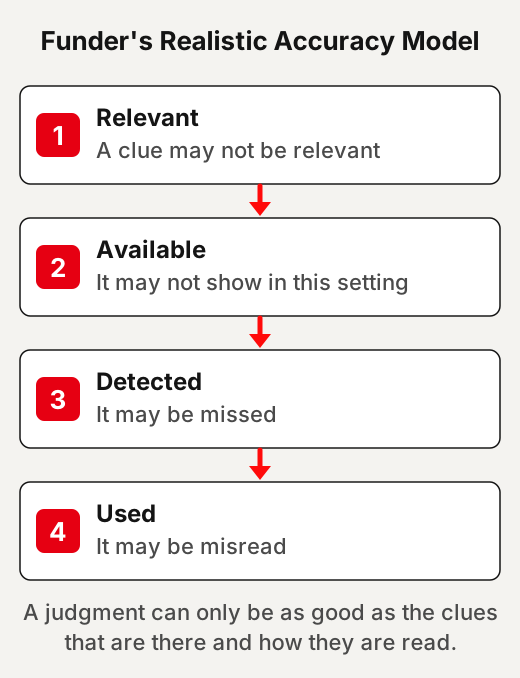
A judgment can only be as good as the clues that are there and how they are read.
David Funder’s Realistic Accuracy Model, from 1995, describes accuracy as depending on whether relevant behavioural cues are available, detected and used. Our reading: each step can fail. A clue may not be relevant, may not show in this setting, may be missed, or may be misread.
Example: a quiet colleague in a loud open-plan office. Their calm under pressure is relevant, but it rarely shows there, so nobody notices it.
Try this: before judging someone, ask which of the four steps you can vouch for.
Strangers, friends and you see different things
Who judges a trait best depends on how visible the trait is.
A 2010 study of 165 people, rated by themselves, friends and strangers, found that people themselves were the best judges of neuroticism-related traits, friends were the best judges of intellect-related traits, and everyone was equally good at extraversion-related traits. A 2010 set of meta-analyses, covering 263 samples, found that seeing someone more often improves accuracy, but that closeness is needed for large gains, especially for traits that are hard to see, such as emotional stability.
How sure: Moderate one detailed study and a large set of meta-analyses point the same way.
Example: a new colleague can tell you are outgoing within a day; only an old friend knows how you handle worry.
Try this: if you want to know how someone copes with stress, ask a person who knows them well, not a stranger.
One moment versus many
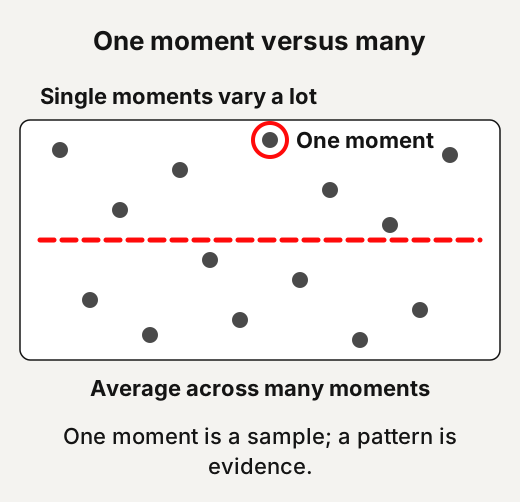
People vary a lot from moment to moment, but their averages are very stable.
Our reading: this is the main lesson of the page. One moment is a sample; a pattern is evidence.
How sure: Moderate three studies that sampled everyday behaviour, by one researcher.
Example: a usually patient friend snaps at you once. One snap tells you less than years of patience.
Try this: before you decide what someone is like, count how many times you have seen it, not how strongly you remember it.
The situation pulls harder than it looks
We tend to explain behaviour by character when the situation could explain it.
Example: a driver cuts you off, and you think “what a selfish person”, without knowing they are rushing to a hospital.
Try this: for one judgment today, write one situation that could explain the behaviour just as well. Our page on whether you can train away bias covers this “consider the opposite” idea.
From a 2010 study of 165 people, rated by themselves, friends and strangers.
| Single moments | The typical person regularly showed nearly all levels of every trait. |
| Averages | Differences between people's averages were almost perfectly stable. |
From William Fleeson's three studies of everyday behaviour, as this page describes them.
2. Five everyday moments, and what they can show
We found no study testing these five moments as signs of character. Each card below leans on the findings above: one moment varies, many moments show a pattern, and the situation matters.
Across several studies, people in most contexts weighed information about moral character more heavily than information about warmth when forming impressions of others. That may be why moments like these feel so telling.
How someone handles praise
Praise shows how someone deals with attention, which is not the same as their character.
What it may hint at: whether they share credit, brush it off, or take more than their share.
What it can’t tell you: shyness, culture and the setting all change how people take praise. A modest shrug in one place can be polite in another.
Example: after a team win, one person thanks the group by name; another changes the subject.
Try this: notice whether someone mentions the people who helped them, over several occasions, not once.
How someone takes criticism
A first reaction to criticism can be defensive, so the second reaction may tell you more.
What it may hint at: whether they can separate the message from the delivery, given time.
What it can’t tell you: a bad day, an unfair critic or a public setting can make anyone defensive.
Example: a friend argues back when you point out a mistake, then fixes it the next morning.
Try this: watch what someone does a day later, not in the first minute. Our page on taking criticism without getting defensive covers the research on the moment itself.
How someone treats strangers and staff
How someone treats people who can do nothing for them is a moment worth watching over time.
What it may hint at: how they act when there is no one to impress.
What it can’t tell you: one rude moment may be a bad day, which is exactly the trap the correspondence bias describes.
Example: a date is short with a waiter who got the order wrong twice.
Try this: look for the pattern across several meals, trips or meetings before you decide.
The questions someone asks
Questions show interest, and being interested is likeable, but likeable is not the same as good.
In two online experiments and an observational study of speed dates, people who asked more questions, particularly follow-up questions, were better liked. A 2019 reanalysis of the speed-dating data argued that a second date is not the same as liking, and that asking questions is not the same as listening. The original authors replied that the reanalysis tested the wrong variables.
Our reading: this finding is about being liked, not about character. A skilled talker can ask good questions too.
Example: a new acquaintance asks how your trip went, then asks what surprised you most.
Try this: notice whether someone’s follow-up questions build on what you said, over more than one conversation. Our guide on making friends as an adult has more on these studies.
Whether someone admits mistakes
Saying “I was wrong” is easier for some people than others, and it can change with the stakes.
What it may hint at: whether someone can update their view when the evidence changes. Our page on 7 thinking skills covers this as intellectual humility.
What it can’t tell you: some workplaces and families punish mistakes, so silence may be about the setting, not the person.
Example: a manager says “I got that wrong, here is what I will change” in a team meeting.
Try this: admit one small mistake yourself this week, and notice how people respond.
3. What everyday cues can’t tell you
Some popular “tells” carry little information in the studies.
Spotting a lie
On average, people are only a little better than chance at spotting lies.
A 2006 meta-analysis of 206 documents and 24,483 judges found that people got 54% of lie-truth judgments right: 47% of lies and 61% of truths. The same analysis found that people appear deceptive when they are motivated to be believed. Our reading: a nervous, honest person can look like a liar.
How sure: Strong a large meta-analysis, and the authors report that lie detection rates varied little from study to study.
Example: a job candidate who badly wants the job fidgets and stumbles, though everything they say is true.
Try this: when you doubt someone’s story, check the facts they gave you rather than their body language.
Eye contact
The belief that liars look away is found worldwide; in one large meta-analysis, many lying cues showed weak or no links.
Two worldwide studies, run in 75 countries and 43 languages, found one dominant belief about liars: that they avert their gaze. A 2003 meta-analysis found liars “less forthcoming” and that many behaviours showed no link, or only weak links, to lying.
Our reading: a shared belief is not the same as a reliable cue. Our Never Split the Difference summary looks at another popular lying cue, word count.
How sure: Moderate the belief is well documented; the weak links come from one large meta-analysis of many cues.
Example: someone avoids your eyes while telling you about a loss. That may be grief, shyness or their culture, not a lie.
Try this: next time you catch yourself reading eye contact, ask what else could explain it.
Reading someone to use them
This page is about understanding people, not getting the upper hand. For the research on manipulation, see our page on dark psychology. For how emotional pressure works in ads and pitches, see how emotional triggers work.
Try this: when you notice yourself studying someone closely, ask them directly instead.
| 54% | of lie-truth judgments were right |
| 47% | of lies were spotted as lies |
| 61% | of truths were judged as truths |
A 2006 meta-analysis of 206 documents and 24,483 judges.
How to read a moment, step by step
Treat a moment as a question, not an answer. These steps are our own suggestions.
| Step | Ask yourself |
|---|---|
| Notice | What exactly did I see or hear? |
| Situation | What else could explain it? |
| Pattern | Have I seen it more than once? |
| Visibility | Is this something a stranger could even see? |
| Check | Can I ask, or check a fact, instead of guessing? |
Where to learn more
- How to take criticism without getting defensive: what the research says, and a simple routine.
- How to make friends as an adult: question-asking, time and closeness.
- Can you train away bias?: what the studies tried, including “consider the opposite”.
- Dark psychology: what researchers study under that label.
- 7 thinking skills: including intellectual humility.
- Related idea guides: is kindness a weakness? and ways of thinking.
Quick answers
Can you tell what someone is like from a first impression?
Partly. Short glimpses of behaviour carried real information in a 1992 meta-analysis, but face-based impressions form fast and a 2015 review argued their accuracy has been greatly overstated.
Can you tell if someone is lying from their body language?
Not reliably. A 2006 meta-analysis found people got 54% of lie-truth judgments right, and a 2003 meta-analysis found many behaviours showed no link, or only weak links, to lying.
Who knows a person best, friends or the person themselves?
It depends on the trait. In a 2010 study, people themselves were the best judges of neuroticism-related traits, friends of intellect-related traits, and everyone was equally good at extraversion-related traits.
What is the correspondence bias?
It is the tendency to read lasting traits into behaviour that the situation could entirely explain, as Gilbert and Malone describe it.
Use this
Treat a moment as a question, not an answer.
Have I seen it more than once?
Quick quiz
Nothing is scored or saved. Recalling it once now is what makes it last.
1. In the 1992 meta-analysis of short observations, did longer observation give more accurate predictions?
Answer: No, longer observation did not give more accurate predictions.Read it again ↑
2. In the 2010 study of self, friend and stranger ratings, who judged neuroticism-related traits best?
Answer: The people themselves.Read it again ↑
3. What did two worldwide studies in 75 countries find people believe about liars?
Answer: That they avert their gaze.Read it again ↑
How we checked this · Last checked November 2026
- The studies were read as their published abstracts, through Europe PMC and OpenAlex, in November 2026.
- We found no study that tests the five everyday moments as signs of character, so those cards describe them in our own words and lean on the general findings.
- The question-asking and lying-cue lines reuse the wording of our pages on making friends and on Never Split the Difference, where they were first checked.
- The examples and the Try this lines are our own suggestions, not research findings.