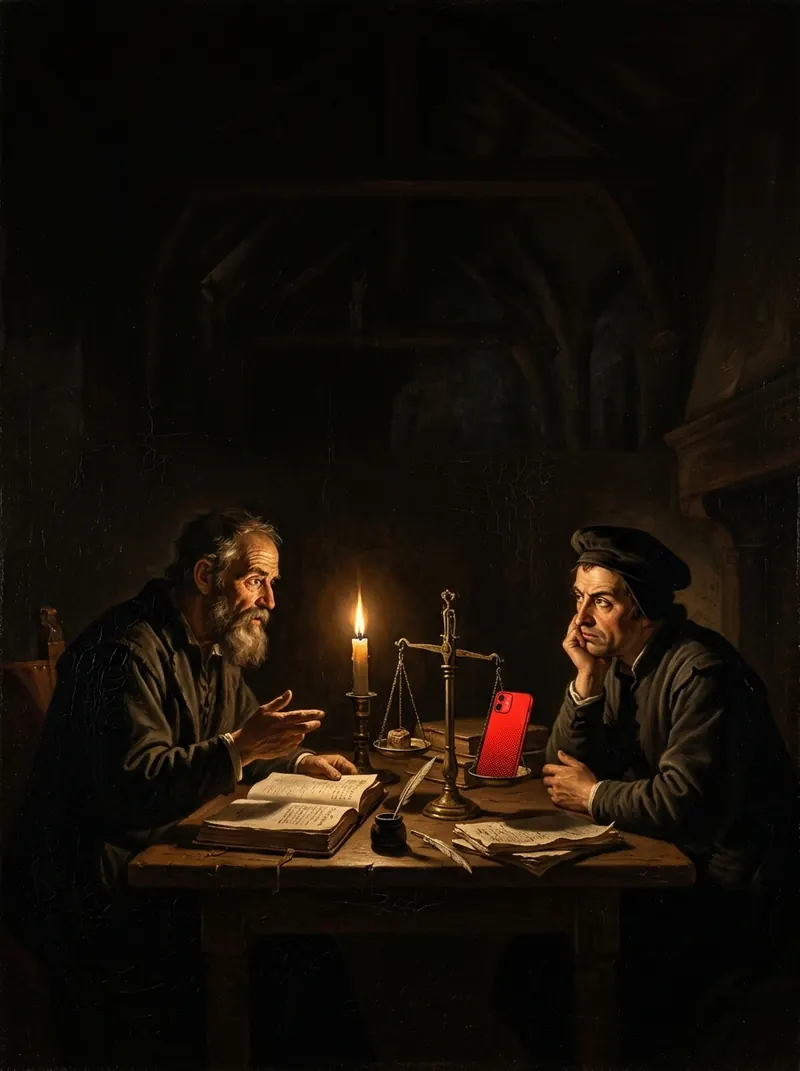
Planned, aimed at a group, and not always false.
The idea
A school notice giving the date of a fair simply informs. A flyer turning parents against another school, using only the facts that suit it, is something else. That's closer to propaganda: a message someone plans and aims at a whole group, to get the reaction they're after. It doesn't have to lie. A message can be accurate and still be propaganda. In early use, the word named a church office for spreading the faith, and only later turned negative.
Its common tricks were named long ago, to help the public spot them. Most of these tricks swap the evidence for a feeling. A nasty label or a shining word like 'freedom' or 'fairness' can stand in for a reason. So can a flag beside a logo, a famous face, or the claim that everybody's doing it. The people who named them weren't saying feelings are bad, only that a feeling isn't a reason. They judged one the hardest to spot. Called card stacking, it simply leaves out the facts that don't help.
In lab tests, hearing a claim again made it feel truer, even when it was false and people knew better. Most of those tests used trivia statements in a single sitting. A slogan heard again and again can start to sound like plain common sense. There's a second pattern, too. Propaganda seems to land best where people already lean its way. In one country's past, radio stirring hatred of a group worked best where that hatred had long been strong. It backfired where it had long been weak. How much it changes minds isn't settled.
Learning to name a trick ahead of time, sometimes called prebunking, helps people spot it in tests. In one large set of tests, a few short videos about the tricks did just that. Those tests mainly measured whether people could recognise a trick. Out on a real video site, the effect was smaller. Older tests of these advance warnings found the effect starting to fade after a couple of weeks. Whether the effect holds up while people scroll a busy feed full of real posts hasn't been shown. It's a bit like learning a pickpocket's moves at a talk. Spotting them on a crowded train may be harder.
Want the research, names and dates? They are in Go deeper, at the end.
The trick is in the other hand.
Picture it
Picture a magician. One hand waves a bright scarf while the other does the trick. The scarf is real, and it's lovely to watch. In propaganda, the waving hand is a feeling: a flag, a crowd, a famous smile. The other hand is the part you don't look at: the missing reason, or the facts left out. While the feeling holds your eye, the reason never gets checked.
For a child: A boy wants a later bedtime. "All my friends stay up late!" he says. His mum asks, "Which friends?" He names one. The crowd shrinks to one friend, and the reason is still missing.
What's worth asking when a message tugs at you.
How it applies
A handful of questions cover most of these tricks. Similar pulls turn up in everyday selling, too. A strong feeling is often the clue that one is in play. Who made this? What do they want you to do? How accurate is it? What's been left out? Does it fit what you already believe? A message you already agree with seems to get the easiest pass. Naming a trick doesn't prove a claim false, though. A crowd's choice, for example, is weak evidence, but it is still some evidence.
Comment sections, phone shops and friendly videos.
Where you’ll see it
- In a comments section: a post pins an ugly label on a whole group of people and gives no reasons.
- At a phone shop: "Everyone's switching to this plan," and not a word about the cost.
- In a product video: a boss on a garden bench chats like a neighbour, one of us.
Signs it’s happening
- A strong feeling shows up before any reason does.
- A label, a symbol or a crowd is doing the job a reason should do.
- A line feels true, but you can't say where you first heard it.
One famous runner, two different thoughts.
Before and after
A sports-drink poster shows a famous runner beside the words "Champions choose it."
"If she drinks it, it must be good." Her fame did the persuading.
"Does she know more about drinks than I do, or is her fame doing the work?" A famous person's word counts as a reason mainly when they know the subject.
The group that named the tricks, then paused.
A story from history: The institute that named the tricks
- An American group, the Institute for Propaganda Analysis, aimed "to assist the public in detecting and analyzing propaganda". Its November 1937 bulletin, "How to Detect Propaganda", named seven devices. They ran from name calling (a nasty label) to band wagon (everybody's doing it).
- It said they fool us because "they appeal to our emotions rather than to our reason".
- On 9 January 1942, in wartime, it suspended the bulletin "for the period of the war emergency".
- To carry on, it said, it would have to analyse all propaganda. That meant its own country's and its allies', as well as the enemy's.
- Its analyses of all kinds of propaganda, it said, were easily misunderstood in a war. It called a second reason "more important": people opposing the government's efforts could misuse them. And making propaganda itself, or even seeming to, would cast doubt on its integrity as a scientific body.
In wartime, the institute judged its work too easy to misread and misuse, and a risk to its integrity. So it paused. Its reasoning still carries over. A fair check covers every side's messages, including your own side's.
Quick check3 questions · nothing is saved
1. Which of these is the trick called card stacking?
2. Can a message made only of true facts be propaganda?
3. Why did the institute pause its bulletin in 1942?
One line worth keeping.
In one line
Propaganda often swaps reasons for feelings, and it seems to land best where you already lean its way.
Which message stirred you lately, and what might it have left out?
Go deeperThe research, names and dates
Where this comes from
A textbook on the subject, Propaganda and Persuasion, calls propaganda "the deliberate, systematic attempt to shape perceptions, manipulate cognitions, and direct behavior". What it wants is a reply that serves the propagandist's own purpose. Persuasion, in the same book, is a two-way exchange meant to meet the needs of both sides. None of this requires a lie: accurate facts can serve propaganda too.
The Institute for Propaganda Analysis was founded to help ordinary readers notice and pick apart propaganda. In November 1937 it put out a bulletin titled "How to Detect Propaganda". It gave seven tricks short names: name calling, glittering generalities, transfer, testimonial, plain folks, card stacking and band wagon. Their pull, it said, comes from playing on feelings over reason. It stressed that emotion itself was not the enemy. Card stacking, it judged, was the toughest to catch. The bulletin offered labels and examples, not an experiment.
Seeing a statement a second time tends to make it seem more believable. Researchers call this the illusory truth effect. Experiments published in 2015 found the pull even for false statements whose right answer people already knew. A 2022 survey of 181 studies on the effect noted that every one came from a Western university. Most tested trivia in one sitting. Two separate studies from 2015 looked at Nazi Germany. One studied radio in the 1920s and 1930s. After the Nazis took power, its broadcasts stirred anti-Semitic acts and denunciations of Jews to the authorities by ordinary citizens. They worked best where anti-Semitism had long been high, and backfired where it had been low. The other, using surveys, found indoctrination worked best where it "could tap into preexisting prejudices". Both studies are about one country under one regime. A 2017 review took a cooler view: propaganda, advertising and the like "are generally not very effective at changing" minds. When people do swallow a misleading message, it argued, the usual reason is that it fits views they already hold.
Research on warning people in advance borrows its name, inoculation, from medicine. It goes back to a 1961 study by the researchers McGuire and Papageorgis. Pooling 54 cases in 2010, one meta-analysis found these messages protected people better than supportive messages or nothing. The protection started to wear off after two weeks. A 2022 Science Advances paper tested five short videos, each about one trick, such as a false choice. Across six randomised experiments with 6,464 people, viewers got better at recognising the tricks. In a field test run as YouTube adverts, the effect was smaller. Recognition rose by about 5% on average, on a single test question within 24 hours. A 2025 PNAS Nexus study mixed real posts into a simulated feed. That "appeared to nullify the effect" of a lesson on emotional manipulation.
White vs black propaganda
| Compared | White | Black |
|---|---|---|
| The source | Identified correctly | Hidden, or credited to a false authority |
| The information | Tends to be accurate | Lies, fabrications and deceptions |
| Example (ours) | A signed government leaflet with accurate figures | A fake leaflet dressed up as the rival side's |
Gray sits in between. Its source may or may not be identified correctly, and its accuracy is uncertain. The textbook Propaganda and Persuasion traces this three-way split to the Psychological Warfare Division of the Allied forces in 1944.
More examples
Some everyday messages, and the trick each one leans on.
- If a car advert puts the national flag right beside the car, it leans on transfer. Respect for the flag gets borrowed for the car.
- If a plan is sold as "the honest choice" with no details, glittering generalities are at work. A shining word takes the place of evidence.
- If a brochure lists every award a gadget won, and no complaints, that's card stacking. Only the facts that help make it in.
What if…?
- What if knowing the tricks only helps in a quiz?
- That's the open question. Short lessons help people recognise the tricks in tests. Whether they also help people tell reliable from unreliable news is disputed. A 2023 reanalysis of five studies found two games that teach the tricks did not improve that. They made people answer "false" more often to everything. A larger 2026 reanalysis of 33 experiments found that games and videos did improve it. So the answer is probably yes, though it isn't settled. Real feeds are a separate question. In one simulated feed, a lesson on emotional manipulation cut engagement only when the feed held nothing else. Mixing in real posts "appeared to nullify the effect".
- What if propaganda isn't that powerful anyway?
- Researchers disagree about that. A 2015 survey study called Nazi indoctrination "highly effective". A 2017 review found that propaganda, advertising and similar efforts "are generally not very effective at changing" minds. Read side by side, the two seem to meet on one point: the fit with what people already believe matters.
- What if it's just ordinary selling, not propaganda?
- Selling leans on many of the same pulls. In his book Influence, the psychologist Robert Cialdini argues people often say yes on a single cue. They respond to it instead of weighing everything. He names six cues that persuaders lean on: reciprocity, commitment and consistency, social proof, liking, authority and scarcity. A 2021 edition adds a seventh, unity. The size of the effects is often smaller than the book's stories suggest.
Words you may meet
- propaganda
- A deliberate, planned attempt to shape how a group of people sees things and what they do, so that their response serves whoever is sending the message. Glossary →
- illusory truth effect
- The finding that people tend to believe a statement more, and rate it as truer, when they have seen or heard it before. Glossary →
- psychological inoculation
- Building resistance to unwanted persuasion in advance, by showing people a weakened example of a misleading argument or technique together with how it misleads, much as a vaccine uses a weakened dose. Glossary →