
Start hereIn 1937 an American institute named seven propaganda devices to help the public spot them. In January 1942 it suspended its bulletin for the period of the war. Why would people who studied propaganda stop?
Propaganda is a planned attempt to shape what a group of people thinks and does, for the ends of whoever sends it. In 1937 an American institute gave seven of its common devices short names. Below: what the word means, where it comes from, the seven devices, examples from the 20th-century record, and what researchers found about how propaganda works and how people resist it.
1. What propaganda is
Propaganda is planned communication aimed at a group, meant to get the response its sender wants. The textbook Propaganda and Persuasion defines it as “the deliberate, systematic attempt to shape perceptions, manipulate cognitions, and direct behavior”. The aim, it adds, is a response that furthers “the desired intent of the propagandist”. The same authors describe persuasion, by contrast, as interactive, an attempt “to satisfy the needs of both persuader and persuadee”.
Older definitions say much the same. In 1937 the Institute for Propaganda Analysis described it as opinion or action “deliberately designed to influence opinions or actions” of others, “with reference to predetermined ends”. In 1927 the political scientist Harold Lasswell wrote that it “refers solely to the control of opinion by significant symbols”, such as stories, rumours, reports and pictures.
In plain words, three things come up again and again: it is planned, it is aimed at a group, and it serves the sender. A message can be accurate and still be propaganda, as the next part shows.
For example, a club newsletter that lists meeting times is simply informing. A campaign by the same club to turn members against a rival club, using only the facts that help, is closer to what these definitions describe.
White, gray and black propaganda
Researchers also sort propaganda by how open it is about its source, and how accurate it is. The textbook traces this three-way split to the Psychological Warfare Division of the Allied forces in 1944.
- White: the source is identified correctly, and the information tends to be accurate.
- Black: the source is hidden or credited to a false authority, and the message spreads lies, fabrications and deceptions.
- Gray: the source may or may not be correctly identified, and the accuracy of the information is uncertain.
The questions that sort them are who is really behind this message, and how accurate it is. For example, a leaflet signed by a government that states accurate facts would be white. A leaflet of invented claims, printed to look as if it came from the other side, would be black.
2. Where the word comes from
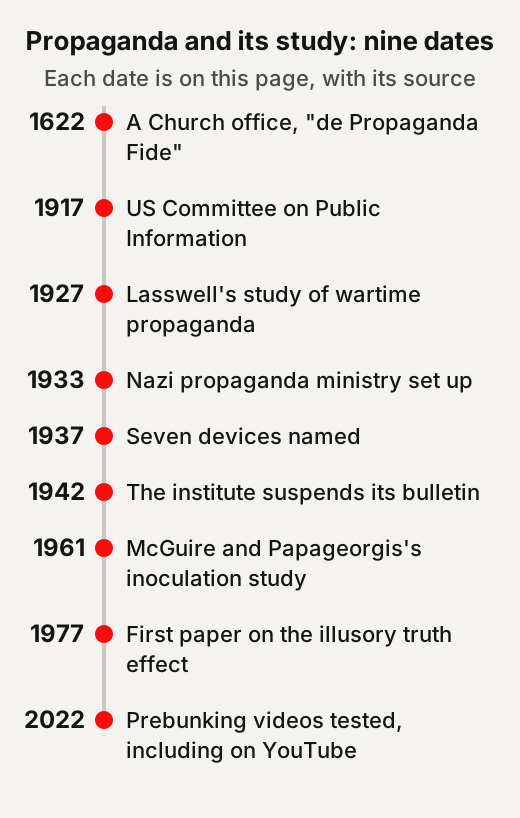
The word began as a name for spreading something, not for lying. In Latin it means “to propagate” or “to sow”. In 1622 Pope Gregory XV established a central office of the Catholic Church to direct missionary work, known as the congregation “de Propaganda Fide”.
So in this early use, the word named an office for propagating the faith. Over time the word took on a negative sense. The textbook authors write that later usage “has rendered the term largely pejorative”. Calling a message propaganda today, they add, gives it a negative and dishonest meaning.
For example, calling the other side’s leaflet “propaganda” and your own side’s leaflet “information” is itself a choice of words worth noticing.
3. The seven classic devices
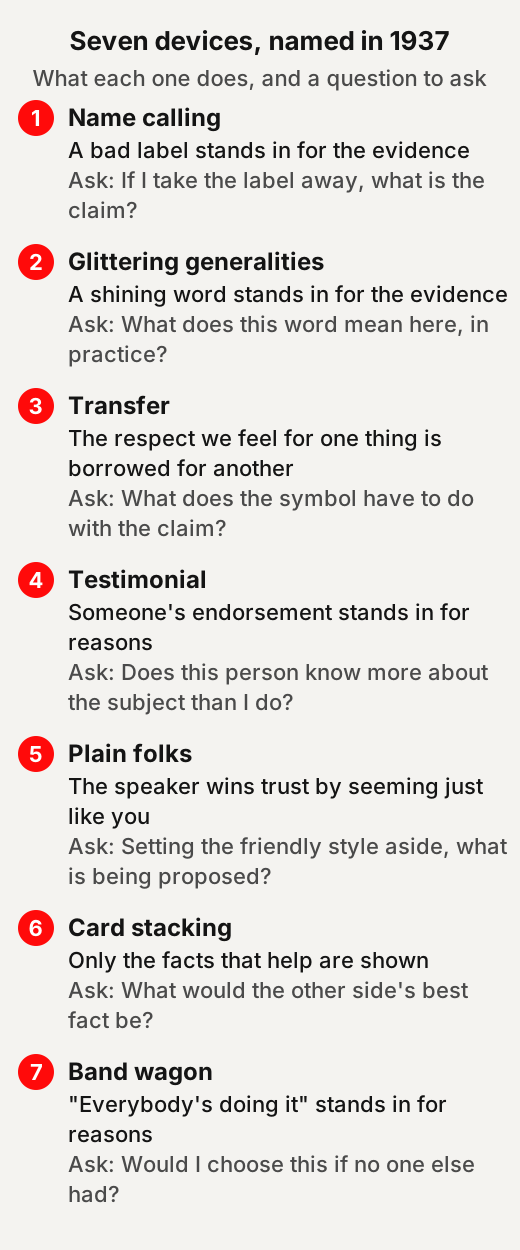
In 1937 an American institute named seven common propaganda devices, to help the public spot them. The Institute for Propaganda Analysis was set up “to assist the public in detecting and analyzing propaganda”. Its November 1937 bulletin, “How to Detect Propaganda”, listed seven devices.
The bulletin said the devices fool us because “they appeal to our emotions rather than to our reason”. It added that this was “not to condemn emotion, an essential part of life”.
The list was written to help the public. The bulletin offers it as a set of labels with examples, suggests practising on the daily newspapers, and reports no experiment behind it. Each device below has the bulletin’s description, an everyday example of ours, and a question you can ask.
Name calling
A bad label stands in for the evidence. The bulletin calls it “a device to make us form a judgment without examining the evidence on which it should be based”. It says the propagandist appeals to our hate and fear.
For example, an advert calls a rival product “junk” without saying what is wrong with it. Ask: if I take the label away, what is the claim?
Glittering generalities
A shining word stands in for the evidence. The propagandist links a program with virtue “by use of ‘virtue words’”. The bulletin’s examples include truth, freedom and honor. It is the mirror image of name calling: a device “to make us accept and approve, without examining the evidence”.
For example, a plan is sold as “the fair choice” with no detail about what it does. Ask: what does this word mean here, in practice?
Transfer
The respect we feel for one thing is borrowed for another. The propagandist “carries over the authority, sanction, and prestige of something we respect and revere to something he would have us accept”. The bulletin points to symbols, such as a flag standing for the nation.
For example, a product advert puts a national flag beside its logo. Ask: what does the symbol have to do with the claim?
Testimonial
Someone’s endorsement stands in for reasons. The bulletin describes a device to make us accept “anything from a patent medicine or a cigarette to a program of national policy”. It notes that the device also works in reverse, with counter-testimonials against a cause.
For example, a famous athlete praises a savings app. Ask: does this person know more about the subject than I do? Our Influence summary covers why authority and liking sway us.
Plain folks
The speaker wins trust by seeming just like you. The bulletin says it is used “to win our confidence by appearing to be people like ourselves”.
For example, a company head records a message at a kitchen table, in an old sweater. Ask: setting the friendly style aside, what is being proposed?
Card stacking
Only the facts that help are shown. The bulletin’s description includes “He omits facts” and “He lets half-truth masquerade as truth”. It called card stacking the hardest device to detect, because it is skilfully done or because “we lack the information necessary to nail the lie”.
For example, an advert quotes the one kind line from a mixed review. Ask: what would the other side’s best fact be?
Band wagon
“Everybody’s doing it” stands in for reasons. The bulletin calls it “a device to make us follow the crowd, to accept the propagandist’s program en masse”.
Popularity is weak evidence, not no evidence. Our logical fallacies cheat sheet explains when it counts for something.
For example, an advert says “Join the thousands who have already switched.” Ask: would I choose this if no one else had?
4. Examples from the 20th-century record
In the 20th century, governments set up offices for propaganda, and a forged document showed how far a false source can travel.
The First World War
The United States set up an official information office for the war. On 13 April 1917, an executive order created the Committee on Public Information. According to the National Archives, it released government news, sustained morale and administered voluntary press censorship.
The war also started the modern study of propaganda. The textbook authors date the modern study of propaganda to after the First World War. Lasswell’s book Propaganda Technique in the World War was published in 1927.
A forged document
A fake source can carry a lie for a very long time. The United States Holocaust Memorial Museum calls The Protocols of the Elders of Zion an antisemitic book used to promote hatred of Jews, and the most widespread antisemitic publication of modern times. It was first published in a newspaper in the Russian Empire in 1903. It falsely presented itself as the record of secret meetings of Jewish leaders.
In 1921 a London Times article exposed it as a fraud, showing that much of it had been copied from a French political satire of 1864. The museum notes that, despite being a forgery, it has been used to spread conspiracy theories about Jews for more than 120 years. Hitler and other top Nazi Party leaders knew it was not factual, the museum adds, and used it anyway to spread hatred of Jews.
In the 1944 terms above, it is black propaganda: a false source carrying false content. The textbook uses it as an example of exactly that.
Nazi Germany
Once in power, the Nazi government ran propaganda through a ministry. A decree of 13 March 1933 established the Reich Ministry for Public Enlightenment and Propaganda, headed by Joseph Goebbels. Its aim was to carry the Nazi message through art, music, theater, films, books, radio, educational materials and the press.
In the periods before new laws and measures against Jews, notably in 1935 and 1938, propaganda campaigns “created an atmosphere tolerant of violence against Jews”. Propaganda also encouraged passivity and acceptance of the coming measures against Jews. The museum concludes that Nazi propaganda played an integral role in advancing the persecution and, in the end, the destruction of Europe’s Jews.
The museum also notes that the stereotypes in Nazi propaganda “were not new, but were already familiar to their intended audience”. The research in section 5 comes back to this point: propaganda built on what people already believed.
The institute stops its bulletin
Even the institute that named the seven devices found it hard to stay neutral in wartime. Its issue of 9 January 1942 said publication was suspended “for the period of the war emergency”. It explained that analyses of all kinds of propaganda are easily misunderstood during a war emergency, and, “more important”, that they could be misused by people opposing the government’s efforts. Making propaganda itself, or even seeming to, it added, would cast doubt on its integrity as a scientific body. To carry on, it said, it would have to analyze all propaganda: that of its own country and its allies, as well as of their enemies.
5. What research found about how propaganda works
Repetition makes claims feel truer, and propaganda seems to work best where it fits existing beliefs. How much it changes minds is argued.
Repetition
Hearing a claim again makes it feel truer, even when it is false. The illusory truth effect is the finding that people rate statements as truer when they have seen them before. The first paper on it was published in 1977, by Lynn Hasher, David Goldstein and Thomas Toppino. In a 2015 set of experiments, repetition made false statements seem truer even when people knew the correct answer.
A 2022 systematic map of 181 studies found that all were run at Western universities, and most used trivia statements in a single session. Our page on choosing what you feed your mind covers how long the effect seems to last.
How sure: Moderate the effect shows up reliably in lab studies, but mostly with trivia statements in a single session.
For example, a slogan you have seen on a hundred posters can start to feel like common sense. That is a good moment to ask where you first heard it.
Fit with what people already believe
Propaganda seemed to work best where people already leaned its way. A 2015 study of radio in 1920s and 1930s Germany looked at what happened after the Nazis established their rule. It found that radio propaganda incited anti-Semitic acts and denunciations of Jews to the authorities by ordinary citizens. It was most effective where anti-Semitism had historically been high, and had a negative effect where it had historically been low.
Another 2015 study used surveys from 1996 and 2006. It found that Germans who grew up under the Nazi regime were much more anti-Semitic than those born before or after that period. Its authors found the indoctrination “most effective where it could tap into preexisting prejudices”.
How sure: Moderate two large studies point the same way, but both are about one country under one regime.
For example, a rumour about a group you already distrust may need less proof to stick than one about a group you like. That is our illustration of the idea, not a finding.
How much propaganda changes minds
Researchers disagree about how powerful propaganda is. The 2015 survey study called Nazi indoctrination “highly effective”. A 2017 review of research found that propaganda, advertising and similar efforts “are generally not very effective at changing” people’s minds. The review argued that when people do accept misleading messages, it is mostly because the message fits what they already believe, not because they defer to the sender.
The two sides differ on how strong propaganda is. On one point they meet: the fit with what people already believe matters. That is our reading of the two papers side by side.
How sure: Unsettled a large historical study and a broad review reach different conclusions about how strong the effect is.
6. Does learning the techniques help you resist?
Learning to name manipulation techniques helps people spot them in tests; whether it lasts in daily life is less clear.
The research idea is called inoculation. The theory follows a medical immunization analogy, and holds that people can build resistance to unwanted persuasion much as medical inoculations build resistance in the body. The 2022 study that describes it this way traces it to a 1961 study by McGuire and Papageorgis.
A 2010 meta-analysis of 54 cases found inoculation messages better at building resistance than supportive messages or no message at all. It also found resistance began to fade after two weeks.
Newer studies teach techniques rather than answers to single claims, much as the 1937 institute did. Their authors argue that focusing on the manipulation techniques behind misinformation may make the approach work at scale.
In a 2022 study in Science Advances, five short videos improved recognition of techniques such as false dichotomies across six randomised experiments with 6,464 people. In the lab the gains ranged from small to medium, depending on the technique, which the authors call substantial for such short videos. The videos covered emotionally manipulative language, incoherence, false dichotomies, scapegoating and ad hominem attacks. In a field test on YouTube the effect was smaller. Recognition rose by about 5% on average, measured by a single test question within 24 hours of the advert. Overall, the field effect fell just short of the smallest size the authors had set in advance as worth finding.
Two questions are still open. Whether these lessons help people tell reliable from unreliable news, and not just name a trick, is disputed, though the larger 2026 reanalysis leans towards yes; our logical fallacies cheat sheet weighs that dispute. Whether any benefit survives a realistic feed has not been shown. In a 2025 study in PNAS Nexus, mixing real posts into a simulated feed “appeared to nullify the effect” of a lesson on emotional manipulation.
How sure: Moderate many experiments show better recognition in tests, but effects outside the lab are smaller and less certain.
For example, after reading section 3, try naming the device in three adverts you see today. Naming a trick is a skill you can practise.
7. Open questions
Some basic questions about propaganda are still open.
- How long repetition lasts. A 2021 registered study of 567 people found it immediately, after a day, a week and a month. It got smaller as the delay grew. That does not fit an earlier meta-analysis, so the question is not settled.
- Whether lessons carry into real life. The prebunking studies measure recognition in tests. A realistic feed is a harder setting, and there the effect has not been shown.
- How strong propaganda is. The studies above disagree on how much propaganda changes minds. In our reading, they agree that it works best where it fits existing beliefs.
8. Something to try
Before you share a message that stirs you up, run four quick checks. These are our suggestions, built from the sections above.
- Name the feeling, then the device. A strong feeling is the cue to look for name calling, glittering generalities or transfer.
- Ask who made it, and what they want you to do. Then ask how accurate it is: those are the questions behind white, gray and black.
- Look for what is missing. Card stacking works by leaving things out.
- Slow down most when it agrees with you. In the studies above, propaganda worked best where it fitted what people already believed.
Quick answers
What is propaganda?
A planned attempt to shape what a group of people thinks and does, for the ends of whoever sends it. The textbook Propaganda and Persuasion calls it "the deliberate, systematic attempt to shape perceptions, manipulate cognitions, and direct behavior".
What are the seven propaganda techniques?
In 1937 the Institute for Propaganda Analysis named seven devices. They are name calling, glittering generalities, transfer, testimonial, plain folks, card stacking and band wagon.
Where does the word propaganda come from?
In Latin it means "to propagate" or "to sow". In 1622 Pope Gregory XV established a central office of the Catholic Church to direct missionary work, known as the congregation "de Propaganda Fide".
What is the difference between white, gray and black propaganda?
In white propaganda the source is identified correctly and the information tends to be accurate. In black propaganda the source is hidden or credited to a false authority. In gray propaganda the source may or may not be correctly identified, and the accuracy is uncertain.
Does learning about propaganda techniques help?
In tests, yes. Short videos improved people's recognition of manipulation techniques. Whether that carries into a real news feed has not been shown.
Use this
Our suggestion, built from the sections above, for any message that stirs you up.
Who made this, and what do they want me to do?
Quick quiz
Nothing is scored or saved. Recalling it once now is what makes it last.
1. Which device makes us form a judgment from a bad label instead of evidence?
Answer: Name calling.Read it again ↑
2. In a 2015 study of 1930s Germany, where did Nazi radio propaganda work best?
Answer: Where anti-Semitism had historically been high.Read it again ↑
3. In a field test on YouTube, by about how much did recognition of a technique rise?
Answer: About 5% on average.Read it again ↑
How we checked this · Last checked November 2026
- We read the Institute for Propaganda Analysis's own bulletins from 1937 and 1942 in the Internet Archive's scans, and the first two chapters of Propaganda and Persuasion (8th edition) in the publisher's sample.
- For the history we used the National Archives, the executive order of April 1917, the German Historical Institute's copy of the decree of March 1933 and the Holocaust Encyclopedia. The museum's site was down on the day, so we read its pages in the Internet Archive.
- For the research we read the abstracts, and the full text where it was open, through Crossref, PubMed, Europe PMC and OpenAlex.
- The 1937 bulletin names politicians of its day as examples. We left them out and used everyday examples of our own.
- Our wording on repetition and on prebunking matches our pages on choosing what you feed your mind, critical thinking in the age of AI, and logical fallacies.
Sources
- N. Snow, G. S. Jowett and V. O’Donnell, Propaganda & Persuasion, 8th edition, Sage, published 2024 (copyright 2025), chapters 1 and 2 (publisher sample chapters).Scholarly
- Institute for Propaganda Analysis, Propaganda Analysis, volume I (October 1937 to October 1938), including “How to Detect Propaganda” (November 1937), Internet Archive.Primary
- Institute for Propaganda Analysis, Propaganda Analysis, volume IV (1940 to 1942), including “We Say Au Revoir” (9 January 1942), Internet Archive.Primary
- H. D. Lasswell, Propaganda Technique in the World War, 1927 (1938 reprint, Internet Archive).Primary
- Holy See Press Office, “Presentation of the International Study Conference on the fourth centenary of Propaganda Fide”, 15 November 2022.Primary
- “Executive Order 2594—Creating Committee on Public Information”, 13 April 1917, The American Presidency Project.Primary
- National Archives, “Records of the Committee on Public Information”, Guide to Federal Records, Record Group 63.Scholarly
- United States Holocaust Memorial Museum, Holocaust Encyclopedia, “Nazi Propaganda” and “Protocols of the Elders of Zion”.Scholarly
- German History Intersections, “Decree Establishing the Reich Ministry for Public Enlightenment and Propaganda (March 13, 1933)”, German Historical Institute Washington.Primary
- M. Adena and colleagues, “Radio and the Rise of the Nazis in Prewar Germany”, The Quarterly Journal of Economics 130(4), 2015.Scholarly
- N. Voigtländer and H.-J. Voth, “Nazi indoctrination and anti-Semitic beliefs in Germany”, PNAS 112(26), 2015.Scholarly
- H. Mercier, “How Gullible are We? A Review of the Evidence from Psychology and Social Science”, Review of General Psychology 21(2), 2017.Scholarly
- L. Hasher, D. Goldstein and T. Toppino, “Frequency and the conference of referential validity”, Journal of Verbal Learning and Verbal Behavior 16(1), 1977.Scholarly
- L. K. Fazio, N. M. Brashier, B. K. Payne and E. J. Marsh, “Knowledge does not protect against illusory truth”, Journal of Experimental Psychology: General 144, 2015.Scholarly
- E. L. Henderson, S. J. Westwood and D. J. Simons, “A reproducible systematic map of research on the illusory truth effect”, Psychonomic Bulletin & Review 29, 2022.Scholarly
- E. L. Henderson, D. J. Simons and D. J. Barr, “The Trajectory of Truth: A Longitudinal Study of the Illusory Truth Effect”, Journal of Cognition 4(1), 2021.Scholarly
- J. A. Banas and S. A. Rains, “A Meta-Analysis of Research on Inoculation Theory”, Communication Monographs 77, 2010.Scholarly
- J. Roozenbeek and colleagues, “Psychological inoculation improves resilience against misinformation on social media”, Science Advances 8(34), 2022.Scholarly
- S. Y. N. Wang and colleagues, “Limited effectiveness of psychological inoculation against misinformation in a social media feed”, PNAS Nexus 4(6), 2025.Scholarly