Shops and venues are built with choices about where things go, what you smell and hear, and how you move. Below are 15 of these ideas, grouped by where you meet them. For each one: what it is, what the research found where someone has tested it, and something to try. Where nobody seems to have measured an idea, we say so and describe it only as something shops are said to do.
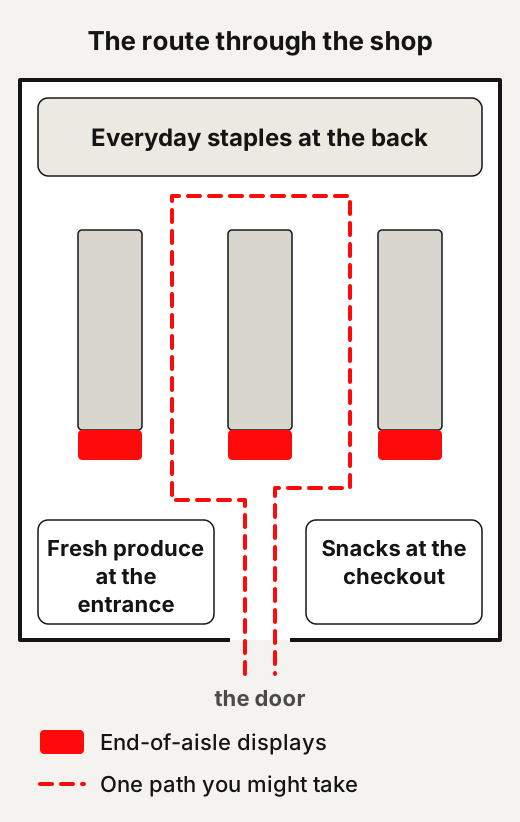
The route through the shop
The layout decides what you walk past, and several of the ideas studied in real shops are about paths.
1. Everyday staples at the back
Milk, bread and other everyday items often sit far from the door.
Example: you come in for milk and pass the snack aisle twice.
Why it’s done: Two reasons are given, and both may be true. A 2014 NPR report found retailers giving both: keeping milk cold all the way from the truck to the store’s cold room, and getting shoppers to walk past other goods. No one the reporter talked to had an empirical study of where milk should go.
Try this: for a quick trip, take the shortest route to the item and back, and leave the trolley at the door.
2. Fresh produce at the entrance
Fruit and vegetables are often the first thing you see.
Example: a wall of bright apples and herbs just inside the door.
What research found: One large trial found a boost at first that faded. A trial in 36 stores of a discount chain in England, run between 2018 and 2022 and published in 2026, moved an expanded fruit and vegetable section near the entrance. Store sales of fruit and vegetables rose by about 2,525 portions per store per week at first. At 3 and 6 months the differences were smaller and not statistically significant. The stores were not chosen at random, which the authors note could bias the results. The authors, who ran it during the COVID-19 pandemic, concluded that putting produce near the entrance may improve what stores sell and what households buy.
Try this: notice whether the first display you meet shapes what you put in the basket.
3. The path you take
Researchers have tracked shoppers’ paths, and wandering further went with buying more. A 2005 study tracked shopping trolleys with radio tags in a real grocery store and sorted the trips into 14 types of path. Its authors wrote that the results dispel common beliefs about aisles, end-of-aisle displays and the “racetrack” loop around a store. A later study found that paths straying further from the shortest route went with larger baskets.
Example: you planned three items and came out with nine after a detour through the middle aisles.
Try this: write your list in the order of the shop’s layout, so the shortest route is the obvious one.
4. Wide aisles and crowds
How busy a part of the shop is changes where people go, and whether they shop there. A 2009 study of grocery shopping paths found that other shoppers draw people towards a zone of the store, but make them less likely to shop there. Wide, open aisles are often said to keep shoppers relaxed, but we did not find a study that tests aisle width itself.
Example: you skip the crowded aisle and come back to it later, or not at all.
Try this: notice whether a crowded spot pulls you in to look, or pushes you on.
5. Malls without windows
Many indoor malls and big shops show little of the outside world. They are often said to be built this way so that shoppers lose track of time and stay longer. We did not find a controlled study that tests it.
Example: you step out of a shopping centre and are surprised that it is already dark.
Try this: set a rough time limit before you go in, and check your phone’s clock once.
What you see
Where a product sits on the shelf, and what sits at the end of the aisle, changes what gets noticed.
6. Eye level, and a child’s eye level
Products on higher shelves get looked at more, though looking is not the same as buying. An eye-tracking study found that the top and middle shelves got more attention than low ones, but only the top shelf lifted how people rated the brand. It also found that the number of facings, how many times a product appears side by side on the shelf, had a strong effect on how people rated it. Shops are also said to put children’s products at a child’s eye level. The studies we found on that came from one lab, so we left them out.
Example: the brand you buy most often sits at the height of your eyes, repeated across half a metre of shelf.
Try this: look one shelf up and one shelf down before you choose.
7. End-of-aisle displays
The ends of aisles are prime space, and in one store they lifted sales a lot. In one UK grocery store in 2010–11, end-of-aisle displays raised drink sales volumes by between 23.2% for beer and 113.8% for tea. The same aisle ends are among the places England now restricts for less healthy foods, alongside store entrances and checkouts, in larger stores.
Example: a stack of crisps on special at the end of the bread aisle.
Try this: when something on an end display catches your eye, check whether it is cheaper than the same item in its own aisle.
8. Seasonal displays
Displays that change with the season give you a reason to look again. Pumpkins in autumn, sun cream in summer, gift sets before holidays: shops are said to use these to make a familiar store feel new. We did not find research that measures the effect of seasonal displays as such.
Example: a pop-up stand of picnic gear near the door on the first warm weekend.
Try this: ask whether you came in needing the seasonal item, or met it on the way.
9. Colour on signs and walls
Colour changes how a space feels, and a meta-analysis, which pools many studies, found warm and cool colours act differently. A meta-analysis of 66 studies found that warm colours produced more arousal than cool ones, while cool colours produced more satisfaction. Across music, scent and colour, it found the average effects were small to medium. Bright red sale signs are a common sight, but we did not find a study we could read that tests them.
Example: a red “SALE” banner over a rack you would otherwise walk past.
Try this: read the price on the label, not the colour of the sign around it.
What you hear, smell and feel
Music, smells and the sense of time all shape how long people stay, though the research here is mixed.
10. Bakery smells
The smell of fresh bread or coffee is often part of the plan. A 1996 study in a simulated shop found that people evaluated and behaved differently in a scented store than in an unscented one. The 66-study meta-analysis found that when a scent was present, people rated their pleasure, satisfaction and intention to return or buy higher. These are mostly ratings, not sales.
Example: a bakery counter by the entrance, baking through the morning.
Try this: eat before a big shop, so a smell is just a smell.
11. Background music and its tempo
Slow music in shops is the classic idea, and the evidence is mixed. The famous result is Ronald Milliman’s 1982 study: in a single supermarket over nine weeks, slow-tempo music brought slower traffic and higher sales than fast-tempo music. A 2012 field experiment found the slow-tempo effect depended on the music: in a minor key slow music did better, while in a major key tempo made no difference. And a 2025 conference paper, testing tempo in 140 stores of one chain, found no significant effect on overall sales, though members of the loyalty programme spent more with slow music.
Restaurants and cafés are said to match the tempo to how fast they want tables to turn. A 1986 restaurant study found that changing the tempo of the music affected purchases and how long people stayed. A 2002 restaurant study found that whether diners liked the music explained the time they spent better than its tempo did. Our page on animal mindsets and shop tricks has more on the music studies.
Example: a slow, quiet playlist in a furniture shop on a Sunday.
Try this: notice the music, then decide your pace yourself.
12. No clocks
Some venues keep clocks out of sight. Casinos and some shops are said to do this so that visitors lose track of time. We did not find a controlled study that tests whether the missing clock changes how long people stay or what they spend.
Example: you look around a casino floor for the time and find only the lights of the machines.
Try this: decide when you will leave before you go in.
Offers and the last few metres
The trolley you push, the offers on the shelf and the checkout itself are the last chances to add something.
13. Large trolleys
A bigger trolley may lead to a bigger shop. In a 2024 conference paper’s three experiments, shoppers with large trolleys bought more products, spent more and stayed longer than those with small ones. It is a conference paper rather than a journal article, so this finding is less certain.
Example: you take a full-size trolley for six items, and it looks oddly empty.
Try this: for a short list, take a basket.
14. Multibuy offers
“Buy one, get one free” and “3 for 2” offers ask you to buy more at once. UK government guidance says food price promotions are widespread and effective at influencing what people prefer and buy, particularly children. That guidance gives 1 October 2025 as the start of England’s limits on multibuy offers for less healthy foods. Our shop tricks page covers two other pricing ideas, the 9-ending price and the decoy option.
Example: two tubs of ice cream for the price of one and a half, when you came in for one.
Try this: work out the price of one unit, and ask whether you would buy the second one on its own.
15. Snacks at the checkout
Sweets and crisps by the till catch you while you wait. When UK supermarkets cleared less healthy foods from their checkouts, households bought 17.3% fewer small packs of sweets, chocolate and crisps straight away. A year later they bought 15.5% fewer. The authors note that the immediate drop held up in their checks, the one-year figure less so, and that other changes may also have played a part. In England, larger shops run by medium and large businesses may not place certain less healthy foods within 2 metres of a checkout, with some exemptions such as specialist retailers.
Example: a child in the queue reaching for chocolate at eye height.
Try this: use the self-checkout or a quieter till, where the wait, and the display, is shorter.
Putting it together
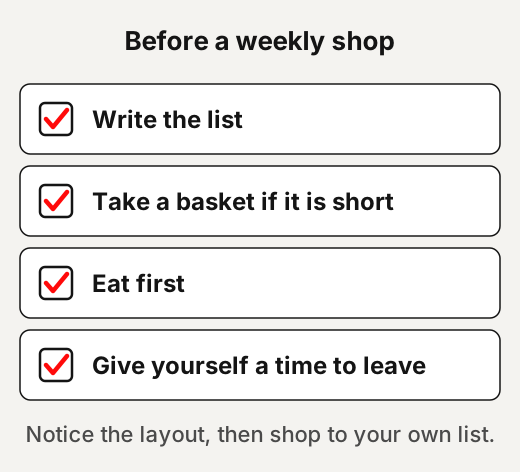
Each idea is small, and together they shape a shop around what the shop wants you to see. None of this means a shop is cheating you. In our reading, many of the same choices also make shopping easier, like fresh food near the door or wide aisles. The useful habit is simply to notice the layout, then shop to your own list.
For example, before a weekly shop: write the list, take a basket if it is short, eat first, and give yourself a time to leave.
| Fresh produce at the entrance | One large trial found a boost at first that faded. |
| The path you take | Wandering further went with buying more. |
| End-of-aisle displays | In one store they lifted sales a lot. |
| Background music and its tempo | Slow music is the classic idea, and the evidence is mixed. |
| Large trolleys | A bigger trolley may lead to a bigger shop; it is a conference paper, so this finding is less certain. |
| Snacks at the checkout | After supermarkets cleared checkout snacks, households bought fewer of them; other changes may also have played a part. |
| Wide aisles | We did not find a study that tests aisle width itself. |
| Malls without windows | We did not find a controlled study that tests it. |
| Seasonal displays | We did not find research that measures the effect of seasonal displays as such. |
| Red sale signs | We did not find a study we could read that tests them. |
| No clocks | We did not find a controlled study that tests whether the missing clock changes how long people stay or what they spend. |
Described here only as something shops are said to do.
Where to learn more
These pages and sources go further on the ideas above.
- Animal mindsets and shop tricks: the 9-ending price, the decoy option and slow music.
- Use emotion honestly: scarcity, urgency and social proof, mostly online.
- The UK government’s implementation guidance on food promotions by location and volume price, with diagrams of the restricted areas.
- Related idea guides: psychological triggers in marketing and 20 pricing strategies.
Quick answers
Why is milk at the back of the supermarket?
Two reasons are given. Retailers told a 2014 NPR report both about keeping milk cold all the way from the truck to the store's cold room, and about getting shoppers to walk past other goods. No one the reporter talked to had an empirical study of where milk should go.
Does slow music make you spend more in shops?
The evidence is mixed. A 1982 study in one supermarket found higher sales with slow music, but a 2025 conference paper testing 140 stores of one chain found no significant effect on overall sales.
Do checkout snacks make people buy more sweets?
When UK supermarkets brought in policies to clear less healthy foods from their checkouts, household purchases of small packs of sweets, chocolate and crisps fell by 17.3% straight away. The authors note other changes may also have played a part.
Do bigger trolleys make you buy more?
Possibly. A 2024 conference paper reported that shoppers with large trolleys bought more products, spent more and stayed longer. It is a conference paper rather than a journal article, so the finding is less certain.
Use this
Our suggestion, built from the sections above, for your next big shop.
Notice the layout, then shop to your own list.
Quick quiz
Nothing is scored or saved. Recalling it once now is what makes it last.
1. In one UK grocery store, what happened when drinks went on end-of-aisle displays?
Answer: Sales volumes rose, by 23.2% for beer up to 113.8% for tea.Read it again ↑
2. In the 2025 conference paper on 140 stores, what did music tempo do to overall sales?
Answer: No significant effect.Read it again ↑
3. In the eye-tracking study, which shelf position carried through to how people rated the brand?
Answer: Only the top shelf.Read it again ↑
How we checked this · Last checked November 2026
- We read the studies' abstracts through Crossref, OpenAlex, PubMed and Europe PMC, and the two conference papers in full.
- The English food promotion rules come from the UK government's implementation guidance on gov.uk.
- Where we found no study that tests an idea, we say so and describe it only as something shops are said to do.
- Our wording on the music studies matches our page on animal mindsets and shop tricks.