

Marketers often reach for a small set of feelings: the fear of missing out, the pull of now, the wish to belong, trust, hope, curiosity, guilt, joy and frustration. Below are nine of these triggers, how each tends to show up when you shop, what researchers found where they looked, and one thing to watch for. Feelings are part of every good decision. The aim here is simply to notice when a message is working on yours.
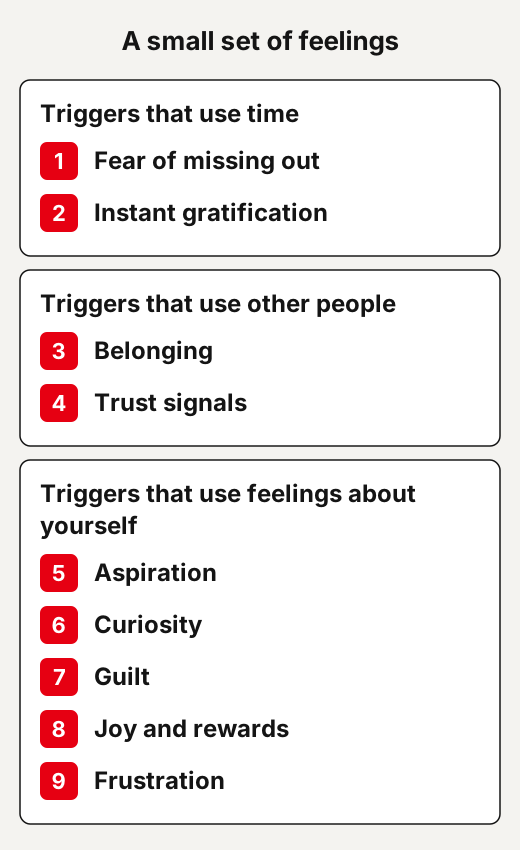
Triggers that use time
Two triggers work on the clock: the fear of missing a deal, and the wish to have something now. Both try to shorten the gap between seeing something and buying it.
1. Fear of missing out (deadlines and “only 5 left”)
A deadline or a low stock count pushes you to decide now. The Cambridge Dictionary defines FOMO as a worried feeling that you may miss exciting events that other people are going to. In shops, the same worry gets attached to a sale or a last few items.
Example: a banner reads “Only 5 left”, and a timer beside it counts down from ten minutes.
What research found: Things in short supply tend to seem more valuable, at least in what people say. In a 1975 experiment, cookies in scarce supply were rated more desirable than the same cookies in abundant supply. A 2022 meta-analysis of 416 effect sizes from 131 studies starts from the finding that scarcity cues generally raise a product’s value and the intention to buy it. Both measure ratings and intentions rather than actual purchases.
Online, these cues are common, and some timers are not what they seem. A 2019 study of about 11,000 shopping websites found countdown timers on 361 of them and low-stock messages on 581. It counted 157 deceptive timers on 140 websites: the timer reset, or the offer stayed valid after it ran out.
A deadline is often framed as a loss: miss it and the deal is gone. Researchers disagree about how strongly losses weigh on us. The figures below come from meta-analyses, studies that pool many earlier studies, and from a re-analysis of one, and they give different answers. A 2024 meta-analysis of 607 estimates put the average loss aversion coefficient at 1.955 — losses weighing roughly twice as much as gains. A 2025 re-analysis of the first meta-analysis’s data found that in studies where gains and losses were the same size and not listed in order, the figure was about 1.07, ‘not significantly above 1.0’. A second 2024 meta-analysis, limited to studies of choices between risky gambles, put the figure at 1.31. Our reading, as on our cognitive biases page, is that loss aversion is probably real in many settings, but its size is still open. Our pages on cognitive biases and on emotional triggers go deeper.
Watch for: a timer that starts again when you reload the page, or a stock count that never changes. Then ask whether you wanted the thing before you saw it was scarce.
2. Instant gratification (have it now)
A reward you can have today often feels worth more than a bigger one later. Economists call this pull present bias.
Example: “Order in the next hour for delivery today”, or “Start watching instantly”.
What research found: On average, people lean towards the sooner reward, though studies vary widely. A 2021 meta-analysis of 220 estimates from 28 articles found that people are on average present-biased, but that the estimates varied a great deal between studies. It also found modest signs that studies over-reported present bias.
Watch for: speed being sold as part of the product. Ask: would I still want this if it arrived next week?
| Fear of missing out | A deadline or a low stock count that pushes you to decide now. |
| Instant gratification | "Order in the next hour for delivery today" |
| Belonging | A long queue outside a new shop. |
| Trust signals | "Money-back guarantee", five gold stars, and a badge that says "Certified". |
| Aspiration | A photo of a cluttered garage, then the same garage spotless. |
| Curiosity | "You won't believe what's inside", a blurred photo, or a box marked "mystery". |
| Guilt | "You promised yourself this year would be different." |
| Joy and rewards | A coffee card that gives a free drink after ten stamps. |
| Frustration | "Tired of tangled cables? Meet the box that hides them." |
Triggers that use other people
Two triggers lean on other people: the crowd that already chose, and the signs that say “you can trust this”.
3. Belonging (the size of the crowd)
Seeing that many others chose something makes it feel like the safe choice. Especially when they are uncertain, people look to what others do to decide what to do themselves.
Example: “Join 2 million happy customers”, or a long queue outside a new shop.
What research found: One well-known test used hotel towels, and researchers still disagree about how strong the evidence is. In the original 2008 hotel study, a sign saying most guests reused their towels beat the standard environmental message: 44.1% against 35.1% reuse in one experiment. Five later replications each failed to reach significance on their own. A 2016 reanalysis that pooled the studies found strong evidence for the effect. Our Influence summary sets out both sides.
The same pull shows up in politics and news. The 1937 list of propaganda devices called it the band wagon, covered in our propaganda techniques page and in the course lesson How does propaganda slip past your reasons?
Watch for: a crowd you cannot see. Ask who is counting, and whether the people in the crowd are like you.
4. Trust signals (guarantees, reviews, badges)
Guarantees, star ratings and badges borrow trust, so it helps to read what stands behind them.
Example: “Money-back guarantee”, five gold stars, and a badge that says “Certified”.
What the rules and research say: A guarantee often comes with conditions, such as returning the item within a set time. In the US, the Federal Trade Commission’s guides say sellers should call something a “Money Back Guarantee” only if they refund the full purchase price at the buyer’s request. The same guides say an advert mentioning such a guarantee should disclose any material limitations or conditions.
Star ratings tend to pile up at the top and the bottom. A 2009 study of Amazon ratings found that 72% to 78% of ratings for books, DVDs and videos were four stars or more. Its authors argued that ratings bunch at five stars, with some one-star ratings and few in between, so the average can be a poor guide to quality.
A badge can count as an endorsement. The FTC’s endorsement guides say the name or seal of an organisation can be an endorsement. Our emotional triggers page covers the rules on fake reviews in the US, the EU and the UK.
Watch for: read the middle reviews, the dates, and the conditions on the guarantee. Ask who gave the badge, and for what.
Triggers that use feelings about yourself
The last five triggers work on how you see yourself: who you hope to be, what you want to know, what you feel you owe, what makes you happy, and what annoys you.
5. Aspiration (before-and-after pictures)
A before-and-after picture invites you to imagine the “after” as yours.
Example: a photo of a cluttered garage, then the same garage spotless, beside a set of storage boxes.
What the rules say: A small “results not typical” line may not change what the picture tells you. The FTC’s endorsement guides say “before” and “after” pictures with a line like “I lost 50 pounds in 6 months” are likely to suggest a typical result. The FTC tested disclosures such as “Results not typical” and found that they did not adequately reduce that impression.
Watch for: one person’s result shown as everyone’s. Ask what most buyers get, not what the happiest buyer got.
6. Curiosity (teasers)
A teaser opens a gap in what you know, and the gap nags until you close it.
Example: “You won’t believe what’s inside”, a blurred photo, or a box marked “mystery”.
What research found: Curiosity can make people give up something scarce to close the gap. A 1994 review described curiosity as a kind of deprivation that arises when we notice a gap in our knowledge or understanding. It also noted curiosity’s tendency to disappoint once satisfied. In a 2009 study using trivia questions, people spent more of a scarce resource, tokens or waiting time, to find out answers they were more curious about.
Watch for: a click or a purchase that only buys the answer. Ask whether you would want the product if you already knew what was inside.
7. Guilt (“you promised yourself”)
A message that hints you have let yourself or others down tries to turn guilt into a purchase.
Example: “You promised yourself this year would be different.”
What research found: One small study found that strong guilt appeals were liked less than milder ones. A 1995 study of 60 working mothers found that moderate guilt appeals made them feel more guilt than weak or strong ones. In that study, anger played a part, and the stronger the guilt appeal, the less they liked the advert and the brand.
Online, a refusal button worded to make you feel foolish is a version of this. The 2019 shopping-site study called it confirmshaming, using shame to steer people away from a choice, and found it on 164 websites.
Watch for: a “No thanks” button that insults you. You can click it anyway.
8. Joy and rewards (points and stamps)
Points, stamps and small wins make buying feel like progress towards a prize.
Example: a coffee card that gives a free drink after ten stamps.
What research found: People tend to speed up as a reward gets close, and a head start, even one handed to them, can speed them up. In a 2006 field study at a real café, customers bought coffee more often the closer they got to a free one. Customers given a 12-stamp card with 2 bonus stamps already filled in finished the 10 purchases faster than customers given a plain 10-stamp card.
Watch for: buying to fill the card. Count what you need, not what is left on the card.
9. Frustration (“tired of X? here’s the fix”)
An advert names a problem you are tired of, then offers itself as the fix.
Example: “Tired of tangled cables? Meet the box that hides them.”
What research found: We found no study that tests this “problem, then fix” pattern in adverts as such. Related work comes from health warnings. In research on public health messages, people seemed to change most when a strong warning came with a step they felt able to take. An older meta-analysis, from 2000, found the greatest behaviour change when strong fear came with high efficacy. Those studies test warnings about risks, not adverts.
Watch for: a problem made bigger than it is. Ask whether the problem is yours, and whether a cheaper fix exists.
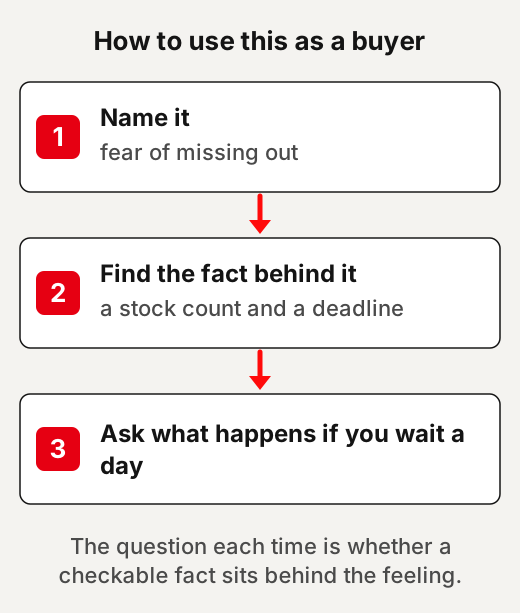
How to use this as a buyer
Naming the trigger gives you a moment to check the facts behind it. None of these feelings is wrong to have. A real deadline, an honest review or a genuine reward can all help you decide well. The question each time is whether a checkable fact sits behind the feeling.
For example: you see “Only 2 left, sale ends tonight”. Name it (fear of missing out), find the fact behind it (a stock count and a deadline), and ask what happens if you wait a day. Our page on emotional triggers has a 30-second pause test and a short quiz for practice.
Where to learn more
These pages go further on each idea, with the research in full.
- Use emotion honestly: how emotional triggers work: fear, scarcity, urgency and social proof, plus the rules in three regions.
- Influence summary: the persuasion principles and what the studies found.
- Cognitive biases, 14 famous findings: loss aversion and other mental shortcuts.
- Propaganda techniques: the seven classic devices from 1937.
- The FTC’s Guides for the Advertising of Warranties and Guarantees and Endorsement Guides, in the US government’s online code of regulations.
- Related idea guides: 20 marketing strategies, 20 pricing strategies and how shops are laid out.
Quick answers
What are psychological triggers in marketing?
They are feelings a message tries to stir so that you act, such as the fear of missing out, belonging, trust, curiosity, guilt or the pull of a reward. Feeling them is normal. The useful step is to check the fact behind the feeling.
Do scarcity messages like "only 5 left" work?
They tend to raise how much people say they want something. A 2022 meta-analysis of 416 effect sizes from 131 studies starts from that finding. Both it and the classic cookie experiment measure ratings and intentions rather than actual purchases.
Are online countdown timers always real?
Not always. A 2019 study counted 157 deceptive timers on 140 shopping websites, where the timer reset or the offer stayed valid after it ran out.
Can I trust the average star rating?
Read beyond it. A 2009 study of Amazon ratings found they bunch at five stars, with some one-star ratings and few in between, so the average can be a poor guide to quality.
Use this
Our suggestion, built from the sections above, for any offer that makes you feel rushed or pulled.
What fact sits behind this feeling, and can I check it?
Quick quiz
Nothing is scored or saved. Recalling it once now is what makes it last.
1. In the 2019 study of shopping websites, what made a countdown timer count as deceptive?
Answer: It reset, or the offer stayed valid after it ran out.Read it again ↑
2. In the FTC's tests of adverts with testimonials, did a "Results not typical" line remove the impression that the results were typical?
Answer: Not adequately, in the FTC's tests.Read it again ↑
3. In the 2006 café study, what sped customers up?
Answer: Getting closer to a free coffee.Read it again ↑
How we checked this · Last checked November 2026
- We read the abstracts of the studies through OpenAlex, Crossref and PubMed, and the 2019 dark-pattern study in full.
- The rules on guarantees and endorsements are quoted from the current US code of federal regulations (eCFR).
- The 2019 study names shopping websites. We left them out and used everyday examples of our own.
- Our wording on scarcity, social proof and loss aversion matches our pages on emotional triggers, Influence and cognitive biases.