A pricing strategy is a seller’s plan for what to charge and how to show the price. Below are 20 common ones, grouped by what they do. Each has an everyday example, what research found where there is some, and one small thing to notice.
1. Prices that play on how we read numbers
These four work on the way we read and compare numbers, not on what the thing costs to make. You can spot all four in shops and online.
Charm pricing (9.99 instead of 10)
A price set just below a round number, such as 9.99 instead of 10.
Example: a jacket labelled 49.99 sits on a rail next to one labelled 50.
Why it works: the leftmost digit of a price can carry extra weight. Prices ending in 9 do feel cheaper, but only when the first digit changes. A 2005 study found a 9-ending price seems smaller than a price one cent higher only when the leftmost digit changes, as with 2.99 against 3.00. Sales can rise even when it does not: in one catalogue test, a dress sold about a third more at $39 than at $34. The sales effect does not always follow: a 2013 field experiment found .99 endings can make no difference. Our page on shop tricks and animal “mindsets” has the fuller story.
Try this: round every price up to the next whole number in your head before you compare.
Psychological pricing (round prices and how a price is written)
Choosing price endings and layouts for the feeling they give, not just the amount.
Example: a restaurant menu prints “29” with no currency sign and no “.00”, while a discount shop prints “28.95”.
How it works: An open marketing textbook from OpenStax describes “odd-even pricing” as a strategy that uses prices ending in odd or even numbers to attract customers. The same textbook says round, even prices are often used for luxury items, to suggest higher quality. It also says longer prices can look more expensive because they take longer to read.
Try this: when a price looks unusually short or tidy, say the full amount out loud.
Anchor pricing
Showing a high number first, so the real price looks small beside it.
Example: a “was” price crossed out above a lower “now” price, or the most expensive item placed at the top of a menu.
Why it works: the textbook calls this price anchoring, a frame of reference that sets what a buyer expects to pay. A number you see first tends to pull your estimate toward it. Amos Tversky and Daniel Kahneman described this “adjustment from an anchor” in 1974. When the Many Labs project tested anchoring questions across 36 samples, the authors wrote that the original studies had produced underestimates of some effects, anchoring among them. That test used a high or low number stated in the question itself. Our page on cognitive biases has more.
Try this: before you look at the “was” price, decide what the item is worth to you.
Decoy pricing
Adding a third option that is clearly worse than one of the others, to make that one look like the smart pick.
Example: a small popcorn, a large one, and a medium priced almost the same as the large.
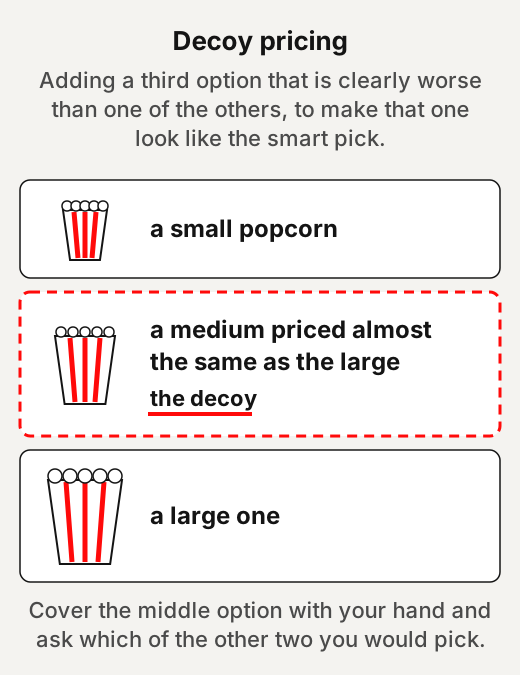
Why it works: it is called the decoy or attraction effect. Huber, Payne and Puto (1982) showed that adding an option clearly worse than one of the others can raise that option’s share. How far it reaches real shopping is argued. Frederick, Lee and Baskin (2014) found the effect may be limited to product descriptions made entirely of numbers, and does not typically occur when people experience the product. Huber, Payne and Puto replied that the effect “remains robust” when the original conditions are replicated.
Try this: cover the middle option with your hand and ask which of the other two you would pick.
2. Pricing something new
These four describe where a new product’s price starts, and who it is meant to reach first.
Penetration pricing
Starting with a low price to win as many customers as possible early on.
Example: a new gym opens with a low monthly fee for its first members.
How it works: The OpenStax textbook describes it as setting the lowest price possible in order to reach the majority of the market in the introduction stage. The aim is to gain as many customers as possible from the start.
Try this: when you sign up for an introductory price, note what the normal price will be and when it starts.
Price skimming
Starting high and lowering the price over time.
Example: a new phone launches at a high price, and the same model costs less a year later.
Where it comes from: The textbook describes setting a high price at first and lowering it over time as new segments of the market are reached. It traces the name to skimming the cream, layer by layer, from raw milk. The first, highest price is aimed at the people keenest to have it first.
Try this: if you do not need it on day one, ask yourself whether waiting a few months matters to you.
Premium (prestige) pricing
A deliberately high price that signals quality or status.
Example: two similar watches, one priced many times higher and sold in a quiet shop with few items on display.
How it works: The textbook describes prestige pricing as setting high prices knowing that demand will increase, because the higher price increases the perceived value of the product. In this case the price itself becomes part of what is being sold.
Try this: list what the expensive version does that the cheaper one does not.
Freemium
A free basic version, with richer features for people who pay.
Example: a note-taking app that is free for one device and charges for syncing across several.
Try this: before you upgrade, check which single feature you are paying for.
| Penetration pricing | Starting with a low price to win as many customers as possible early on. |
| Price skimming | Starting high and lowering the price over time. |
| Premium (prestige) pricing | A deliberately high price that signals quality or status. |
| Freemium | A free basic version, with richer features for people who pay. |
3. Prices that move
These three change the price by time, by demand or by place.
Dynamic pricing (airline seats)
A price that changes over time as demand and the number of seats or rooms left change.
Example: the same flight shows a different fare on Monday than it did on Friday.
How it works: a seller with a fixed number of seats adjusts the price as they sell. A 2012 study of US airline data found that the price increases as the inventory decreases, and decreases as there is less time to sell.
Try this: check the same trip on a few different days before you decide.
Surge pricing
Prices that jump when demand suddenly outstrips supply, as with ride-hailing apps at rush hour.
Example: a ride home after a concert costs several times the usual fare.
How it works: A 2017 study describes ride-hailing platforms that may charge riders prices and pay drivers wages that both adjust based on prevailing demand conditions. The same study notes that surge pricing has been criticised over concerns for the welfare of drivers and riders. In its model, all sides could benefit from surge pricing. That is a model, so how it plays out in a real city is less certain.
Try this: if the app shows a higher multiplier, check again after a short wait or walk a block away.
Geographic pricing
Charging different prices for the same thing in different places.
Example: the same paperback costs a different amount in two countries.
How it works: The Legal Information Institute at Cornell describes price discrimination as a seller charging different purchasers different prices, adding that many price differences are often lawful. For pricing in a foreign market, the OpenStax textbook lists tariffs, the local economy and shipping as factors to consider. So a different price in another country can reflect costs such as tariffs and shipping, the local economy, or both.
Try this: when you buy something online from abroad, compare the total with shipping and duties, not just the shelf price.
| Dynamic pricing | Time: the price changes as demand and the number of seats or rooms left change. |
| Surge pricing | Demand: prices jump when demand suddenly outstrips supply. |
| Geographic pricing | Place: different prices for the same thing in different places. |
4. Packaging the price
These six change what you pay for, or when and how you pay.
Bundle pricing
Several items sold together for less than, or about the same as, they cost separately.
Example: a burger, fries and a drink as a “meal” that costs a little more than the burger alone.
How it works: The OpenStax textbook says bundles are used to prod customers to purchase, and spend, more than they may have otherwise. The saving is real only if you wanted every part.
Try this: add up only the items you would have bought anyway.
Tiered pricing (basic, standard, premium)
Offering the same product in levels, each with more features at a higher price.
Example: a streaming plan with a basic, a standard and a premium level.
How it works: The textbook describes product line pricing as setting a higher price for some lines and lower price points for others, to capture various target markets. A tier priced close to the next one up can work like the decoy described above.
Try this: find the cheapest tier that does the one thing you need.
Subscription pricing
Paying a regular fee for ongoing access instead of buying once.
Example: a monthly fee for a box of coffee beans or a software plan.
How it works: The OpenStax textbook on entrepreneurship notes that subscriptions give the seller cash up front, with the buyer receiving benefits throughout the year. The cost is small each time but adds up.
Try this: once a year, list every subscription you pay and its yearly total.
Loss leaders
One item sold very cheaply, even at a loss, to bring you in to buy other things.
Example: cheap milk at the back of a supermarket, past aisles of snacks.
How it works: The Legal Information Institute describes a loss leader as pricing an item below market value to draw customers in, in the hope that they will buy more. It adds that a store may place the item where customers pass other, higher-margin goods.
Try this: shop the bargain with a list, and leave with only that list.
Pay what you want
The buyer chooses the price, sometimes including zero.
Example: a museum with a suggested donation, or a musician selling an album for whatever fans choose to pay.
What research found: in field studies, people paid more than zero on average. Three field studies published in 2009 found that prices paid were significantly greater than zero, and that this kind of pricing can even raise a seller’s revenue. A 2010 field experiment with 113,047 participants found that pay what you want, with half the revenue going to charity, was substantially more profitable. At a fixed price, the charity part only slightly increased demand.
Try this: pay what the thing was worth to you, and notice what you based that number on.
Buy now, pay later
Splitting a purchase into a few instalments, often without interest if every payment is on time.
Example: a pair of shoes paid for in four parts over a few weeks at checkout.
How it works: this is a form of credit, so it is a loan, not a discount. The UK’s Financial Conduct Authority describes two types: one that charges interest, and an interest-free kind repayable in 12 or fewer instalments over 12 months or less. It says that kind of agreement has been regulated since 15 July 2026 when the lender and the seller are different businesses. Lenders must now give you information, including any late fee, before you take one out. Plans offered by the seller itself, and any taken out before 15 July 2026, are not regulated. Rules differ by country.
Watch for: what happens if a payment is late, and how many of these plans you have running at once.
| Bundle pricing | Several items sold together for less than, or about the same as, they cost separately. |
| Tiered pricing | The same product in levels, each with more features at a higher price. |
| Subscription pricing | A regular fee for ongoing access instead of buying once. |
| Loss leaders | One item sold very cheaply, even at a loss, to bring you in to buy other things. |
| Pay what you want | The buyer chooses the price, sometimes including zero. |
| Buy now, pay later | A form of credit, so it is a loan, not a discount. |
5. How the base price gets set
Behind the presentation, the OpenStax textbook lists cost, rivals and the buyer’s value among the bases sellers price on.
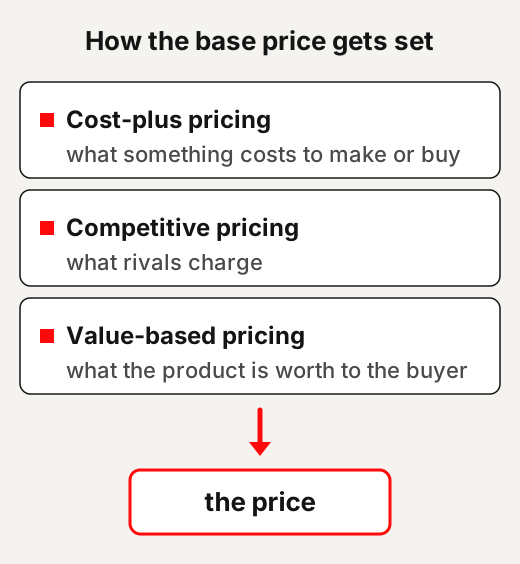
Cost-plus pricing
Working out what something costs to make or buy, then adding a margin on top.
Example: a baker adds a fixed share on top of the cost of flour, butter and time for each loaf.
How it works: The OpenStax textbook calls this a cost-based objective, pricing based on the costs of doing business. It notes that many retailers simply double the wholesale price, known as keystone pricing.
Try this: if you sell anything, write down every cost before you pick a number.
Competitive pricing
Setting the price by looking at what rivals charge.
Example: two petrol stations on the same road keep their prices within a few cents of each other.
How it works: The textbook describes this as pricing based on the prices of a company’s competitors. A seller can choose to match, undercut or sit above them.
Try this: when prices look identical everywhere, compare what else is included, like delivery or support.
Value-based pricing
Setting the price by what the product is worth to the buyer, not what it costs to make.
Example: a spreadsheet template that saves a small firm hours each week is priced by the time it saves, not the hours it took to build.
How it works: The textbook describes it as pricing based on a company’s understanding of the value-added benefits of a product. The same item can be worth very different amounts to different buyers.
Try this: before paying for something, ask what problem it solves and what that is worth to you.
Where to learn more
- OpenStax, Principles of Marketing, chapter 12: a free, open textbook that covers every strategy above in more depth.
- The UK Financial Conduct Authority’s page on buy now, pay later: what changed in 2026 and what lenders must tell you.
- Our pages on shop tricks, Influence and Nudge go deeper on why some of these work.
- Related idea guides: 20 marketing strategies, 20 business models and psychological triggers in marketing.
Quick answers
What is the difference between penetration pricing and price skimming?
Penetration pricing starts with a low price to win as many customers as possible early on. Price skimming starts with a high price and lowers it over time as new segments of the market are reached.
What is a loss leader?
An item priced below market value to draw customers in, in the hope that they will buy more. The Legal Information Institute adds that a store may place it where customers pass other, higher-margin goods.
Does pay what you want pricing work?
In field studies, people paid more than zero on average. Three field studies published in 2009 found prices paid were significantly greater than zero, and that this kind of pricing can even raise a seller's revenue.
What is the decoy effect in pricing?
Adding an option clearly worse than one of the others can raise that option's share. It is real in the lab, and how far it reaches real shopping is argued.
Use this
Our suggestion, built from the strategies above, for the next time a price catches your eye.
If this price were shown plainly, with no anchor or deadline, would I still buy?
Quick quiz
Nothing is scored or saved. Recalling it once now is what makes it last.
1. When does a price ending in 9 feel noticeably cheaper?
Answer: When the first digit changes, as with 2.99 against 3.00.Read it again ↑
2. What does price skimming do?
Answer: Starts high and lowers the price over time.Read it again ↑
3. In a 2012 study of US airline data, what happened to prices as seats sold?
Answer: They went up.Read it again ↑
How we checked this · Last checked November 2026
- Definitions come from two free OpenStax textbooks, Principles of Marketing and Entrepreneurship, read on Business LibreTexts, and from the Legal Information Institute at Cornell.
- For the research we read the abstracts through EconPapers, Crossref and OpenAlex, and the summary pages at Harvard Business Review.
- The charm, decoy and anchoring lines use the same wording as our pages on shop tricks and cognitive biases.
- Buy now, pay later is from the UK Financial Conduct Authority's own consumer page, read in November 2026. Rules differ by country.
- The examples are our own and name no company.