

Start hereIn a 2006 study, students who reread prose passages did better on a test five minutes later. On tests two days or a week later, the students who had taken practice tests remembered substantially more. Why does the method that feels better lose?
Researchers have tested many study habits. Two stand out: test yourself instead of rereading, and spread your study over several days. Below: what holds up, what holds up less well, and a four-week plan.
1. The short list
The first two rows are the two habits a 2013 review rated highest.
| Method | What you do | How it holds up |
|---|---|---|
| Test yourself | Recall from memory, then check | Holds up |
| Space it out | Spread the same study over several days | Holds up |
| Mix problem types | Practise different kinds of problem in one session | Partly |
| Explain it in your own words | Say why each step or fact is true | Partly |
| Learn from worked examples | Study solved problems before solving your own | Holds up for beginners |
| Sleep and memory | People recall more after sleep than after the same time awake | Holds up, modest effect |
A 2013 review of ten study techniques gave its highest rating to two: practice testing and spaced practice. It said they “benefit learners of different ages and abilities”. It rated highlighting and rereading of low utility.
2. Methods that hold up
These habits have research behind them; the “How sure” line under each says how much.
Test yourself
Holds up Recalling what you studied helps you remember it better than reading it again. Recalling from memory is one of the two habits the 2013 review rated highest. Researchers call this retrieval practice, or the testing effect.
How sure: Strong a review of 222 classroom studies backs it; for maths, there are too few studies yet to say.
In a 2006 study, students who reread prose passages did better on a test five minutes later. On tests two days or a week later, the students who had taken practice tests remembered substantially more.
Rereading did raise the students’ confidence that they would remember the material.
A 2021 review of 222 classroom studies, covering 48,478 students, found that quizzing raised achievement to a medium extent. How much it helped depended on things like corrective feedback and how many times students were tested.
Maths is the open question. A 2025 meta-analysis of maths learning found, across only seven studies, no reliable benefit yet for testing over restudying.
For example, after reading a chapter, close the book, write down its main points from memory, then check what you missed.
Space it out
Holds up Spreading study over several sessions beats cramming it into one. Cramming helps in the short term; spreading study out helps you remember for longer. Researchers call this the spacing effect.
How sure: Strong reviews covering hundreds of experiments agree; in maths the benefit may be smaller.
A 2006 review of 317 experiments on verbal recall found that the best gap between sessions grows with how long you need to remember. In a 2008 study of more than 1,350 people, the best gap was about 20 to 40% of the time until a test a week away. For a test a year away, it was about 5 to 10%.
Our arithmetic from those figures: for a test in a week, a first review after one to three days. To remember for a year, review after roughly three to five weeks. Treat that as a rough guide from one large study, not a formula. For example, for new words you need next week, you might review them the day you learn them, two days later and the day before the test.
A 2021 meta-analysis found a strong benefit when self-tests were spaced out rather than massed together. It found no significant difference between gaps that grow longer and gaps that stay even. Growing gaps did better the more times learners were tested. The same 2025 maths meta-analysis found a small-to-medium benefit for spacing, possibly smaller than in other subjects.
Combining the two, testing yourself until you get each item right and repeating that on later days, is called successive relearning. In two experiments it improved course exam results and long-term retention. For maths procedures, a 2020 study of 431 college students found only a small advantage.
Mix problem types
Partly Mixing different kinds of problem in one session helps with some material, not all. Mixing helps most with pictures, a little with maths, and practising one kind at a time did better with word lists. Researchers call this interleaving.
How sure: Moderate a 59-study review and a large randomised controlled trial in classrooms support it, but results depend on the material.
In a randomised trial in 54 seventh-grade maths classes, the classes given interleaved assignments scored 61% against 38% on an unannounced test a month after a review. The authors add that important caveats remain.
A 2019 meta-analysis of 59 studies found a moderate benefit overall. It was largest for paintings and other visual material, and small for maths tasks. It was unclear for expository texts, and for word lists practising one category at a time did better.
For example, a maths worksheet can mix area, volume and percentage questions, so each one makes you decide which method fits.
Explain it in your own words
Partly Explaining why something is true, to yourself or to someone else, helps you learn it. Explaining helps, but it has been tested less in real classrooms than quizzing and spacing. Researchers call this self-explanation.
How sure: Moderate two reviews support it, but classroom tests are few and it made worked examples less effective in maths.
Two limits keep this at “partly”. The 2013 review rated self-explanation only moderate, partly because it had not been adequately tested in real classrooms. A 2023 maths meta-analysis found that adding self-explanation prompts to worked examples made them less effective.
For example, after each line of a solved problem, say out loud why it follows from the line before.
Learn from worked examples
Holds up Beginners learn a new procedure better from solved examples than from solving problems straight away. Studying solved examples first helps beginners; once you know the task, solving problems helps more.
How sure: Moderate a 55-study review supports it, but mostly in maths and other step-by-step tasks.
A 2023 meta-analysis of 55 studies, from primary school to university, found a medium effect of worked examples on maths performance. Correct examples on their own worked better than incorrect ones or a mix.
Researchers describe an expertise reversal: once you know the task, solving problems becomes the better way to learn. These effects have mainly been studied with highly structured tasks.
For example, before writing your first spreadsheet formula, study two or three finished ones and work out why each part is there.
Sleep and memory
Holds up People remember more after sleep than after the same time awake, though the effect is modest. Sleep after study goes with better memory, but the effect is smaller than once thought.
How sure: Moderate a 177-article review finds a benefit for episodic memory, but a 2021 review calls it smaller and less robust than assumed.
A 2021 meta-analysis of 177 articles found a moderate benefit of sleep for episodic memory, our memory of particular events. After allowing for selective reporting, the benefit was smaller but still significant.
A 2021 review found that several key findings could not be replicated or occurred only under certain conditions. It suggested that the effects of sleep on memory are “smaller, more task-dependent” and “less robust” than once assumed.
This section describes research only. It is not advice about sleep. Our Why We Sleep summary looks at sleep claims in more depth.
Why the methods that work feel slower
The methods that work often feel harder, so they can seem less useful than they are.
Robert and Elizabeth Bjork write that how well you do during practice “can be a highly unreliable index of whether learning has occurred”. Rereading, they note, can give a sense of familiarity that we take for understanding.
In a randomised study of college physics classes, students in active classes learned more but rated their learning lower than students taught by lecture. The Bjorks add a limit: a difficulty only helps if you have the background to respond to it successfully.
For example, rereading your notes feels smooth, while a blank-page quiz can feel like failing. That smooth feeling is not a reliable sign of what you have learned.
Our stretch zone guide looks at how to find that useful level of difficulty.
3. Popular ideas, checked
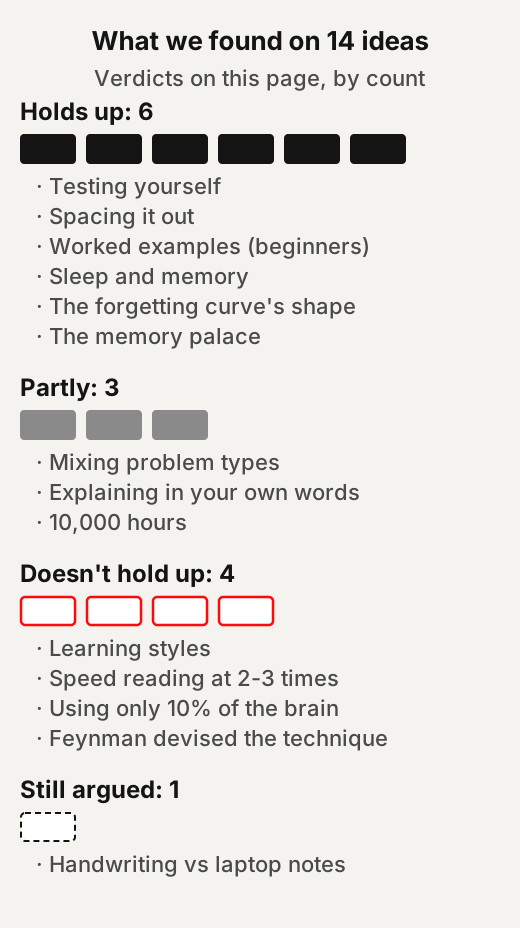
Of these eight ideas, two hold up and four don’t.
“I’m a visual learner”
Doesn't hold up You learn best when lessons match your learning style. Matching lessons to a learning style makes little or no difference in the better studies. The idea is easy to believe, because preferences are real.
How sure: Strong reviews from 2008 to 2025 agree that matching adds little.
But a 2008 review found virtually no evidence of the result that would show matching works: each style doing best with its own method. Of the few studies with a suitable method, several found results that “flatly contradict” the idea. The authors added that many versions of learning styles have simply not been tested at all.
A 2024 meta-analysis of 21 studies found an overall benefit from matching. But only 26% of its outcome measures showed the pattern the idea predicts. Its authors judged the benefits “too small and too infrequent to warrant widespread adoption”. They pointed to the time and cost of putting it into practice and to the low quality of the studies. A 2025 review drawing on 17 meta-analyses put the effect in studies testing matching at d = .04, which is almost no difference.
Our reading: match the format to the material, not the person, such as a map for geography or audio for pronunciation.
The forgetting curve
Holds up Memory fades fast at first, then more slowly. Forgetting is steepest just after learning, then slows down.
How sure: Moderate a 1996 review of 210 data sets found the same few curve shapes fit most; the classic figures come from one man.
Hermann Ebbinghaus measured it on himself, learning lists of nonsense syllables. He measured forgetting as the work it took to relearn a list.
An hour after learning, relearning took half the original work. About a third of the first effort still persisted after a day, and fully a fifth after a month. A 2015 replication with one person found results similar to his.
Our reading: his figures measure work saved in relearning meaningless syllables. They don’t tell you what share of a real lesson you will forget. The useful part is the shape: an early review catches the steepest drop.
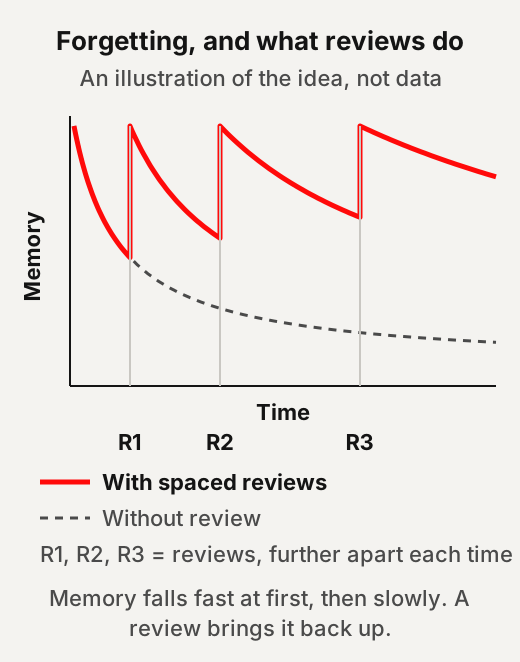
For example, if you learn ten new words on Monday, a short quiz on Tuesday is the kind of early review this shape points to.
“10,000 hours”
Partly It takes 10,000 hours of practice to get really good. Practice matters, by an amount that varies a lot from field to field; the number is not a rule.
How sure: Moderate a large corrected review measured it, but Ericsson disputes how it defined practice.
A 2014 meta-analysis, as corrected by its authors in 2018, measured how much of the differences in performance deliberate practice explained. It was 24% in games, 23% in music and 20% in sports, but 5% in education and 1% in professions. Ericsson replied that it defined deliberate practice much more broadly than he had.
In plain terms, deliberate practice explained about a quarter of the differences between people in games and music, and very little in professions. For example, an hour spent on the one chord change you keep missing, checked against a recording, aims practice at a weak spot instead of just adding hours.
Our summaries of Outliers and Grit cover this debate in full.
Speed reading
Doesn't hold up You can train yourself to read two or three times faster with the same understanding. Reading much faster usually means understanding less, so skimming suits only times when the gist is enough.
How sure: Moderate one broad 2016 review of reading research finds a trade-off between speed and understanding.
A 2016 review found it unlikely that readers can double or triple their speed and still understand the text as well. Its example was going from around 250 to 500–750 words per minute.
Skimming gets you through faster with moderate comprehension, if full understanding is not the goal.
For example, skim a news article for its main point, but read a contract or a recipe word by word.
“We only use 10% of our brain”
Doesn't hold up We only ever use 10% of our brains. Virtually every part of the brain gets used.
How sure: Limited we rely on one neurologist’s account in Scientific American and did not review brain research ourselves.
“We use virtually every part of the brain, and that [most of] the brain is active almost all the time,” the Johns Hopkins neurologist Barry Gordon told Scientific American. The same article allows that at certain moments, such as when we are simply at rest and thinking, we may be using only 10 percent of our brains. What doesn’t hold up is the idea that the rest is never used.
The “Feynman technique”
Doesn't hold up The physicist Richard Feynman devised the “Feynman technique”. The routine is a study-skills idea, named in 2011 as far as we found, and only loosely based on Feynman’s practices.
How sure: Moderate the writer who named it says so himself, but a search cannot rule out an earlier use.
The earliest named use we found is a September 2011 post by the study-skills writer Scott Young. In 2024 he wrote that it was “the most popular piece of studying advice” he had come up with. He added that it is “only loosely based on Richard Feynman’s practices”.
Feynman did prize plain explanation. In a 1996 article, David Goodstein recalls asking Feynman to explain a hard result in physics so that he could understand it. Feynman offered to prepare a freshman lecture on it. A few days later he came back to say: “I couldn’t reduce it to the freshman level. That means we don’t really understand it.” The routine itself rests on the explaining research above, which partly holds up.
For example, explain how a bicycle’s gears work on a blank page as if to a twelve-year-old, then look up the parts you skipped.
The memory palace
Holds up Placing things along a familiar route in your mind helps you recall them. Picturing items along a familiar route helped recall in trials, mostly with university students.
How sure: Moderate 13 randomised controlled trials show a medium effect, but their authors flag a high risk of bias.
A 2021 meta-analysis of 13 randomised trials, mostly in universities, found a medium effect. Its authors also found a high risk of bias, because most trials did not report steps to prevent bias in how people were assigned to groups.
Our reading: it suits lists you need in order more than understanding an idea. For example, to remember a shopping list, picture the milk on your doorstep, the bread on the hall table and the eggs on the sofa. Then walk the route in your head.
Handwriting vs laptop notes
Still argued Notes taken by hand help you learn more than notes typed on a laptop. Handwriting may give a small edge, but the studies disagree.
How sure: Unsettled a direct replication and a newer meta-analysis disagree; the evidence leans to a small edge for handwriting.
In three studies published in 2014, students who took notes on laptops did worse on conceptual questions than students who wrote by hand. The authors linked it to laptop users copying lectures word for word.
A 2021 direct replication again found that laptop users took more word-for-word notes. But its authors concluded that the results “do not support the idea that longhand note taking improves immediate learning via better encoding of information”. Its exploratory meta-analyses of eight similar studies echoed this pattern.
A 2024 meta-analysis of 24 studies of college students found that taking and reviewing notes by hand led to higher achievement. Typing produced more notes.
Our reading: the evidence leans towards a small edge for handwriting, not a large one. The larger, newer review found a small advantage for taking and reviewing notes by hand. The direct replication, with no chance to review, did not support a longhand advantage for immediate learning.
For example, whichever you use, write the speaker’s point in your own words rather than copying it word for word.
4. A four-week plan
This is our suggestion, not a tested programme. It uses only the methods above that hold up or partly hold up. Week 2’s daily round of cards, until each is right once, is a form of successive relearning. It assumes one topic with a good source and about 30 to 45 minutes a day.
| Week | Focus | What to do |
|---|---|---|
| 1 | Learn it for recall | After each short chunk, close the source, write what you remember, then check. Turn key points into question cards. Study worked examples before new procedures. |
| 2 | Space and mix | Daily, go through your cards until each is right once. Mix problem types you have met. Explain one big idea from memory; reopen the source where you stall. |
| 3 | Stretch | Work on your weakest spot, checking each try against an answer key or a teacher. |
| 4 | Check yourself | Take a closed-book test on the whole topic and fix the gaps. Review cards every few days, then weekly. Teach the topic to someone. |
If it isn’t working
If the plan stalls, try one of these.
- You get almost nothing right. The difficulty may be too high to help. Go back to worked examples or a smaller chunk.
- The cards pile up. Keep only the points you need. Even gaps between reviews are fine; they don’t need to grow.
Quick answers
What is the fastest way to learn something?
Two methods have the strongest support, testing yourself and spreading study over several days. A 2013 review of ten study techniques gave those two its highest rating.
Are learning styles real?
People do have preferences, but a 2008 review found virtually no evidence that matching teaching to a learning style improves learning. A 2024 meta-analysis found an overall benefit from matching, but its authors judged it too small and too infrequent to warrant widespread adoption.
Does speed reading work?
A 2016 review found it unlikely that readers can double or triple their speed and still understand the text as well. Skimming gets you through faster, with moderate comprehension.
Is it better to take notes by hand or on a laptop?
It is still argued. Three studies published in 2014 found handwriting better on conceptual questions, a 2021 direct replication did not support that, and a 2024 meta-analysis found handwritten notes led to higher achievement among college students.
What is the Ebbinghaus forgetting curve?
It is Hermann Ebbinghaus's measure of how fast memory fades, from tests on himself with lists of nonsense syllables. An hour after learning, relearning a list took half the original work.
Use this
Our suggestion, built only from the methods above that hold up or partly hold up, over four weeks.
Could I recall this tomorrow without looking?
Quick quiz
Nothing is scored or saved. Recalling it once now is what makes it last.
1. In the 2006 study, who remembered more on the later tests?
Answer: Students who had taken practice tests.Read it again ↑
2. What did a 2021 meta-analysis find about review gaps that grow longer?
Answer: No significant difference from even gaps.Read it again ↑
3. Where does the earliest named use of the "Feynman technique" that we found come from?
Answer: A study-skills writer's post in 2011.Read it again ↑
How we checked this · Last checked October 2026
- For the reviews and studies we read the abstracts through PubMed, ERIC, Crossref and OpenAlex, and the full text where it was open, including the 2020 deliberate-practice review and the 2024 learning-styles meta-analysis.
- We read Ebbinghaus in the 1913 English translation and Quintilian in H. E. Butler's translation.
- We could not open the full text of the 2021 note-taking replication, so we use only the findings and conclusion in its abstract.
- The origin of the "Feynman technique" is the earliest named use we found. A search cannot prove there is no earlier one.
- Our wording on spacing, mixing and deliberate practice matches our Range, Outliers and Grit summaries.
Sources
- J. Dunlosky and colleagues, “Improving Students’ Learning With Effective Learning Techniques”, Psychological Science in the Public Interest 14(1), 2013.Scholarly
- H. L. Roediger and J. D. Karpicke, “Test-enhanced learning: taking memory tests improves long-term retention”, Psychological Science 17(3), 2006.Scholarly
- C. Yang and colleagues, “Testing (quizzing) boosts classroom learning: A systematic and meta-analytic review”, Psychological Bulletin 147(4), 2021.Scholarly
- E. Murray, A. J. Horner and S. M. Göbel, “A Meta-analytic Review of the Effectiveness of Spacing and Retrieval Practice for Mathematics Learning”, Educational Psychology Review 37, 2025.Scholarly
- H. Ebbinghaus, Memory: A Contribution to Experimental Psychology (1885), translated by H. A. Ruger and C. E. Bussenius (1913), chapters 3, 7 and 8.Primary
- N. J. Cepeda and colleagues, “Distributed practice in verbal recall tasks: A review and quantitative synthesis”, Psychological Bulletin 132(3), 2006.Scholarly
- N. J. Cepeda and colleagues, “Spacing effects in learning: a temporal ridgeline of optimal retention”, Psychological Science 19(11), 2008.Scholarly
- A. Latimier, H. Peyre and F. Ramus, “A Meta-Analytic Review of the Benefit of Spacing out Retrieval Practice Episodes on Retention”, Educational Psychology Review 33, 2021.Scholarly
- K. A. Rawson, J. Dunlosky and S. M. Sciartelli, “The Power of Successive Relearning: Improving Performance on Course Exams and Long-Term Retention”, Educational Psychology Review 25, 2013.Scholarly
- K. A. Rawson, J. Dunlosky and J. L. Janes, “All Good Things Must Come to an End: A Potential Boundary Condition on the Potency of Successive Relearning”, Educational Psychology Review, 2020.Scholarly
- D. Rohrer and colleagues, “A randomized controlled trial of interleaved mathematics practice”, Journal of Educational Psychology 112, 2020.Scholarly
- M. Brunmair and T. Richter, “Similarity matters: A meta-analysis of interleaved learning and its moderators”, Psychological Bulletin 145(11), 2019.Scholarly
- K. Bisra and colleagues, “Inducing Self-Explanation: a Meta-Analysis”, Educational Psychology Review 30, 2018.Scholarly
- K. Kobayashi, “Learning by Preparing-to-Teach and Teaching: A Meta-Analysis”, Japanese Psychological Research 61, 2019.Scholarly
- C. A. Barbieri and colleagues, “A Meta-Analysis of the Worked Examples Effect on Mathematics Performance”, Educational Psychology Review, 2023.Scholarly
- F. Nievelstein and colleagues, “The Worked Example and Expertise Reversal Effect in Less Structured Tasks: Learning to Reason about Legal Cases”, Contemporary Educational Psychology, 2013.Scholarly
- S. Berres and E. Erdfelder, “The sleep benefit in episodic memory: An integrative review and a meta-analysis”, Psychological Bulletin 147(12), 2021.Scholarly
- M. J. Cordi and B. Rasch, “How robust are sleep-mediated memory benefits?”, Current Opinion in Neurobiology 67, 2021.Scholarly
- E. L. Bjork and R. A. Bjork, “Making things hard on yourself, but in a good way”, in Psychology and the Real World, 2011.Scholarly
- L. Deslauriers and colleagues, “Measuring actual learning versus feeling of learning in response to being actively engaged in the classroom”, PNAS 116(39), 2019.Scholarly
- H. Pashler, M. McDaniel, D. Rohrer and R. Bjork, “Learning Styles: Concepts and Evidence”, Psychological Science in the Public Interest 9(3), 2008.Scholarly
- V. Clinton-Lisell and C. Litzinger, “Is it really a neuromyth? A meta-analysis of the learning styles matching hypothesis”, Frontiers in Psychology 15, 2024.Scholarly
- American Psychological Association, APA Dictionary of Psychology, “spacing effect” and “testing effect”.Scholarly
- J. Hattie and T. O’Leary, “Learning Styles, Preferences, or Strategies? An Explanation for the Resurgence of Styles Across Many Meta-analyses”, Educational Psychology Review 37(2), 2025.Scholarly
- J. M. J. Murre and J. Dros, “Replication and Analysis of Ebbinghaus’ Forgetting Curve”, PLoS One 10(7), 2015.Scholarly
- D. C. Rubin and A. E. Wenzel, “One hundred years of forgetting: A quantitative description of retention”, Psychological Review 103(4), 1996.Scholarly
- K. A. Ericsson and R. Pool, excerpt from Peak, “Malcolm Gladwell got us wrong”, Salon, 2016.Primary
- D. Z. Hambrick, B. N. Macnamara and F. L. Oswald, “Is the Deliberate Practice View Defensible?”, Frontiers in Psychology 11, 2020.Scholarly
- K. A. Ericsson, “Given that the detailed original criteria for deliberate practice have not changed, could the understanding of this complex concept have improved over time? A response to Macnamara and Hambrick (2020)”, Psychological Research 85, 2021.Scholarly
- K. Rayner and colleagues, “So Much to Read, So Little Time: How Do We Read, and Can Speed Reading Help?”, Psychological Science in the Public Interest 17(1), 2016.Scholarly
- Scientific American, “Do People Only Use 10 Percent of Their Brains?”.Popular
- S. H. Young, “Learn Faster with the Feynman Technique”, 2011 (Internet Archive copy), and “5 Keys to Get the Most out of the Feynman Technique”, 2024.Primary
- D. L. Goodstein and J. R. Goodstein, “Feynman’s Lost Lecture: The Motion of Planets Around the Sun”, Engineering & Science 59(3), Caltech, 1996.Primary
- Quintilian, Institutio Oratoria XI.2, translated by H. E. Butler (LacusCurtius).Primary
- C. Twomey and M. Kroneisen, “The effectiveness of the loci method as a mnemonic device: Meta-analysis”, Quarterly Journal of Experimental Psychology 74(8), 2021.Scholarly
- P. A. Mueller and D. M. Oppenheimer, “The pen is mightier than the keyboard: advantages of longhand over laptop note taking”, Psychological Science 25(6), 2014.Scholarly
- H. L. Urry and colleagues, “Don’t Ditch the Laptop Just Yet: A Direct Replication of Mueller and Oppenheimer’s (2014) Study 1 Plus Mini Meta-Analyses Across Similar Studies”, Psychological Science 32(3), 2021.Scholarly
- A. E. Flanigan and colleagues, “Typed Versus Handwritten Lecture Notes and College Student Achievement: A Meta-Analysis”, Educational Psychology Review 36, 2024.Scholarly