
Start hereIn two student studies, procrastinators reported lower stress early in the semester. Late in the term they reported higher stress, and they got lower grades on all assignments. So why does the delay feel better at first?
Putting things off is often less about time than about how a task feels. Psychologists describe it as a way to escape an unpleasant feeling now, at a cost later. What helps: make the start tiny, plan the moment, go easy on yourself after a slip, and keep temptations out of reach.
1. What procrastination is
Procrastination means choosing to delay something you meant to do, while knowing the delay may cost you.
The APA Dictionary of Psychology defines procrastination as “the unnecessary and voluntary delay of intended tasks despite awareness of potential negative consequences for oneself or others”. The psychologists Fuschia Sirois and Tim Pychyl describe the same idea: delaying an intended action while knowing you will probably be worse off for it.
Our reading: so not every delay counts. Waiting for information you need, or dropping a task that no longer matters, is a choice, not procrastination.
For example, leaving an awkward email unsent all week, while knowing each day makes it harder, fits the definition.
2. Why we put things off
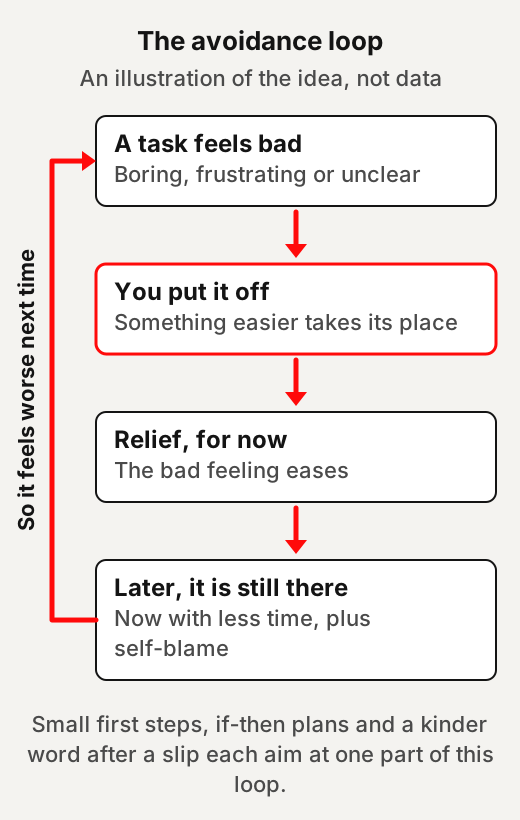
Current research frames procrastination as a way of escaping how a task makes you feel.
Emotion regulation is how people manage and change their own feelings. Procrastination can work as a quick, short-lived version of it.
The same APA entry says contemporary research frames procrastination as an emotion regulation strategy. In that view, people avoid not the task itself but the negative emotions tied to it, such as anxiety, frustration or boredom. The psychologists Fuschia Sirois and Tim Pychyl argue it “has a great deal to do with short-term mood repair and emotion regulation”. Our motivation vs discipline guide covers this idea briefly; this page goes further into what to do about it.
They write that it happens most often with tasks that feel aversive: boring, frustrating, or lacking meaning or structure. The consequences of the delay are typically borne by the future self. They add that falling behind has been linked to self-blame, which in turn predicts stress and anxiety.
A 2007 meta-analysis of 691 correlations found that strong and consistent predictors of procrastination included task aversiveness, task delay, self-efficacy and impulsiveness. Conscientiousness and its facets, including self-control, distractibility and organisation, were strong predictors too. Neuroticism, rebelliousness and sensation seeking showed only a weak connection.
In temporal motivation theory, which that review’s results fit, procrastination is more likely with tasks of low expectancy, low value and distant rewards, combined with high impulsiveness. In plain words, four things make a task easy to put off:
| What makes a task easy to put off | What it looks like | What you could try (our suggestion) |
|---|---|---|
| It feels unpleasant | Boring, frustrating, or without a clear structure | Make the first step tiny and clear |
| You doubt you can do it | Low expectation of success | Start with the part you already know how to do |
| The payoff is far away | Distant rewards | Fix a near, specific time to start |
| You act on impulse easily | High impulsiveness | Put the main distraction out of reach |
For example, a long form can be boring, confusing and not due for months, all at once. That is three of the four.
3. What helps, and how sure we can be
Several methods have research behind them; the “How sure” line under each says how much.
Make the first step tiny
A first step small enough to be easy makes the task feel less bad to start; this is our reading, not a tested rule.
The Two-Minute Rule says a new habit should take less than two minutes to start: “read before bed each night” becomes “read one page”. Our Atomic Habits summary looks at that book’s ideas in full.
It fits the research above: if the feeling is what you are avoiding, a smaller first step brings less of it.
How sure: Limited it follows from the mood-repair research, but we found no trial testing tiny first steps on their own.
For example, “write the report” becomes “open the file and type the title”.
Plan the moment with an if-then plan
Partly If-then plans stop you putting things off. If-then plans help people act on goals in general; trials aimed at procrastination itself disagree.
How sure: Moderate large reviews support if-then plans in general; the procrastination trials we found are small and mixed.
An if-then plan names the moment and the action in advance. Psychologists call it an implementation intention. Peter Gollwitzer described such plans in a 1999 paper as plans that link anticipated critical situations to goal-directed responses.
A 2006 meta-analysis of 94 tests found a medium-to-large effect on reaching goals; a 2024 update of 642 tests found them effective. Allowing for publication bias, the effect is small. Our goal funnel guide covers that research in full.
The tests on procrastination point both ways. In a 2008 study of 152 students, those who made an if-then plan to attend an appointment had nearly 8 times the odds of keeping it. Odds compare the chance something happens with the chance it doesn’t, so when an outcome is common, 8 times the odds is much less than 8 times as likely. In plain words, far more of the planners turned up. But in a 2017 study of 177 students, neither goal-setting exercises nor if-then plans significantly reduced academic procrastination over three weeks.
A 2026 randomised trial of 81 students compared if-then plans paired with mental contrasting against positive thinking. The group that combined both found tasks less aversive and was more willing to start them, and the effect lasted to a one-week follow-up. Mental contrasting means picturing the goal, then the obstacles in the way.
Our reading: an if-then plan costs a minute and holds up in general, so it is worth a try, even if it is no sure cure for procrastination.
For example: “If I sit down with my coffee at 9, then I write one sentence of the report before opening email.”
Go easy on yourself after a slip
Partly Being kind to yourself about procrastinating makes you procrastinate less. Self-compassion goes with less procrastination and less stress, but most of the evidence shows a link, not a cause.
How sure: Limited mostly studies that measure a link at one time, plus one set of lab experiments on studying after failure.
Self-compassion means treating your own failings without harsh self-criticism.
In four samples, people who procrastinated more had lower self-compassion and higher stress. Pooled together, the four showed a moderate negative link between procrastination and self-compassion.
In a 2010 study of first-year students, more self-forgiveness for procrastinating before one exam went with less procrastination before the next. This was a correlation, not an experiment.
In one of four experiments published in 2012, people in a self-compassion condition spent more time studying for a difficult test after an initial failure. We did not find a replication of that experiment.
Our reading: harsh self-talk adds one more bad feeling to the task, and that is the kind of feeling procrastination tries to escape.
For example, swap “I’ve wasted the whole week” for “I put it off; what is the smallest next step?”
Keep temptations out of reach
Changing your surroundings so a distraction is harder to reach can make self-control easier; the support is mostly argument.
A 2016 review argues that changing your situation in advance, before a temptation grows strong, may be especially effective at preventing unwanted actions. One of its examples is the student who goes to the library without a cell phone.
How sure: Limited the review argues from a model of self-control; we did not find a trial on procrastination itself.
For example, leave your phone charging in another room while you write the first paragraph.
Get structured help
Holds up Structured psychological programmes can reduce procrastination. Three meta-analyses found that programmes reduced procrastination; they disagree on how much, from small to large.
How sure: Moderate three meta-analyses agree on the direction, but their sizes differ and the CBT results rest on few trials.
Cognitive behavioural therapy (CBT) is a talking therapy that works on unhelpful thoughts and habits together.
A 2018 meta-analysis of 12 randomised trials, with 718 people, found that psychological treatments seem to have small benefits on procrastination. The trials varied a lot, and CBT showed a moderate benefit, but in only three studies. Another 2018 meta-analysis, of 24 studies, found a large reduction in procrastination after the interventions, and its findings suggested CBT reduced it more than the other types.
The first review counted only randomised trials against an inactive comparison. A third, 2019 meta-analysis of 12 randomised trials, with 646 people, found a large effect, larger for programmes delivered in person, for student samples and against no treatment. So the reviews agree that programmes help, but not on how much.
For example, CBT might pair noticing a thought like “this has to be perfect” with a plan for starting anyway.
Set your own deadlines
Can't confirm Setting yourself deadlines beats procrastination. People like setting their own deadlines, but we found no solid evidence that it helps.
How sure: Limited one field experiment found strong demand but self-misjudgement; a 2026 replication found deadline changes made little difference.
In a field experiment with students, Alberto Bisin and Kyle Hyndman found a strong demand for self-imposed deadlines. They also found that students partly misjudged their own self-control when setting those deadlines. Having several repeated tasks seemed to switch on effective self-control of its own. A 2026 replication of an earlier deadline experiment, by the same two researchers, found that changes in the deadlines “had a negligible effect” on the performance measures the original used.
Our 4-Hour Workweek summary looks at the evidence on tighter deadlines more broadly.
For example, a self-set Friday deadline can still help you plan the week; just don’t count on it to make the task feel easier.
4. Popular ideas, checked
Of these three ideas, none fully holds up.
“It’s just bad time management”
Partly Procrastination is a time-management problem. Organisation plays a part, but how a task feels and how impulsive you are matter too.
How sure: Moderate one large meta-analysis and a current dictionary entry point the same way.
The 2007 meta-analysis above lists organisation among the strong predictors, next to task aversiveness and impulsiveness. So better planning can help, but a perfect calendar won’t fix a task that feels awful.
For example, a to-do app reminds you of a task; it does not make the task less dreaded.
“I work better under pressure”
Doesn't hold up Leaving things to the last minute makes you do better work. In two student studies, procrastinators felt better early on but got lower grades and more stress later.
How sure: Moderate two long-term student studies agree; a later study found deliberate delayers did about as well as non-procrastinators.
Two longitudinal studies, published in 1997, found that procrastinators reported lower stress and less illness than others early in the semester. Late in the term they reported higher stress and more illness. Procrastinators also received lower grades on all assignments.
A 2005 study described “active procrastinators”, who prefer to work under pressure and decide to delay on purpose. On outcomes including academic performance, they were more similar to non-procrastinators than to other procrastinators. That puts them close to non-procrastinators; the abstract does not report them doing better.
For example, an essay written the night before may get done, but these studies point to a lower mark and a worse week.
“It’s harmless”
Partly Procrastination is a small habit with no real cost. Often it is minor, but in students it has been linked with later stress, poor sleep and other problems.
How sure: Moderate a large study followed students over time and allowed for many other factors, but links don’t prove cause.
A 2023 study followed 3,525 university students in Sweden and found that more procrastination was linked, nine months later, with more symptoms of depression, anxiety and stress. It was also linked with poor sleep quality, physical inactivity, loneliness and economic difficulties. These are links, so the study cannot show that procrastination caused them.
For example, a hard conversation you keep putting off can sit in the back of your mind all week.
5. When it may be something else
If putting things off comes with low mood most days, or has followed you since childhood, it may be worth talking to a doctor.
Sometimes putting things off is part of something bigger, and a web page can’t tell which.
The WHO describes a depressive episode as a depressed mood or a loss of pleasure or interest in activities. These last most of the day, nearly every day, for at least two weeks. Other signs can include poor concentration and feeling very tired or low in energy.
The NHS lists signs of ADHD in adults that include finding it hard to organise your time and finding it hard to finish tasks. It says these symptoms usually start before the age of 12.
A doctor or specialist can assess either one. If putting things off is affecting your work, studies or relationships, or comes with low mood that lasts, talk to a doctor or a mental health professional.
6. A plan for the next task you’re avoiding
This is our suggestion, built from the methods above; it is not a tested programme.
- Name the task, and the feeling it brings: bored, anxious, unsure.
- Shrink the first step until it takes about two minutes.
- Write one if-then plan for when and where you will take that step.
- Put the main distraction out of reach for that time.
- Take the step, then decide whether to take another.
- If you slip, note it without blaming yourself, and set the next if-then plan.
If it isn’t working
If the plan stalls, try one of these.
- The first step still feels too big. Cut it again, until it feels almost silly.
- You keep missing the “if”. Tie the plan to something you already do every day, such as your first coffee.
- The same task stalls every time, for weeks. Look at what the task asks of you. It may need a skill, a decision or some help you don’t have yet.
Quick answers
Why do I procrastinate even on things I care about?
Current research frames procrastination as a way of escaping the negative feelings a task brings, not the task itself. Tasks that feel boring, frustrating or lacking structure are the ones people put off most often.
How do I stop procrastinating right now?
Make the first step tiny, such as opening the file and typing the title. Then write an if-then plan for when you will take it. If-then plans help people act on goals in general, though trials aimed at procrastination itself disagree.
Is procrastination a sign of ADHD?
It can be part of a bigger picture, but only an assessment can tell. The NHS lists finding it hard to organise your time and to finish tasks among the signs of ADHD in adults, and says the symptoms usually start before the age of 12.
Do people work better under pressure?
Not in the studies we read. In two 1997 student studies, procrastinators got lower grades on all assignments and reported more stress late in the term.
Use this
Our suggestion, built from the methods above, for the next task you're avoiding.
What is the smallest step I could take in the next two minutes?
Quick quiz
Nothing is scored or saved. Recalling it once now is what makes it last.
1. What do Sirois and Pychyl say procrastination has a great deal to do with?
Answer: Short-term mood repair and emotion regulation.Read it again ↑
2. In the two 1997 student studies, what happened to procrastinators late in the term?
Answer: They reported higher stress and more illness.Read it again ↑
3. What did a 2017 study of 177 students find about if-then plans and academic procrastination?
Answer: No significant reduction over three weeks.Read it again ↑
How we checked this · Last checked October 2026
- We read the studies and reviews through their abstracts on PubMed, OpenAlex and Semantic Scholar, the author's version of Sirois and Pychyl's paper in full, the full texts of Gollwitzer's 1999 paper and the 2024 if-then meta-analysis, and the APA Dictionary entries.
- We could not read the full text of the 2007 meta-analysis, so we use only its abstract. A critique of "active procrastination" could not be opened, so it is left out.
- One well-known study of self-set deadlines has been retracted, so we did not use it.
- Our wording on if-then plans matches our Atomic Habits summary and goal funnel guide; the self-forgiveness study is the same one our motivation vs discipline guide describes.
Sources
- American Psychological Association, APA Dictionary of Psychology, “procrastination” (updated 2026), “emotion regulation”, “self-compassion” and “cognitive behavior therapy”.Scholarly
- F. Sirois and T. Pychyl, “Procrastination and the Priority of Short-Term Mood Regulation: Consequences for Future Self”, Social and Personality Psychology Compass 7(2), 2013 (author’s version).Scholarly
- P. Steel, “The nature of procrastination: A meta-analytic and theoretical review of quintessential self-regulatory failure”, Psychological Bulletin 133(1), 2007.Scholarly
- J. Clear, “How to Stop Procrastinating by Using the 2-Minute Rule”, excerpt from Atomic Habits (ch. 13).Popular
- P. M. Gollwitzer, “Implementation intentions: Strong effects of simple plans”, American Psychologist 54(7), 1999.Scholarly
- P. M. Gollwitzer and P. Sheeran, “Implementation Intentions and Goal Achievement: A Meta-analysis of Effects and Processes”, Advances in Experimental Social Psychology 38, 2006.Scholarly
- P. Sheeran, O. Listrom and P. M. Gollwitzer, “The when and how of planning: Meta-analysis of the scope and components of implementation intentions in 642 tests”, European Review of Social Psychology, 2024.Scholarly
- S. G. Owens, C. G. Bowman and C. A. Dill, “Overcoming Procrastination: The Effect of Implementation Intentions”, Journal of Applied Social Psychology 38(2), 2008.Scholarly
- D. E. Gustavson and A. Miyake, “Academic Procrastination and Goal Accomplishment: A Combined Experimental and Individual Differences Investigation”, Learning and Individual Differences 54, 2017.Scholarly
- X. Zhou and colleagues, “Beyond positive thinking: A randomized trial of mental contrasting with implementation intentions to curb academic procrastination”, Acta Psychologica 262, 2026.Scholarly
- F. M. Sirois, “Procrastination and Stress: Exploring the Role of Self-compassion”, Self and Identity 13(2), 2014.Scholarly
- M. J. A. Wohl, T. A. Pychyl and S. H. Bennett, “I forgive myself, now I can study: How self-forgiveness for procrastinating can reduce future procrastination”, Personality and Individual Differences 48(7), 2010.Scholarly
- J. G. Breines and S. Chen, “Self-compassion increases self-improvement motivation”, Personality and Social Psychology Bulletin 38(9), 2012.Scholarly
- A. L. Duckworth, T. S. Gendler and J. J. Gross, “Situational Strategies for Self-Control”, Perspectives on Psychological Science 11(1), 2016.Scholarly
- A. Rozental and colleagues, “Targeting Procrastination Using Psychological Treatments: A Systematic Review and Meta-Analysis”, Frontiers in Psychology 9, 2018.Scholarly
- W. van Eerde and K. B. Klingsieck, “Overcoming procrastination? A meta-analysis of intervention studies”, Educational Research Review 25, 2018.Scholarly
- J. M. Malouff and N. S. Schutte, “The Efficacy of Interventions Aimed at Reducing Procrastination: A Meta-Analysis of Randomized Controlled Trials”, Journal of Counseling & Development 97(2), 2019.Scholarly
- Cochrane, Cochrane Handbook for Systematic Reviews of Interventions, “Chapter 6: Choosing effect measures and computing estimates of effect”, sections 6.4.1.1–6.4.1.3.Scholarly
- A. Bisin and K. Hyndman, “Present-Bias, Procrastination and Deadlines in a Field Experiment”, NBER Working Paper 19874; published in Games and Economic Behavior 119, 2020.Scholarly
- Hyndman & Bisin, Psychological Science 37(8), 2026.Scholarly
- D. M. Tice and R. F. Baumeister, “Longitudinal Study of Procrastination, Performance, Stress, and Health: The Costs and Benefits of Dawdling”, Psychological Science 8(6), 1997.Scholarly
- A. H. C. Chu and J. N. Choi, “Rethinking Procrastination: Positive Effects of “Active” Procrastination Behavior on Attitudes and Performance”, The Journal of Social Psychology 145(3), 2005.Scholarly
- F. Johansson and colleagues, “Associations Between Procrastination and Subsequent Health Outcomes Among University Students in Sweden”, JAMA Network Open 6(1), 2023.Scholarly
- World Health Organization, “Depressive disorder (depression)”, fact sheet.Primary
- NHS, “ADHD in adults”.Primary
Change how the start feels
If putting things off is a way to escape a feeling, the start is where to work. Notice what the task makes you feel. Then make the first step smaller and clearer.
Fix the task, not just yourself
- Give a dull task a reason. Our view: write one line on why it matters, or who it helps. Researchers link delay to tasks lacking meaning.
- Leave the next step written down. Our view: before you stop, write the next step at the top of the file, so restarting is small.
- Bring the payoff closer. Our view: plan a small treat for straight after the first step, so something good comes soon.
- Tell someone your first step. Our view: say what you'll do and when to a friend or colleague, then tell them when it's done.
This week: settle your oldest task
Pick the oldest task on your list. Take only its first small step this week. Then decide: carry on, hand it over, or drop it. Dropping a task that no longer matters is a choice, not procrastination.
Turn this into work
- Help freelancers or small teams turn vague projects into lists of small, dated first steps.
- Write clear first-step guides for jobs people dread, such as setting up a tool or filling in a long form.
- Design simple trackers that log the next step and the restart, not just the deadline.
Ideas to explore, not financial or business advice. No result is promised.
Keep going
- Pre-mortem decision helperImagine the task has stalled again, and list the likely reasons before you start.
- From big goal to todayIf-then plans and turning a big goal into today's step.
- Atomic Habits, summarisedThe book behind the two-minute idea, and what holds up.
- Motivation vs disciplineBuilding a habit when you don't feel like it.