

There are many ways to set a goal. This guide shares eight methods worth knowing, grouped by the job each one does: choosing what matters, writing the goal down well, and following through.
Some have decades of research behind them, such as if-then plans. Others are simple exercises with no research claim attached, and we say which is which. For a step-by-step way to turn one big goal into today’s task, see From Big Goal to Today.
1. Choosing what matters
These three methods help you decide which goals deserve your time. Choosing comes before planning: a well-written plan for the wrong goal still takes you the wrong way.
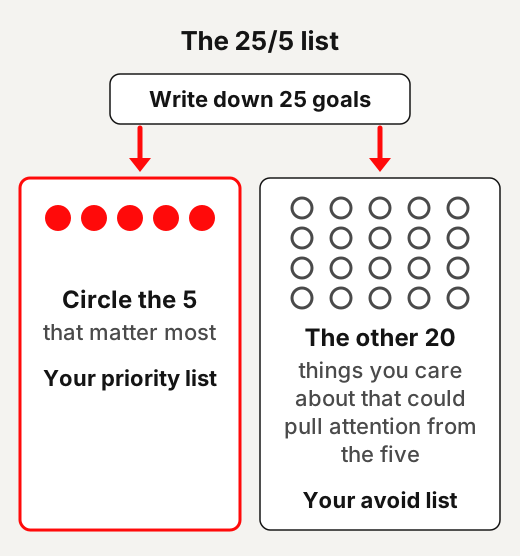
The 25/5 list
Write down 25 goals, circle the 5 that matter most, and avoid the other 20.
How it works: the five become your priority list. The other twenty are not bad goals. The method treats them as an avoid list: things you care about that could pull attention from the five.
Where it comes from: the method is often credited to Warren Buffett. Asked about it at Berkshire Hathaway’s 2013 shareholder meeting, he said that he and Charlie Munger were not disciplined enough to decide that way, as CNBC reported in 2018. He added: “I can’t recall making a list in my life.” So we share it as a method, without a name attached. The method itself is the same either way.
Example: your list includes learning Spanish, running a half marathon and starting a podcast. You circle Spanish and running, and the podcast waits.
Try this: write your 25 on paper, circle five, and put the list of twenty somewhere you will see it before saying yes to anything new.
The urgent-important matrix
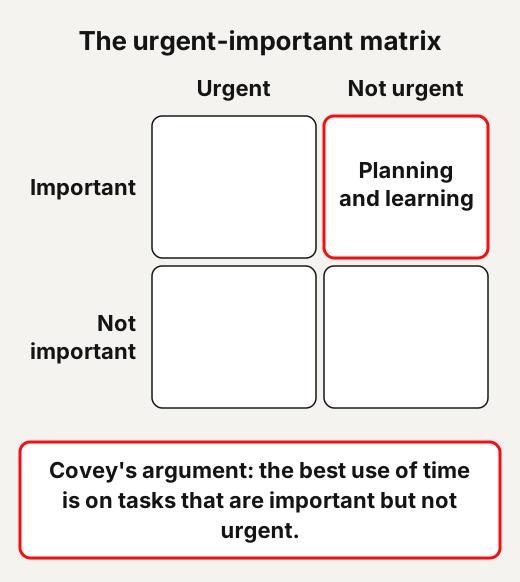
Sort each task by two questions: is it urgent, and is it important?
How it works: the answers give four boxes. The four-quadrant grid is the tool Covey teaches in Habit 3 of his book, The 7 Habits of Highly Effective People. Covey’s argument is that the best use of time is on tasks that are important but not urgent, such as planning and learning.
Where it comes from: the four-quadrant grid is often called the Eisenhower matrix. On 19 August 1954, speaking in Evanston, Illinois, Dwight Eisenhower quoted a former college president as saying he had “two kinds of problems, the urgent and the important”. Quote Investigator, which traced the saying, writes that it does not know whether he used the matrix. So the saying has a record, and who first drew the grid is less certain. Our 7 Habits summary goes into it.
Example: answering a group chat feels urgent; preparing for next month’s interview is important. The matrix puts them in different boxes.
Try this: list this week’s tasks in the four boxes, then book one block of time for a task that is important but not urgent.
The five-year question
Picture who you will be in five years if your books, habits and people stay the same.
How it works: it is a reflection exercise, not a research finding. You look at three inputs you can change: what you read, what you do every day, and who you spend time with. Then you ask where they lead.
Example: you notice that most of your evenings go to scrolling, and that the people you talk to most are the ones from work. You decide one evening a week will go to a class instead.
Try this: write down the last three books you read, three daily habits and the three people you see most. Circle one you would change.
2. Writing the goal down
Once you know the goal, these two methods help you write it so you can tell when it is done. Both ask for something you can measure, and both started out in the workplace.
SMART goals
SMART is a checklist for writing a goal clearly.
Where it comes from: the acronym is usually traced to George T. Doran, the president of a management consultancy, writing in Management Review in November 1981. His letters stood for Specific, Measurable, Assignable, Realistic and Time-related. A University of Florida guide notes that the wording of SMART goals “has evolved over time”. Doran also wrote that the acronym “doesn’t mean that every objective written will have all five criteria”. Our page on business and self-help rules covers its history.
Related research: Edwin Locke and Gary Latham found that specific, difficult goals consistently led to higher performance than urging people to do their best. Our reading: that speaks to the “specific” part of the checklist.
Example: “get fit” becomes “walk for thirty minutes on Monday, Wednesday and Friday until the end of next month”.
Try this: take one vague goal and rewrite it so a friend could tell, on a set date, whether you did it.
OKRs (objectives and key results)
An OKR pairs one ambitious objective with a few measurable results that show progress.
How it works: the What Matters site describes OKRs as a collaborative goal-setting method used by teams and individuals to set challenging, ambitious goals with measurable results. It adds that they can also work for personal goals.
Where it comes from: The What Matters site says the method was created by Andy Grove at Intel and taught to John Doerr by him. Google’s guide to OKRs says the “sweet spot” for an OKR grade is 60% to 70%. The same guide says that someone who consistently fully reaches their objectives needs to think bigger.
Example: objective: “become comfortable speaking in public”. Key results: give three short talks at work, join one speaking club, record yourself twice.
Try this: write one objective for the next three months and three results you could count.
The wording of SMART goals has evolved over time, a University of Florida guide notes.
3. Following through
The last three methods help a goal survive a busy week. Two have been tested in many studies. The third is a simple habit idea, with no research claim attached.
If-then plans
An if-then plan links a situation you expect to a specific action.
Where it comes from: Peter Gollwitzer described them in a 1999 paper as plans that link anticipated critical situations to goal-directed responses. Psychologists call them implementation intentions.
Why it works: an earlier meta-analysis of 94 tests found a medium-to-large effect on reaching goals. A larger 2024 update of 642 tests found if-then plans effective. The effect is smaller than early studies suggested: after allowing for publication bias, the authors call it robust but small. Our Atomic Habits summary uses the same research.
Example: “If it is 7am on a weekday, then I write for twenty minutes.”
Try this: write one if-then plan for the goal you circled above, naming a time and a place.
WOOP (mental contrasting)
WOOP pairs the future you want with the obstacle in the way, then plans for that obstacle.
How it works: mental contrasting means imagining the future you want and then thinking about the obstacles in the way. A version you may meet is WOOP, short for Wish, Outcome, Obstacle, Plan.
Why it works: in four studies published in 2002, believing a good outcome was likely went with more effort and better results. Enjoying daydreams about it went the other way. A 2021 meta-analysis pulled together 21 studies of the technique, paired with if-then plans, with 15,907 participants. It found a small to medium effect on reaching goals. Because of some publication bias, the authors add, the actual effects may be smaller.
Example: wish: finish a course. Outcome: a new job option. Obstacle: you are tired after work. Plan: if I get home tired, then I watch one lesson before dinner.
Try this: run one WOOP in your head before bed tonight. It takes a few minutes.
A little every day
Give a skill a short block of time most days, instead of waiting for a free weekend.
How it works: a short daily slot fits an ordinary week. One version you may meet is the “Rule of 100”: 100 hours a year, or about 16 minutes a day. It is often shared with a promise of getting ahead of 95% of people. We found no study behind that part, and our page on animal mindsets and shop tricks explains who the 95% would include. The useful part is the daily habit.
Example: fifteen minutes of guitar after dinner, most days.
Try this: pick a skill and a daily time slot, and keep a tally on the calendar for one month.
| If-then plan | Links a situation you expect to a specific action: "If it is 7am on a weekday, then I write for twenty minutes." |
| WOOP | Pairs the future you want with the obstacle in the way, then plans for that obstacle: if I get home tired, then I watch one lesson before dinner. |
How to pick a method
Match the method to the problem you have now. You can combine them: choose with one, write with another, follow through with a third.
| If your problem is… | Try |
|---|---|
| Too many goals | The 25/5 list |
| A week full of urgent things | The urgent-important matrix |
| Not sure where you are heading | The five-year question |
| A vague goal | SMART goals |
| A team that needs one direction | OKRs |
| Good intentions that fade | If-then plans |
| Big dreams, little action | WOOP |
| A skill you keep putting off | A little every day |
Some methods have research behind them; others are simple exercises. As this page describes each one.
Where to learn more
- From Big Goal to Today: the goal funnel, step by step, with the research on specific goals, if-then plans and picturing obstacles.
- Essentialism summary: choosing fewer things, on purpose.
- The 7 Habits summary: the four quadrants in context.
- Atomic Habits summary: if-then plans and habit cues.
- WOOP my life: the official site for WOOP.
- Google re:Work, “Set goals with OKRs”: Google’s own guide.
- University of Florida IFAS, “Developing SMART Goals for Your Organization”: a plain university guide.
- Related idea guides: ways of thinking and areas worth learning about.
Quick answers
What is the 25/5 rule?
You write down 25 goals, circle the five that matter most, and avoid the other 20. It is often credited to Warren Buffett, but CNBC reported that at the 2013 Berkshire Hathaway meeting he said he could not recall making a list in his life.
Who invented the Eisenhower matrix?
That is less certain. In 1954 Eisenhower quoted a former college president on having two kinds of problems, the urgent and the important, and Quote Investigator does not know whether he used the matrix. The four-quadrant grid is the tool Covey teaches in Habit 3.
What does SMART stand for?
In George Doran's 1981 article, Specific, Measurable, Assignable, Realistic and Time-related. A University of Florida guide notes that the wording has evolved over time.
Do if-then plans work?
A 2024 update of 642 tests found them effective. After allowing for publication bias, the authors call the effect robust but small.
Use this
Choose first, write it down second, then plan for the moment you will want to quit.
What will I do when the obstacle shows up?
Quick quiz
Nothing is scored or saved. Recalling it once now is what makes it last.
1. What did Warren Buffett say at the 2013 Berkshire Hathaway meeting when asked about the 25/5 list?
Answer: That he could not recall making a list in his life.Read it again ↑
2. In George Doran's 1981 article, what did the A in SMART stand for?
Answer: Assignable.Read it again ↑
3. What does WOOP stand for?
Answer: Wish, Outcome, Obstacle, Plan.Read it again ↑
How we checked this · Last checked November 2026
- We read CNBC's 2018 report on the 25/5 question, the What Matters OKR page and Google's OKR guide in November 2026.
- Our lines on SMART goals, the urgent-important matrix, if-then plans, WOOP and the Rule of 100 reuse the checked wording of our earlier pages on those topics.
- The five-year question is a reflection exercise. We make no research claim for it.
- The examples and the Try this lines are our own suggestions, not research findings.