

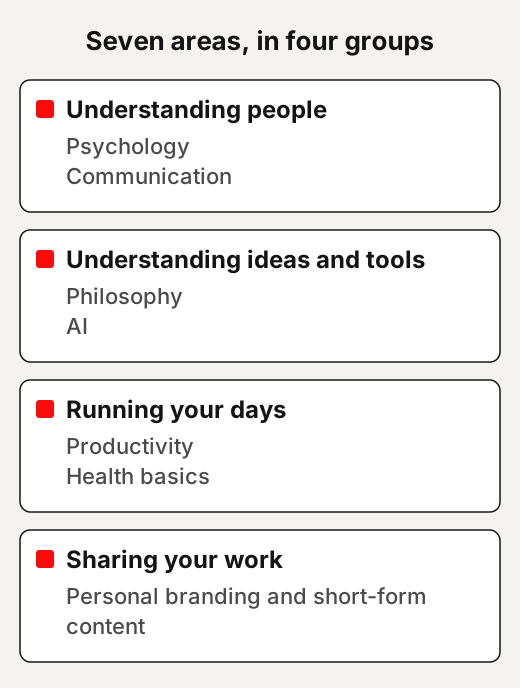
Here are seven areas that are useful in everyday life and work, and where to start with each. For each, we say what it covers and why it can help. Then we point to our own pages first, and to a reputable place to go next.
None of these needs a degree. Each one rewards a little time spent often, and each has good material you can read today.
1. Understanding people
Two areas help you understand people: how they think, and how to reach them. Psychology looks at how minds work. Communication is the craft of being understood. They work best together: knowing how people decide makes it easier to explain things to them.
Psychology: how people think and decide
Psychology studies how the mind works, including the mental shortcuts behind everyday choices.
What it covers: memory, emotion, learning, habits, and how people weigh up choices. MIT’s introductory course describes itself as “a survey of the scientific study of human nature, including how the mind works, and how the brain supports the mind”.
Why it can help: our reading is that knowing the common shortcuts makes them easier to notice. That goes for your own choices and for the ads aimed at you.
Start here: our Thinking, Fast and Slow summary, then Cognitive Biases, Checked and Famous Psychology Experiments, Checked.
Next step: MIT OpenCourseWare’s Introduction to Psychology. The course page says it was designed for independent study and includes a full set of lecture videos.
Try this: notice one choice today that you made in under a second, and ask what shortcut you used.
Communication: storytelling, writing, speaking and negotiation
Communication is the skill of getting an idea from your head into someone else’s, intact.
What it covers: telling a story with a clear point, writing plainly, speaking to a room, and negotiating without a fight.
Why it can help: our reading is that almost every other skill on this list reaches people through it. A good idea explained badly tends to go nowhere.
Start here: our summaries of How to Win Friends and Influence People and Never Split the Difference, each with what the research says about its advice.
Next step: the Purdue OWL, Purdue University’s online writing lab. It says it houses writing resources and instructional material, provided as a free service.
Try this: take the last long message you sent and rewrite it in half the words.
2. Understanding ideas and tools
Two areas help you think clearly about big questions and new tools. Philosophy takes on the oldest questions. AI is a newer tool that changes fast. Both reward careful reading over quick takes.
Philosophy: Stoicism, logic and ethics
Philosophy asks how to live, how to reason and what is right, and it shows its working.
What it covers: ethics (how to act), logic (how to reason well), and schools of thought such as Stoicism.
Why it can help: our reading is that it gives you ways to slow a reaction down. In Meditations 8.47, Marcus Aurelius says that when an outside thing pains you, “it is not this thing that disturbs thee, but thy own judgment about it”. The translation is George Long’s. He adds that it is in your power to wipe that judgement out.
Start here: our page on Stoicism, Your Fears, Answered by the Stoics, the Meditations summary, and the Logical Fallacies Cheat Sheet.
Next step: the Stanford Encyclopedia of Philosophy. It says each entry is maintained and kept up to date by an expert or group of experts in the field. For logic, forall x: Calgary describes itself as “a free and open introduction to formal logic”. For ethics, Harvard’s Justice course has its lectures online.
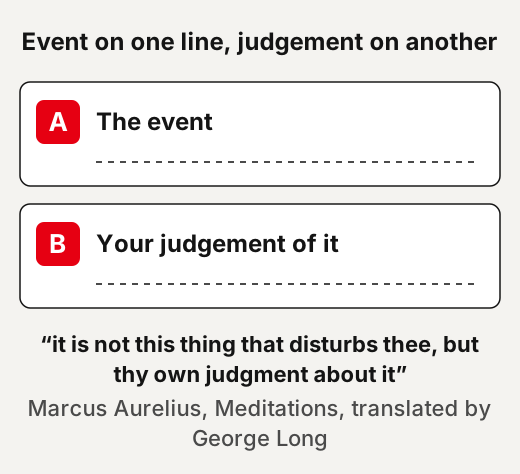
Try this: next time something annoys you, write the event in one line and your judgement of it in another.
AI: what the tools are and how they work
AI covers software that learns patterns from data, including chatbots.
What it covers: the difference between AI, machine learning and deep learning, how chatbots produce text, and where they go wrong.
Why it can help: our reading is that knowing how a chatbot works makes its mistakes less surprising, and easier to catch.
Start here: AI vs Machine Learning vs Deep Learning, How Large Language Models Work, Why AI Makes Things Up, and our AI Glossary.
Next step: Elements of AI. It describes itself as a free online introduction to artificial intelligence for non-experts. For a more technical start, Google describes its Machine Learning Crash Course as a fast-paced, practical introduction to machine learning.
Try this: ask a chatbot about something you know well, then check every claim in its answer.
| Philosophy | Takes on the oldest questions: how to live, how to reason and what is right |
| AI | A newer tool that changes fast |
Both reward careful reading over quick takes.
3. Running your days
Two areas shape your ordinary days: your time and your body. Small, steady habits matter more here than big plans. That is our reading, not a research finding.
Productivity: goals, priorities, deep work and weekly planning
Productivity is choosing what matters and protecting the time to do it.
What it covers: setting goals, sorting priorities, focused work without interruptions, and a regular review of where things stand.
Why it can help: our reading is that a short, clear list of priorities makes a busy week easier to steer.
Start here: our summaries of Deep Work, Essentialism and Getting Things Done, and From Big Goal to Today. Our Getting Things Done summary covers the book’s Weekly Review. It is a set time to go through your lists and refresh them once a week.
Next step: The 7 Habits summary covers its third habit, which sorts activities by whether they are urgent and whether they are important.
Try this: on Friday, spend ten minutes listing what got done and the three things that matter most next week.
Health basics: sleep, nutrition, training and recovery
Health basics means knowing what the official guidance covers, so you can ask better questions.
What it covers: sleep, eating, exercise, and rest between hard efforts. These pages describe guidance and research. For your own body and situation, a doctor or other qualified health professional is the right person to ask.
Why it can help: our reading is that official guidance says who each recommendation is for. That helps you ask a professional better questions.
Start here: our Why We Sleep summary, our guide to Darebee’s free home-workout library, and Home Workout Hacks.
Next step: three official pages. The US National Heart, Lung, and Blood Institute has a page on how much sleep is enough. It says the amount children need depends on their age, and lists recommended hours. The NHS Eatwell Guide shows how much of what we eat overall should come from each food group. The World Health Organization’s fact sheet on physical activity points to its guidelines, which give recommendations for children aged 5 and up, adolescents, adults and older adults, among other groups.
Try this: read one of those three pages from top to bottom, and write down one thing you did not know.
4. Sharing your work
One area is about being found: showing what you do, in the places people already look. A clear one-line description comes before any posting plan.
Personal branding and short-form content
Personal branding is how people understand what you do; short-form content is one way they find out.
What it covers: describing your work in a sentence, picking a format you can keep up, and making short videos.
Why it can help: our reading is that it turns skills from the other six areas into something other people can see.
Start here: our guides to YouTube’s new creator features, the post-authenticity shift, making motion graphics videos with AI, and researching and scripting a history video.
Next step: YouTube for Creators, the platform’s own guide. It addresses creators “whether you’re just getting started or looking to grow and earn more”.
Try this: write one sentence that says what you do and who it helps. Read it aloud to a friend.
Where to learn more
If you only pick one area, pick the one you would use this week. This table gathers the first step for each.
| Area | Start on this site | Then try |
|---|---|---|
| Psychology | Thinking, Fast and Slow summary | MIT OpenCourseWare, Introduction to Psychology |
| Communication | Never Split the Difference summary | Purdue OWL |
| Philosophy | Stoicism | Stanford Encyclopedia of Philosophy |
| AI | How Large Language Models Work | Elements of AI |
| Productivity | From Big Goal to Today | Getting Things Done summary |
| Health basics | Why We Sleep summary | NHS Eatwell Guide |
| Personal branding | YouTube’s new creator features | YouTube for Creators |
For how to study once you have picked an area, see our guide to learning faster.
- Related idea guides: ways of thinking and goal-setting methods.
Our reading, from each section of this page.
Quick answers
Where can I learn psychology for free?
MIT OpenCourseWare has an Introduction to Psychology course designed for independent study, with a full set of lecture videos. On this site, our Thinking, Fast and Slow summary is a gentle start.
Where should I start with Stoicism?
Our Stoicism page and our guide to the Stoics on fear are good first stops. For the source itself, Meditations 8.47 in George Long's translation says it is not the external thing that disturbs you, but your own judgment about it.
Where can a beginner learn about AI?
Elements of AI describes itself as a free online introduction to artificial intelligence for non-experts. Google's Machine Learning Crash Course is a more technical next step.
Where can I find reliable health basics?
Official pages are a good start: the NHLBI page on how much sleep is enough, the NHS Eatwell Guide and the WHO fact sheet on physical activity. For your own situation, ask a doctor or other qualified health professional.
Use this
Pick one area you would use this week, not the most impressive one.
Which of these would I use before Friday?
Quick quiz
Nothing is scored or saved. Recalling it once now is what makes it last.
1. How does the Purdue OWL describe what it offers?
Answer: Writing resources and instructional material, provided as a free service.Read it again ↑
2. In Meditations 8.47, in George Long's translation, what does Marcus Aurelius say disturbs you?
Answer: Your own judgment about the thing.Read it again ↑
3. Who does Elements of AI describe itself as being for?
Answer: Non-experts.Read it again ↑
How we checked this · Last checked November 2026
- We read each outside resource's own page in November 2026 and describe it in that page's words.
- Every page we point to on this site has been through our fact-check.
- The CDC's sleep page blocked our script, so we point to the NHLBI's page instead. We print no figures from the health pages.
- The "why it can help" lines and the Try this lines are our own suggestions, not research findings.