

Start hereIn a 2023 study of 87 students, those on fixed breaks reported less fatigue than those who chose their own breaks. In a 2026 study, self-chosen breaks led to more positive moods. So should you trust the timer?
A to-do list tells you what needs doing. Time blocking tells you when you will do it. The Pomodoro Technique tells you how to work through it, in short timed rounds with breaks. They answer different questions, so you can use them together. Below: where each one comes from, what the research found, and how to try them.
1. At a glance
Our reading: a to-do list answers “what”, time blocking answers “when”, and the Pomodoro Technique answers “how”.
| To-do list | Time blocking | Pomodoro Technique | |
|---|---|---|---|
| The question it answers | Our reading: what needs doing? | Our reading: when will I do it? | Our reading: how do I work through it? |
| Where it comes from | Our reading: no single inventor that we could find | Cal Newport was writing about it by name in 2007; we could not find who used the name first | Francesco Cirillo, who began it in the 1980s as a university student |
| The basic unit | Our reading: one task | A block of time marked off on a calendar | 25 minutes of work, then a 3 to 5 minute break |
| What you need | Our reading: paper or an app | A calendar, or a sheet of paper | A timer, pencil and paper |
| What research has tested | Reminders outside your head, in four online experiments; plans for unfinished tasks, in one set of lab studies | Daily planning, in one two-week study of employees | Fixed breaks against self-chosen ones, in four small studies of 30 to 176 students |
| Where it can go wrong | Our reading: it says nothing about when | Plans tend to run longer than expected | Our reading: a fixed timer can cut into work that is going well |
The cells marked “Our reading” are our own summary; the other cells come from the sources below.
2. What each one is
The to-do list
A to-do list moves the things you need to do out of your head and onto paper or a screen.
That sounds too simple to study, but the reminder side of it has been tested. In four online experiments with 1,196 participants, people who held intentions in mind for short periods did better when they set themselves reminders.
Whole systems are built on lists. One is Getting Things Done, the system created by David Allen. Our Getting Things Done summary covers it and the research behind it.
Our reading: a list’s weak spot is time. A list of twelve tasks does not tell you whether today has room for them. In 2007 Newport wrote that a to-do list lacks two things: “How long each task requires” and where your free time falls in the day.
For example, a list might read: pay the gas bill, book the dentist, draft the report, reply to the landlord.
Time blocking
Time blocking gives each task its own slot in your day, so your plan becomes a timetable rather than a list.
The idea is much older than the name. In his autobiography, Benjamin Franklin printed a “scheme of employment for the twenty-four hours of a natural day”. His rule of Order, he wrote, required that every part of his business “should have its allotted time”. Order, he says, “cost me so much painful attention” that he nearly gave up on it. He found it hard to keep when others set the hours: it could not be “exactly observed by a master, who must mix with the world”.
Cal Newport was already recommending time blocking to students on his blog in December 2007: “Assign specific times on your schedule for when you want to complete specific tasks”. In a 2013 post, he wrote: “I call this planning method time blocking”. He described spending ten to twenty minutes every evening building the next day’s schedule from his task lists and calendars. For work he cannot predict, he blocks off time for reacting to requests, like any other obligation.
He estimated that a 40-hour time-blocked week produces as much as a week of 60 hours or more without structure. Our reading: that is his own estimate, not a measured result.
Our Deep Work summary covers the book Newport published later. A search of the preview finds phrases on scheduling every minute and on a shutdown ritual.
The official guide to The ONE Thing describes time blocking as “taking a calendar and marking off adequate time” for your most important work. We could not find who first used the name.
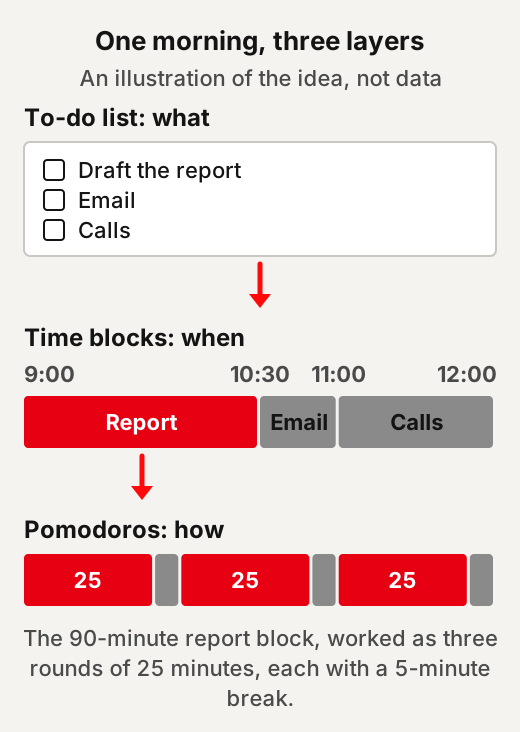
For example, a blocked morning might read: 9:00 to 10:30, draft the report; 10:30 to 11:00, email; 11:00 to 12:00, calls.
The Pomodoro Technique
The Pomodoro Technique works in short timed rounds: 25 minutes of work, then a short break.
Francesco Cirillo says he began developing it in the 1980s, while he was a university student, with a tomato-shaped kitchen timer. Pomodoro is Italian for tomato. His 2006 paper presents the technique “as defined in 1992”.
In that paper, each Pomodoro is 25 minutes of work, followed by a break of 3 to 5 minutes. Every four Pomodoros, you take a longer break of 15 to 30 minutes. A Pomodoro “can’t be split up”: if something interrupts it for good, it counts as void and you start a new one.
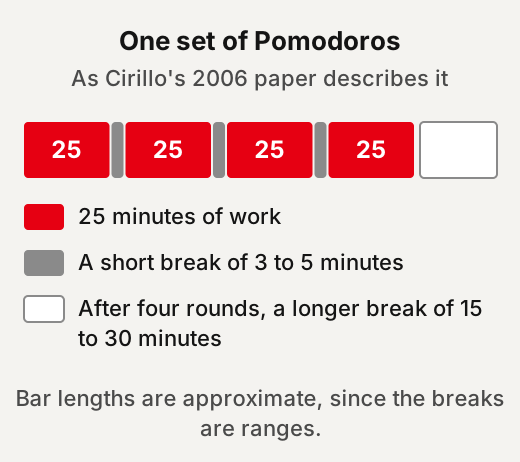
The timer is only part of it. His official site says that the technique “is much more than a sequence of 25-minute sessions”: it also covers planning, estimating effort, recording and reflection. Each day starts from a To Do Today Sheet, and a Weekly Timetable connects the days with longer goals.
For example, set a timer for 25 minutes on one task, then stand up and stretch for five. After four rounds, take a longer walk.
3. Where they overlap
The three often sit inside one another: a list feeds the blocks, and timed rounds fill a block.
Each method borrows from the others. Cirillo’s method starts each day with a to-do list of its own, and his paper has a whole objective on setting up a timetable. Newport builds his blocks from his task lists and calendars. The guide to The ONE Thing puts time blocking first, then has you make a task list to work from when time permits.
4. What the research says
We found studies of their parts, mainly plans and breaks, but none that tested any of the three as a whole system.
Plans for unfinished tasks
Partly Writing down a specific plan for an unfinished task stops it nagging at you. This has support, but from one set of lab studies.
How sure: Limited one 2011 set of studies, mostly with university students, and we found no replication.
In a 2011 paper’s lab studies, unfinished goals caused intrusive thoughts and worse performance on unrelated tasks, and making a specific plan for them removed those effects. We found no replication.
In practice, if a report keeps nagging at you, write down when and where you will do the next step, then set it aside.
Do unfinished tasks stick in memory?
Doesn't hold up Unfinished tasks are remembered better than finished ones. Not as a general rule, though people do tend to go back to unfinished tasks.
How sure: Moderate one 2025 meta-analysis pooled the studies, and its authors say the memory effect lacks universal validity.
The Zeigarnik effect is the older idea that unfinished tasks are remembered better. A 2025 meta-analysis found no memory advantage for unfinished tasks, though it did find a general tendency to go back to them.
Our reading: a list is less about not forgetting than about that pull to go back. Writing the next step down gives the pull somewhere to land.
For example, before you stop for the day, note the next step on each unfinished task. That gives the pull to go back somewhere to go.
Short breaks
Partly Short breaks during work help you feel better and work better. Short breaks lift energy and ease tiredness a little; their effect on how much you get done is unclear.
How sure: Moderate a review of 22 study samples finds small benefits for how people feel, but most of its studies were in labs.
A 2022 meta-analysis of 22 study samples, covering 2,335 people, looked at breaks of up to ten minutes. It found small boosts in vigour and small drops in fatigue, measured by people’s own ratings. The overall effect on performance was not significant, and the breaks helped only on less demanding tasks. Longer breaks went with bigger gains in performance.
In plain terms, a short break is more likely to change how you feel than how much you get done. For example, after an hour of filling in forms, a five-minute walk may leave you less tired.
Fixed breaks or breaks you choose
Still argued Taking breaks on a fixed timer works better than taking them when you feel like it. Four small studies point different ways: most found no difference in work done or test results, and they disagree about mood.
How sure: Unsettled four small studies of students point different ways; three of them come from one research group at Maastricht University.
In a 2023 study of 87 students, those who chose their own breaks studied and rested for longer. They also reported more fatigue, and less concentration and motivation, than those on fixed breaks. It found no difference in task completion. The authors read this as an efficiency gain for fixed breaks: similar task completion in a shorter time.
A 2026 study of 176 students found no difference in test performance, though the authors note their measure may not have been sensitive enough. In that study, self-chosen breaks led to more positive moods.
A smaller 2026 study had 30 college students try both kinds of break, one session each, and found higher test scores after self-chosen breaks. The order of the two sessions was not varied between students, and the authors call the result preliminary.
Our reading: the timer is worth a try. If it keeps breaking your focus, self-chosen breaks are a fair alternative. In these studies they did about as well on work done, though in one study they took longer to get there.
For example, try the 25-minute timer for two days and your own breaks for two days, and note which days you got more done.
Managing time in general
Partly People who manage their time well get better results. Good time management goes with better results and wellbeing, but most studies show a link, not a cause.
How sure: Moderate a 158-study review finds a moderate link, but most of the studies measured everything at one point in time.
A 2021 meta-analysis of 158 studies, covering 53,957 people, found time management moderately related to job performance, academic achievement and wellbeing. Its link with wellbeing was slightly stronger than its link with performance. The authors note that most time management studies are cross-sectional, and warn against seeing time management as a panacea.
Our reading: these reviews look at time management as a whole, so they cannot tell you which of the three methods works best.
For example, pick the one method that matches what goes wrong in your week, rather than starting all three at once.
Planning the day, and interruptions
Partly Planning your day by the clock helps you work better. Daily planning helped in one study, but less on days full of interruptions.
How sure: Limited one two-week study of employees, and we found no study of time blocking by name in the research databases we searched.
A 2018 study followed employees for two weeks and compared days when they planned their work with days when they did not. Making task lists, setting priorities and deciding how and when to do each task helped, but the benefit depended on how many interruptions the day brought. Planning ahead for likely interruptions helped whatever their number.
Our reading: that fits Newport’s habit of blocking off time for reacting to requests.
Blocks also tend to run over. In a 1994 set of studies, people’s predictions of how long their own tasks would take were too optimistic, across a variety of academic and nonacademic tasks. In one of the studies, the bias disappeared when people were asked to connect relevant past experiences with their predictions.
Psychologists call this the planning fallacy. Cirillo’s method asks you to record the effort you actually spent and compare what you planned with what happened.
For example, if your “one hour” email block keeps taking ninety minutes, plan ninety.
5. Who each one might suit
Our reading: the right choice depends on how predictable your day is and what gets in your way.
This table is our own reading, not a research finding.
| If this sounds like you | Try first | Why |
|---|---|---|
| Your days are full of small, separate tasks | A to-do list | It is the lightest to keep up. |
| Big work keeps getting crowded out | Time blocking | It saves a slot before other things fill it. |
| You find it hard to start, or you drift | The Pomodoro Technique | A short, set round is easier to begin. |
| Your day is mostly interruptions | A list, plus a block for reacting to requests | A tight timetable will keep breaking. |
6. How to combine them
Our suggestion: list first, then blocks, then timed rounds inside the longest blocks.
- Keep one list of everything you need to do.
- Each evening, give tomorrow’s most important tasks a block of time.
- Leave at least one block for messages and requests.
- Inside long blocks, work in 25-minute rounds with short breaks.
- At the end of the day, compare what you planned with what happened, and adjust tomorrow’s blocks.
For example: list ten tasks, block 9:00 to 11:00 for the report, work it in four Pomodoros, and leave 11:00 to 12:00 for email.
Our From big goal to today guide shows how to get from a someday goal down to this week’s list. For choosing what goes on the list at all, our Essentialism summary looks at picking fewer priorities. Our Atomic Habits summary covers making the first step tiny.
Quick answers
Who invented the Pomodoro Technique?
Francesco Cirillo. He says he began developing it in the 1980s, while he was a university student, with a tomato-shaped kitchen timer. Pomodoro is Italian for tomato.
How long is a Pomodoro?
In Cirillo's 2006 paper, each Pomodoro is 25 minutes of work, followed by a break of 3 to 5 minutes. Every four Pomodoros, you take a longer break of 15 to 30 minutes.
Is time blocking better than a to-do list?
We found no study that compares them head to head in the research databases we searched. Our reading: they do different jobs, since a list says what to do and a block says when, so you can use them together.
Does the Pomodoro Technique work?
Its fixed breaks have been tested against self-chosen breaks in four small studies of students. Three found no difference in work done or test results; a fourth, weaker study found better test scores after self-chosen breaks. They disagreed about mood.
What is the Zeigarnik effect?
It is the older idea that unfinished tasks are remembered better. A 2025 meta-analysis found no memory advantage for unfinished tasks, though it did find a general tendency to go back to them.
Use this
Our suggestion: test each method on your own work for a week, then keep what helped.
Is my problem knowing what to do, when to do it, or how to stay on it?
Quick quiz
Nothing is scored or saved. Recalling it once now is what makes it last.
1. In Cirillo's 2006 paper, how long is the longer break after four Pomodoros?
Answer: 15 to 30 minutes.Read it again ↑
2. In the 2018 study of daily planning, what weakened the benefit of planning the day?
Answer: Many interruptions.Read it again ↑
3. What did a 2025 meta-analysis find about unfinished tasks?
Answer: No memory advantage, but people tend to go back to them.Read it again ↑
How we checked this · Last checked October 2026
- We read Francesco Cirillo's own 2006 paper on the technique in an Internet Archive copy from 2009, and his current site.
- For the research we read the abstracts of the studies, and the full text of the two meta-analyses in PLOS ONE.
- We could not find who first used the name "time blocking", or any study that tests time blocking by name in the research databases we searched.
- Our wording on unfinished tasks and plans matches our Deep Work and Getting Things Done summaries.
Sources
The methods, in their creators’ words
- F. Cirillo, “The Pomodoro Technique”, paper v1.3 (2006), Internet Archive copy of 6 March 2009, sections 2.1 and 2.5.Primary
- Francesco Cirillo, Pomodoro Technique official site: home page, What Is the Pomodoro Technique? and Francesco Cirillo.Primary
- C. Newport, “Monday Master Class: Don’t Use a Daily To-Do List”, calnewport.com (3 December 2007).Primary
- C. Newport, “Deep Habits: The Importance of Planning Every Minute of Your Work Day”, calnewport.com (21 December 2013).Primary
- G. Keller and J. Papasan, The ONE Thing: “The Kick-Ass Guide to Goal Setting”, the1thing.com.Primary
- B. Franklin, The Autobiography of Benjamin Franklin, Project Gutenberg, part two.Primary
- David Allen Company, “About”, gettingthingsdone.com.Primary
- C. Newport, Deep Work, Google Books preview (Grand Central, 2016).Primary
Research
- S. J. Gilbert, “Strategic offloading of delayed intentions into the external environment”, Quarterly Journal of Experimental Psychology 68(5) (2015), 971-992.Scholarly
- E. J. Masicampo and R. F. Baumeister, “Consider it done! Plan making can eliminate the cognitive effects of unfulfilled goals”, Journal of Personality and Social Psychology 101(4) (2011), 667-683.Scholarly
- R. Ghibellini and B. Meier, “Interruption, recall and resumption: a meta-analysis of the Zeigarnik and Ovsiankina effects”, Humanities and Social Sciences Communications 12 (2025).Scholarly
- P. Albulescu and others, “Give me a break! A systematic review and meta-analysis on the efficacy of micro-breaks for increasing well-being and performance”, PLOS ONE 17(8) (2022), e0272460.Scholarly
- F. Biwer, W. Wiradhany, M. G. A. Oude Egbrink and A. B. H. de Bruin, “Understanding effort regulation: Comparing ‘Pomodoro’ breaks and self-regulated breaks”, British Journal of Educational Psychology 93 Suppl 2 (2023), 353-367.Scholarly
- E. J. C. Smits, N. Wenzel and A. de Bruin, “Investigating the Effectiveness of Self-Regulated, Pomodoro, and Flowtime Break-Taking Techniques Among Students”, Behavioral Sciences 15(7) (2025), 861.Scholarly
- A. Göksu, W. Wiradhany and A. B. H. de Bruin, “When to Take a Break: Comparing Effects of Systematic Short (Pomodoro) and Self-Regulated Breaks on Subjective Experience and Actual Learning”, Behavioral Sciences 16(7) (2026), 1158.Scholarly
- V. Mabalda and others, “Effects of the Pomodoro Technique and Self-Directed Study Breaks on College Students’ Immediate Post-Test Performance”, Psychology and Education: A Multidisciplinary Journal 57 (2026), 1327-1335.Scholarly
- B. Aeon, A. Faber and A. Panaccio, “Does time management work? A meta-analysis”, PLOS ONE 16(1) (2021), e0245066.Scholarly
- B. Liu, P. Ma and F. Jia, “Systematic review and meta-analysis of the impact of time management on college students’ learning outcomes”, Frontiers in Psychology 17 (2026), 1700298.Scholarly
- M. R. Parke, J. M. Weinhardt, A. Brodsky, S. Tangirala and S. E. DeVoe, “When daily planning improves employee performance: The importance of planning type, engagement, and interruptions”, Journal of Applied Psychology 103(3) (2018), 300-312.Scholarly
- R. Buehler, D. Griffin and M. Ross, “Exploring the ‘planning fallacy’: Why people underestimate their task completion times”, Journal of Personality and Social Psychology 67(3) (1994), 366-381.Scholarly
- American Psychological Association, APA Dictionary of Psychology: “Zeigarnik effect” and “planning fallacy”.Scholarly
Fix the part that's stuck
Each method answers a different question: what, when or how. Our view: you don't need to start all three at once. Name the part of your day that keeps going wrong, change only that, and leave the rest.
Size your blocks from the record
- Note your guess before you start. Our view: write down how long you think the task will take.
- Note the real time after. Cirillo's method asks you to record the effort you spent and compare it with your plan.
- Next time, recall a similar task. In 1994 studies, people's time guesses for their own tasks were too optimistic. In one, the bias disappeared when people were asked to connect relevant past experiences with their predictions.
- Keep the gap in view. Our view: after a week, you may see which kinds of task tend to run over. Block those by the record, not the guess.
This week: end with a review
Our suggestion: on Friday, take a short look back at whichever method you used. What held, and what slipped? Keep one change for next week. Cirillo's method also covers recording and reflection.
Put planning skills to paid use
- Keep a busy client's task list and calendar in order, as a virtual assistant.
- Set up shared calendars and task lists for a small business.
- Design printable planning sheets, such as a daily block page with a list beside it.
Ideas to explore, not financial or business advice. No result is promised.
Keep going
- From big goal to todayA planner that breaks a someday goal down to this week's list.
- Getting Things Done, summarisedDavid Allen's list-based system and the research behind it.
- Deep Work, summarisedNewport's later book on long stretches of focused work.
- Pre-mortemA short worksheet for a big decision. One step asks how things like it usually go.