

These are seven money habits people often talk about, from keeping an emergency fund to keeping your income private. For each one we explain what it means and share what official guidance or research says, where it exists.
This page is for information only. It is not advice about your money, and what fits your situation is your call.
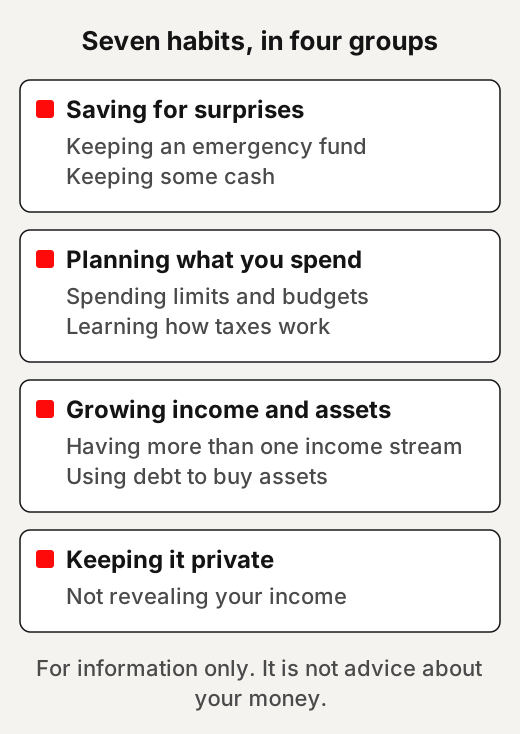
Saving for surprises
1. Keeping an emergency fund
An emergency fund is money kept aside only for surprises, such as a car repair or a sudden bill.
Example: a separate savings account labelled “surprises only”, topped up a little each payday.
What official guidance says: Guidance differs on how much to keep. The CFPB says the amount depends on your situation, and that even a small amount can provide some financial security. Australia’s government money site, Moneysmart, calls enough to cover three months of expenses “a good target”. It also suggests a separate savings account, so you are less tempted to dip into it.
How many people have a cushion like this? In the Federal Reserve’s 2025 survey, 63% of US adults said they would cover a $400 emergency expense completely using cash or its equivalent. Put the other way, more than a third would not cover it that way.
The book The Psychology of Money has a related idea. Our summary of the book covers it. Its author’s 2018 essay makes the case for room for error, which “lets you endure”.
Try this: the CFPB suggests starting from the most common unexpected expenses you have had, and what they cost. Writing down your last three is a simple first step.
2. Keeping some cash
A little cash at home is a back-up for the day cards and cash machines stop working.
Example: a few small notes kept in an emergency kit, for a power cut that takes card payments down with it.
What official guidance says: The US government’s Ready.gov advises keeping a small amount of cash at home in a safe place. It says small bills matter because ATMs and credit cards may not work during a disaster. The CFPB notes the other side: cash can be stolen, lost or destroyed.
So the idea is a small back-up, not a place for your savings.
Try this: ask yourself how you would pay for food for one day if card payments stopped.
| Emergency fund | Money kept aside only for surprises, such as a car repair or a sudden bill |
| Cash at home | A small back-up for the day cards and cash machines stop working, not a place for your savings |
Two different kinds of back-up.
Planning what you spend
3. Spending limits and the 50/30/20 budget
A budget sets a limit for each kind of spending before the month starts.
Example: on take-home pay of 2,000 a month, a 50/30/20 split would set aside about 1,000 for needs, 600 for wants and 400 for savings.
Where it comes from: The 50/30/20 split comes from Elizabeth Warren and Amelia Warren Tyagi’s 2005 book All Your Worth, where it is called the Balanced Money Formula. The book’s formula is must-haves 50%, wants 30% and savings 20%. It measures must-haves against your after-tax income.
It is a rule of thumb from a personal finance book. Our reading: housing costs differ so much from place to place that the split will suit some households better than others.
Try this: sort last month’s spending into must-haves, wants and savings, and see what your own split looks like.
4. Learning how taxes work
Knowing how tax comes out of your pay helps you read a payslip and avoid surprises.
Example: checking your payslip to see how much tax was taken before your pay reached your account.
Where to learn: In the US, the tax agency’s Understanding Taxes program is open to schools and to the general public. The IRS explains that the income tax your employer withholds depends on how much you earn and the information you give on Form W-4. Its Tax Withholding Estimator compares an estimate of your tax with what is being withheld. In the UK, GOV.UK’s introduction to Income Tax explains that most people get a Personal Allowance of tax-free income.
Tax rules differ from country to country, so your own tax agency’s pages are the place to start.
Try this: find your tax agency’s page for employees and read its first page.
Growing income and assets
5. Having more than one income stream
Multiple income streams means earning from more than one source, such as a job plus a small side business.
Example: a teacher who also tutors at weekends.
How common it is: In the US, 5.4% of employed people held more than one job in 2025. The Bureau of Labor Statistics notes that its 2025 figures are an 11-month average that leaves out October.
A second income also takes time, and it can come with its own rules and costs. Our guide to AI side hustles looks at what seven side jobs involve and how to check any “easy money” claim. Our page on why money and work matter explains why success stories can make extra income look easier than it is.
Try this: list the skills you already use at work that someone else might pay for.
6. Using debt to buy assets
Using borrowed money to buy something that may grow in value makes both gains and losses bigger.
Example: the US Securities and Exchange Commission’s investor site works through one with a margin account, where a broker lends you money to buy shares. If a $50 stock rises to $75, paying in full earns a 50% return, while borrowing half earns 100% on your own money. If it falls to $15, the cash buyer loses 70%, while the borrower loses more than 100% and still owes the broker.
What official guidance says: FINRA’s margin disclosure statement warns that you can lose more money than you deposit in a margin account. It adds that the firm can sell your securities without contacting you. Investor.gov says margin accounts can be very risky and are not appropriate for everyone.
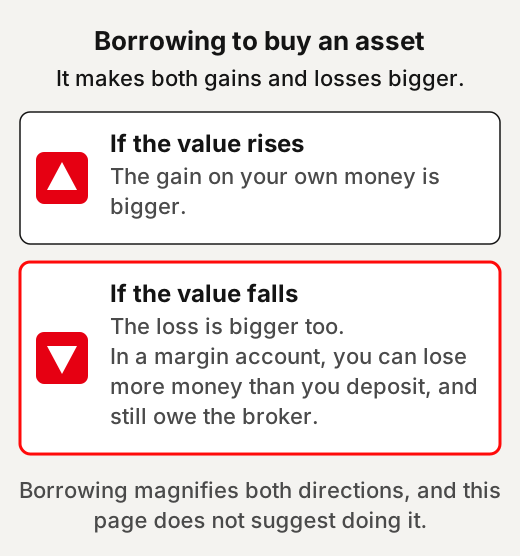
Borrowing magnifies both directions, and this page does not suggest doing it. The book Rich Dad Poor Dad uses its own test of an asset, explained in our Rich Dad summary. In the company’s words, an asset “puts money into your pocket, while a liability takes money out of your pocket”.
Try this: if you ever weigh a loan for an asset, ask yourself what you would still owe if its value fell by a third.
Keeping it private
7. Not revealing your income
Some people choose not to share what they earn, for privacy or to avoid comparison.
Example: answering “enough to get by” when a relative asks about your salary.
What to know: this is a personal and social choice, and the right answer differs between families, workplaces and cultures. We are not sharing any research claim about it here. The Psychology of Money summary has a related idea in its section on why wealth is what you don’t see.
Try this: decide in advance what you will say when someone asks, so a question never catches you off guard.
Where to learn more
- Consumer Financial Protection Bureau (US): free guides on saving, budgeting and borrowing.
- Moneysmart (Australia): budgeting and saving tools from the Australian government.
- Investor.gov (US SEC): plain explanations of investing and its risks.
- FINRA for investors: guides on brokerage accounts, margin and avoiding fraud.
- IRS Understanding Taxes and GOV.UK Income Tax: how income tax works in the US and the UK.
- Related idea guides: why the world uses the US dollar and career moves people talk about.
Quick answers
How much should an emergency fund be?
Official guidance differs. The CFPB says the amount depends on your situation, and that even a small amount can provide some financial security. Australia's Moneysmart calls enough to cover three months of expenses a good target.
Who came up with the 50/30/20 rule?
The 50/30/20 split comes from Elizabeth Warren and Amelia Warren Tyagi's 2005 book All Your Worth, where it is called the Balanced Money Formula.
Is it risky to borrow money to invest?
Borrowing makes both gains and losses bigger. FINRA's margin disclosure statement warns that you can lose more money than you deposit in a margin account, and Investor.gov says margin accounts are not appropriate for everyone.
How many people have more than one job?
In the US, 5.4% of employed people held more than one job in 2025, by the Bureau of Labor Statistics' count.
Use this
A short way to look at your own money habits, using the ideas on this page.
Which of these habits do I already have, and which one would I look into first?
Quick quiz
Nothing is scored or saved. Recalling it once now is what makes it last.
1. Where does the 50/30/20 budget split come from?
Answer: A 2005 personal finance book.Read it again ↑
2. Why does Ready.gov suggest small bills at home?
Answer: ATMs and cards may not work during a disaster.Read it again ↑
3. In Investor.gov's example, what can happen to a margin buyer if the stock falls from $50 to $15?
Answer: They lose more than 100% and still owe the broker.Read it again ↑
How we checked this · Last checked November 2026
- Guidance is from official agency pages: the CFPB, Ready.gov, the IRS, GOV.UK and Australia's Moneysmart; investor-education pages from Investor.gov and FINRA.
- The 50/30/20 split was checked in a scanned printing of the 2005 book through Open Library's search inside the text.
- Some government sites block scripts, so the CFPB and BLS pages were read in a browser tool. A UK guidance page asked for a bot check, so it was not used.