

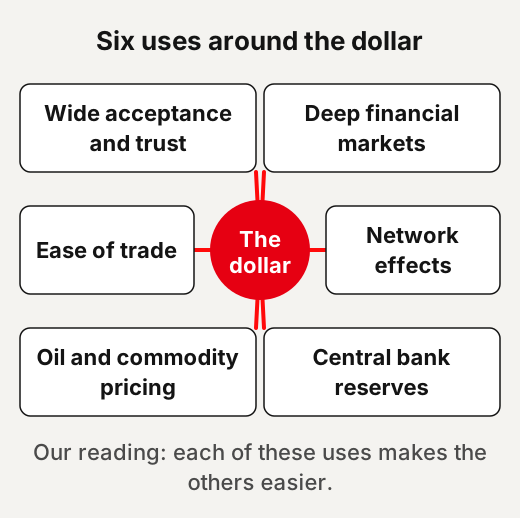
The US dollar is used far beyond the United States because people trust it, oil is priced in it, central banks hold it, and its financial markets are large. Our reading: each of these uses makes the others easier, so the habit tends to keep itself going.
This page explains how the dollar is used around the world. It is for information only and does not tell you what to do with your money.
The dollar at a glance
The dollar leads on every common measure of international use, by different margins.
| What is measured | Dollar’s share | Source, and the period it covers |
|---|---|---|
| Central bank foreign exchange reserves | 56.7% | IMF, second quarter of 2026 |
| Foreign exchange trades it is part of | 89.2% | BIS survey, April 2025 |
| International payments on SWIFT | About 50% | Federal Reserve note, data to 2024 |
| Foreign currency debt issued by firms | Around 60% | Federal Reserve note, since 2010 |
A foreign exchange trade always involves two currencies, so shares of trades add up to 200%, not 100%. The Federal Reserve note explains that the percentages sum to 200 percent because every foreign exchange transaction includes two currencies. Each row is explained, with its source, in the sections below.
Each measure has its own source and period, shown in the table.
Trust and deep markets
1. Wide acceptance and trust
People use the dollar far from home because they trust it to hold its value.
Example: a traveller keeps a few dollar notes as a back-up on a trip abroad.
Where it comes from: A 2025 Federal Reserve note traces the dollar’s role to the size and strength of the US economy and its openness to trade and capital flows. It adds the economy’s stability, strong property rights and the rule of law. Its staff estimate that over $1 trillion in dollar banknotes were held by foreigners in early 2025, roughly half of all dollar notes. In plain terms, a lot of the world’s paper dollars live outside the United States.
Try this: look at the money in your wallet and ask what makes you trust it to be worth the same next month.
2. Deep financial markets
The US has very large markets for safe assets, which makes dollars easy to hold and easy to sell.
Example: a central bank wants somewhere to keep savings it might need tomorrow, and it needs to be able to sell a lot quickly without moving the price.
How it works: The same note says the depth and liquidity of US financial markets is unmatched, with a large supply of extremely safe dollar-denominated assets. Most official dollar reserves are held as US Treasury securities, and in early 2025 foreign investors held $9 trillion, or 32%, of marketable Treasuries. “Deep” here simply means big enough that large trades barely move the price.
Try this: when you read that a market is “deep”, ask how much someone could sell before the price would drop.
Trade and prices
3. Oil and commodity pricing
The main oil benchmarks are priced in dollars, so oil buyers around the world deal in dollars.
Example: when a news report gives the price of a barrel of Brent crude, the figure is in dollars.
Where it comes from: A 2014 European Central Bank working paper notes that the prices of West Texas Intermediate, Brent and Dubai crude “are all expressed in dollars”. It describes the usual explanation, tied to history: the US was the largest oil producer for about a century, until the Middle East overtook it in the 1950s.
The payments themselves are less well measured than the prices. The same paper says there had been “no meaningful empirical work” on currency choice in oil, because virtually all recent transactions are “widely believed” to be in dollars.
Try this: the next time oil is in the news, notice which currency the price is quoted in.
4. Ease of trade
Outside Europe, most international trade is invoiced in dollars, so one currency serves many buyers.
Example: a small exporter quotes one dollar price to customers in several countries, instead of a price in each of their currencies.
How it works: Over 1999–2019 the dollar accounted for 96% of trade invoicing in the Americas, 74% in the Asia-Pacific region and 79% in the rest of the world. Europe was the exception, where the euro is dominant with 66%. The dollar’s share of international payments on SWIFT is about 50%. One estimate found that over half of countries in 2019 had their currency anchored to the dollar, meaning they limit how far it moves against the dollar.
Our reading: one shared currency saves firms from juggling many, which is a large part of its pull.
Try this: look at an online shop that sells abroad and see which currency it shows first.
| Prices | The main oil benchmarks are priced in dollars |
| Payments | Less well measured than the prices |
Central banks and habits
5. Central bank reserves
Central banks keep a large share of their savings in dollars, though a smaller share than in 2001.
Central banks hold foreign exchange reserves: safe assets in other currencies that they can draw on when needed. The European Central Bank describes them as readily available holdings in monetary authorities’ safe external assets.
Example: a central bank can use its reserves to buy its own currency during a sudden sell-off. The ECB names carrying out such interventions as one possible use of reserves, common to both advanced and emerging economies.
How it works: In the IMF’s latest figures, for the second quarter of 2026, the dollar’s share of global foreign exchange reserves fell to 56.70 percent, from 57.18 percent. The euro’s share rose to 20.60 percent, mostly because of active buying. The Federal Reserve note says the dollar’s share has declined from a peak of 72 percent in 2001. Reserve managers added smaller currencies, such as the Australian and Canadian dollars.
So the dollar is still the largest reserve currency by far, at a little over half of reported reserves.
Try this: the IMF publishes these shares each quarter. Compare the next release with the figures above.
6. Network effects
The more people use the dollar, the more useful it becomes for the next person.
Example: it works like a shared language. You learn the one most of your trading partners already speak.
How it works: the ECB working paper describes the idea for oil. Once a critical mass of trades used dollars, “it was costly for individual buyers and sellers to do otherwise”. Its authors question how strong this pull is: before and after World War II, Europe’s oil import payments were split between the dollar and other currencies, mainly sterling. The paper notes that its views are the authors’, not the ECB’s.
The authors conclude that a shift toward a system with several currencies is not impossible. Our reading: habit matters a great deal, but history suggests it does not lock a currency in forever.
Try this: think of a tool you use mainly because everyone else does, and whether you would switch if they did.
How it could change
A 2025 Federal Reserve note sees limited near-term challenges to the dollar, with more risk over a longer horizon.
The note finds near-term challenges to the dollar limited, and says modern history has only one case of a leading currency being replaced: the British pound, by the dollar. Among the possible challenges it discusses are sanctions, closer European integration, the growth of China, and a changing payments landscape.
- Sanctions: the note says that, so far, sanctions on Russia have not led to a notable decline in the dollar’s share of foreign reserves.
- The euro: the note says a large, liquid market for EU bonds could make the euro more attractive. It adds that political uncertainty among the many countries that use the euro holds it back.
- The renminbi: the note says China’s currency is not freely exchangeable and its capital account is not open. In the BIS survey, the renminbi’s share of global foreign exchange turnover rose to 8.5% in April 2025.
- New ways to pay: the note says digital currencies could reduce reliance on the dollar, or technology could solidify its role. About 99 percent of stablecoin market value is linked to the dollar.
The note’s data arrive with a lag. It says it could not yet show any effect of 2025 events such as the change in the US credit rating or new tariffs.
For one recent test of the dollar’s place in oil and trade, see our analysis of the Sino-Iranian strategic nexus.
Try this: when you read that the dollar’s role is growing or shrinking, check which of the measures above the writer is using.
Where to learn more
- IMF: Currency Composition of Official Foreign Exchange Reserves (COFER): reserve shares by currency.
- BIS Triennial Central Bank Survey, 2025: who trades which currencies.
- Federal Reserve: The International Role of the U.S. Dollar, 2025 Edition: reserves, trade, payments and debt in one note.
- European Central Bank: The international role of the euro: the same questions, seen from the euro’s side.
- Related idea guides: money habits people talk about and career moves people talk about.
Quick answers
What share of world reserves is held in US dollars?
In the IMF's figures for the second quarter of 2026, the dollar's share of global foreign exchange reserves fell to 56.70 percent, from 57.18 percent. The euro's share rose to 20.60 percent, mostly because of active buying.
Is oil only sold in US dollars?
The main oil benchmarks are priced in dollars: a 2014 European Central Bank working paper notes that the prices of West Texas Intermediate, Brent and Dubai crude "are all expressed in dollars". The same paper says virtually all recent oil deals are widely believed to be settled in dollars, though this had not been studied in detail.
Has the dollar's share of reserves always been this high?
No. The Federal Reserve note says the dollar's share has declined from a peak of 72 percent in 2001, as reserve managers added smaller currencies such as the Australian and Canadian dollars.
Could another currency replace the dollar?
A 2025 Federal Reserve note sees limited near-term challenges to the dollar, with more risk over a longer horizon. It says modern history has only one case of a leading currency being replaced: the British pound, by the dollar.
Use this
A way to read any news story about the dollar's role, using the measures on this page.
Which measure, from which date, compared with what?
Quick quiz
Nothing is scored or saved. Recalling it once now is what makes it last.
1. Why do the dollar's shares of foreign exchange trades add up to more than 100%?
Answer: Every trade involves two currencies.Read it again ↑
2. In which region was the euro, not the dollar, the main currency for trade invoicing over 1999–2019?
Answer: Europe.Read it again ↑
3. What did the ECB working paper find about oil payments before and after World War II?
Answer: They were split between the dollar and other currencies, mainly sterling.Read it again ↑
How we checked this · Last checked November 2026
- Reserve shares are from the IMF's data brief of 30 September 2026, covering the second quarter of 2026, the latest quarter published; the IMF site does not allow scripts, so it was read in a browser tool.
- Trading shares are from the BIS survey of April 2025; trade, payments, debt and banknote figures from the Federal Reserve's 2025 note on the dollar.
- We looked for an official figure for the share of world oil trade paid in dollars and found none, so the page gives none.