

Switching jobs, building a wide network, learning skills and stretching yourself are four career ideas people share often. Here is what each one means, what the data and research found, and what sits on the other side of the scale.
This page is for information only. It makes no promise about pay, and what suits your career is your call.
Switching jobs
Do job switchers get bigger raises?
In US data, people who changed jobs have usually seen faster pay growth than people who stayed, but the gap moves.
Example: two friends in the same field, one of whom moves to a new employer while the other stays put.
What the data show: The Federal Reserve Bank of Atlanta’s Wage Growth Tracker splits job switchers from job stayers. It measures the median change in the hourly pay of the same people, observed 12 months apart.
- Lately: in the 12-month average to September 2026, median pay growth was 4.4% for switchers and 3.5% for stayers.
- The widest gap: in late 2022 and early 2023, switchers reached 7.7%, against about 5.5% for stayers.
- The other way round: from mid-2009 to late 2010, switchers’ pay grew more slowly than stayers’. It happened again, by 0.1 point, in May and June 2025.
So the switching gap is real in this data, but it widens, shrinks and has even reversed. The tracker counts as a switcher anyone in a different occupation or industry than a year earlier, or who changed employer or job duties in the past three months. That is broader than “changed employer”.
Our reading: the tracker compares two groups of people. It does not show that switching itself causes a raise, because the people who switch may differ from those who stay.
How sure: Moderate large official survey data over many years, but it compares groups rather than testing cause.
Try this: before weighing an offer, look up typical pay for your role, so you compare the offer with the market and not only with your current pay.
The costs of switching too often
Moving often can cost things a raise does not show, such as unvested benefits.
Example: leaving a job a few months before your employer’s contributions to your retirement plan become yours.
What official guidance says: in the US, the right to keep a benefit like this is called vesting. The Department of Labor explains that you vest immediately in your own retirement plan contributions, but not necessarily in your employer’s. If you leave before you are vested, you may lose some employer-provided benefits.
Other costs are harder to measure: the time it takes to learn a new place, and fewer people around you who know your work.
The other side is finding a better fit. Our Range summary covers this. Economists use match quality for how well a person’s work fits their abilities and interests. In that summary, the evidence that later specialisers find better-fitting careers comes mainly from one British natural experiment.
Try this: before a move, ask for your benefits plan’s vesting schedule and read it.
Skills and degrees
Skills compared with degrees
Employers talk more about skills, but in US pay data a degree still goes with higher earnings on average.
Example: a self-taught designer with a strong portfolio applies for a role that used to ask for a degree.
What the research and data show:
- Dropping degree requirements: a 2024 report by the Burning Glass Institute and Harvard Business School looked at firms that dropped degree requirements. In those roles, the firms hired about 3.5 percentage points more people without a degree. But only 3.6% of roles dropped a requirement, so the change reached “not even 1 in 700 hires” in the year studied.
- For the people hired: non-degree workers hired into roles that used to require a degree saw a 25% salary increase on average, the report found.
- Degrees and pay: in 2025, median weekly earnings in the US were $1,578 for people with a bachelor’s degree and $966 for those with a high school diploma. Unemployment was 2.8% for bachelor’s degree holders and 4.3% for high school graduates. The figures cover people aged 25 and over, and earnings are for full-time wage and salary workers.
- Skills changing: the World Economic Forum’s 2025 report draws on a survey of over 1,000 employers. It says that, on average, workers can expect 39% of their existing skills to be transformed or become outdated over 2025–2030.
In these sources, degrees and skills are not either-or: a degree still goes with higher pay on average, while hiring on skills is growing slowly. The Burning Glass report is a research report rather than a peer-reviewed study, and the World Economic Forum figure is what employers expect, not a measurement.
How sure: Moderate official pay data and one large research report, which measure different things.
Try this: take one job ad you like and mark which asks are skills you can show and which are credentials.
Networks
Weak ties: acquaintances and new jobs
The weak-ties idea is that acquaintances can bring job news that close friends don’t have.
Weak ties are loose, occasional connections, such as a former classmate, as opposed to close friends and family. Stanford’s summary describes them as “infrequent, arms-length relationships”. The sociologist Mark Granovetter argued in 1973 that weak ties help with new jobs because they bring new information about the job market.
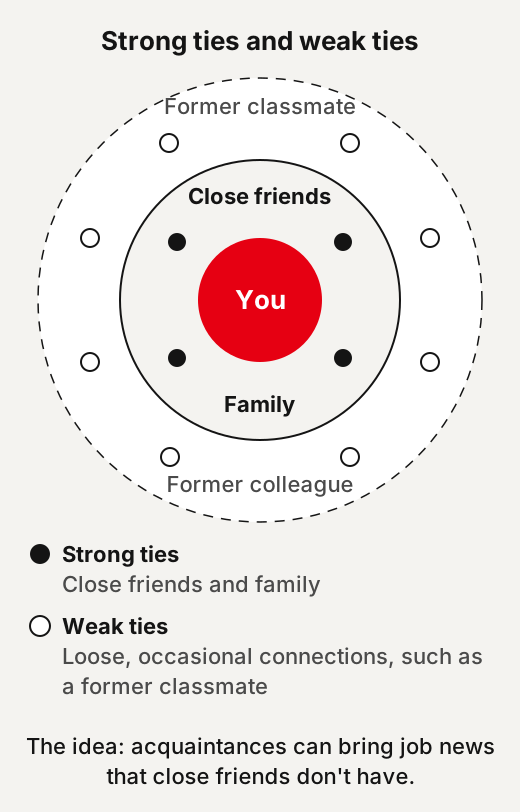
Example: a former colleague you message twice a year mentions an opening at her firm.
What the research found: a 2022 study in Science used experiments on LinkedIn’s connection suggestions, which randomly varied the share of weak ties for over 20 million people over five years.
- Weaker ties increased job moves, but only up to a point. By one measure (mutual connections) moderately weak ties did best; by another (how often people interacted) the weakest ties did.
- Weak ties helped more in digital industries, while strong ties helped more in less digital ones.
- Two of the five authors were affiliated with LinkedIn.
Earlier large studies, which were not experiments, had found what researchers called “a paradox of weak ties”, in which strong ties seemed to deliver the jobs. So the experiment matters because it tested cause, not just correlation.
How sure: Moderate one very large experiment supports it, on one platform, with results that vary by industry.
Try this: get back in touch with one person you have not spoken to in a year, just to catch up.
| Weak ties | Loose, occasional connections, such as a former classmate. In the study, they helped more in digital industries. |
| Strong ties | Close friends and family. In the study, they helped more in less digital industries. |
Comfort zones
Stretching, one step at a time
A stretch is a step you can do with effort and perhaps some help, and it belongs to a task, not to you.
Example: speaking up once in a team meeting before offering to give the whole presentation.
How to use it: our stretch zone guide works this out in detail. In our version of the diagram, your stretch is a step you can do with effort and perhaps some help. The guide suggests rating the next step from 1 to 10 and resizing it until it feels like a 5 or 6. Those cut-offs are our own rule of thumb, not research.
Two of our book summaries look at the same question from other angles. The Deep Work summary covers focused, undistracted work, and the Range summary covers trying several fields first.
Try this: pick one career skill and rate your next step in it from 1 to 10.
Where to learn more
- Atlanta Fed Wage Growth Tracker: pay growth for job switchers and stayers, updated monthly.
- US Bureau of Labor Statistics, Education pays: earnings and unemployment by education.
- US Department of Labor, retirement plan FAQs: vesting and what happens when you leave a job.
- World Economic Forum, Future of Jobs Report 2025: what employers expect to change.
- A causal test of the strength of weak ties (Science, 2022): the LinkedIn experiment.
- Related idea guides: money habits people talk about and industries built on lasting needs.
Quick answers
Do people who switch jobs earn more?
In the Atlanta Fed's data, median pay growth in the 12-month average to September 2026 was 4.4% for switchers and 3.5% for stayers. The gap moves over time: from mid-2009 to late 2010, switchers' pay grew more slowly than stayers'.
Are skills more important than a degree?
The sources point both ways. In 2025, median weekly earnings in the US were $1,578 for people with a bachelor's degree and $966 for those with a high school diploma, while one report found dropping degree requirements changed not even 1 in 700 hires.
What are weak ties?
Weak ties are loose, occasional connections, as opposed to close friends and family. Stanford's summary describes them as "infrequent, arms-length relationships".
What is vesting?
Vesting is earning the right to keep a benefit. The US Department of Labor explains that you vest immediately in your own retirement plan contributions, but not necessarily in your employer's.
Use this
A short way to weigh a career move, built from the ideas on this page.
What would I gain from this move, and what would I leave behind?
Quick quiz
Nothing is scored or saved. Recalling it once now is what makes it last.
1. From mid-2009 to late 2010, how did job switchers' pay growth compare with stayers'?
Answer: It was slower.Read it again ↑
2. In the LinkedIn experiment, what happened as ties got weaker?
Answer: Job moves rose, but only up to a point.Read it again ↑
3. What can happen if you leave a job before you are vested?
Answer: You may lose some employer-provided benefits.Read it again ↑
How we checked this · Last checked November 2026
- Switcher and stayer figures were read from the Atlanta Fed's own data file (12-month averages, updated 8 October 2026), not from charts.
- The original 1973 weak-ties paper sits behind a journal paywall; we used the 2022 Science abstract and Stanford's summary of it.
- The skills-based hiring report is from the Burning Glass Institute and Harvard Business School; the World Economic Forum figure is an employer survey. The BLS and US Department of Labor pages block scripts, so they were read in a browser tool.