Start here"A picture is worth a thousand words" is often called a Chinese proverb. The earliest example a phrase dictionary found is an editor's talk to an advertising club in March 1911. So where did the Chinese label come from?
Many sayings sound wiser when they arrive with a far-off label, such as “an ancient Chinese proverb” or “a Cherokee legend”. Some of those labels were added in English, long after the words were written. Below: 14 sayings and translation stories, the oldest versions we found, and what each one can still teach you.
The verdicts
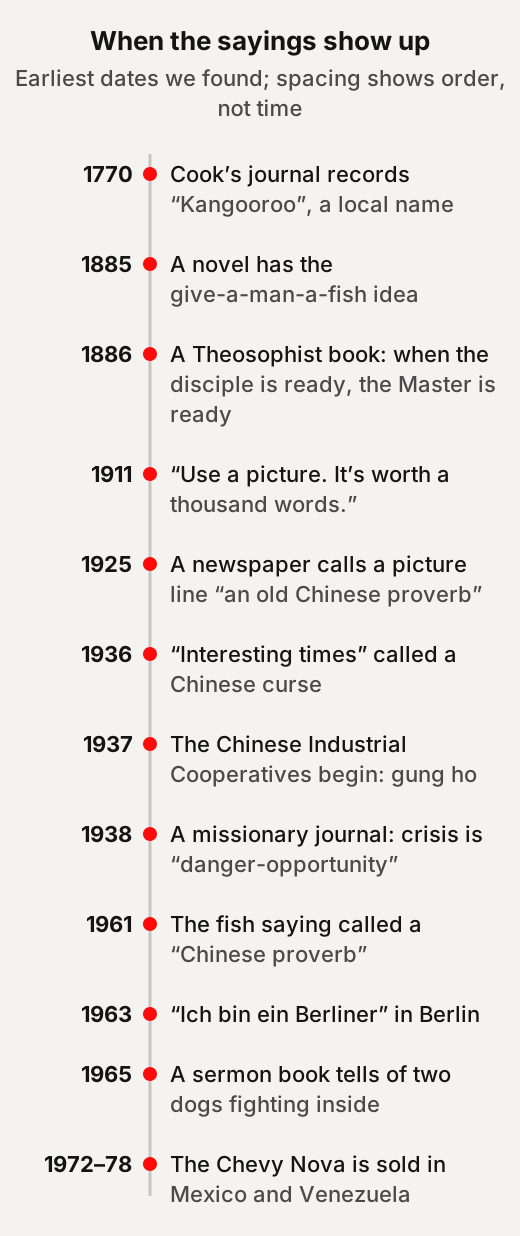
1. Where the sayings and stories show up
Most of these labels can be dated, and many of the sayings turn out to be younger and closer to home than they sound.
| Saying or story | Often credited to | What we found |
|---|---|---|
| Give a man a fish | China, or Laozi | An English novel, 1885 |
| A picture is worth a thousand words | China, or Confucius | Advice to an advertising club, 1911 |
| May you live in interesting times | A Chinese curse | A British speech, 1936 |
| When the student is ready, the teacher will appear | Buddhism | A Theosophist book, 1886 |
| The two wolves | The Cherokee | Christian sermon books with two dogs, 1965 and 1978 |
| It takes a village to raise a child | Africa | Not traced |
| Que sera, sera | Spain | English sources, from the 1400s |
| Trust in God, but tie your camel | An Arab proverb | Hadith collections |
| Crisis = danger + opportunity | The Chinese language | A missionary journal, 1938 |
| Gung ho | An old Chinese saying | A Chinese cooperative movement, 1937 |
| Hundreds of words for snow | Inuit and Yupik languages | Word lists of several dozen terms; the largest more than 100 |
| “I am a jelly doughnut” | A blunder in Berlin, 1963 | A story told outside Germany |
| Kangaroo means “I don’t know” | Cook’s crew, 1770 | Cook’s journal: a local name |
| The Nova flopped because “no va” | Spanish speakers | No sales data behind it |
2. Proverbs credited to China
Three famous “Chinese” sayings first appear in English, though China has real sayings on related ideas.
“Give a man a fish, and you feed him for a day”
Doesn't hold up It is an ancient Chinese proverb, or a saying of Laozi. The earliest fishing version found is in an English novel of 1885. The idea behind it is older than the fish.
How sure: Strong a quotation researcher and a phrase dictionary both found no Chinese source.
In Anne Isabella Thackeray Ritchie’s novel Mrs. Dymond, a character supposes someone meant that “if you give a man a fish he is hungry again in an hour”. The line goes on: “If you teach him to catch a fish you do him a good turn”. The novel ran as a serial in 1885. Quote Investigator traces the idea further back, to the 12th-century philosopher Maimonides: an 1826 account of his highest degree of charity includes helping someone “by teaching him a trade”.
A 1961 newspaper report has a missionary calling the modern version a “Chinese proverb”. A 1976 book linked it to “Lao-tse and Chairman Mao”. Quote Investigator says the claim that it is an old proverb from China or elsewhere “has only weak support at this time”. The Phrase Finder says there is “no evidence” linking it with China.
China does have an old saying on a related idea. The Book of Han, an early Chinese history, quotes “the ancients”: 臨淵羨魚,不如退而結網. Our plain English: rather than stand by the deep water wishing for fish, go back and weave a net. For example, if you keep envying someone’s skill, spend that hour learning its first step.
“A picture is worth a thousand words”
Doesn't hold up It is an old Chinese proverb, perhaps from Confucius. It was American advertising advice in the 1910s and 1920s, and the “Chinese” label came later.
How sure: Strong a quotation dictionary editor and a phrase dictionary trace it to American advertising.
The Phrase Finder’s earliest example is a talk by the newspaper editor Arthur Brisbane to an advertising club, in March 1911: “Use a picture. It’s worth a thousand words”. The Yale Book of Quotations, as reported by its editor Fred Shapiro, finds a Washington Post line of 26 July 1925. It calls “The picture is worth ten thousand words” “an old Chinese proverb”. Shapiro adds: “There appears to be no basis for the Chinese attribution”.
A real Chinese saying makes a similar point. In the Book of Han, the general Zhao Chongguo answers the emperor’s question about how many troops he needs: 百聞不如一見. Our plain English: hearing a hundred times is not as good as seeing once. For example, before you write a long email to explain a problem, check whether one screenshot would do.
“May you live in interesting times”
Doesn't hold up It is an ancient Chinese curse. No Chinese source has been found; the earliest strong match found is a British speech of 1936.
How sure: Strong a quotation dictionary and a quotation researcher found no Chinese saying like it.
Fred Shapiro, editor of The Yale Book of Quotations, writes: “No authentic Chinese saying to this effect has ever been found”. In March 1936, the British statesman Sir Austen Chamberlain said a diplomat who had served in China had told him of a Chinese curse. The curse, he said, “took the form of saying, ‘May you live in interesting times’”. Quote Investigator concludes there is “no substantive evidence” that it was an ancient or modern Chinese curse.
A real Chinese maxim may sit behind it. Quote Investigator points to a 1627 Chinese story collection with the line, in Shuhui Yang and Yunqin Yang’s translation, “better be a dog in days of peace / Than a human in times of war”. The Chinese text reads 宁為太平犬,莫作亂离人. Our reading: the real saying is a plain wish for peace, not a clever curse. For example, if your week feels too “interesting”, that line is the honest one to quote.
3. Wisdom credited to other traditions
These five are credited to Buddhism, the Cherokee, Africa, Spain and Arab tradition, and for only one did we find a written source in that tradition.
“When the student is ready, the teacher will appear”
Doesn't hold up It is a Buddhist proverb. The earliest close version found is in a Theosophist book printed in 1886, written in English.
How sure: Moderate dated printings trace it to that book; we did not search Buddhist texts ourselves.
The word researcher Barry Popik says it “is often said to be a Buddhist proverb, but there’s no evidence to support this”. He finds it in an 1886 printing of Mabel Collins’s Light on the Path: “For when the disciple is ready the Master is ready also”. The book’s own subtitle says it was written for those “who are ignorant of the Eastern wisdom”. By 1907 a newspaper called it Hindu philosophy, and Popik cites “When the student is ready the teacher appears!” from a 1921 advertisement.
Our reading: the line came from Western writers presenting “Eastern wisdom”, so it picked up an Eastern label. For example, once you are ready to ask, look for a teacher already around you, in a colleague or a good book.
“The two wolves inside you”
Can't confirm The story of two wolves, one good and one bad, is a Cherokee legend. We found no Cherokee source; the earliest versions we could open are Christian sermon stories about two dogs.
How sure: Limited an absence of evidence, from the books we could search; a source could still exist.
A 1965 book on prayer by a pastor tells of a man called Joe who says: “I have a black dog and a white dog inside of me”. Asked which one wins, Joe says: “The one I feed the most”. A 1978 book on the Holy Spirit by the evangelist Billy Graham tells of “an Eskimo fisherman” with two dogs, in a chapter called “The Christian’s Inner Struggle”.
Our reading: the image works on its own, without a borrowed source. Crediting it to a real people without evidence puts words in their mouths. For example, tell it as “an old sermon story about two dogs”, and the point still lands.
“It takes a village to raise a child”
Can't confirm It is an African proverb. We found no one who has traced this exact English sentence to an African language, though similar sayings are reported.
How sure: Limited a 2016 NPR report and the scholars it quotes could not trace it; that is not proof it is not African.
An NPR report that asked experts in 2016 concluded: “And in the end, the answer might be: We just don’t know”. One commenter in a scholars’ discussion it quotes gave a Kijita proverb, “Omwana ni wa bhone,” meaning a child’s upbringing belongs to the community. The same commenter gave a Swahili proverb that “approximates to the same”. The African studies professor Lawrence Mbogoni began his comment “Proverb or not”. He wrote that the line “reflects a social reality some of us who grew up in rural areas of Africa can easily relate to”.
The fairer way to put it is “a saying in the spirit of proverbs reported in Kijita and Swahili”. For example, if you quote it at a school event, name the Kijita saying instead, as a saying reported in that language.
“Que sera, sera”
Doesn't hold up It is an old Spanish saying. It is an English proverb dressed in Spanish-looking words, and a 2013 study finds it is not grammatical Spanish.
How sure: Strong a study of the phrase finds it almost only in English, from the 1400s on.
In a 2013 study in the yearbook Proverbium, Lee Hartmann writes that it is “ungrammatical in all three” of Spanish, Italian and French. He traces its “first documentation” to 15th-century England, and finds that “the phrase has virtually no history in Spain or Italy”. He suggests a possible origin in Middle French, but calls the evidence that it was grammatical there “inconclusive”. He follows it up to Doris Day’s 1956 hit song.
One early English use is a scene worth knowing. In Christopher Marlowe’s play Doctor Faustus (1604 text), Faustus reads “The reward of sin is death” and “If we say that we have no sin, we deceive ourselves”. He concludes “Che sera, sera, / What will be, shall be? Divinity, adieu!” and calls books of magic “heavenly”. In the King James Bible, Romans 6:23 goes on “but the gift of God is eternal life”. The verse after 1 John 1:8 begins “If we confess our sins”. Our reading: the play shows a man reaching his “what will be” by stopping halfway through each passage. We take no view on the passages themselves. For example, when you catch yourself saying “what will be, will be”, check whether you stopped reading halfway too.
“Trust in God, but tie your camel”
Partly It is an Arab proverb. It goes back to hadith reports, accounts of the Prophet Muhammad’s sayings, and the English wording is a paraphrase.
How sure: Moderate the reports are in two collections; their English wording differs from the proverb.
A hadith is a report of the sayings or actions of the Prophet Muhammad or his companions. In Jami’ at-Tirmidhi, number 2517, a man asks “Shall I tie it and rely (upon Allah), or leave it loose and rely (upon Allah)?” in the English on that page. The answer: “Tie it and rely (upon Allah)”. A similar report in the collection of Ibn Hibban names the animal: a man asks “Shall I release my camel and trust in Allah?” and is told to tie her.
Our reading: the original pairs trust with the practical step, and neither half replaces the other. We describe the text only and take no view on belief. For example, before a trip, lock the door and then stop worrying about it.
4. Words that changed in translation
Three words carry stories that grew bigger than their meaning, though in each case part of the story is true.
The Chinese word for “crisis”
Partly The Chinese word for crisis is made of “danger” plus “opportunity”. The first part does mean danger, but on its own the second part means something like “crucial point”, not opportunity.
How sure: Moderate a scholar of Chinese rejects the gloss; another writer sees a kernel of truth.
Victor Mair, professor of Chinese at the University of Pennsylvania, writes that the jī of wēijī “most definitely does not signify ‘opportunity’”. He says it means “something like ‘incipient moment; crucial point (when something begins or changes)’”. He also notes that jī is part of jīhuì, the word for opportunity, “but by itself jī does not mean ‘opportunity’”.
The linguist Ben Zimmer reports that Gary Feng argued “the urban myth has some kernel of truth in it”. Feng’s reason is that jī is used in a “generally more positive than negative” way. Zimmer adds that even if Feng is right, reading wēijī by its separate characters is “little more than the Sinitic equivalent of the etymological fallacy”. Zimmer’s earliest find is an unsigned editorial in a missionary journal in China, in January 1938: “The Chinese term for crisis is “danger-opportunity” (危機)”.
Our reading: a crisis is a turning point that calls for a decision, which is useful without the promise of a hidden prize. For example, in a bad week at work, ask “what has to be decided now?” before “where is the upside?”
“Gung ho”
Partly “Gung ho” is an old Chinese saying meaning eager. It is Chinese, but it began as the short name of a 1937 cooperative movement, roughly “work together”.
How sure: Strong a word historian and a major dictionary give the same origin.
The word historian David Wilton traces it to the Mandarin 工合, gōnghé, a clipping of the name of the Chinese Industrial Cooperatives, “started in 1937 in Shanghai”. In 1942 a US Marine officer made it his battalion’s motto, and a press report called it “an old Chinese saying”. The American Heritage Dictionary glosses its two parts as “work” and “combine, join”. It defines the English word as “Extremely enthusiastic and dedicated”.
Our reading: the word started as teamwork, not zeal. For example, a “gung ho” team in the old sense is one that pulls together, not one that rushes ahead.
Words for snow
Still argued The “Eskimo” languages have hundreds of words for snow. Most snow word lists run to several dozen terms, the largest more than 100 counting derived forms, and linguists still argue about how to count them.
How sure: Unsettled no known list runs into many hundreds, but how to count derived words is argued.
Geoffrey Pullum writes that the anthropologist Franz Boas, in 1911, “cited four snow-connected roots” and claimed nothing about there being many. Igor Krupnik and Ludger Müller-Wille, summing up the anthropologist Laura Martin, report that those four words later “snow-balled” into up to “two hundred”. They also write that “none of the known Eskimo snow lists expands into “many hundreds,” local snow lexicons commonly feature several dozen terms”. The largest list they know, compiled from a Nunavik Inuktitut dictionary, “has more than 100 terms, including numerous derivative forms”. Pullum agrees there are “several distinct” snow words, but warns that in languages that build words freely you can make “arbitrarily many” of them.
Our reading: the inflated number has no source, and the correction can overshoot too. People who live with snow and ice do name many kinds of it. For example, when a striking number backs an argument, ask for the list it came from.
5. Translation blunders that did not happen
These three are told as funny mistakes, and in each the record says the mistake was in the story.
“Ich bin ein Berliner” means “I am a jelly doughnut”
Doesn't hold up Kennedy’s 1963 line in Berlin was a grammar slip that made him call himself a pastry. His German was correct, and the doughnut story grew up outside Germany.
How sure: Strong a scholar of German explains the grammar, and the pastry word is not used in Berlin.
The Max Kade Institute at the University of Wisconsin-Madison, summarising Professor Jürgen Eichhoff’s 1993 article, says Kennedy’s words “were in fact grammatically correct”. German uses “ein” when the speaker has only some of the qualities named, not literally being one. It adds that the myth “developed only outside of Germany”, and that the pastry sense of Berliner is not even used in Berlin.
The useful part: a famous blunder can be a blunder about the blunder. For example, before you repeat a joke about someone’s grammar, check it with a native speaker.
“Kangaroo” means “I don’t understand”
Doesn't hold up Cook’s crew asked the animal’s name and wrote down a local phrase for “I don’t know”. The word comes from gaŋurru, a real name in the Guugu Yimidhirr language of north-east Australia.
How sure: Strong a major dictionary and a word historian agree, from Cook’s own journal.
On 4 August 1770, Cook’s journal mentions animals “called by the natives Kangooroo, or Kanguru”. The American Heritage Dictionary says the “I don’t know” belief “is in fact untrue”, and that linguistic fieldwork “has confirmed the existence of a word gangurru” in Guugu Yimidhirr. It says the myth grew after an explorer recorded a different word for the animal in 1820. David Wilton points to an earlier source of the confusion: in 1793 a British officer at Botany Bay wrote that “Kanguroo, was a name unknown to them for any animal, until we introduced it”. Wilton notes that Guugu Yimidhirr is spoken far to the north, not around Botany Bay. Both accounts agree a later, different word fed the myth, and Wilton calls the “I don’t understand” tale “a funny story, but utterly untrue”.
Our reading: the joke story erased the people who named the animal. For example, when a word comes from another language, look up which language; the answer is often a real community.
The Chevy Nova did not sell because “no va” means “doesn’t go”
Doesn't hold up The Chevrolet Nova sold badly in Spanish-speaking countries because of its name. We found no evidence that the name hurt sales, and the car sold in Mexico and Venezuela.
How sure: Moderate a linguist and a fact-checker agree, but we saw no published sales figures.
The Yale linguist Laurence Horn wrote that “there’s no evidence whatsoever that the name had any depressing effect on sales”. He added that Spanish speakers would more likely link “nova” with words for “new”. The fact-checking site Snopes, whose sources include a 1993 letter from General Motors, says the Nova was sold in Mexico and Venezuela from 1972 to 1978 and “sold well” in both.
Our reading: a cautionary tale that fits its lesson perfectly deserves a second look. For example, when a business story ends in a neat moral, ask for the sales numbers.
6. How to check a saying credited to another culture
You can test most of these labels in a few minutes, starting with the oldest copy you can find.
- Write down the exact words and the culture they are credited to.
- Look the saying up with a quotation researcher or a phrase dictionary that gives dated examples.
- Find the earliest example and check what language it is in. A “Chinese proverb” first printed in English is a warning sign.
- Look for a primary source: the book, letter or collection the saying is supposed to come from.
- Search that culture’s own texts or dictionaries for a real saying on the same idea, and quote that instead.
- When you pass it on, say “the earliest we found”, not “the first”.
Most of the sayings in sections 2 and 3 are a misattribution: the words are real, but the label is wrong. For example, the picture saying took us two steps: a phrase dictionary gave the 1911 talk, and a quotation dictionary showed the “Chinese” label arriving later.
Quick answers
Is "give a man a fish" a Chinese proverb?
No Chinese source has been found. The earliest fishing version found is in an English novel of 1885, and a 1961 newspaper report is where a missionary calls the modern version a "Chinese proverb".
Is "may you live in interesting times" a Chinese curse?
No authentic Chinese saying like it has been found. The earliest strong match found is a British speech of 1936, by a man who said a diplomat had told him of it.
Does the Chinese word for crisis mean danger plus opportunity?
Partly. The first part does mean danger, but on its own the second part means something like "crucial point", not opportunity. Gary Feng argues the gloss has "some kernel of truth".
Did Kennedy call himself a jelly doughnut in Berlin?
No. His German was correct, and the doughnut story grew up outside Germany. The pastry sense of Berliner is not even used in Berlin.
Does "kangaroo" mean "I don't understand"?
No. The word comes from gaŋurru, a real name in the Guugu Yimidhirr language of north-east Australia, and Cook recorded it in 1770.
Use this
Before you pass on a saying credited to another culture, find its oldest copy and the language it is in.
Is the earliest copy of this saying in the language of the people it is credited to?
Quick quiz
Nothing is scored or saved. Recalling it once now is what makes it last.
1. Where is the earliest fishing version of "give a man a fish" found?
Answer: In an English novel of 1885.Read it again ↑
2. What does Victor Mair say the jī in the Chinese word for crisis means on its own?
Answer: Something like a crucial point.Read it again ↑
3. Where does the word "kangaroo" come from?
Answer: Gaŋurru, a word in the Guugu Yimidhirr language.Read it again ↑
How we checked this · Last checked October 2026
- We read Quote Investigator, the Phrase Finder, Barry Popik, Wordorigins, Language Log and the American Heritage Dictionary entries, and the editor of The Yale Book of Quotations as reported by him.
- We read the Chinese texts of the Book of Han and Feng Menglong's stories on Wikisource; the plain English renderings are ours.
- We read the 1965 and 1978 sermon books only as search snippets of scanned copies, and found no Cherokee source.
- We read the hadith in English and Arabic on sunnah.com, and the Ibn Hibban report in an English translation.
- We read the abstract of the 2013 Proverbium study, not the full paper, and saw no published sales figures for the Nova.
- Every date is the earliest we found. Older printings can still turn up.
Sources
Proverbs credited to China
- Quote Investigator, “Give a Man a Fish, and You Feed Him for a Day” (28 August 2015, updated 10 January 2025) and “May You Live in Interesting Times” (18 December 2015, updated 22 June 2024).Popular
- Phrase Finder (G. Martin), “Give a man a fish” and “A picture is worth a thousand words”.Popular
- F. Shapiro, “A Picture’s Worth a Thousand Words”, Freakonomics, 14 July 2011 (from The Yale Book of Quotations).Scholarly
- Ban Gu, Book of Han (漢書), chapters 56 and 69, Chinese text at Wikisource (ch. 56, ch. 69).Primary
- Feng Menglong, Xingshi hengyan (醒世恆言), story 3, Chinese text at Wikisource.Primary
Other traditions
- B. Popik, “When the student is ready, the teacher will appear”, The Big Apple.Popular
- M. Collins, Light on the Path (Project Gutenberg #14599); third edition, Boston: Cupples, Upham and Company, 1886 (Internet Archive).Primary
- J. R. Bisagno, The Power of Positive Praying (Zondervan, 1965), and B. Graham, The Holy Spirit (Word Books, 1978), read as search snippets of scanned copies via Open Library; Billy Graham Evangelistic Association, “Billy Graham”.Primary
- J. Goldberg, “It Takes A Village To Determine The Origins Of An African Proverb”, NPR Goats and Soda, 30 July 2016.Popular
- L. Hartmann, ““Que sera sera”: The English Roots of a Pseudo-Spanish Proverb”, Proverbium 30 (2013), pp. 51–104.Scholarly
- C. Marlowe, The Tragical History of Doctor Faustus, 1604 quarto, ed. A. Dyce (Project Gutenberg #779).Primary
- Romans 6:23 and 1 John 1:8–9, King James Version (Bible Gateway).Primary
- Jami’ at-Tirmidhi 2517, English and Arabic at sunnah.com; Sahih Ibn Hibban 731, translated by Abu Amina Elias, Daily Hadith Online, 6 July 2023.Primary
- Rumi, Masnavi, trans. R. A. Nicholson, at Sufinama.Primary
Words and translation stories
- V. H. Mair, “danger + opportunity ≠ crisis” (last revised September 2009).Scholarly
- B. Zimmer, “Crisis = danger + opportunity: The plot thickens”, Language Log, 27 March 2007.Scholarly
- D. Wilton, Wordorigins.org, “gung-ho” (3 December 2020) and “kangaroo” (16 March 2021).Popular
- The American Heritage Dictionary of the English Language, 5th edition, “gung ho” and “kangaroo”.Scholarly
- G. K. Pullum, “Bad science reporting again: the Eskimos are back”, Language Log, 15 January 2013.Scholarly
- I. Krupnik and L. Müller-Wille, “Franz Boas and Inuktitut Terminology for Ice and Snow”, in SIKU: Knowing Our Ice (Springer, 2010), pp. 377–400.Scholarly
- Max Kade Institute, University of Wisconsin–Madison, “Ich bin ein Berliner” (summarising J. Eichhoff, Monatshefte 85, 1993).Scholarly
- L. Horn, “(Chevy) Nova —Query”, American Dialect Society mailing list, 6 May 2005.Scholarly
- D. Mikkelson, “Did the Chevrolet Nova Fail to Sell in Spanish-Speaking Countries?”, Snopes, 2 April 1999.Popular
A far-off label is a claim to check
A far-off label can make a saying sound wiser, which is why it is worth checking. Our view: a label like "an old Chinese proverb" is a claim, not a credential. The words can still be worth quoting, under a label you can stand behind.
This week: collect far-off labels
Our suggestion: for one week, note each saying you meet with a far-off label, such as "a Cherokee legend". At the week's end, look up two. Write what you found beside each, even if it is "no source yet".
Keep a sourced file of the sayings you quote
- Start one note. Our suggestion: keep a single note for the sayings you like to quote in talks, posts or emails.
- Give each line four fields. The exact words, who they are credited to, the earliest copy you found with its date, and its language.
- Write a label you can stand behind. Our view: if the label does not hold, keep the words and use a label that does.
- Mark what is still open. Some trails end without an answer, like the two wolves. Note "no source found yet", since one could still turn up.
- Check again before print. Our dates are the earliest we found, and older printings can still turn up. Our suggestion: recheck a line before it goes into print.
Put source-checking to paid use
- Offer quote checks for speakers and writers: the earliest copy found, its date, and a label that holds.
- Write short posts on the earliest copy you can find of a familiar saying, each dated and sourced. Link to original texts rather than reprinting them, and make no language or culture the joke. With religious texts, describe the text and take no view on belief.
- Write quiz questions on word origins for puzzle pages or quiz books, with a source for every answer.
Ideas to explore, not financial or business advice. No result is promised.
Keep going
- Who really said it?Search the lines we have checked, with what we found and a link to each full check.
- How to spot a fake quoteWhy quotes get pinned on famous names, and how to trace a line to the earliest copy you can find.
- Confucius quotes, checkedOther popular lines credited to Confucius, read against the Analects in Chinese and English.
- Laozi and the Tao Te ChingOther popular claims about Laozi, checked against the Chinese text and the scholarship.
- Buddha quotes, checkedOther famous lines credited to the Buddha, read against the early Buddhist texts.
Goes with: 6. How to check a saying credited to another culture ↑