
Start here"Cleanliness is next to godliness" sounds like scripture, but the word "cleanliness" is not in the King James text. Its best-known use is a sermon by John Wesley, who put it in quotation marks. So where did the other famous lines come from?
Some lines that people quote as Bible verses are not in the Bible, and some that are say more than the famous few words. “Cleanliness is next to godliness” is a line from a sermon. “Spare the rod and spoil the child” is a rhyme from a comic poem.
We describe the texts and where phrases come from. We take no view on what any passage means for any faith.
The verdicts
1. How we checked each line
We searched the whole King James text for each line, then read the verses around it and one or two newer translations.
Our searches cover the King James Old and New Testaments, plus an older English text of the Apocrypha; where translations differ, we quote a newer one too.
| Line | Where it is found | In the King James text? |
|---|---|---|
| Cleanliness is next to godliness | A sermon by John Wesley | No |
| The Lord works in mysterious ways | A hymn by William Cowper, printed in 1774 | No |
| God helps those who help themselves | An Aesop fable; Franklin’s Poor Richard | No |
| Spare the rod and spoil the child | Samuel Butler’s poem Hudibras | A similar idea, in other words |
| Three kings | Matthew 2 has “wise men” and three gifts | No number, no kings |
| Eve ate an apple | Genesis 3:6 says “fruit” | No apple |
| The Needle Gate | A medieval note | No such gate |
| The prodigal son | Luke 15 | The story, but not the word |
| Scapegoat | Leviticus 16 in older English Bibles | Yes; newer ones say “Azazel” |
| Moses had horns | The Latin Bible, Exodus 34:29 | No; his face “shone” |
| Joseph’s coat of many colours | Genesis 37:3 | Yes; newer ones differ |
| Judge not | Matthew 7:1 | Yes, and the passage goes on |
| An eye for an eye | Exodus 21:24 | Yes, in a list of penalties |
| Eat, drink and be merry | Four different books | In pieces |
2. Lines that are not in the Bible
Four lines that sound like scripture come from a sermon, a hymn, a fable and a comic poem.
It’s in the Bible: “Cleanliness is next to godliness”
Doesn't hold up “Cleanliness is next to godliness” is a Bible verse. The word “cleanliness” is not in the King James text; the line’s best-known use is a sermon by John Wesley.
How sure: Strong a search of the whole King James text finds no such verse, and the sermon is in print.
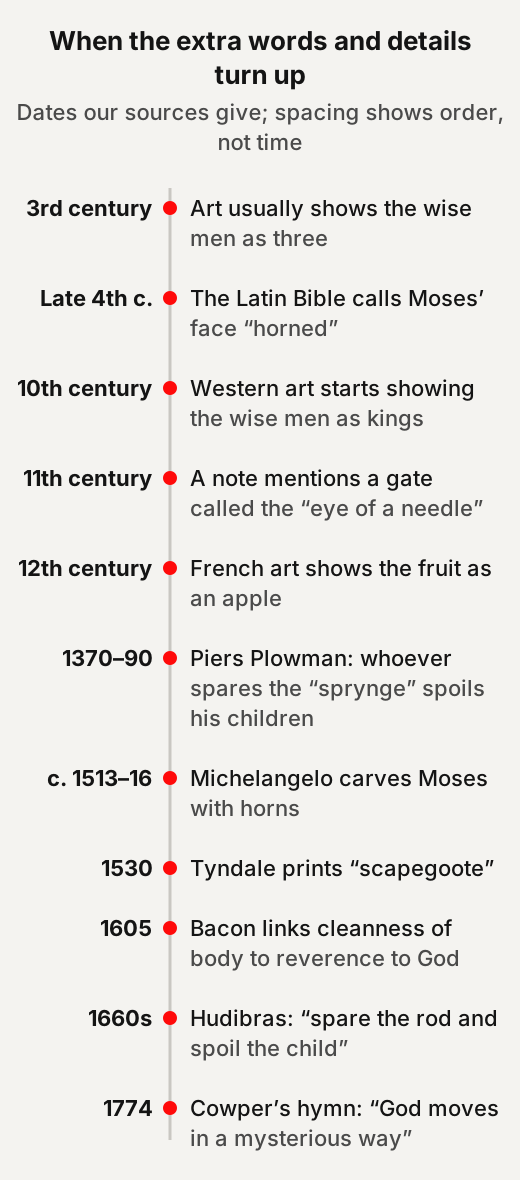
Our reading: Wesley put the words in quotation marks, which suggests he was quoting a saying already in use. The Phrase Finder traces the idea to Francis Bacon in 1605: “Cleanness of body was ever esteemed to proceed from a due reverence to God, to society, and to ourselves”.
For example, search a full Bible text for a line’s key word before you quote it as a verse.
It’s in the Bible: “The Lord works in mysterious ways”
Doesn't hold up “The Lord works in mysterious ways” is a Bible verse. The word “mysterious” is not in the King James text; the line comes from a hymn by William Cowper.
How sure: Strong the King James text has no “mysterious”, and the hymn’s 1774 printing is dated.
The hymn begins “God moves in a mysterious way”. Hymnary.org says it was published in John Newton’s Twenty-six Letters on Religious Subjects in 1774. It later appeared in the Olney Hymns as “Light Shining out of Darkness”.
Our reading: the everyday version turned “God moves” into “the Lord works”. For example, if a line scans like a hymn, check a hymn index too.
It’s in the Bible: “God helps those who help themselves”
Doesn't hold up “God helps those who help themselves” is a Bible verse. It is not in the King James text; the idea appears in an Aesop fable, and the wording in Franklin’s sayings.
How sure: Strong no such verse turns up in the King James text, and the fable and Franklin’s text are both in print.
In George Fyler Townsend’s translation of Aesop, a carter whose wagon is stuck in a rut cries out to Hercules for help. Hercules tells him to put his shoulders to the wheels, and “never more pray to me for help, until you have done your best to help yourself”.
In The Way to Wealth, a speech built from Poor Richard’s almanac sayings, an old man says: “God helps them that help themselves,” as Poor Richard says. Poor Richard, Franklin’s narrator, adds that not a tenth part of that wisdom was his own.
Our reading: the fable’s point is to do your own part as well as asking for help. For example, write down one step you can take yourself before you ask for help.
It’s in the Bible: “Spare the rod and spoil the child”
Partly “Spare the rod and spoil the child” is a Bible verse. A similar idea is in Proverbs 13:24, but the rhyming words come from a comic poem.
How sure: Strong the verse and the poem are both in print, and a phrase dictionary links them.
The Phrase Finder credits the rhyme to Samuel Butler’s satirical poem Hudibras, first published in 1663. In the poem’s second part, a lady offers to free a knight if he will take a whipping for her sake. Her reason: “Love is a boy by poets stil’d; / Then spare the rod and spoil the child”. An older English form is in William Langland’s Piers Plowman, from 1370–90: “Who-so spareth ye sprynge, spilleth his children”.
Our reading: the famous rhyme is a joke about a lover, not a verse. For example, if you mean the verse, quote Proverbs 13:24 itself.
3. Details that later tradition added
In these four, the text tells a story, and later art, notes or titles added a detail the words do not give.
It’s in the Bible: three kings visited the baby Jesus
Partly The Bible says three kings visited the baby Jesus. Matthew tells of “wise men from the east” and three gifts, but gives no number and does not call them kings.
How sure: Strong the text is short and plain, and an art historian traces the later tradition.
Matthew 2:1 says “there came wise men from the east to Jerusalem”. In 2:11 they come “into the house” and give “gold, and frankincense and myrrh”.
The art historian Pamela Patton writes that Matthew “offers no information about the number of magi”. Showing them as a trio became the usual way from the third century, she writes, “perhaps inspired by the three gifts”. Their familiar names appear much later, in Byzantine texts and images of the sixth century. Only in the tenth century, in western Europe, were they reimagined as royal figures.
Our reading: a nativity scene with three crowned kings blends a short text with centuries of art. For example, sort a familiar story’s details into two piles: what the text says, and what pictures added.
It’s in the Bible: Eve ate an apple
Doesn't hold up The Bible says Eve ate an apple. Genesis says “fruit”, and so does the Latin Bible; why art settled on an apple is still argued.
How sure: Strong on the text — Genesis and the Latin Bible both say fruit; why the apple won is still argued.
Genesis 3:6 says “she took of the fruit thereof, and did eat”. The Latin Vulgate has “tulit de fructu illius”, in our translation “she took of its fruit”.
The literature professor Robert Appelbaum told NPR the apple came from a Latin pun, since malus can mean “bad” or “apple”. The scholar Azzan Yadin-Israel says that explanation “has no support in the Latin sources”. He finds the apple in pictures of the scene in France in the 12th century. He links it to a word change: Old French “pom” first meant any fruit, then took on the narrower meaning “apple”.
Both scholars agree the text does not name the fruit. For example, check whether a text names a story’s key object before you build a point on it.
The “Needle Gate” was a real gate in Jerusalem
Doesn't hold up “The eye of a needle” was the name of a small gate in Jerusalem. A recent study found no ancient evidence for such a gate; the earliest mention it found is medieval.
How sure: Strong a 2022 study reports that most biblical scholars reject the gate idea, and it found no ancient evidence.
A 2022 study in New Testament Studies found “no ancient evidence” of “eye of a needle” as the name of a gate in Jerusalem’s wall. The earliest note it found that mentions such a gate “seems to be a gloss attributed to Anselm of Canterbury (11th cent.)”. That note is preserved in Thomas Aquinas’s thirteenth-century Catena aurea.
Our reading: a neat explanation of a famous phrase deserves the same check as the phrase itself. For example, ask for the oldest source of any explanation of a famous line.
It’s in the verses: “the prodigal son”
Doesn't hold up The verses of Luke 15 call him “the prodigal son”. The parable is in Luke 15, but the word “prodigal” is not in the King James text; it means wasteful.
How sure: Strong the word is absent from the King James text, and dictionaries define it as wasteful.
Luke 15:13 says the younger son “wasted his substance with riotous living”. In 15:20, “when he was yet a great way off, his father saw him, and had compassion, and ran”. The English Standard Version prints the heading “The Parable of the Prodigal Son” above Luke 15:11. The New Revised Standard Version’s heading is “The Parable of the Prodigal and His Brother”. Neither uses the word in the verses we read.
The American Heritage Dictionary defines prodigal as “Rashly or wastefully extravagant”. It comes from Latin prōdigere, “to drive away, squander”.
Our reading: the word in the story’s name first meant spending, not coming home. Today the Cambridge Dictionary also lists a second sense: “someone who returns to a place, organization, team, etc. after previously leaving it”. For example, check which sense a writer means before you repeat “the prodigal has returned”.
4. Words that changed in translation
Here the words are in an English Bible, but translators read the older Hebrew or Latin in different ways.
It’s in the Bible: the word “scapegoat”
Partly The word “scapegoat” is in the Bible. It is in the King James Version and in Tyndale’s 1530 translation, but newer translations keep the Hebrew name “Azazel”.
How sure: Moderate the translations are plain to read; what “Azazel” meant is uncertain, and readings differ.
In the King James Version, Leviticus 16:8 reads: “one lot for the LORD, and the other lot for the scapegoat”. William Tyndale’s 1530 translation of the same verse already has “scapegoote”. The New Revised Standard Version reads “the other lot for Azazel”. The English Standard Version also has “Azazel”.
The American Heritage Dictionary says “scapegoat” translated a Hebrew phrase meaning “goat that escapes”, a misreading of Azazel. The Blue Letter Bible lexicon marks the meaning of Azazel as “dubious”. Simon Holloway of the Sydney Jewish Museum writes that Jewish tradition takes Azazel as “the name of a rocky headland”.
The readings differ, and we take no side. Today the dictionary’s first meaning is “One that is made to bear the blame of others”. For example, the everyday word fits a team that blames one person for a shared failure.
It’s in the Bible: Moses had horns
Partly The Bible says Moses had horns. The Latin Vulgate says his face was “horned”; the King James and newer translations from the Hebrew say it shone.
How sure: Strong on the texts — the wording of each translation is plain, and the Hebrew verb can mean “shine” or “have horns”.
The King James Version of Exodus 34:29 says Moses “wist not that the skin of his face shone while he talked with him”. The Vulgate is the Latin Bible that Jerome made. It dates from the end of the fourth century AD. Its wording of the same verse is “cornuta esset facies sua”, his face was horned.
The Blue Letter Bible lexicon gives the Hebrew verb as “send out rays”, and Strong’s dictionary glosses it “have horns, shine”. The art historian Gerd Blum writes that the horns of the Vulgate were “common” in pictures of Moses in Northern Europe. He calls the horns on Michelangelo’s statue of Moses, made in about 1513–1516, both “a literal rendering of the Vulgate” and, in central Italy, “a deliberate anachronism”. He adds that Latin commentaries linked the “horns” with light.
Our reading: in Northern Europe, many pictures of Moses followed one translation’s word. For example, when an old picture puzzles you, ask which translation the artist read.
It’s in the Bible: Joseph’s “coat of many colours”
Still argued Genesis says Joseph’s coat had many colours. The King James Version says so; other translations read the Hebrew differently, and one notes that its meaning is uncertain.
How sure: Unsettled translators disagree, and one major translation says the Hebrew is uncertain.
The King James Version gives Joseph “a coat of many colours”. The English Standard Version has “a robe of many colors”. The New Revised Standard Version has “a long robe with sleeves”, with a note: “Traditional rendering (compare Gk): a coat of many colours; Meaning of Heb uncertain”.
The Brown-Driver-Briggs lexicon, on the Blue Letter Bible site, reads the phrase as a “tunic reaching to palms and soles”. The same phrase is used of Tamar’s robe in 2 Samuel 13:18–19, which the King James calls “a garment of divers colours”.
Our reading: when translations of one verse differ this much, the word behind them is uncertain. For example, before you build a point on one detail of an old story, compare two translations of that verse.
5. Lines that are there, with more around them
These words are in the Bible, and the verses around them add a condition, a contrast or a reply.
It’s in the Bible: “Judge not”
Holds up “Judge not” is in the Bible. It is, in Matthew 7:1, and the next verses go on to talk about the standard you judge by.
How sure: Strong the words and the verses that follow are all in the text.
Matthew 7:1–2 reads: “Judge not, that ye be not judged. For with what judgment ye judge, ye shall be judged”. Verse 5 goes on: “first cast out the beam out of thine own eye; and then shalt thou see clearly to cast out the mote out of thy brother’s eye”. John 7:24 reads: “Judge not according to the appearance, but judge righteous judgment”.
Our reading: in the passage, the two words come with a measure and a mirror. That describes the words, not how any faith applies them. For example, when someone quotes “Judge not”, read verses 2 to 5 before you reply.
It’s in the Bible: “An eye for an eye”
Holds up “An eye for an eye” is in the Bible. It is, in a list of legal penalties in Exodus (and again in Leviticus 24:20 and Deuteronomy 19:21), and it is quoted in Matthew.
How sure: Strong the verses are in the text, and the later Jewish legal reading is in print.
Exodus 21:23–25 reads: “thou shalt give life for life, Eye for eye, tooth for tooth, hand for hand, foot for foot”. In Matthew 5:38–39 the words are quoted and followed by “But I say unto you, That ye resist not evil”.
In Jewish law, the Mishnah has one who injures another pay “for damage, for pain, for medical costs, for loss of livelihood, and for humiliation”. The Talmud quotes an early teaching: “one might have thought” the court blinds the eye of one who blinded another. It concludes he “is liable to pay monetary compensation”. A similar rule is in the laws of Hammurabi, who ruled Babylonia from around 1792 to around 1750 BCE. Law 196 of Hammurabi’s code says that if a man puts out the eye of another man, his own eye shall be put out.
Our reading: in Exodus the words sit in a list of laws, two verses after a case settled “as the judges determine”. For example, when the line is quoted about getting even, read the verses around it first.
It’s in the Bible: “Eat, drink and be merry, for tomorrow we die”
Partly “Eat, drink and be merry, for tomorrow we die” is one Bible verse. The pieces are spread over four books, and the verses around them answer in different ways.
How sure: Strong all four passages are in the text.
Ecclesiastes 8:15 says “a man hath no better thing under the sun, than to eat, and to drink, and to be merry”. Luke 12:19 has the exact words “eat, drink, and be merry”, spoken by a rich man to himself. The next verse begins: “But God said unto him, Thou fool, this night thy soul shall be required of thee”.
Isaiah 22:13 has “let us eat and drink; for to morrow we shall die”, and the next verse calls this “iniquity”. Paul quotes the same words in 1 Corinthians 15:32, after “if the dead rise not”.
Our reading: two different ideas were joined into one saying. For example, look up each half of a two-part saying on its own.
6. Lines we have looked at elsewhere
Four more lines are covered on other pages, so we give them a line each here.
- “Money is the root of all evil”: 1 Timothy 6:10 reads “the love of money is the root of all evil”. See Did They Really Say That? Part 2.
- “Pride comes before a fall”: Proverbs 16:18 reads “Pride goeth before destruction, and an haughty spirit before a fall”. Same page.
- “As a man thinketh”: in Proverbs 23:7 the line sits in a warning about a host who does not mean his welcome. See our As a Man Thinketh summary.
- “A law unto themselves”: in Romans 2:14 it describes people who do what the law asks without having been given it. See sayings that used to mean the opposite.
More pages like this one are gathered on Quotes, sayings and stories, checked.
7. How to check a “Bible line” yourself
You can check most of these in a few minutes with a full Bible text and one newer translation.
- Search a full Bible text for the line’s most unusual word.
- If you find it, read the verses before and after.
- Compare two translations of the same verse.
- If it is not there, look the line up in a phrase dictionary or a hymn index.
- Ask whether a detail comes from the words or from later pictures, notes and titles.
- When you pass it on, give the book, chapter and verse, and the translation you used.
For example, the cleanliness line took one search and one phrase dictionary.
Quick answers
Is "God helps those who help themselves" in the Bible?
Our search of the King James text found no such verse. An older form of the idea is in an Aesop fable, where Hercules tells a carter to do his best to help himself, and the English line is in Benjamin Franklin's Poor Richard sayings.
Is "spare the rod and spoil the child" a Bible verse?
Not in those words. Proverbs 13:24 reads "He that spareth his rod hateth his son", and the rhyme comes from Samuel Butler's comic poem Hudibras.
How many wise men visited Jesus?
Matthew does not say. It tells of "wise men from the east" and three gifts, and the art historian Pamela Patton writes that showing them as a trio became usual from the third century, "perhaps inspired by the three gifts".
Where does the word "scapegoat" come from?
From William Tyndale's 1530 English translation of Leviticus 16:8, where it is spelled "scapegoote"; the King James Version kept it. Newer translations keep the Hebrew name "Azazel", whose meaning is uncertain.
Is "eat, drink and be merry" in the Bible?
The exact words are in Luke 12:19, spoken by a rich man to himself. "For tomorrow we die" comes from Isaiah 22:13 and 1 Corinthians 15:32, so the full saying joins verses from different books.
Use this
Before you quote a line as scripture, find the verse and read the verses around it.
Can I point to the book, chapter and verse, and does the passage around it say the same thing?
Quick quiz
Nothing is scored or saved. Recalling it once now is what makes it last.
1. Where is "Cleanliness is next to godliness" best known from?
Answer: A sermon by John Wesley.Read it again ↑
2. What does Genesis 3:6 say Eve ate?
Answer: Fruit, without naming it.Read it again ↑
3. How does the King James Version describe Moses' face in Exodus 34:29?
Answer: It shone.Read it again ↑
How we checked this · Last checked October 2026
- We searched the whole King James text (Project Gutenberg's file of the Old and New Testaments) for each line, then read the verses around it on Bible Gateway, and compared the New Revised Standard Version (with its notes) and the English Standard Version where translations differ.
- We read the other sources in their own words where we could reach them, including Wesley's sermon, Cowper's hymn in an edition of his works, Townsend's Aesop, Franklin's Way to Wealth, Butler's Hudibras, Tyndale's 1530 Pentateuch, the Mishnah and Talmud in the William Davidson English edition, and a 2022 study on the needle gate.
- For Hebrew words we used the Brown-Driver-Briggs and Strong's entries on the Blue Letter Bible site.
- We also searched an older English text of the Apocrypha (the Deuterocanonical books) for the lines marked as not in the King James text; none of them is there.
- We describe texts and where phrases come from. We take no view on what any passage means for any faith.
- We could not open the 1660s printing of Hudibras's second part or a dated first printing of Franklin's speech, so those dates are left out or given as the reference works give them.
Sources
Bible texts
- The King James Version: the full text searched in Project Gutenberg #10; verses linked on Bible Gateway.Primary
- The Latin Vulgate, Genesis 3:6 and Exodus 34:29 (Bible Gateway).Primary
- The New Revised Standard Version (Anglicized), Genesis 37:3 and Leviticus 16:8, with notes (oremus Bible Browser).Primary
- The English Standard Version, Genesis 37, Leviticus 16 and Luke 15 (esv.org); the New Revised Standard Version, Luke 15:11–13 (oremus Bible Browser).Primary
- The Deuterocanonical books (the Apocrypha), searched in Project Gutenberg #124.Primary
- W. Tyndale, The Pentateuch, 1530, Leviticus 16 (Internet Archive scan).Primary
- Blue Letter Bible lexicon, Brown-Driver-Briggs and Strong’s entries H5799, H6446 and H7160.Scholarly
- Mishnah Bava Kamma 8:1 and Talmud Bava Kamma 83b, William Davidson English edition, which adds explanatory words to the translation (Sefaria).Primary
Where the other lines come from
- J. Wesley, “On Dress”, Sermon 88, paragraph 5 (Wesley Center Online, 1872 edition).Primary
- W. Cowper, “Light Shining out of Darkness”, Olney Hymns, in The Works of William Cowper (Project Gutenberg #47790); Hymnary.org, “God moves in a mysterious way”.Primary
- Aesop, “Hercules and the Wagoner”, in Three Hundred Aesop’s Fables, trans. G. F. Townsend (Project Gutenberg #21).Primary
- B. Franklin, Franklin’s Way to Wealth; or, “Poor Richard Improved” (Project Gutenberg #43855).Primary
- S. Butler, Hudibras, Part II, Canto I (Project Gutenberg #4937).Primary
- Phrase Finder (G. Martin), “Cleanliness is next to godliness” and “Spare the rod and spoil the child”.Popular
- The American Heritage Dictionary of the English Language, 5th edition, “prodigal”, “scapegoat” and “Vulgate”; Cambridge Dictionary, “prodigal”.Scholarly
Art, tradition and scholarship
- P. Patton, “Wise Guys”, Index of Medieval Art, Princeton University, 21 December 2018.Scholarly
- N. Martyris, “Paradise Lost: How The Apple Became The Forbidden Fruit”, NPR, 30 April 2017.Popular
- “How the Forbidden Fruit Became an Apple”, Rutgers Today, 16 February 2023 (interview with Azzan Yadin-Israel).Popular
- A. Ziemińska, “The Origin of the ‘Needle’s Eye Gate’ Myth: Theophylact or Anselm?”, New Testament Studies 68(3), 2022, 358–361.Scholarly
- S. Holloway, “The origins of the scapegoat”, Sydney Jewish Museum, 8 October 2019.Popular
- G. Blum, “In foramine petrae”, Vulgata in Dialogue 4, 2020, 45–78 (doi:10.25788/vidbor.v4i0.305).Scholarly
- The Code of Hammurabi, trans. L. W. King, law 196 (Avalon Project, Yale Law School).Primary
- K. E. Slanski, “The Law of Hammurabi and Its Audience”, Yale Journal of Law & the Humanities 24 (2012), p. 102.Scholarly
A line you know by heart is a lead
Four lines here sound like scripture but come from a sermon, a hymn, a fable and a comic poem. Our view: a line you know by heart is a lead, not a citation. If you cannot find it in the text, say where you did find it.
This week: log the lines you hear
Our suggestion: for one week, note each line you hear or read that is credited to the Bible. At the week's end, look up two. Write down the reference and translation, or where else the line turns up.
Compare translations without picking one
- Read the notes, not just the verse. Some translations print notes with the text. The NRSV's note on Joseph's coat says the meaning of the Hebrew is uncertain.
- Quote each wording with its name. Our suggestion: when versions differ, give both wordings and name each version. Your reader can then see the difference.
- Tell a heading from the text. Some modern Bibles print a heading over the story in Luke 15, and the wording differs between them. Our view: quote the verse, and say when a name comes from a heading.
Put quotation-checking to paid use
- Offer quotation checking for manuscripts: match each scripture line to its book, chapter, verse and translation.
- Build a reference list for an author, with each quoted line beside where it is found.
- Write short posts on where familiar sayings come from, such as a sermon, a hymn or a fable. Describe the texts, not what they mean, and name the translation of each verse.
Ideas to explore, not financial or business advice. No result is promised.
Keep going
- Who really said it?Search the lines we have checked, each with what we found and its source.
- Quotes that change with the next sentenceFamous lines read again with the sentence that follows them in the original.
- Sayings that used to mean the oppositeWhere common phrases came from, including "a law unto themselves", and how their meaning shifted.
- How to spot a fake quoteChecks for invented quotes and sources, including ones made up by AI.
- GlossaryPlain meanings for terms used on this page, such as Vulgate and parable.