

Start hereIn autumn 1834, newspapers mocked a man who claimed to have discovered perpetual motion. One said he could now hand himself over a river "by the straps of his boots". So how did that joke become advice?
Some everyday sayings now mean nearly the opposite of what they first meant. “Pull yourself up by your bootstraps” began as a joke about something impossible. “A moot point” first meant a point open to debate. Below: 12 phrases, the oldest versions we found, and what each change can teach you.
The verdicts
1. Where the older versions turn up
Most of these changes happened slowly, and the older versions can be dated in books, letters and newspapers.
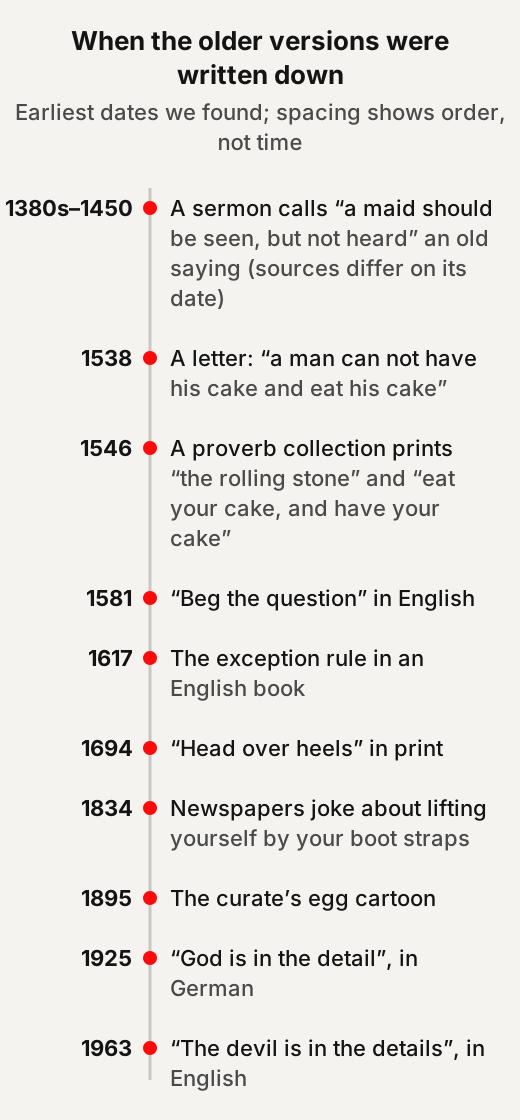
The dates are the earliest we found, not proof that nobody said these things sooner. Older copies can still turn up.
| Saying | What the old version meant | How it is often used now |
|---|---|---|
| Pull yourself up by your bootstraps | Something impossible | Succeed by your own effort |
| The curate’s egg | A bad egg, politely praised | Partly good, partly bad |
| One bad apple | It spoils the rest | Only a few, not the whole group |
| A rolling stone gathers no moss | Roaming costs you | No ties, no responsibilities |
| The exception proves the rule | A stated exception shows a general rule | An exception confirms a rule |
| Begs the question | Assumes what it should prove | Raises a question |
| A moot point | Open to debate | Not worth debating |
| Head over heels | Upside down | In love |
| Have your cake and eat it | Same sense; Heywood (1546) put eating first | Same meaning |
| The devil is in the details | God is in the detail | Trouble hides in small things |
| Children should be seen and not heard | A maid should be seen, not heard | About children |
| A law unto themselves | Doing right without a written law | Answering to no one |
The right-hand column is how each saying is often used today. Where we found no dictionary for a use, its section labels it as our reading.
2. Sayings that began as jokes or warnings
Four of these started as mockery, a polite joke or a warning, and now often carry a milder meaning.
“Pull yourself up by your bootstraps”
Doesn't hold up “Pull yourself up by your bootstraps” has always meant succeeding by your own effort. It began as a joke about something impossible. You cannot lift yourself by your own boots, and that was the point.
How sure: Moderate dated newspaper copies and a linguist’s account agree; an earlier use could still turn up.
In late September and October 1834, newspapers mocked a man who claimed to have discovered perpetual motion. One said he would now be able to hand himself over the Cumberland river “by the straps of his boots”.
The linguist Anne Curzan writes that, from what she can tell, for the rest of the 1800s the phrase meant “absurd and unfeasible attempts” to better your situation. By the 1920s, she writes, it had come to mean something possible and desirable.
The useful part: a success story told as pure self-lifting often leaves something out. For example, when you hear one, it can be worth asking who lent a hand, a tool or a first chance along the way.
“It’s a bit of a curate’s egg”
Partly “Like the curate’s egg” means partly good and partly bad. That is how the American Heritage Dictionary defines it now, but in the original joke the egg was simply bad. Our reading: an egg cannot be partly fresh.
How sure: Strong the 1895 cartoon shows the joke, and a current dictionary gives the modern sense.
The phrase comes from a cartoon called “True Humility” in the magazine Punch, on 9 November 1895. At breakfast, the host, a bishop, says: “I’m afraid you’ve got a bad egg, Mr. Jones!” The curate answers: “Oh no, my Lord, I assure you! Parts of it are excellent!”
Our reading: the curate was too polite to tell his superior the truth. That makes the phrase a useful warning about feedback. For example, if someone calls your plan “a bit of a curate’s egg”, ask which parts they would cut.
“It’s just a few bad apples”
Doesn't hold up The bad-apple proverb says one bad member does no harm to the rest. The old proverb says the opposite: one rotten apple spoils the others.
How sure: Strong the proverb is printed in Chaucer, and the passage around it shows how it was meant.
In Chaucer’s Cook’s Tale, a master recalls a proverb: “Wel bet is roten appel out of hord / Than that it rotie al the remenaunt”. Our plain English: better to take a rotten apple out of the store than let it rot all the rest. So the master sends his rowdy apprentice away, rather than let him spoil every servant in the house.
Our reading: today “just a few bad apples” is often said to mean the problem is small. The Cambridge Dictionary still defines a bad apple as “a person whose bad actions spoil the good work of other people”, and its examples include “You get a few bad apples in every profession”. The proverb treated a bad apple as a reason to act before the rest go bad.
A 2010 review of research on unethical choices at work uses “bad apple” for the person, “bad case” for the moral issue, and “bad barrel” for the workplace. The review drew on over 30 years of research and found that unethical choices have several causes at once.
For example, if one person on a team keeps cutting corners, the old proverb would ask two questions. What should happen with that person, and are others starting to copy them?
“A rolling stone gathers no moss”
Partly “A rolling stone gathers no moss” praises a life on the move. Some people read it that way now, but the earliest English record we found is a rebuke for roaming.
How sure: Moderate the 1546 text is clear, but we found no study of when the second reading spread.
The proverb is in John Heywood’s collection of English proverbs, published in 1546. There an uncle scolds the narrator for “Roming in and out”: “the rolling stone never gatherth mosse”. Greek and Latin versions are older: Erasmus listed them in his collection of proverbs in 1508.
The Phrase Finder gives the old meaning as “Someone who does not settle in one place rarely prospers”. In that reading, moss is what you gain by staying put. The Cambridge Dictionary now gives both sides: no responsibilities, but also no permanent place to live.
For example, before you quote it about a job change, decide which half you mean: the freedom, or the roots you give up.
3. Sayings from law and logic
Three of these come from courts and textbooks, where the words had exact meanings that everyday use has bent.
“The exception that proves the rule”
Doesn't hold up An exception proves that a rule is true. In the old legal sense, an exception that is spelled out shows that a general rule exists for every other case.
How sure: Moderate a phrase dictionary traces the legal maxim, and Cicero argued the same way; we did not open the 1617 book.
The Phrase Finder calls it “a legal maxim, established in English law in the early 17th century”. It finds examples in print, in slightly varied wording, going back to at least 1617. Its example: a statement that entry is free on Sundays tells you that on other days you pay.
The idea is older. In a Roman court speech, Cicero argued that treaties barring some peoples from Roman citizenship implied it was allowed where no such bar was written. In C. D. Yonge’s translation: “it is quite evident that it is lawful where there is no such exception made”.
Another reading takes “prove” in its old sense of “test”, as in “proving ground”. A maxim is a short statement of a rule or principle. Our reading: either way, a case that breaks your rule never makes the rule truer, and this maxim was about reading rules, not defending them.
For example, “all our customers pay on time, except one” means you have found where the rule stops. It is not proof that the rule holds.
“That begs the question”
Partly “That begs the question” means “that raises the question”. It is used that way now and dictionaries list both senses, but the older meaning is a term from logic.
How sure: Strong the logic texts and a current dictionary agree.
The phrase is a rather over-literal translation of the Latin petitio principii, which itself translates Greek from Aristotle’s Prior Analytics. In A. J. Jenkinson’s translation of that work: “whenever a man tries to prove what is not self-evident by means of itself, then he begs the original question”. The Phrase Finder records it in English by at least 1581.
In everyday English, “that begs the question” is also used to mean “that raises the question”, and Merriam-Webster lists both senses. The Phrase Finder suggests the newer sense came from reading “beg” as “request”.
The older sense, begging the question, names a trap: an argument whose conclusion is hidden in its starting point. For example, “this app is the most trusted, because so many people trust it” assumes what it set out to show. Our logical fallacies cheat sheet has more on it.
“That’s a moot point”
Doesn't hold up A moot point has always meant one not worth arguing about. It first meant a point open to debate; the “irrelevant” sense came later.
How sure: Strong a major dictionary’s usage note sets out the history.
The American Heritage Dictionary says the adjective moot is “originally a legal term going back to the 1500s”. It comes from the moot, a hypothetical case argued by law students as an exercise. That noun goes back to an Old English word for a meeting.
So a moot question was one that was “arguable or open to debate”. In the mid-1800s people began using moot to mean “of no significance or relevance”. In the dictionary’s 2008 survey, 83 percent of its usage panel accepted that newer sense in a test sentence, up from 59 percent in 1988.
The dictionary suggests making clear which sense you mean, or using “debatable” or “irrelevant” instead. For example, “that question is now moot” can confuse a reader who knows the older sense; “that question no longer matters” cannot.
4. Sayings whose words turned around
In these three, the words themselves were reversed or swapped, and only some of the meanings moved with them.
“Head over heels”
Holds up “Head over heels” once meant being upside down. It began as “heels over head”, a plain picture of a tumble, and only later meant being in love.
How sure: Moderate two word historians set out dated examples; we did not open the medieval or 1694 texts.
The Phrase Finder says the phrase began in the 14th century as “heels over head”, meaning doing a cartwheel or somersault. David Wilton’s Wordorigins site finds “head over heels” in print by 1694, in The French Rogue, where a man “tumbl’d Head over Heels” down the stairs. The Phrase Finder’s love examples are from newspapers of 1832 and 1833, the earlier one reading “overhead and heels in love”.
The Phrase Finder points out that the newer order makes no literal sense, since your head is normally over your heels. Yet everyone understands it. The useful part: a phrase means what its users agree it means, even when the logic has gone.
“You can’t have your cake and eat it”
Holds up “You can’t have your cake and eat it” still means what it first meant. The meaning has held since at least 1538, and Heywood’s 1546 version put the words the other way round.
How sure: Moderate a 1538 letter and Heywood’s 1546 text agree on the meaning; we read the letter in its printed summary.
The earliest record we found is a letter of 14 March 1538 from the Duke of Norfolk to Thomas Cromwell. Its printed summary quotes the line “a man can not have his cake and eat his cake”. Heywood’s 1546 collection turns it round: “Wolde ye bothe eate your cake, and haue your cake?” The Phrase Finder says it meant the same to the Tudor court as it does to us.
Our reading: Heywood’s order is easier to follow. Once you have eaten the cake, you cannot still have it. For example, if the modern version ever sounds odd, say it Heywood’s way round and the logic comes back.
“The devil is in the details”
Doesn't hold up “The devil is in the details” is the saying’s original form. An older German version put God, not the devil, in the detail.
How sure: Moderate a major quotation dictionary gives both earliest dates; earlier uses could still be found.
The Yale Book of Quotations dates “Der liebe Gott steckt im Detail” (God is in the detail) to 11 November 1925. That is the date of a notice of a seminar by the art historian Aby Warburg at Hamburg University. It dates the English “The devil is in the details” to The Times of London, 9 July 1969.
The Phrase Finder found the English form earlier, in a 1963 book by Richard Mayne about the European Community. It calls the devil form “an inversion” of the older German saying, and reports that a German idiom dictionary dates a German devil version to about 1940. It calls the common credit to the architect Mies van der Rohe “almost certainly a misattribution”.
Our reading: the two versions point at the same small things for different reasons. One says good work lives in the details; the other says trouble hides there. For example, before you sign off a plan, check its small print for both: what could be done better, and what could go wrong.
5. Sayings from an old sermon and scripture
These two come from religious writing, and in both the source says something different from the modern use.
“Children should be seen and not heard”
Doesn't hold up “Children should be seen and not heard” was first said about children. The earliest record we found is about young women, and it already calls the saying old.
How sure: Moderate a medieval sermon and a phrase dictionary agree; the sermon calls the saying old, so its first form is unknown.
A sermon by John Mirk, an Augustinian clergyman, says: “hyt ys an old Englysch sawe: ‘A mayde schuld be seen, but not herd’”. Our plain English: it is an old English saying that a maid should be seen but not heard. The Phrase Finder explains that a “mayde” was normally a young woman, usually unmarried. The sermon, for the feast of the Assumption, says Mary had this virtue.
The Phrase Finder dates the sermon collection to about 1450. The publisher’s description of Susan Powell’s 2010 scholarly edition says it was most probably composed in the late 1380s.
Our reading: either way, the sermon already treats the saying as old, and we found no record of when it moved from young women to children. That describes the sermon; it is not a view on its teaching. For example, when someone quotes an old saying about who should keep quiet, ask who it was first said about.
“A law unto themselves”
Doesn't hold up “A law unto themselves” began as a description of people who ignore rules. In its source it describes people who do what the law asks without having been given it.
How sure: Strong the wording comes from one verse, and the next verse continues it.
In the King James Bible, Romans 2:14 speaks of Gentiles “which have not the law”. It says they “do by nature the things contained in the law” and “are a law unto themselves”. The next verse says they “shew the work of the law written in their hearts”.
Today the American Heritage Dictionary defines a law unto oneself as “a totally independent operator”. Our reading: the phrase moved from describing people who do what the law asks without having it to a label for someone who answers to no one. That describes how the words are used; it is not a view on the passage’s meaning for any faith. For example, “she’s a law unto herself” can be a compliment if you mean the older sense: she does right without being told.
6. Sayings we have looked at elsewhere
Five more sayings that changed are covered on other pages, so we give them a line each here.
- The older form of the cat proverb blamed care, meaning worry, not curiosity. See quotes that get cut short.
- “The proof is in the pudding” is short for “the proof of the pudding is in the eating”, where proof means test. Same page.
- Every early use of “jack of all trades” that we found was a put-down, not a compliment. See what a Renaissance man is.
- We found no source for the story that “blood is thicker than water” once meant the opposite. See Did They Really Say That? Part 2.
- A letter credited to Alcuin quotes “vox populi, vox Dei” in order to say that those who say it should not be heeded. See our page on quotes that change when you read the next sentence.
More pages like this one are gathered on Quotes, sayings and stories, checked.
7. How to trace a saying yourself
You can check most sayings in a few minutes with a phrase dictionary and one old book.
- Write down the exact words you heard, and the meaning you think they carry.
- Look the saying up in a phrase dictionary that gives dated examples, and read any usage note in a general dictionary.
- Find the oldest example it gives, then read the sentences around it in a scanned book, letter or newspaper.
- Ask who is speaking and why: a joke, a warning, a rebuke, or a legal rule?
- Check whether a later writer shortened it, swapped its words or turned its meaning round.
- When you pass it on, say “the earliest we found”, not “the first”. Older copies can still turn up.
For example, the curate’s egg took us three steps: a dictionary named the 1895 cartoon, a scan of the magazine showed it, and the caption made the joke plain.
Quick answers
What does "pull yourself up by your bootstraps" originally mean?
It began as a joke about something impossible. In late September and October 1834, newspapers mocked a man who claimed to have discovered perpetual motion by saying he could now hand himself over a river "by the straps of his boots".
What does "the exception that proves the rule" really mean?
It comes from a legal maxim. An exception that is spelled out shows that a general rule exists for every other case, so a sign saying entry is free on Sundays tells you that you pay on other days.
What is the original meaning of "a moot point"?
A point open to debate. The American Heritage Dictionary says the "of no significance or relevance" sense began in the mid-1800s, and suggests making clear which sense you mean.
Where does "a curate's egg" come from?
From a cartoon called "True Humility" in Punch, on 9 November 1895. A curate served a bad egg tells his host, a bishop, "Parts of it are excellent!"
Is "a rolling stone gathers no moss" a good or bad thing?
In the earliest English record we found, in Heywood's 1546 proverb collection, it is a rebuke for roaming. The Cambridge Dictionary now gives both sides, freedom from responsibilities and no permanent place to live.
Use this
Before you lean on a saying, find its oldest version and read the sentences around it.
Does this saying mean here what its earliest known users meant by it?
Quick quiz
Nothing is scored or saved. Recalling it once now is what makes it last.
1. What did "pull yourself up by your bootstraps" mean in the 1834 newspaper jokes?
Answer: Something impossible.Read it again ↑
2. In the 1895 Punch cartoon, what was wrong with the curate's egg?
Answer: It was bad, though he praised parts of it.Read it again ↑
3. Which form of "the devil is in the details" is older?
Answer: A German form with God in the detail.Read it again ↑
How we checked this · Last checked October 2026
- We read the oldest versions where we could reach them, including the 1895 Punch page, Chaucer's Cook's Tale, Heywood's 1546 proverbs in an 1874 edition, Mirk's sermon in its 1905 edition, the 1538 Norfolk letter in its printed summary, Cicero in Yonge's translation and Romans in the King James Version.
- For the other dates we relied on the Phrase Finder, Wordorigins, the American Heritage Dictionary, the Cambridge Dictionary and The Yale Book of Quotations as reported by its editor.
- We could not open the 1617 law book, the 14th-century "heels over head" texts or the 1694 and 1963 books, so those dates rest on the reference works named.
- Every date is the earliest we found. Older printings can still turn up.
- Our wording on four related sayings matches our quotes-cut-short, Renaissance man and Did They Really Say That? Part 2 pages.
Sources
Jokes and warnings
- B. Popik, “Pull yourself up by your bootstraps”, The Big Apple (dated newspaper copies of September and October 1834).Popular
- A. Curzan, “Just Try That With Your Bootstraps” (first published in The Chronicle of Higher Education’s Lingua Franca blog).Popular
- “True Humility”, Punch, or the London Charivari 109, 9 November 1895, p. 222 (Internet Archive scan).Primary
- The American Heritage Dictionary of the English Language, 5th edition, entries “curate’s egg”, “moot” (with usage note) and “law”.Scholarly
- G. Chaucer, The Cook’s Tale, lines 4405–4410, in The Canterbury Tales, ed. W. W. Skeat (Project Gutenberg #22120).Primary
- J. J. Kish-Gephart, D. A. Harrison and L. K. Treviño, “Bad apples, bad cases, and bad barrels: meta-analytic evidence about sources of unethical decisions at work”, Journal of Applied Psychology 95(1), 2010.Scholarly
- J. Heywood, The Proverbs of John Heywood (the 1546 Proverbes), ed. J. Sharman, 1874, pp. 54 and 162 (Internet Archive scan).Primary
- Cambridge Dictionary, “a rolling stone (gathers no moss)” and “bad apple”.Scholarly
Law and logic
- Phrase Finder (G. Martin), “The exception that proves the rule”, “Beg the question”, “A rolling stone gathers no moss”, “Head over heels”, “Children should be seen and not heard”, “You can’t have your cake and eat it” and “The devil is in the details”.Popular
- Cicero, For Cornelius Balbus 32, trans. C. D. Yonge (1891), Perseus Digital Library; Latin text at The Latin Library.Primary
- Aristotle, Prior Analytics II.16, trans. A. J. Jenkinson (MIT Internet Classics Archive).Primary
- Merriam-Webster, “beg the question”.Scholarly
Words turned around and old texts
- F. Shapiro, “Quotes Uncovered: God or the Devil in the Details?”, Freakonomics, 7 January 2010 (from The Yale Book of Quotations).Scholarly
- D. Wilton, “head over heels”, Wordorigins.org, 15 August 2022.Popular
- Letters and Papers, Foreign and Domestic, Henry VIII, vol. 13 part 1, ed. J. Gairdner (1892), no. 504 (British History Online).Primary
- J. Mirk, sermon 54, “In Die Assumpcionis Beate Marie”, in Mirk’s Festial, part I, ed. T. Erbe (Early English Text Society, 1905), p. 230 (Internet Archive scan).Primary
- S. Powell (ed.), A Critical Edition of John Mirk’s Festial, vol. 1 (Early English Text Society, Oxford University Press, 2010), publisher’s description (Oxford University Press).Scholarly
- Romans 2:14–15, King James Version (Bible Gateway).Primary
Say the meaning you mean
Some of these sayings can now be read two ways. Our view: when it matters, pick one meaning and say it plainly. A reader of your email can't stop you to ask which one you meant.
This week: keep a sayings list
Our suggestion: for one week, jot down each saying you hear at work or online. Beside each, note what the speaker seemed to mean. At the end, mark the ones a listener could have taken another way.
Check the sayings in your own writing
- Scan your draft. Our suggestion: before you send something important, look for sayings like "moot point" or "begs the question".
- Ask how each could be read. Some, like "moot" and "begs the question", carry an older and a newer sense. A reader may know either.
- Swap in plain words where it matters. For moot, the American Heritage Dictionary suggests making your sense clear, or using "debatable" or "irrelevant". Our view: the same move works for others.
- Keep the saying when it's clear. Our view: a saying is fine when the sentence around it leaves only one reading.
Put phrase-checking to paid use
- Offer copy-editing that flags sayings a reader could take two ways, with a plain-words swap for each.
- Make short posts or videos on where a saying came from, naming the oldest source you found.
- Write quiz questions on phrase origins for quiz hosts or puzzle pages, with a source for every answer.
Ideas to explore, not financial or business advice. No result is promised.
Keep going
- Who really said it?Search the lines we have checked, each with what we found and its source.
- Quotes that get cut shortSayings that read differently once you see how the original ends.
- Logical fallacies cheat sheetBegging the question and other argument traps, and when each one is not a fallacy.
- How to spot a fake quoteChecks for invented quotes and sources, including ones made up by AI.
- Famous Latin phrases, checkedWhere well-known Latin sayings come from, read against their sources.