Start hereAt the 1912 inquiry into the Titanic, a commissioner asked whether SOS stood for anything. Guglielmo Marconi answered: "Simply three letters, My Lord." So where did "save our souls" come from?
Some of the best-known word origin stories were made up after the word already existed. “Posh” did not come from ship tickets, and “SOS” does not stand for “save our souls”. The real histories are often odder: “OK” began as a newspaper joke. Below: 11 everyday words and phrases, the stories told about them, and what the oldest records show.
The verdicts
1. The word came first, the story later
In most cases here, the word is in print long before the story about its origin.
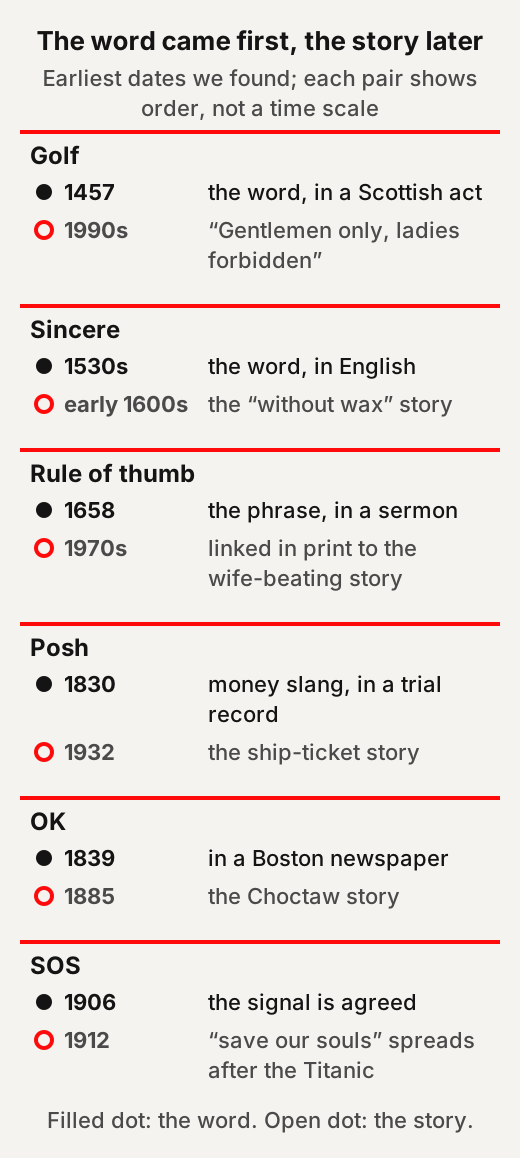
The dates are the earliest we found, not proof that nobody used these words sooner. Older copies can still turn up.
| Word or phrase | The story often told | What the oldest records show |
|---|---|---|
| Rule of thumb | A law about the size of a stick | A rough way to measure |
| The whole nine yards | Machine-gun belts, kilts or concrete | In print by 1907; origin unknown |
| Turn a blind eye | Nelson at Copenhagen | The image is in a novel printed before the battle |
| Mind your Ps and Qs | Pints and quarts in a pub | Origin unknown; letters are the likeliest guess |
| Posh | “Port Out, Starboard Home” | Probably money slang; no stamped tickets found |
| SOS | “Save our souls” | Three letters chosen for Morse code |
| Tip | “To insure promptness” | Thieves’ slang; origin unknown |
| Cop | “Constable on patrol” | A slang verb meaning to grab |
| Golf | “Gentlemen only, ladies forbidden” | A Scots word; origin unknown |
| OK | Choctaw, Greek or Andrew Jackson | A joke spelling of “all correct” |
| Sincere | Latin for “without wax” | Latin sincerus, “clean, pure” |
Our reading: a neat story is easy to remember and easy to pass on. That is part of why these stories outlast the dull truth.
2. Phrases with a better story attached
Four phrases picked up a vivid story that the early records do not support, or support only in part.
“Rule of thumb”
Doesn't hold up The phrase comes from a law letting a man beat his wife with a stick no thicker than his thumb. The phrase is about rough measuring, and it has never been a rule in English law.
How sure: Strong two word historians agree, and a 1994 law-journal study found the phrase nowhere in legal records.
The earliest known use is in a sermon by James Durham, written before his death in 1658. He compares many Christians to foolish builders “who build by guess, and by rule of thumb and not by Square and Rule”. The American Heritage Dictionary traces the phrase to using the thumb as a makeshift ruler, as in carpentry.
The Phrase Finder says the rule of thumb “has never been the law in England”. It adds that English common law once held it legal for a man to chastise his wife “in moderation”. Two University of Oregon writers, Jennifer Freyd and JQ Johnson, summarise a 1994 law-journal study by the scholar Henry Ansgar Kelly. They report his finding that the exact phrase “rule of thumb” never occurs in legal history.
The thumb-sized stick itself is an old idea, though not a law. In 1782 a judge, Francis Buller, was reported to have said a husband could beat his wife with a stick no bigger than his thumb. No record of him saying it has been found, but cartoons mocked him as “Judge Thumb”. A summary of Kelly’s study reads the record differently, saying Buller gave the thumb standard credence in a legal opinion.
In an 1868 North Carolina case, a trial judge acquitted a husband because the switch he used was smaller than a thumb. The state Supreme Court rejected the thumb test but let the acquittal stand, because no lasting injury was found. The Phrase Finder found no printed record linking the phrase itself to domestic violence until the 1970s.
The word historian David Wilton adds that the story being wrong does not make spousal abuse any less real. Our reading: the phrase and the folklore are two separate things that got stuck together. For example, you can use “rule of thumb” for a quick estimate without it carrying that history.
“The whole nine yards”
Doesn't hold up “The whole nine yards” refers to a machine-gun belt, a kilt or a load of concrete. Early uses are not about belts, kilts or concrete; the yards seem to be a loose way of saying “a lot”.
How sure: Strong the early uses are about other things, though no one has pinned down a single source.
The earliest known use with all the parts of today’s phrase is in an Indiana newspaper, the Mitchell Commercial, on 2 May 1907. It said of a baseball game “we can not promise the full nine yards”. The same paper printed “the whole nine yards” on 4 June 1908, about a man with a long fishing story.
A Kentucky paper then printed “the whole six yards” on 17 May 1912. Wilton thinks the phrase grew from “yard” as a vague word for a large amount. Our reading: nine came first in print, but six was also in use, so the number had no fixed meaning. Wilton rejects the ammunition-belt, kilt, ship’s-spars and cement-mixer stories.
The useful part: a date can settle an argument faster than a clever explanation. For example, a story about World War II cannot explain a phrase printed in 1907.
“Turn a blind eye”
Partly Admiral Nelson coined “turn a blind eye” at the Battle of Copenhagen in 1801. His biographers report the Copenhagen story, but the image of a blind eye to turn was already in print.
How sure: Moderate Nelson’s words come from biographies written after his death; the earlier novel is in print.
Robert Southey’s 1813 Life of Nelson reports that, when ordered to stop fighting, Nelson said: “I have only one eye,—I have a right to be blind sometimes”. Southey writes that he then put the telescope to his blind eye and said: “I really do not see the signal!” The Phrase Finder notes that an earlier biography printed “what they claimed to be” his words. It adds that in these accounts Nelson does not use the words “turn a blind eye”.
Before the battle, a character in Francis Lathom’s novel Men and Manners jokes about a general’s glass eye. She says: “It is lucky for the poor man he has a blind eye to turn to her”. We found the line in printings dated 1799 and 1800. The Phrase Finder finds the modern form, “turn a blind eye and a deaf ear”, in a letter of 1823.
It credits Nelson’s actions in battle with making the phrase an everyday expression. Our reading: the phrase still means a choice, not an accident. For example, a manager who “turns a blind eye” to late reports has seen them and decided not to act.
“Mind your Ps and Qs”
Can't confirm “Mind your Ps and Qs” comes from barkeepers counting pints and quarts. Nobody knows where it comes from, and the pub story has no clear early support.
How sure: Limited the origin is unknown; a word historian found no early uses about counting drinks or printing.
Wilton finds the phrase first in print in 1756, in the Life and Memoirs of Mr. Ephraim Tristram Bates: “Mind your P’s and your Q’s”. Wilton writes that the origin is not known for certain. He thinks the likeliest source is children learning to read, who often mix up a small p and a small q.
Of the pints-and-quarts story, he notes that no early uses are about tallying drinks. He does quote a 1612 poem in which a drinker calls for “a quart of Maligo” that must “be Pee and Kew”. What that meant is not known, and Wilton guesses it has no connection to the later phrase. He finds no early uses about printing either, and says “pleases and thank yous” does not appear until the 20th century.
Our reading: “we don’t know” is a fair answer, and it beats a confident wrong one. For example, if someone asks you where the phrase comes from, you can say “probably learning letters, but nobody is sure”.
3. Words that were never acronyms
Five common words gained stories that they stand for a phrase, and the records show they never did.
An acronym is a word made from the first letters of a phrase, like NATO. A backronym is a phrase made up afterwards to fit the letters of a word that already exists. Wilton’s advice is to question any acronym story, because “Most stories of acronymic word origins are false”. Each word in this section picked up a backronym of this kind.
“Posh”
Doesn't hold up “Posh” stands for “Port Out, Starboard Home”, stamped on ship tickets for the best cabins. No such tickets have been found, and the story appears long after the word.
How sure: Strong a dictionary and a word historian agree, and the story is dated well after the word.
Wilton reports that no tickets with posh stamped on them have ever been found and company records show no sign of the phrase. He adds that the explanation does not appear until 1932. The American Heritage Dictionary says no known evidence supports the ship story.
Posh meaning money is in a London trial record of 8 July 1830. The adjective meaning smart or stylish is clear by 1914. The American Heritage Dictionary says the likely source is that money slang, from a Romani word. Wilton says the origin is not known for certain.
Our reading: when a word’s origin is a tidy set of initials, check the dates first. For example, a story first told in 1932 cannot explain a word in use in 1830.
“SOS”
Doesn't hold up “SOS” stands for “save our souls”. The letters stand for nothing; they were picked as a signal that is easy to send.
How sure: Strong the 1912 Titanic inquiry recorded it, and a word history agrees.
Wilton writes that SOS was chosen because it is easy to send in Morse code, and that the letters do not stand for anything. It was agreed at an international radio conference in 1906 and came into force in 1908. The agreement gave the signal as three dots, three dashes and three dots, without naming any letters.
At the British inquiry into the Titanic on 18 June 1912, the commissioner asked whether SOS stood for anything. The radio pioneer Guglielmo Marconi answered: “Simply three letters, My Lord”. When a lawyer suggested “Save our souls” as “an easy way to remember it”, Marconi agreed. Wilton dates the “save our souls” reading to the time after the Titanic sank in 1912.
The useful part: a memory aid is not an origin. For example, “save our souls” helps people remember SOS, and that is all it was ever for.
“Tip”
Doesn't hold up “Tip” stands for “to insure promptness”. The word comes from old thieves’ slang, and why they chose it is unknown.
How sure: Strong a dictionary and a word historian agree; the word is recorded as slang from 1610.
Wilton traces tip, meaning to give, to criminal slang recorded in 1610. A tip as money given to servants is in print by 1755. He calls the “to insure prompt service” story “utterly false”. The American Heritage Dictionary gives the origin of tip in this sense as unknown.
Our reading: a word with a long record as ordinary slang needs real evidence before anyone calls it a set of initials. For example, before you repeat what a word “stands for”, look up when the word itself first appears.
“Cop”
Doesn't hold up “Cop” stands for “constable on patrol”. It comes from a slang verb meaning to grab, so a cop is someone who catches people.
How sure: Strong dictionaries trace it to a verb, and the longer word “copper” came first.
Wilton traces cop to an English dialect verb, to cop, meaning to grab or seize. The American Heritage Dictionary says that verb is probably a form of cap, to catch, from Latin capere. Copper for a police officer is in print by 1838, and the short form cop by 1859.
Wilton says it is not an acronym for “constable on patrol”, nor named after copper buttons. Our reading: the order of the words gives it away. “Copper” came first, then was shortened, which is the opposite of how an acronym is born.
“Golf”
Doesn't hold up “Golf” stands for “gentlemen only, ladies forbidden”. The word is centuries older than the story, and its real origin is unknown.
How sure: Strong the word is in a 1457 Scottish law; a researcher found the story in print only from the 1990s.
An act of the Scottish parliament in 1457 ordered that “the fute-bal and golfe be vtterly cryed downe”. Games were thought to distract men from military training. Wilton writes that the word golf is of unknown origin.
The researcher Barry Popik found the “Gentlemen Only, Ladies Forbidden” story in print only from the 1990s. Our reading: the story may say something about how some clubs treated women. It just doesn’t explain the word.
4. Two words whose real story is stranger
These two have a true history that is odder than the story people tell.
“OK”
Doesn't hold up “OK” comes from Choctaw, from Greek, from a West African word, or from Andrew Jackson’s bad spelling. It is first recorded in 1839, as a newspaper joke: a misspelled abbreviation of “all correct”.
How sure: Strong the 1839 newspaper uses were found and dated, and a dictionary and two word historians agree.
The scholar Allen Walker Read showed that OK is a joke spelling of “all correct” (oll korrect), from Boston newspapers in 1839. Its first known use is in the Boston Morning Post on 23 March 1839. The American Heritage Dictionary adds that it “was probably in circulation before that date”. The American Heritage Dictionary explains the joke: neither the O nor the K was correct.
It caught on in 1840, when supporters of President Martin Van Buren, nicknamed Old Kinderhook, formed a Democratic O.K. Club. The nearest thing to evidence for the Andrew Jackson story is a 1790 record marked “O.R.”, which stood for “order recorded”. Wilton says the evidence clearly shows the Choctaw story, first proposed in 1885, is not correct.
Michael Quinion’s World Wide Words lists proposed sources in Greek, Choctaw and West African languages such as Wolof, and calls them coincidences. Our reading: the true story is the strangest one. One of the most used words on earth began as a joke in a Boston paper.
“Sincere”
Doesn't hold up “Sincere” comes from the Latin sine cera, “without wax”, after sculptors who hid flaws with wax. It comes from Latin sincerus, meaning clean or pure, and its first part does not mean “without”.
How sure: Moderate the Oxford English Dictionary rejects the wax story, but we read its view only as quoted.
The American Heritage Dictionary gives the source of sincere as the Latin sincerus. The Grammarphobia blog, citing the Oxford English Dictionary, says it is first recorded in English in the 1530s, from sincerus, “clean, pure, sound”. It quotes the dictionary: “There is no probability in the old explanation”.
Grammarphobia found versions of the wax story going back to the early 1600s. The oldest it gives are about honey sold pure, without any wax, as in a religious dictionary of 1661. Our reading: the story changes with each telling, from honey to sculptors to cabinet makers. When the details keep moving, the story is usually being built backwards from the word.
5. Stories we have looked at elsewhere
Two more origin stories are covered on other pages, so they get a line each here.
- A Library of Congress folklorist writes that the plague reading of “Ring a ring o’ roses” emerged in the mid-twentieth century. See the Black Death page.
- “Pull yourself up by your bootstraps” began as a joke about something impossible. See sayings that used to mean the opposite.
More pages like this one are gathered on Quotes, sayings and stories, checked.
6. How to check an origin story yourself
You can test most word stories in a few minutes by comparing two dates.
- Write down the word and the story you were told.
- Look the word up in a dictionary that gives its origin, such as the American Heritage Dictionary.
- Find the earliest date the word is recorded, from a dictionary or a word-history site that gives dated examples.
- Find when the story itself first appears, if a source gives it.
- If the story is younger than the word, it cannot be the origin.
- Be extra careful with acronym stories, and say “the earliest we found”, not “the first”.
For example, “posh” took us two dates: the word in an 1830 trial record, the ship story from 1932. That settled it.
Quick answers
Does "rule of thumb" come from a law about wife-beating?
No. The phrase is about rough measuring and was in use by 1658. The Phrase Finder says the rule of thumb "has never been the law in England", and the earliest printed link to domestic violence it found is from the 1970s.
Does posh stand for "Port Out, Starboard Home"?
No. No tickets with posh stamped on them have been found, and the earliest telling of the ship story that word historians have found is from 1932. Posh meaning money is in a London trial record of 1830.
What does SOS stand for?
Nothing. Asked at the 1912 Titanic inquiry, Marconi called it "Simply three letters". A word historian says it was chosen because it is easy to send in Morse code; asked why it was adopted, Marconi said, "I really cannot say."
Where does "the whole nine yards" come from?
Nobody knows for sure. "The full nine yards" is in print by 1907 in an Indiana newspaper, in a story about a baseball game; "the whole nine yards" follows in 1908, and a Kentucky paper printed "the whole six yards" in 1912.
Did Nelson invent "turn a blind eye"?
Not quite. His biographers report him putting a telescope to his blind eye at Copenhagen in 1801, but the image of a blind eye to turn is in a novel printed by 1799.
Use this
Before you repeat where a word comes from, compare when the word appears with when the story does.
Is this story older than the word it claims to explain?
Quick quiz
Nothing is scored or saved. Recalling it once now is what makes it last.
1. What does SOS stand for?
Answer: Nothing; the letters were chosen for Morse code.Read it again ↑
2. Where does "OK" come from?
Answer: A joke spelling of "all correct" in an 1839 Boston newspaper.Read it again ↑
3. Which came first in print?
Answer: The whole nine yards.Read it again ↑
How we checked this · Last checked October 2026
- We read the oldest texts we could reach: Southey's 1813 Life of Nelson, two scans of Lathom's Men and Manners (1799 and 1800), and Marconi's 1912 evidence to the Titanic inquiry.
- For the other dates we relied on David Wilton's Wordorigins, the Phrase Finder, the American Heritage Dictionary, World Wide Words, Grammarphobia and Barry Popik, which give dated examples.
- We could not open the Oxford English Dictionary, Henry Ansgar Kelly's article on the legal history, the old newspapers behind the nine yards dates, or the 1756 and 1823 texts, so those points rest on the works named.
- Every date is the earliest we found. Older printings can still turn up.
- Our wording on "Ring a ring o' roses" and on "bootstraps" matches our Black Death and sayings pages.
Sources
Dictionaries and word histories
- The American Heritage Dictionary of the English Language, 5th edition, entries “rule of thumb”, “posh”, “tip”, “cop”, “OK”, “sincere”, “acronym” and “backronym”.Scholarly
- D. Wilton, Wordorigins.org, “rule of thumb” (4 October 2021), “the whole nine yards” (19 September 2025), “mind your p’s and q’s” (11 January 2022), “posh” (6 April 2022), “SOS” (2 December 2021), “tip” (22 June 2022), “cop” (25 July 2020), “golf” (5 November 2020) and “OK / okay” (22 June 2021).Popular
- Phrase Finder (G. Martin), “Rule of thumb” and “Turn a blind eye”.Popular
- M. Quinion, “OK”, World Wide Words.Popular
- P. O’Conner and S. Kellerman, “Sincere”, The Grammarphobia Blog, March 2012 (quoting the Oxford English Dictionary).Popular
- B. Popik, “Gentlemen Only Ladies Forbidden (golf backronym)”, The Big Apple, 20 March 2014.Popular
Old texts and records
- J. Freyd and JQ Johnson, “Domestic Violence, Folk Etymologies, & ‘Rule of Thumb’”, University of Oregon, 1998 (on H. A. Kelly, Journal of Legal Education 44, 1994).Scholarly
- R. Southey, The Life of Horatio, Lord Nelson (1813), chapter VII (Project Gutenberg #947).Primary
- F. Lathom, Men and Manners: A Novel, vol. 1, a new edition (London: J. Davis for J. Wright and H. D. Symonds, 1800), p. 227 (Internet Archive scan); also the Dublin printing of 1799 (William Porter), vol. 1, p. 124 (Internet Archive scan).Primary
- British Wreck Commissioner’s Inquiry into the loss of the Titanic, day 26, 18 June 1912, evidence of G. Marconi, questions 24873–24879 (Titanic Inquiry Project).Primary
Enjoy the story, and say it is a story
Our view: when you tell where a word comes from, your listeners may pass it on. You can still enjoy a good story, if you call it a story. Then give the dated history beside it.
Retell a word's history so it holds up
- Sort the story first. Our suggestion: put each story in one of three piles. Supported at least in part, ruled out by the dates, or not settled yet.
- Keep the hedges. Where a word historian writes "probably" or "not known for certain", keep those words when you retell it.
- Name whose dates you use. Say which dictionary or word historian gave the date, so your reader can look it up.
- Note what you read yourself. Our suggestion: mark whether you read the old text yourself or saw it quoted by someone else.
This week: collect "stands for" stories
Our suggestion: for one week, note each word someone says "stands for" a phrase. At the week's end, look up two. Write beside each whether the word was in use before the phrase, or that you could not tell.
Put word-checking to paid use
- Offer origin checks for writers and speakers who want to use a word's history in a talk, book or post.
- Help a business check a word's history before it uses that history in a slogan or product story.
- Write short posts that set a popular word story beside the dated record. Name your source, and keep any "origin unknown".
- Make word-origin puzzles for puzzle books or newsletters, with a dated source behind every answer.
Ideas to explore, not financial or business advice. No result is promised.
Keep going
- Sayings that used to mean the oppositeEveryday phrases traced to the oldest versions we found, including how "bootstraps" began as a joke.
- Ancient proverbs and lost-in-translation storiesSayings and translation stories traced to their oldest versions, with the real sayings where they exist.
- The Black DeathWhat happened, and when the plague reading of "Ring a ring o' roses" emerged.
- How to spot a fake quoteWhy quotes get pinned on famous names, and how to trace a line to the earliest copy you can find.
- GlossaryPlain meanings of terms used on our pages, including backronym.