

Some industries meet needs that do not go away: staying healthy, having shelter, energy, food, moving goods, clean water, learning, and finding out what is for sale. Below are eight of them, what each covers, what drives the demand, and an official data source that shows its size. This page describes; it makes no promise about any job, business or investment.
How to read this page
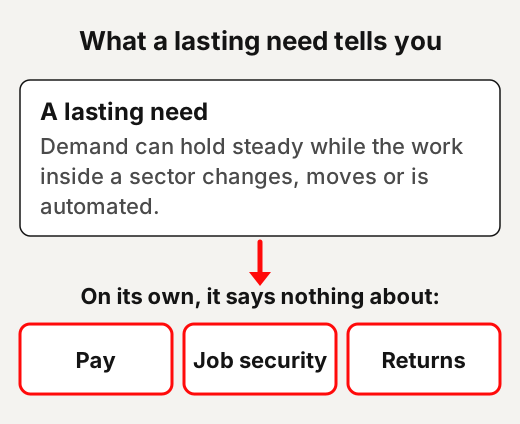
Every size figure here comes from an official body, and most come from one source so they can be compared. The International Labour Organization’s modelled estimates put world employment in 2025 at about 3.6 billion people. The sector figures below come from the same table. A lasting need is not the same as a safe job or a good investment. Demand can hold steady while the work inside a sector changes, moves or is automated.
For example, everyone needs food, yet in 2025 about 3% of workers in high-income countries worked in agriculture, against about 59% in low-income countries.
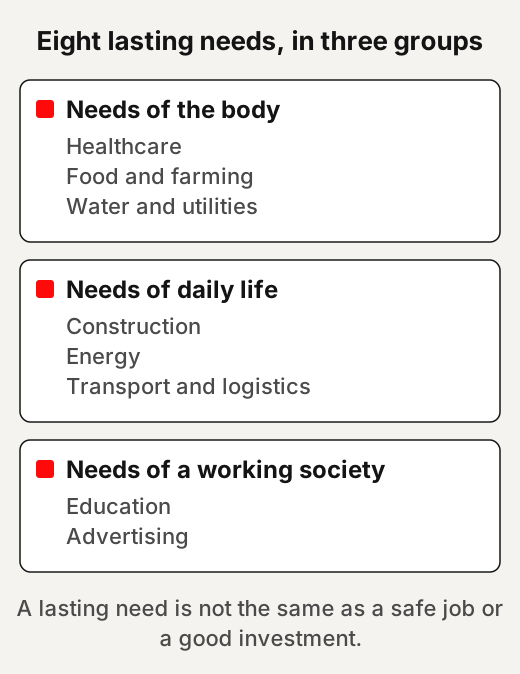
Needs of the body
Health, food and water are needs every person has, every day.
1. Healthcare
Care for the sick and the old, plus everything that supports it.
What it covers: hospitals, clinics, nursing, care homes, medicines, and the staff and suppliers behind them.
Why demand persists: People everywhere are living longer, so there are more older people to care for. The World Health Organization expects that by 2030, 1 in 6 people in the world will be aged 60 years or over. It projects a shortage of 11 million health workers by 2030.
Size, from official data: The ILO’s estimates count about 149 million people working in human health and social work in 2025. The WHO puts the number of health workers at more than 70 million. The two figures measure different things: the ILO’s group includes social work, the WHO’s counts health workers only.
Try this: look up your own country on ILOSTAT, and compare its health and social work figure with ten years ago.
2. Food and farming
Growing, catching and producing food for a world that keeps growing.
What it covers: farming, forestry and fishing, and the food businesses that depend on them.
Why demand persists: Everyone eats, and there will be more people for decades yet. The UN’s 2024 projections show the world population peaking at around 10.3 billion people in the mid-2080s.
Size, from official data: The ILO’s estimates count about 928 million people working in agriculture, forestry and fishing in 2025. That is roughly one worker in four worldwide, though the share differs hugely between countries.
Try this: compare the farming share of work in two countries you know, and notice how far apart they are.
3. Water and utilities
Clean water, power and gas delivered to homes, and waste taken away.
What it covers: water supply, sewerage, waste collection, and the networks that bring electricity and gas.
Why demand persists: Every home needs these services daily, and many people still lack safely managed drinking water. In 2024, about three in four people had safely managed drinking water at home, and one in four still did not.
Size, from official data: The ILO’s estimates count about 33 million people working in utilities, meaning electricity, gas, water and waste, in 2025. It is the smallest workforce of the sectors on this page that have their own ILO figure.
Try this: find your local water supplier’s annual report, which usually shows how much water it supplies and to how many homes.
| The ILO's count | Human health and social work together |
| The WHO's count | Health workers only |
The two figures measure different things.
Needs of daily life
Shelter, energy and transport are what keep a household running.
4. Construction
Building and repairing the places where people live and work.
What it covers: homes, offices, roads, bridges and other infrastructure, plus repair and renovation.
Why demand persists: Populations grow and move into cities, and, in our reading, buildings wear out and need repair. The UN reports that cities are now home to 45 per cent of the world’s 8.2 billion people, up from 20 per cent of 2.5 billion in 1950. Looking ahead through 2050, it projects two-thirds of global population growth to occur in cities.
Size, from official data: The ILO’s estimates count about 302 million people working in construction in 2025. That is about one worker in twelve worldwide.
Try this: notice how many cranes or new buildings you pass in a week, then check your city’s own building permit data.
5. Energy
Power for homes, transport and industry.
What it covers: electricity, oil, gas, coal and renewables, from producing them to delivering them.
Why demand persists: A US government agency builds its energy outlook on the assumption that people use more energy as incomes and populations rise. Its outlook assumes energy use rises as more people can afford to drive, buy goods and heat or cool their buildings. In its central case, it projects global energy use to grow 34% between 2022 and 2050. A projection is a scenario, not a forecast that will come true, and the agency’s other cases range from lower to higher. The World Bank’s figure is 91.9% of the world’s population with electricity in 2024.
Size, from official data: the agency’s International Energy Outlook gives energy use by region and fuel. Energy jobs are spread across several of the ILO’s groups, so there is no single comparable figure in its table.
Try this: read one chart in an energy outlook and note which fuel grows fastest in the central case.
6. Transport and logistics
Moving people and goods from where they are to where they are needed.
What it covers: trucks, trains, ships, planes, warehouses and delivery, plus the planning behind them.
Why demand persists: In our reading, goods are rarely made where they are used, and people travel to work, study and visit; logistics fills that gap.
Size, from official data: The ILO’s estimates count about 239 million people working in transport, storage and communication in 2025. The ILO groups communication with transport here, so the figure is wider than transport alone.
Try this: pick one item in your home and trace how many steps it took to reach you.
Needs of a working society
Learning and finding out what is on offer are needs too, for people and for businesses.
7. Education
Teaching children and adults the skills they need.
What it covers: schools, universities, training, and the teachers and staff who run them.
Why demand persists: In our reading, each generation must be taught, and skills keep changing. UNESCO’s global report on teachers found an urgent need for 44 million primary and secondary teachers worldwide by 2030.
Size, from official data: The ILO’s estimates count about 175 million people working in education in 2025.
Try this: look at the UNESCO figures for your region and see where the shortage is greatest.
8. Advertising
Telling people what is for sale, and why they might want it.
What it covers: advertising agencies, media buying, public relations and related services.
Why demand persists: In our reading, businesses need customers to know they exist. Our page on psychological triggers in marketing looks at the methods from the buyer’s side.
Size, from official data: Official world totals are rare, so here is one national series. The US Bureau of Labor Statistics counted 478,200 jobs in advertising, public relations and related services in September 2026, a preliminary figure. That is a little below its September 2016 level of 494,700. A lasting need does not mean a growing number of jobs.
Try this: check the same series for another sector you are curious about, and see whether its jobs rose or fell over ten years.
What these numbers don’t tell you
Big, steady demand says nothing on its own about pay, job security or returns. In our reading, a large workforce can still mean low pay for many, technology can change parts of the work, and a sector can grow in one country while it shrinks in another.
For example, the farming shares above show how differently the same need is met from one country to another. If you are weighing a career or an investment, local data and a qualified adviser will tell you far more than a world total.
Our page on why money and work matter looks at how people earn and why success stories can mislead.
Where to learn more
These official sources let you check the numbers for your own country.
- ILOSTAT, the International Labour Organization’s database: employment by sector for most countries.
- World Bank Open Data: electricity access, population and many other indicators by country.
- UN World Population Prospects: population estimates and projections.
- WHO Global Health Observatory: health workforce and ageing data.
- UNESCO Institute for Statistics: education and teacher data.
- US Bureau of Labor Statistics: US jobs by industry, month by month.
- Related idea guides: 20 business models and career moves people talk about.
Official sources that let you check the numbers for your own country.
Quick answers
Which industries will people always need?
Some sectors meet needs that do not go away, such as healthcare, food, water and utilities, construction, energy, transport and education. A lasting need is not a promise of a job, good pay or a return on an investment.
How many people work in construction worldwide?
The ILO's estimates count about 302 million people working in construction in 2025. That is about one worker in twelve worldwide.
Why will healthcare demand keep growing?
People everywhere are living longer. The World Health Organization expects that by 2030, 1 in 6 people in the world will be aged 60 years or over, and it projects a shortage of 11 million health workers by 2030.
Where can I find official data on an industry's size?
ILOSTAT, the International Labour Organization's database, gives employment by sector for most countries. National statistics offices, such as the US Bureau of Labor Statistics, publish more detailed figures.
Use this
Our suggestion for looking into a sector you are curious about.
A lasting need is not a promise; check the local numbers.
Quick quiz
Nothing is scored or saved. Recalling it once now is what makes it last.
1. In the ILO's estimates for 2025, about how many people worked in agriculture, forestry and fishing?
Answer: About 928 million.Read it again ↑
2. By 2030, how many people in the world does the WHO expect to be aged 60 or over?
Answer: 1 in 6.Read it again ↑
3. How did US jobs in advertising, public relations and related services in September 2026 compare with September 2016?
Answer: A little lower.Read it again ↑
How we checked this · Last checked November 2026
- Sector sizes come from one table, the ILO's modelled estimates of November 2025, read through ILOSTAT's data service, so they can be compared.
- We read the WHO, UN, UNESCO, World Bank and US Energy Information Administration pages directly, and the US advertising jobs series on the Bureau of Labor Statistics site.
- The International Energy Agency's pages showed a bot check, which we did not bypass, so the energy outlook is the US agency's.
- Our wording on population, electricity access and drinking water matches our Factfulness and clean tap water pages.