

Start hereVyro's FAQ says a post with 100,000 views on a $1 CPM campaign earns $100. Its help pages also set a 5,000-view minimum, and a cap of up to $1,000 per clip. So how can a clip with plenty of views earn little or nothing?
Clipping means cutting short clips out of long videos and posting them. Per-view clipping campaigns pay a set rate for every 1,000 views a clip gets. Between the views and your bank, there are several points where that pay can stop. Below: how the pay is worked out, where it goes missing, and the other ways clippers get paid.
1. What clipping is
Clipping turns long videos into short ones, and some brands and creators pay for the views those clips get.
Whop’s help page describes clipping campaigns as creators turning long videos, such as podcasts and livestreams, into short clips for TikTok, YouTube Shorts, X and Instagram Reels. In May 2026, NPR reported that marketplaces such as Content Rewards and Vyro were fueling demand for clips. It said they offer a space where marketing agencies can advertise clip-for-cash campaigns.
Content Rewards started inside Whop and now also runs as its own site. Its terms (last updated 4 October 2026) are with Content Rewards Inc, and call Whop “a separate company” whose platform it uses for payments.
For example, a clipper might cut a 40-second moment from a two-hour podcast, add captions, and post it on their own account for a campaign.
2. Six ways clipping pays
Per-view campaigns are one of six routes, and each route pays in a different way.
| Route | Who pays | How the amount is set |
|---|---|---|
| Per-view campaign | The brand or creator funding it | A rate per 1,000 verified views, between a minimum and a cap |
| Pool campaign | The brand or creator funding it | A fixed pot, shared by each eligible clipper’s share of the counted views |
| Per-post campaign | The brand or creator funding it | A flat amount for each approved clip |
| Retainer | The brand, per cycle | A fixed sum per cycle for agreed clips |
| Freelance editing | A client | A price agreed with the client |
| Your own clip channel | The platform, if you qualify | The platform’s own programme rules |
Marketplaces call the per-view rate the CPM: what a clip earns for every 1,000 views. Content Rewards’ terms list four campaign types: CPM, per-post, retainer and pool. In a pool, what is left after the brand’s platform fee is shared among eligible clippers by their share of the counted views when the pool ends.
3. How a per-view clip is paid
Pay is the views divided by 1,000, times the rate, inside any minimum and cap the campaign sets.
Our reading of the marketplaces’ own examples: pay = verified views ÷ 1,000 × the rate. Vyro’s FAQ gives the arithmetic: a post with 100,000 views on a $1 CPM campaign earns $100.
Two limits sit around that sum. The first is a minimum. The brand may set a minimum a clip must earn before it is paid, and a maximum it can earn. Whop’s worked example uses a $3 rate per 1,000 views and a $6 minimum payout. Then only videos with at least 2,000 views reach the brand’s review queue.
The second is a cap. Vyro says each clip can earn up to $1,000. On a $1 CPM campaign, that ceiling is reached at 1 million views, and views beyond it add nothing. Vyro adds that each campaign shows a notice of the most a post can earn.
Some campaigns add a fixed bonus. Whop’s example: a $3 rate, a $10 flat fee and 2,000 views pay $16 in total.
Our arithmetic, as an example only: at $1 per 1,000 views, a clip with 50,000 views would earn $50 before any fee. That holds only if it clears the minimum and the budget still has money.
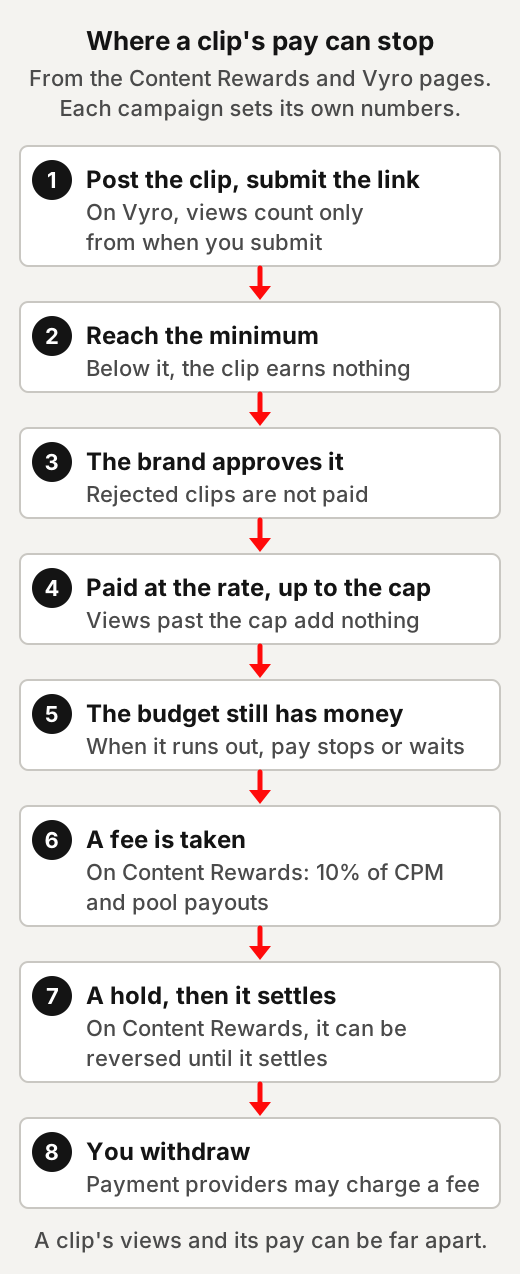
4. Where the money goes missing
Pay can stop or shrink at several points, and each one is written into a marketplace’s own rules.
Views below the minimum
A clip under the minimum earns nothing, however close it gets. Vyro’s help centre says each approved post must reach 5,000 views to start earning, and that this is per post, not a total across posts. In Content Rewards’ pool campaigns, clippers below the pool’s minimum views “receive no share”.
For example, on Vyro four clips of 4,000 views each do not add up to one earning clip, because the minimum counts per post.
Views past the cap
Past the cap, a clip earns the same as one that only just reached it. Whop’s help page tells brands the cap protects their budget. Without one, it says, one very big video could use up the whole budget.
The budget runs out
When the budget is spent, pay stops or waits, even if the clip keeps getting views. Vyro’s FAQ says earning stops when the campaign’s budget runs out. Its help centre says that when a budget is nearly spent, payments are prorated to share what is left among clippers.
NPR reported one campaign paying 50 cents per 1,000 views from a total budget of $70,000 “for clippers to fight over”. In practice, check how much of a budget is left before you start a clip.
Campaigns that were never funded
A campaign can go live before the money arrives, and approved clips can go unpaid. Vyro’s clipper terms say campaigns can be published before the brand’s money has settled. If the money never arrives, Vyro may cancel the campaign, and then no rewards are issued, even for approved clips.
Rejection
The brand decides whether each clip is approved, and only approved clips are paid. Content Rewards’ terms say the brand decides whether to approve or reject each submission. Its FAQ says only approved posts get paid.
The same FAQ lists the usual reasons clips get rejected: “wrong platform, missing tags or disclosure, reused content, or the post being edited or deleted after you submitted”. Vyro’s most common reasons are not following the campaign brief, missing the required ad disclosure, and low quality and spammy content.
Timing: when views count
On Vyro, views count from when you submit the link, not from when you post. Vyro says earnings are calculated from the moment a clip is submitted, not when it is posted.
So on Vyro, a clip that takes off before you submit it may earn on only part of its views. Content Rewards’ FAQ says to post, then submit the link within 30 minutes.
Fees, holds and clawbacks
You get the earned amount minus fees, after a hold, and a clawback can take some of it back. Content Rewards’ creator terms charge a flat 10% creator fee on every CPM and pool payout.
A CPM payout round there is normally a 7-day earning period followed by a 3-day hold. So a funded round generally settles about 10 days after it opens.
On Content Rewards, a payout that has not yet settled may be reversed if the clip is rejected after approval or a fraud or policy flag is upheld. Once settled, it is not reversed through this process.
Vyro’s FAQ says earnings stay pending until the campaign ends, and that you can withdraw once you have earned at least $10, once a week. Vyro’s terms say payment providers may deduct fees, and that Vyro is not responsible for them. Withdrawals from Content Rewards go through Whop, which runs its own payout timing and fees.
Bought views
Buying views can cost the whole account, not just one clip. Content Rewards says buying or generating views “results in a permanent ban”. Vyro says that if a post is flagged for fraudulent or botted views, the account may be permanently banned.
Rights you hand over
An approved clip can be reused by the brand, including in ads, and sometimes the brand owns it. Once a clip is approved, Content Rewards’ terms give the platform and the brand a perpetual, worldwide licence to reuse it. That includes paid advertising. The terms add that no further payment is owed beyond the campaign amounts.
Where the brand supplied the underlying content, such as long-form footage, the terms go further: the brand owns the edited clip. You assign all rights in it to the brand once it is approved. That replaces the licence above.
5. Per post, retainers and freelance work
Flat-fee routes trade the chance of a big clip for a known amount per clip. That is our reading of how the routes compare.
On Content Rewards, a per-post campaign pays a flat amount per approved clip, and the clip earns nothing more from views after approval. If the campaign sets a minimum view count and the clip misses it, the reserved payout goes back to the campaign budget.
Its FAQ says a retainer pays a fixed sum per cycle for agreed deliverables. It pays “either pro rata on what you deliver or only once you hit every target”. So read which of the two a retainer uses before you agree to it.
Freelance clipping is editing work for a client, at a price you agree. Upwork’s freelancer service fee ranges from 0% to 15% per contract. Asked how to get permission to use someone’s work, the US Copyright Office answers: “You can ask for it”. Our guide to AI side hustles has a weekend test for client clipping.
For example, a small podcast might pay a flat fee for three captioned clips of each episode, which the podcast posts on its own accounts.
6. Your own clip channel
A platform’s own creator pay is separate from campaign pay, and reused clips often do not qualify. Each platform sets its own rules. YouTube’s are below, as one example.
YouTube allows reused content “if viewers can tell that there’s a meaningful difference between the original video and your video”. It adds that the policy applies “even if you have permission from the original creator”.
From 1 February 2027, YouTube Help says, a share of Shorts ad revenue will need at least 10 million qualified Shorts views in the last 90 days. It gives unedited clips from others’ movies or TV shows as an example of ineligible views.
YouTube’s examples of reused content it allows include using clips for a critical review, and edited footage where you add a storyline and commentary. YouTube notes that other policies, such as copyright, still apply to those examples. For example, a clip with your own explanation of why the moment matters is closer to those examples than a straight re-post.
7. Three things you may hear about clipping pay
Two of these do not hold up, and the third cannot be confirmed as typical.
Every view earns money
Doesn't hold up A clip earns money on every view it gets. Clips below the minimum, views past the cap, and views after the budget runs out can earn nothing.
How sure: Strong the marketplaces’ own terms and help pages set out the minimums, caps and budget limits.
The sections above show each limit in the marketplaces’ own words. A clip’s view count and its pay can be far apart.
Permission means YouTube will pay
Doesn't hold up If the creator says yes, YouTube will pay you for re-posting their clip. YouTube’s pay rule asks for a meaningful difference, and says permission does not change that.
How sure: Strong YouTube’s own policy says the rule applies even with the creator’s permission.
Clippers typically earn thousands a month
Can't confirm A typical clipper earns thousands a month. We found no typical or median clipper income on any marketplace page we read.
How sure: Moderate we found no published typical figure; one could exist that we did not find.
We read Content Rewards’ terms, FAQ and AI summary, Whop’s help page, and Vyro’s FAQ, help pages, terms and content requirements. The earnings shown on Content Rewards’ creators page are testimonials from people who earned. They say nothing about clips that earned little or nothing.
Content Rewards’ own summary for AI tools calls earnings examples “individual outcomes, not guarantees”. Its terms say it does not guarantee “any level of views, earnings, Campaign availability”. Vyro’s content requirements tell clippers not to disclose their own income from the platform.
Rates differ widely too. NPR’s May 2026 examples ran from 50 cents per 1,000 views to $25 per 1,000 views from an AI startup.
For offers that promise big income, two lines from the FTC’s job-scam page help. The FTC says a job offer claiming you can make a lot of money in a short time with little work is “almost certainly a scam”. It adds that honest employers never ask you to pay to get a job.
8. Before you clip for a campaign
Read the campaign page first: rate, minimum, cap, budget left, platforms and disclosure. Vyro’s home page says its briefs show the pay rate, budget and full instructions before you start.
A quick way to use what you just read:
- Work out the views you need to clear the minimum, and what the cap is worth.
- Check how much of the budget is already paid out, and when the campaign ends.
- Note where the disclosure must go, and which platforms count.
- Keep your own record of each clip, the date you submitted it, and what was paid.
Content Rewards’ terms make the clipper responsible for disclosure, placed at the beginning of the video. The FTC’s guide for influencers says a video endorsement’s disclosure “should be in the video and not just in the description”. Vyro’s terms make clippers responsible for their own taxes on what they earn.
This page describes how the pay rules work. It is not financial or legal advice; the campaign page and the marketplace’s terms decide what you are paid.
Quick answers
How much do clippers get paid per 1,000 views?
Each campaign sets its own rate. NPR's May 2026 examples ran from 50 cents to $25 per 1,000 views. At $1 per 1,000, Vyro's FAQ says 100,000 views earn $100.
Why did my clip get views but no pay?
A clip below the campaign's minimum earns nothing, views past its cap or after the budget runs out can earn nothing, and a clip the brand rejects is not paid. On Vyro, views also count only from when you submit the link.
Do clipping marketplaces publish what clippers usually earn?
We found no typical or median income on the marketplace pages we read. Content Rewards calls its earnings examples "individual outcomes, not guarantees".
Should I pay to join a clipping campaign?
Vyro says signing up is free. For any offer that asks you to pay first, the FTC's job-scam page says honest employers never ask you to pay to get a job, and that an offer promising a lot of money in a short time with little work is "almost certainly a scam".
Use this
Our suggestion, built from the pay rules above.
Do I know the minimum, the cap and the budget left?
Quick quiz
Nothing is scored or saved. Recalling it once now is what makes it last.
1. On Vyro, do four clips of 4,000 views each count toward the 5,000-view minimum?
Answer: No, the minimum counts per post.Read it again ↑
2. What does Vyro say happens when a campaign's budget is nearly spent?
Answer: Payments are prorated.Read it again ↑
3. Does the creator's permission make a re-posted clip eligible for YouTube's pay?
Answer: No, YouTube says the rule applies even with permission.Read it again ↑
How we checked this · Last checked October 2026
- We read Content Rewards' creator terms (last updated 4 October 2026) and FAQ, Whop's Content Rewards help page, and Vyro's FAQ, help pages, clipper terms and content requirements, in October 2026.
- Testimonials and income claims on marketplace pages are not used, and no clipper, creator or account is named.
- One marketplace's site showed a bot check to our requests, so it is not covered here.
- Rates and rules change often, so we recheck this page by the end of December 2026.
Sources
- Content Rewards, “Creator Terms of Service”, last updated 4 October 2026.Primary
- Content Rewards, “For creators” (FAQ), read October 2026.Primary
- Content Rewards, “llms.txt”, read October 2026.Primary
- Whop Docs, “Content Rewards”, read October 2026.Primary
- Vyro, home page and FAQ, read October 2026.Primary
- Vyro Help Center, “How many views do I need before I can start earning?”, “What’s the most I can earn per clip?” and “Why aren’t my earnings matching the CPM on the campaign?”.Primary
- Vyro, “Clipper Terms & Conditions”, last modified 20 December 2025, and “Content Requirements”.Primary
- Upwork Help, “Learn about the Freelancer Service Fee”.Primary
- US Copyright Office, “Fair Use FAQ”.Primary
- YouTube Help, “YouTube channel monetization policies” and “YouTube Shorts monetization policies”.Primary
- FTC, “Disclosures 101 for Social Media Influencers”, November 2019.Primary
- FTC Consumer Advice, “Job Scams”, March 2023.Primary
- Bobby Allyn, “The clipping economy: How short-form video ‘clippers’ are overrunning the internet”, NPR, 12 May 2026.Popular
Judge each campaign by its own rules
A clip's view count and its pay can be far apart. Each marketplace's own terms set where pay stops. We found no typical income figure on the pages we read. Our view: read a campaign's limits before you spend time editing for it.
Work out a campaign before you clip
- Write down its four numbers. Our suggestion: the rate, the minimum, the cap and the budget left, with the date you read them.
- Do the sum their examples show. Our reading of their examples: pay is verified views ÷ 1,000 × the rate. Where a minimum is a payout amount, it shows how many views that takes. On Vyro, the minimum is already a view count.
- Know what the cap means. Past the cap, a clip earns the same as one that only just reached it. Vyro says each campaign shows the most a post can earn.
- Read any sum as before fees. Our view: a figure you work out is before any fee. It holds only if the clip is approved, clears the minimum and the budget still has money.
Watch the points where pay stops
- Submit the link straight away. On Vyro, views count from when you submit the link, not when you post. Content Rewards' FAQ says to submit within 30 minutes of posting.
- Check the budget left. Vyro says earning stops when a campaign's budget runs out. When it is nearly spent, Vyro prorates what is left among clippers.
- Go through the rejection reasons. Content Rewards' FAQ names wrong platform, missing tags or disclosure, and reused content. It also names editing or deleting the post after you submit.
- Never buy views. Content Rewards says buying or generating views "results in a permanent ban". Vyro says flagged botted views may get an account permanently banned.
- Know when a payout is final. On Content Rewards, a payout not yet settled may be reversed. That happens if a clip is rejected after approval, or a fraud or policy flag is upheld. Vyro's terms let it claw back amounts already paid. That applies if the activity is later found fraudulent, ineligible or against its terms.
This week: compare two campaign pages
Our suggestion: copy two campaigns' numbers into one note, before you edit anything. Mark each as per-view, per-post or retainer. Content Rewards' FAQ says a retainer pays one of two ways. It pays "either pro rata on what you deliver or only once you hit every target". Note which one each retainer uses.
Before you post, and after
- Put the disclosure in the video. Content Rewards' terms make the clipper responsible for disclosure, placed at the beginning of the video. The US FTC's influencer guide says a video endorsement's disclosure "should be in the video and not just in the description".
- Keep your own record. Our suggestion: each clip's link, the date you submitted it, and what was paid. Compare it with the campaign's terms.
- Ask about tax where you live. Vyro's terms make clippers responsible for their own taxes on what they earn. A tax adviser where you live can tell you what applies.
- Step back from pay-to-join offers. Vyro says signing up is free. The FTC's job-scam page says honest employers never ask you to pay to get a job.
Keep going
- Which clips earn and which get cutWhat five platforms say about reused clips, and what makes a clip count as your own.
- Whop Content Rewards explainedWho sets the pay on Content Rewards, what it keeps, when money arrives, and what its terms say.
- AI side hustlesSeven ideas, what each involves, and the rules that decide whether it works.
- Use emotion honestlyFear, scarcity, urgency and social proof: what the research says, and a test to spot them.
- GlossaryThe plain meaning of CPM and clawback.