

Start hereTwo clipping marketplaces can show the same rate per 1,000 views and still differ in what reaches you, when it arrives, and what you give up. Here they are side by side.
Clipping marketplaces sit between brands that want views and people who cut and post clips. This page puts two of them side by side: Content Rewards and Vyro. It covers who runs each one, how pay is set, and what a clip needs before it earns. It also covers the fee, when money arrives, and the terms you agree to. It does not rank them.
How per-view pay works in general is in our page on how clipping pays. Content Rewards has its own page, and the platforms’ own pay rules are in which clips earn and which get cut.
1. Which marketplaces are on this page, and why
We list a marketplace only if it has current clipper terms, some history and independent news coverage. We also say what each one’s own pages tell you about who runs it.
Two marketplaces met all three when we checked in October 2026. Others we looked at were left out. For each, we found no independent news coverage or no clipper terms we could read, or the site would not load for us. We do not name them.
In May 2026, NPR reported that marketplaces such as Content Rewards and Vyro were fueling demand for clips. It said they offer a space where marketing agencies can advertise clip-for-cash campaigns.
Content Rewards
Content Rewards is run by a named company, and Whop, a separate company, moves the money. Its creator terms, last updated 4 October 2026, are an agreement with Content Rewards Inc, a Delaware corporation. They call Whop “a separate company” whose platform it uses for payments.
In May 2025, Digiday reported that the social commerce company Whop had launched a dedicated clipping platform that March. It added that most clipping had until then been organised through private Discord servers. Content Rewards started inside Whop and now also runs as its own site. Campaigns you joined there stay under the older terms you accepted at the time.
Vyro
Vyro’s terms name the operator only as “Vyro”; we found no company name, address or country on its pages. Its clipper terms, last modified 20 December 2025, cover a platform “owned or controlled by Vyro”. We read its terms, privacy policy and help pages and found no legal company name. Its website terms choose New York law.
An archived copy of vyro.com from 13 August 2025 shows a “Request access” page for a clipping platform. By 16 October 2025, the archived home page asked visitors to “Start Clipping”. A Los Angeles Times report of 28 October 2025 described Vyro as a clipping operation launched by the business of a well-known YouTube creator.
Our reading: a company name matters most if a payment goes wrong, because it tells you who you are dealing with.
2. Side by side
The two differ most in fees, when money arrives, and what you license. Each line below comes from the marketplace’s own terms or help pages, read in October 2026.
| Content Rewards | Vyro | |
|---|---|---|
| Who runs it | Content Rewards Inc; Whop moves the money | “Vyro”; no company details found on its pages |
| Terms dated | 4 October 2026 (older Whop-hosted campaigns: earlier terms) | 20 December 2025 |
| How pay is set | The brand sets the rate; CPM, per-post, retainer or pool campaigns | Each campaign lists a rate per 1,000 views |
| Minimum before a clip earns | Set by the brand in each CPM campaign | 5,000 views per post |
| Most a clip can earn | Set by the brand in each CPM campaign | Up to $1,000; each campaign shows its own maximum |
| Fee taken from you | 10% on CPM and pool; on per-post and retainer, 10% or 0% by campaign budget | No clipper fee found on the pages we read; payment providers may deduct fees |
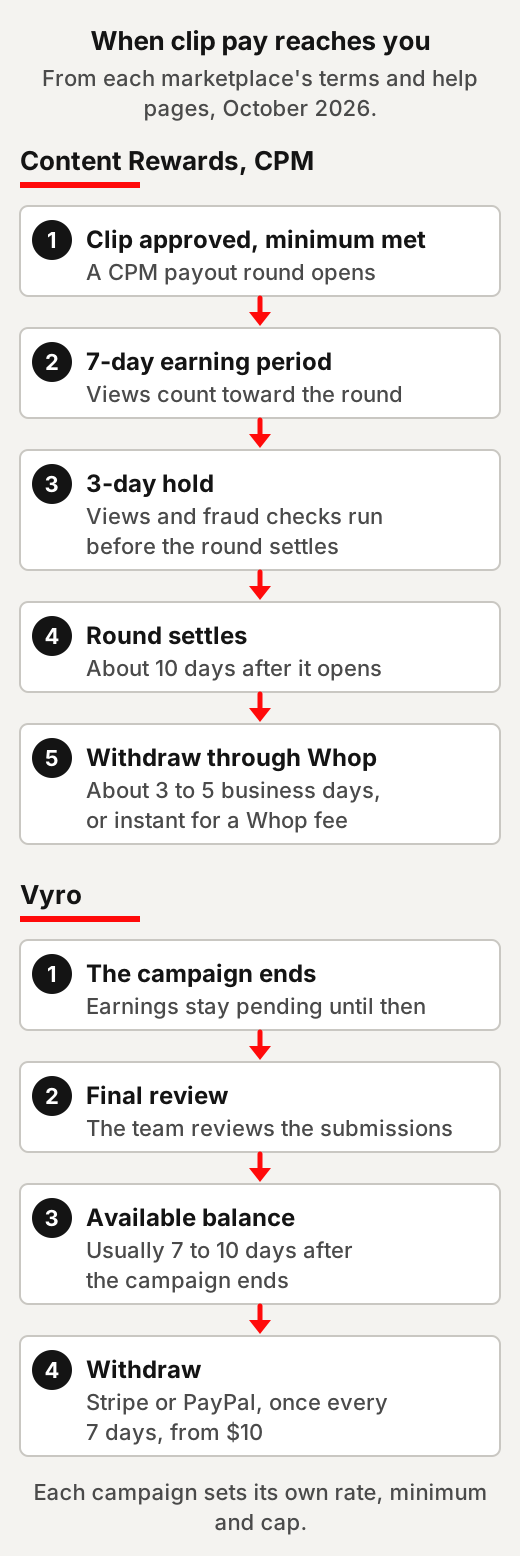
| When pay is ready | A CPM round generally settles about 10 days after it opens | Usually 7 to 10 days after the campaign ends |
| How you withdraw | Through Whop, from $1; about 3–5 business days, or instant for a Whop fee | Stripe or PayPal, depending on country; from $10, once every 7 days |
| What you license | Perpetual, worldwide, including paid ads for the brand’s own products | Irrevocable and perpetual, for any purpose, including AI training |
| Who can join | 18 or older | 18 or older; one account per person |
| Disputes | Individual arbitration; 30-day opt-out | Individual arbitration; 30-day opt-out |
3. How pay is set
On both, each campaign lists its own rate; Content Rewards’ terms leave the requirements to the brand. Content Rewards’ terms say the brand sets the campaign requirements and reviews submissions. They list four kinds of campaign: CPM, per-post, retainer and pool.
Vyro’s FAQ says each campaign has a pay rate listed per 1,000 views, its CPM. Its FAQ says brands come to Vyro and create the campaigns. Its example: a post with 100,000 views on a $1 CPM campaign earns $100.
For example, the same clip could be worth a flat amount on a per-post campaign and a per-view amount on a CPM campaign. Read which kind it is first.
4. The minimum and the cap
Content Rewards leaves both limits to each brand; Vyro sets a minimum and a top limit of its own. On Content Rewards’ CPM campaigns, the brand may set a minimum a clip must earn before it is paid, and a maximum it can earn. Its FAQ says each campaign shows its maximum payout per clip on the campaign page.
Vyro’s help centre says each approved post must reach 5,000 views to start earning, and that this is per post, not a total across posts. Vyro says each clip can earn up to $1,000. It adds that each campaign shows a notice of the most a post can earn.
For example, a 4,000-view clip earns nothing on Vyro, whatever the rate. On Content Rewards, it depends on the minimum that campaign sets.
5. The fee
Content Rewards takes a stated cut; on Vyro we found no clipper fee, only payment-provider fees. Content Rewards’ creator terms charge a flat 10% creator fee on every CPM and pool payout. On per-post and retainer campaigns the fee is 10% when the total budget is under $5,000 and 0% at $5,000 or more.
We read Vyro’s FAQ, clipper terms, content requirements and payment help pages and found no fee Vyro takes from clippers. Its terms say payment providers may deduct fees, and that Vyro is not responsible for them. A fee could exist on a page we did not read, so check what your withdrawal screen shows.
For example, on a Content Rewards CPM campaign, $50 earned becomes $45 after the 10% fee, before any withdrawal fee. That is our arithmetic on the stated rate, not an earnings figure.
6. When pay arrives and how you get it
Content Rewards’ CPM campaigns pay in rounds as they run; Vyro holds earnings until the campaign ends. A CPM payout round on Content Rewards is normally a 7-day earning period followed by a 3-day hold. So a funded round generally settles about 10 days after it opens. Pool payouts are allocated when the pool ends and ordinarily settle after a 3-day hold.
Withdrawals go through Whop, which the terms say typically takes about 3–5 business days, or is instant for a fee charged by Whop. The terms call that timing an estimate that Content Rewards does not control. Content Rewards’ FAQ says you can withdraw from your wallet whenever you have $1 or more.
Vyro’s help centre says earnings stay pending until the campaign ends and the team reviews the submissions. Funds then reach your available balance, usually 7 to 10 days after the campaign ends. Its terms add that Vyro does not guarantee a specific timeline for fund availability.
Cash-outs on Vyro can be requested once every 7 days, from a minimum of $10. Payouts go through Stripe or PayPal, depending on your country, and Vyro does not support IBAN, ACH or cryptocurrency withdrawals.
Vyro’s clipper terms say campaigns can be published before the brand’s money has settled. If the money never arrives, Vyro may cancel the campaign, and then no rewards are issued, even for approved clips. On Content Rewards, if a campaign lacks funds, unpaid CPM earnings are retried when money comes in, but Content Rewards “cannot pay unfunded earnings” if it never does.
In practice, a long Vyro campaign means a longer wait, because nothing becomes available until it ends.
7. What you license when you clip
Both take wide, lasting rights in your clips; Vyro’s terms also name AI training. The terms are quoted below; we do not say what they would mean in a dispute.
Once a clip is approved, Content Rewards’ terms give the platform and the brand a perpetual, worldwide licence to reuse it. That includes paid advertising for the brand’s own products, services and brands. The terms add that no further payment is owed beyond the campaign amounts. Where the brand supplied the underlying content, such as long-form footage, the brand owns the edited clip.
Vyro’s terms call content you make yourself, including your own additions to a client’s video, “Clipper Content”. For that content they take an “irrevocable, non-exclusive, sub-licensable, worldwide, fully-paid, royalty free, and perpetual right and license” to use it “for any purpose, without the requirement to make payment to you”. The licence includes “the right to sublicense Clipper Content to third parties, including Clients, for use on other media or platforms known or hereinafter developed, such as for use on mobile phones, or in video, music, or software programs, as well as generative AI tools and other artificial intelligence tools, including, but not limited for purposes of training”.
Vyro’s terms also say a short clip made from a client’s long video counts as the client’s content. Such new versions are the client’s “exclusive property”, and the terms say they constitute “works made for hire” as defined in the US Copyright Act of 1976. If one is not, “you hereby irrevocably assign to Client all right, title and interest worldwide in and to such New Client Content”.
Your name and likeness are handled differently. Content Rewards’ terms limit the use of your username, voice and likeness to running and promoting that campaign and clip. They rule out unrelated marketing. Vyro’s terms license your name, voice, likeness and more “perpetually and irrevocably”, including to promote the platform.
For example, a clip you post on your own account for a Vyro campaign can be reused by the client long after the campaign ends. Read the licence clause before you join if that matters to you.
8. Who can join and how disputes work
Both are for adults only, and both send most disputes to individual arbitration. Content Rewards’ terms say you must be at least 18 years old. Vyro’s terms say you must be 18 or older, with one account per person.
Vyro’s help centre lists countries it cannot support because of its payment processor’s restrictions. Content Rewards’ terms say it may screen you against sanctions lists and withhold payouts if you are in a prohibited place.
Content Rewards’ terms send most disputes to binding individual arbitration and waive class actions, with a 30-day opt-out. They add that this does not remove the mandatory local rights of consumers in the EU or UK.
Vyro’s terms require a written notice and good-faith talks first; formal steps follow only if the dispute is not resolved within 60 days. After that, disputes go to individual arbitration with a class action waiver; you can opt out in writing within 30 days of first having notice of the terms.
The opt-out windows are short, and each set of terms explains how to use its own.
9. The freelance route
Freelance clipping is editing for one client at a price you agree, not a share of a campaign budget. Upwork’s freelancer service fee ranges from 0% to 15% per contract.
Asked how to get permission to use someone’s work, the US Copyright Office answers: “You can ask for it”. Our guide to AI side hustles has a weekend test for client clipping. Whether a reuse could count as fair use is a separate question; our page on what official sources say about fair use sets it out.
For example, a podcast might pay a set amount for three captioned clips of each episode, whatever views they get.
10. What no marketplace page tells you
Neither marketplace publishes a typical income, and Content Rewards says it does not guarantee earnings. Content Rewards’ terms say it does not guarantee “any level of views, earnings, Campaign availability”. Vyro’s content requirements tell clippers not to disclose their own income from the platform.
So a comparison of rates says little about what you would take home. The minimum, the cap, the budget left and the fee decide that, one campaign at a time.
If an offer asks you to pay, or to hand over your login, before you have earned anything, official guides call that a warning sign; our page on clipping scams describes the patterns.
This page describes each marketplace’s terms. It is not financial or legal advice; the campaign page and the terms you accept decide what you are paid and what you give up.
Quick answers
Which clipping marketplace pays the most?
Neither publishes a typical income, and each campaign lists its own rate on both. What you take home also depends on the minimum, the cap, the budget left and the fee.
Does Vyro take a fee from clippers?
We found no fee Vyro takes from clippers on its FAQ, clipper terms, content requirements or payment help pages. Its terms say payment providers may deduct fees.
How do I get paid on Content Rewards?
On CPM campaigns, earnings settle in rounds, and withdrawals go through Whop. Its FAQ says you can withdraw when you have $1 or more; the terms say Whop typically takes about 3–5 business days, or is instant for a Whop fee.
Who can join these marketplaces?
Both require you to be 18 or older. Vyro allows one account per person and cannot support some countries because of its payment processor; Content Rewards screens against sanctions lists.
Use this
Our suggestion, built from the terms above.
Do I know the fee, the wait and what I am licensing?
Quick quiz
Nothing is scored or saved. Recalling it once now is what makes it last.
1. On Vyro, when do earnings from a campaign become available?
Answer: Usually 7 to 10 days after the campaign ends.Read it again ↑
2. What creator fee do Content Rewards' terms set on CPM payouts?
Answer: 10%.Read it again ↑
3. What do Vyro's terms say its licence to your own clip content covers?
Answer: Any purpose, including use in AI tools for training.Read it again ↑
How we checked this · Last checked October 2026
- We read Content Rewards' creator terms (last updated 4 October 2026) and FAQ, and Vyro's clipper terms (last modified 20 December 2025), website terms, privacy policy, FAQ, content requirements and help pages, in October 2026.
- A marketplace is listed only if it has current clipper terms, some history and independent news coverage; we also say what its own pages tell you about who runs it. Others we checked did not meet all three, or would not load for us, and are not named.
- Testimonials and income claims are not used, and no clipper, creator or account is named.
- Terms and help pages change often, so we recheck this page by the end of December 2026.
Sources
- Content Rewards, “Creator Terms of Service”, last updated 4 October 2026.Primary
- Content Rewards, “For creators” (FAQ), read October 2026.Primary
- Vyro, home page and FAQ, read October 2026.Primary
- Vyro, “Clipper Terms & Conditions”, last modified 20 December 2025, and “Content Requirements”.Primary
- Vyro, “Terms of Service”, effective 17 November 2025.Primary
- Vyro Help Center, “How many views do I need before I can start earning?”, “What’s the most I can earn per clip?”, “When will I receive my earnings?”, “How can I withdraw my earnings?”, “How will I get paid?” and “What countries are supported?”.Primary
- Internet Archive, Wayback Machine copies of vyro.com from 13 August 2025 and 16 October 2025.Primary
- Upwork Help, “Learn about the Freelancer Service Fee”.Primary
- US Copyright Office, “Fair Use FAQ”.Primary
- Digiday, “WTF is clipping? The low-lift creator strategy grabbing advertisers’ attention”, 26 May 2025.Popular
- Bobby Allyn, “The clipping economy: How short-form video ‘clippers’ are overrunning the internet”, NPR, 12 May 2026.Popular
- Los Angeles Times, business report on clipping, 28 October 2025.Popular
Compare the terms, not just the rate
This page does not rank the two marketplaces. Our reading: the fee, the wait and the licence differ more than the pay rate does. Our view: read those three for any campaign before you edit a clip.
Goes with: 1. Which marketplaces are on this page, and why ↑
Before you join any campaign
- Save the terms with the date. Our suggestion: save a copy of the terms and the campaign page, with the day you read them. Content Rewards' terms say campaigns joined inside Whop stay under the older terms.
- Note what kind of campaign it is. Content Rewards' terms list four kinds: CPM, per-post, retainer and pool. Vyro's FAQ says each campaign lists a rate per 1,000 views.
- Write down the minimum and the cap. On Content Rewards' CPM campaigns, the brand may set both. Vyro's help centre says each approved post must reach 5,000 views to start earning. Vyro also says each campaign shows the most a post can earn.
- Note the fee. Content Rewards' terms set a 10% creator fee on CPM and pool payouts. On Vyro, we found no clipper fee on the pages we read. Its terms say payment providers may deduct fees. A fee could exist on a page we did not read.
Know when pay would arrive
- On Content Rewards, check the campaign type. The terms say a funded CPM round generally settles about 10 days after it opens. On pool campaigns, payouts are allocated when the pool ends.
- On Vyro, think in whole campaigns. Vyro's help centre says earnings stay pending until the campaign ends and submissions are reviewed. Funds usually reach your balance 7 to 10 days after it ends.
- Know what each says about timing. Content Rewards' terms call Whop's withdrawal timing an estimate it does not control. Vyro's terms say it does not guarantee a specific timeline for fund availability.
- Know what happens if the brand never pays in. Vyro's terms say it may cancel the campaign, and then no rewards are issued, even for approved clips. Content Rewards' terms say unpaid CPM earnings are retried when money comes in. If it never does, it "cannot pay unfunded earnings".
- Check how you would withdraw. Content Rewards' withdrawals go through Whop. Vyro's help centre says payouts go through Stripe or PayPal, depending on your country. Our suggestion: check this where you live before your first clip.
Compare the licence each one takes
- Content Rewards' licence. Once a clip is approved, its terms give the platform and the brand a perpetual, worldwide licence. That includes paid ads for the brand's own products, with no further payment owed beyond the campaign amounts.
- Vyro's licence. For your own clip content, its terms take a perpetual, irrevocable licence "for any purpose". They add "without the requirement to make payment to you". The licence lets Vyro sublicense that content to third parties, including Clients, for AI tools, including for training.
- Clips cut from footage the brand supplies. Content Rewards' terms say the brand owns the edited clip where it supplied the footage. Vyro's terms say a clip made from a client's long video counts as the client's content.
- Your name, voice and likeness. Content Rewards' terms limit their use to running and promoting that campaign and clip. Vyro's terms license your name, voice, likeness and more "perpetually and irrevocably", including to promote the platform.
- Decide before you post. Our view: picture the clip being reused long after the campaign ends. Join only if you are comfortable with that.
This week: find your opt-out dates
Both sets of terms send most disputes to individual arbitration, each with a 30-day opt-out. Content Rewards' window counts from when you first accept its terms. Vyro's counts from when you first had notice of them. Our suggestion: write down both dates. Read each arbitration section in full, and decide on purpose. A lawyer where you live can tell you what applies to you.
What to keep on record
- Note who you are dealing with. Our suggestion: write down the operator's name exactly as each set of terms gives it. Our reading: a company name matters most if a payment goes wrong.
- Keep a note per campaign. Our suggestion: the kind of campaign, its rate, minimum, cap and fee, and the day you read them.
- Log every clip. Our suggestion: the post link, the day you submitted it, and whether it was approved.
- Match each payout to its campaign. Our suggestion: note what arrived, any fee taken, and the date. Compare it with your campaign note.
- Step back from pay-first offers. Some offers ask you to pay, or for your login, before you earn anything. Official guides call that a warning sign.
Keep going
- How clipping paysHow per-view campaigns pay, where a clip's pay can stop, and the other ways clippers get paid.
- Whop Content Rewards explainedWho sets the pay on Content Rewards, what it keeps, when money arrives, and what its terms say.
- Which clips earn and which get cutWhat five platforms say about reused clips, and what makes a clip count as your own.
- Fair use, describedWhat US law, the Copyright Office and YouTube say about using other people's clips.
- Clipping scamsThe scam patterns official consumer guides describe, applied to clipping, with the signs to watch.
- GlossaryThe plain meaning of CPM, licence and arbitration.