

Start hereUnder Content Rewards' terms, a clip can be approved and still have its payout reversed before the money settles. Who decides, and what can you check first?
Content Rewards is a marketplace where brands pay people to post short videos, including clips cut from longer ones. Its current terms are dated 4 October 2026. A company called Content Rewards Inc runs the marketplace, and Whop moves the money.
Below: who sets the pay, the fee, when money arrives, and what the terms say about rejections, fraud checks and your clips.
Clipping as a side income in general is in our guide to AI side hustles. This page looks at one marketplace and its terms.
1. Who runs it: Content Rewards and Whop
Content Rewards runs the marketplace; Whop, a separate company, handles sign-in and moving the money.
The creator terms, last updated 4 October 2026, are an agreement with Content Rewards Inc, a Delaware corporation. They call Whop “a separate company” whose platform it uses for payments.
| Who | What it handles |
|---|---|
| Content Rewards | Earning, submissions, view checks, fraud flags and running campaigns |
| Whop | Sign-in, withdrawals and identity checks |
Under the terms, Whop handles withdrawals and the related identity checks, and Content Rewards handles earning, submissions, view checks, fraud flags and campaigns. Sign-in details are managed by Whop, under Whop’s own terms.
Content Rewards started inside Whop and now also runs as its own site. Its terms say it still runs “an earlier experience hosted inside the Whop platform”. Campaigns you joined there stay under the older terms you accepted at the time. Whop’s own help page still describes Content Rewards as an app that a business adds to its Whop page.
We found no page that says who owns which company. The terms only call them separate companies. In practice, you deal with two sets of rules: Content Rewards’ terms for campaigns, and Whop’s terms for your account and withdrawals.
2. Who sets the rate
The brand running each campaign sets the pay rate, the limits and the rules, not Content Rewards or Whop.
The terms say “The Organization sets the Campaign requirements and reviews Submissions”. The “Organization” is the brand, or an agency acting for it.
Whop’s guide for brands tells them to “Set how much creators earn per 1,000 views on their videos”. On CPM campaigns, the brand may also set a minimum a clip must earn before it is paid, and a maximum it can earn.
CPM means a rate per 1,000 views. It is one of four kinds of campaign the terms list:
| Type | How it pays |
|---|---|
| CPM | A rate per 1,000 verified views |
| Per-post | A flat amount for each approved clip |
| Retainer | A fixed amount for each agreed period |
| Pool | A budget split by each person’s share of the views |
The terms list four kinds of campaign: CPM, per-post, retainer and pool. Per-post pays a flat amount per approved clip, and retainer pays per cycle. A pool splits the budget in proportion to each creator’s counted views on approved submissions.
For example, a campaign might pay $1 for every 1,000 views, stop paying a clip once it has earned a set ceiling, and accept clips only on two platforms. Those numbers are ours, to show the shape; each real campaign sets its own.
On 27 October 2026 the Content Rewards creators page showed seven featured CPM campaigns, paying from $0.50 to $1.50 per 1,000 views. That is a snapshot of rates on one day, not of what anyone earns. The same page claims “$20M paid out” and “1M+ creators”. Those are the company’s own figures; we have not checked them.
No page we read gives a typical or median income for people who clip. Content Rewards itself says “Earnings examples are individual outcomes, not guarantees”.
3. How a payout is worked out
On CPM campaigns, pay follows verified views and the rate, within the floor and ceiling, while the budget lasts.
Whop’s guide for brands, written for the app inside Whop, gives three worked examples. They are Whop’s numbers, not a forecast:
- The floor. With a $3 rate and a $6 minimum payout, only videos with at least 2,000 views reach the brand’s review queue.
- The ceiling. With a $3,000 maximum and a $3 rate, a clip stops earning at 1 million views, even if it keeps growing.
- A bonus. With a $3 rate, a $10 flat fee and 2,000 views, a creator earns $16 in total.
Whop’s guide sets out those three examples under “Minimum payout”, “Maximum payout” and “Flat fee bonus”. The Content Rewards creator fee, in the next section, then comes out of what you earn.
Pools work differently. Anyone below a pool’s minimum views gets no share. The terms say a pool amount shown before the pool ends is “an estimate, not guaranteed earnings”.
Budgets can run out. If a campaign lacks funds, unpaid CPM earnings are retried when money comes in, but Content Rewards “cannot pay unfunded earnings” if it never does. So check the budget left, not only the rate.
In practice, before you post, read four numbers on the campaign page: the rate, the minimum, the maximum and the budget left.
4. The fee
Content Rewards takes 10% of what you earn on most campaigns; Whop may charge separately when you withdraw.
The terms charge a flat 10% creator fee on every CPM and pool payout. On per-post and retainer campaigns, the fee is 10% when the total budget is under $5,000 and 0% at $5,000 or more. Brands pay their own platform fee of 10%, or 8% once verified, on work they approve.
For example, on a per-post campaign the campaign’s total budget, not your clip, decides whether the fee is 10% or nothing. Check it on the campaign page.
Whop’s side is separate.
The terms say withdrawal timing and fees on Whop are set by Whop, not by Content Rewards. Whop’s fees page lists a fee for each payout method, such as $2.50 for a next-day transfer to a US bank and $23.00 for a bank wire.
That page is written for businesses that sell on Whop, and it does not say which fees apply to Content Rewards earnings. Check the amount Whop shows before you confirm a withdrawal.
5. When the money arrives
A CPM round normally settles about 10 days after it opens; then you withdraw through Whop.
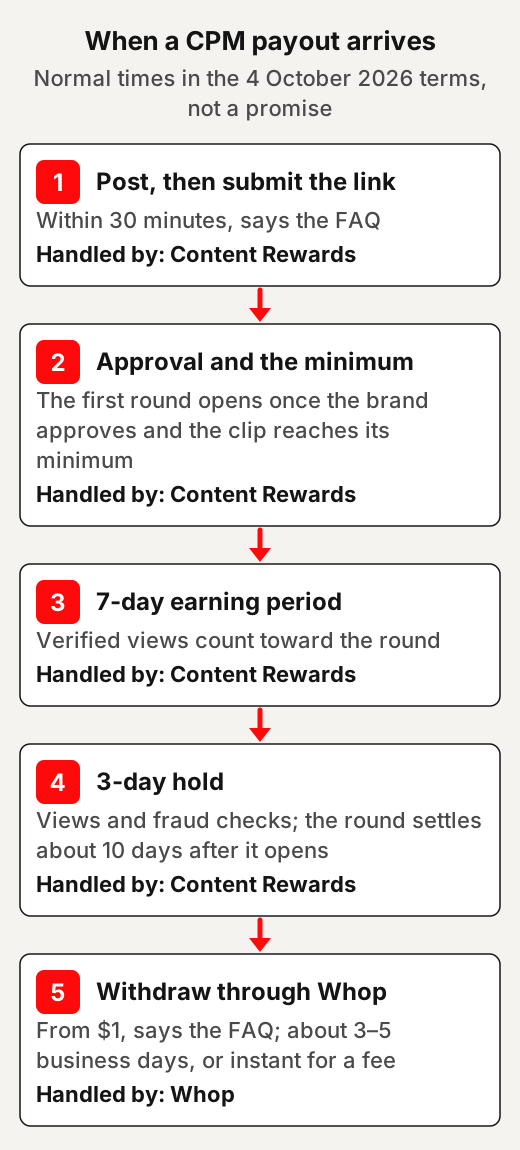
The first payout round opens once the brand has approved the clip and it has reached the campaign’s minimum payout. A CPM round is normally a 7-day earning period followed by a 3-day hold, so it generally settles about 10 days after it opens. If earnings remain unpaid, the next round opens after the previous one settles.
There is also an outer limit. The earning period normally ends 30 days after the clip first meets its minimum, or when tracking ends, if that comes first. Tracking normally lasts 30 days from submission, and the terms say a later approval does not extend the earning window. The terms add that Content Rewards may adjust these periods.
The FAQ gives a shorter version. Content Rewards’ FAQ says: “On CPM your clip earns for 7 days from approval, then the payout is held 3 days.” The terms tie the start to the minimum as well, and add the 30-day window. Where documents conflict, the terms put the Creator Terms first for creator matters.
Then you withdraw. Content Rewards’ FAQ says you can withdraw from your wallet whenever you have $1 or more. Withdrawals go through Whop, which the terms say typically takes about 3–5 business days, or is instant for a fee charged by Whop. The terms call that timing an estimate that Content Rewards does not control.
Whop adds its own checks. To receive payouts, Whop asks you to pass its KYC checks, short for “know your customer”: proof of who you are.
Whop’s terms say you must complete all required identity verification and compliance checks to receive payouts. Whop says it “may flag some withdrawals for compliance review”. Its payout page, written for businesses that sell on Whop, says creators outside the United States need a bank account in the currency of their registered country.
6. Approval, rejection and clawbacks
The brand approves or rejects each clip, and money can still be taken back until it settles.
In the terms’ words, the brand “decides whether to approve or reject each Submission”. The FAQ says every submission is reviewed by the brand or its campaign manager, and “nothing approves automatically”. The terms also say Content Rewards may use automated tools to review submissions and apply campaign requirements.
Content Rewards’ FAQ lists the usual reasons clips get rejected: “wrong platform, missing tags or disclosure, reused content, or the post being edited or deleted after you submitted.”
If a brand reviews a draft first, the terms say draft approval “does not guarantee payment”.
If you think a brand rejected a clip in error, you can raise it with Content Rewards Support, which may investigate and overrule the brand. The terms add that it does not guarantee it will “intervene, reverse a decision, or arrange payment”, except where the law requires it.
The terms call a reversal of a credited payout a clawback. Under the terms, a clawback reaches money still in the hold.
The terms say a credited payout “that has not yet settled may be reversed” if the clip is rejected after approval. The same applies if a fraud or policy flag on it is upheld. Once a payout has settled to your available balance, “it is not reversed through this process”. A cancelled pool share goes back to the brand’s budget, not to the other creators.
In plain words: money in the hold can still go back to the brand; money that has settled is not reversed through this section. A ban does not cancel money already validated to your balance, though Content Rewards may withhold what you owe it or losses from confirmed fraud.
7. The Bot Score and bans
Each submission gets a 0–100 fraud-risk score; a high score can pause the payout until a person decides.
The Bot Score is a 0–100 fraud-risk score, produced with help from a third-party fraud-detection provider. The terms say its signals, weights and methods are proprietary and may change without notice. The privacy policy says the model estimates “the likelihood that views or engagement are non-genuine”.
A submission at or above a fraud threshold may be flagged for human review, and its payout is paused while the flag is open. The threshold is set by Content Rewards, or by the brand for its own campaign.
The score does not approve or reject anything by itself; a person decides on the flag. You can file one appeal per flagged submission, and Content Rewards aims to reply within 10 business days. It may also look at accounts that appear to be run by the same person, and act on all of them together.
Content Rewards says buying or generating views “results in a permanent ban”. Under the October terms you may appeal that ban once, and a person reviews the appeal. Campaigns joined inside Whop follow the older Clippers Terms of Service. An Internet Archive copy of those older terms, saved in August 2026, says the offences it lists “result in PERMANENT BAN with NO APPEAL and forfeiture of ALL pending and earned payouts”.
The terms also bar content designed to inflate views, naming botting, view farms, click farms and engagement pods. They ask you not to co-post with Instagram’s Collab feature unless the brand allows it, because it splits the view count.
For example, if a friend offers to share your clip from a network of accounts to “boost” it, that could look like coordinated views. Leave it.
8. What the brand can do with your clip
An approved clip can be reused worldwide and for good to promote the brand, paid ads included.
Section 17.3 says that once your clip is approved, you give Content Rewards and the brand “a perpetual, worldwide, royalty-free, non-exclusive and sublicensable license”. It lets them reuse the clip “on any platform and in any medium, including in paid advertising, for the Brand’s own products, services and brands”. The clause adds that “No further payment is owed beyond the Campaign amounts”.
Two of those words, in plain terms:
- Royalty-free: the clause itself says “No further payment is owed beyond the Campaign amounts.”
- Non-exclusive: not an exclusive licence, which usually stops the owner sharing the work with anyone else.
Where the brand supplied the footage, templates or scripts, the brand owns the final clip, and you assign your rights in it once it is approved. The terms also let the brand use your username, voice and likeness as they appear with the clip, to run and promote that campaign.
You may show your clips in your own portfolio, unless the brand has opted out. For retainer campaigns, the terms say deliverables are made “on a work-for-hire / assignment basis” under the campaign’s own terms.
Content Rewards’ terms make clippers warrant that a clip “does not infringe anyone’s rights” and that they have cleared any third-party content it uses, including music.
Where the brand provides footage, its licence to you is “limited, revocable, non-exclusive” and only for making that campaign’s clip. Copyright and fair use, and each platform’s own rules on reused clips, are separate questions from these terms.
9. If there is a dispute
The terms send most disputes to arbitration, one person at a time, unless you opt out within 30 days.
Arbitration means a neutral decision maker, not a court, hears both sides and decides.
Disputes go to binding arbitration with the American Arbitration Association, before one arbitrator, seated in Delaware. You and Content Rewards “waive any right to bring or participate in a class, collective, or representative action”.
You may opt out of arbitration by written notice within 30 days of first accepting the terms. Small-claims court stays open for claims that qualify. The section does not apply where it would be unenforceable for consumers in the EU or UK, or would unlawfully restrict their rights.
In plain words, the terms say that unless you opt out in time, most disputes go to an arbitrator rather than a judge. They also have you give up the right to bring or join a class action, a lawsuit brought for a whole group. You also agree to “indemnify, defend and hold harmless” Content Rewards against claims, losses and costs. These are claims arising from your use of the platform, your clips or drafts, or your breach of the terms, to the extent the law allows.
These are the terms’ own words. Whether a clause applies to you depends on where you live and on facts we cannot see; a lawyer where you live can tell you.
10. What changed in the October 2026 terms
Since the August version, the CPM fee became a flat 10%, pools arrived and the licence was spelled out.
The Internet Archive holds one earlier copy of this terms page, last updated 19 August 2026. We compared it with the 4 October version. A version in between may have existed; the Archive holds none.
| 19 August 2026 | 4 October 2026 | |
|---|---|---|
| Fee on CPM campaigns | 25% down to 7%, falling as your lifetime earnings grow | A flat 10% |
| Fee on per-post and retainer under $5,000 | 7% | 10% |
| Pool campaigns | Not listed | Added |
| CPM payout timing | Cycles “currently every 3 days” | 7-day earning period, then a 3-day hold |
| A brand’s rejection | “not separately appealable” | Can be raised with support, which may overrule the brand |
| Ban for bought views | No appeal | One appeal, reviewed by a person |
| Licence to brands | “a license to your Clip”, scope not spelled out | Perpetual, worldwide, sublicensable, including paid ads |
In August, the CPM fee was tiered by lifetime earnings: 25% under $1,000, 20% from $1,000, 12.5% from $2,500 and 7% from $5,000. The August version said a confirmed botting ban “carries no appeal”.
In practice, on CPM campaigns someone new pays less under the October terms (10% instead of 25%). Someone past $5,000 in lifetime earnings pays more (10% instead of 7%).
11. Before you join a campaign: what to read
The campaign page is the rulebook; read it and the key parts of the terms before your first clip.
Content Rewards calls the individual campaign brief “the source of truth”. Six things to check:
- The rate, the minimum and the maximum per clip.
- How much budget is left, and the campaign type.
- The platforms, tags and paid-content label the brief asks for.
- Whether the brand supplies the footage, and what licence you give.
- Whether you must apply first, or submit a draft.
- Whop’s fee and timing for the payout method you will use.
Labels are your job. The terms make you “solely responsible” for following FTC endorsement rules, with a clear disclosure at the start of the video. Content Rewards’ own guide says a spoken disclosure must come “within the first 10 seconds”.
One more check. Under these terms the fee comes out of what you earn. Our reading: a request to pay upfront to join a Content Rewards campaign does not match how the terms describe it. Whop’s community rules also bar earnings claims that imply “atypical results are typical”.
Quick answers
Is Content Rewards part of Whop?
Its terms are with Content Rewards Inc and call Whop a separate company whose platform it uses for payments. Content Rewards started inside Whop, and campaigns joined there stay under the older terms.
How much does Content Rewards take?
A flat 10% of every CPM and pool payout. On per-post and retainer campaigns it is 10% under a $5,000 budget and 0% at $5,000 or more. Whop may charge separately when you withdraw.
How long do Content Rewards payouts take?
Under the terms, a CPM round is normally a 7-day earning period and a 3-day hold, about 10 days. Withdrawing through Whop typically takes about 3–5 business days, or is instant for a fee.
Why was my Content Rewards clip rejected?
The brand decides. The FAQ lists the usual reasons, such as the wrong platform, missing tags or disclosure, reused content, or editing or deleting the post after submitting.
How much can you earn clipping on Content Rewards?
No page we read gives a typical income. Each brand sets its own rate, and Content Rewards says earnings examples are individual outcomes, not guarantees.
Use this
Our suggestion, built from the terms and FAQ above, for before your first clip.
Could I explain this campaign's rate, fee and licence to a friend?
Quick quiz
Nothing is scored or saved. Recalling it once now is what makes it last.
1. Who decides whether a clip is approved?
Answer: The brand running the campaign.Read it again ↑
2. Under the 4 October 2026 terms, what is the creator fee on CPM payouts?
Answer: A flat 10%.Read it again ↑
3. Once a payout has settled to your available balance, can the clawback section reverse it?
Answer: No, not through that section.Read it again ↑
How we checked this · Last checked October 2026
- We read Content Rewards' creator terms of 4 October 2026 in full, with its creators FAQ, pricing page, privacy policy and FTC guide.
- For what changed, we compared those terms with the 19 August 2026 version saved by the Internet Archive, the only earlier copy of this page it holds.
- We read Whop's own help pages on Content Rewards, fees and payout methods, and Whop's terms. Whop's fee list is written for businesses that sell on Whop and does not mention Content Rewards.
- We did not sign up or log in. We did not compare the older Clippers Terms of Service, which still govern campaigns joined inside Whop; Content Rewards sends a copy by email, and the Internet Archive holds copies saved in 2026, the latest marked "Last Updated: 12 February 2025".
- Fees, timings and rates change. These are as of October 2026, and the campaign page is the place to check before you start.
Sources
- Content Rewards, “Creator Terms of Service” (last updated 4 October 2026), sections 1–20, 31–33.
- Content Rewards Creator Terms, version last updated 19 August 2026, Internet Archive copy of 30 August 2026.
- Content Rewards, Clippers Terms of Service (older terms for campaigns joined inside Whop), Internet Archive copy of 8 August 2026.
- Legal Information Institute, Wex, “exclusive license”.
- Content Rewards, “For creators” (FAQ and featured campaigns, read 27 October 2026), “Pricing”, “Privacy Policy” (4 October 2026), “FTC Compliance & Transparency Guide” (12 February 2025) and “llms.txt”.
- Whop Docs, “Content Rewards”, “Fees”, “Payout Methods” and “Community Guidelines”.
- Whop, “Terms of Service” (last updated 9 October 2026).
Know which rules cover each step
You deal with two companies here. Content Rewards' terms cover campaigns; Whop's terms cover your account and withdrawals. Content Rewards' terms say campaigns joined inside Whop stay under the older terms you accepted then. Our view: before your first clip, note where you joined and which terms apply.
Read the numbers before you edit
- Copy the campaign's four numbers. Our suggestion: note the rate, minimum, maximum and budget left, with the date you read them.
- Check what is left in the budget. The terms say Content Rewards "cannot pay unfunded earnings" if a campaign's money never comes in.
- Work out the fee. The terms charge a flat 10% on CPM and pool payouts. On per-post and retainer, the campaign's total budget decides whether it is 10% or nothing. Whop's withdrawal fees are separate, and the terms say Whop sets them.
- Read a pool figure as an estimate. The terms call a pool amount shown before the pool ends "an estimate, not guaranteed earnings".
- Read the brief word for word. Content Rewards calls the campaign brief "the source of truth". Our view: read it before you edit, and again before you post.
Keep a record for every clip
- Log each submission. Our suggestion: the post link, when you submitted it, and a saved copy of that day's brief.
- Know what the hold means. Under the terms, a payout not yet settled may be reversed if the clip is rejected after approval. The same applies if a fraud or policy flag is upheld.
- Know what settled means. Once a payout settles to your available balance, the terms say it is not reversed through the clawback section. On a ban, they say Content Rewards may still withhold what you owe it or confirmed fraud losses.
- Keep your views clean. The terms bar botting, view farms, click farms and engagement pods. A high Bot Score can pause a payout while a person reviews it.
- Raise a rejection you think is wrong. The terms say Support may investigate and overrule the brand. They do not guarantee it will.
- Appeal a flag with your notes. The terms allow one appeal per flagged submission. Our view: your log makes that appeal easier to write.
Decide on the licence before you post
- Picture the clip in an ad. Once a clip is approved, the terms let the brand reuse it worldwide and for good. That includes paid ads for the brand's own products, with no further payment owed. Our view: post only what you'd be glad to see there.
- Your voice and face go with it. The terms let the brand use your username, voice and likeness as they appear with the clip. That use is to run and promote that campaign.
- Know who owns brand-made clips. Where the brand supplied the footage, templates or scripts, the terms say the brand owns the final clip.
- Note where every piece came from. The terms make you warrant that your clip "does not infringe anyone's rights", music included. Our suggestion: note where each piece of footage and music came from.
- Check the portfolio line. The terms let you show clips in your own portfolio unless the brand has opted out. Our suggestion: confirm that before you use one.
This week: read the dispute section
Our suggestion: find the day you first accepted the terms and write it down. The terms allow opting out of arbitration by written notice within 30 days of that day. Read the arbitration section in full before then, and decide on purpose. Whether it applies to you depends on where you live, among other things. A lawyer where you live can tell you.
Keep going
- AI side hustlesSeven ideas, clipping among them, what each involves, and the rules that apply.
- AI tools for short videosFive AI video and picture tools, how to start with each, and what their terms say.
- Use emotion honestlyFear, scarcity, urgency and social proof: what the research says, and a test to spot them.
- Cybersecurity crash courseScams, attacks and protections, explained in plain words.
- GlossaryThe plain meaning of CPM, KYC, arbitration and class action.