
The idea
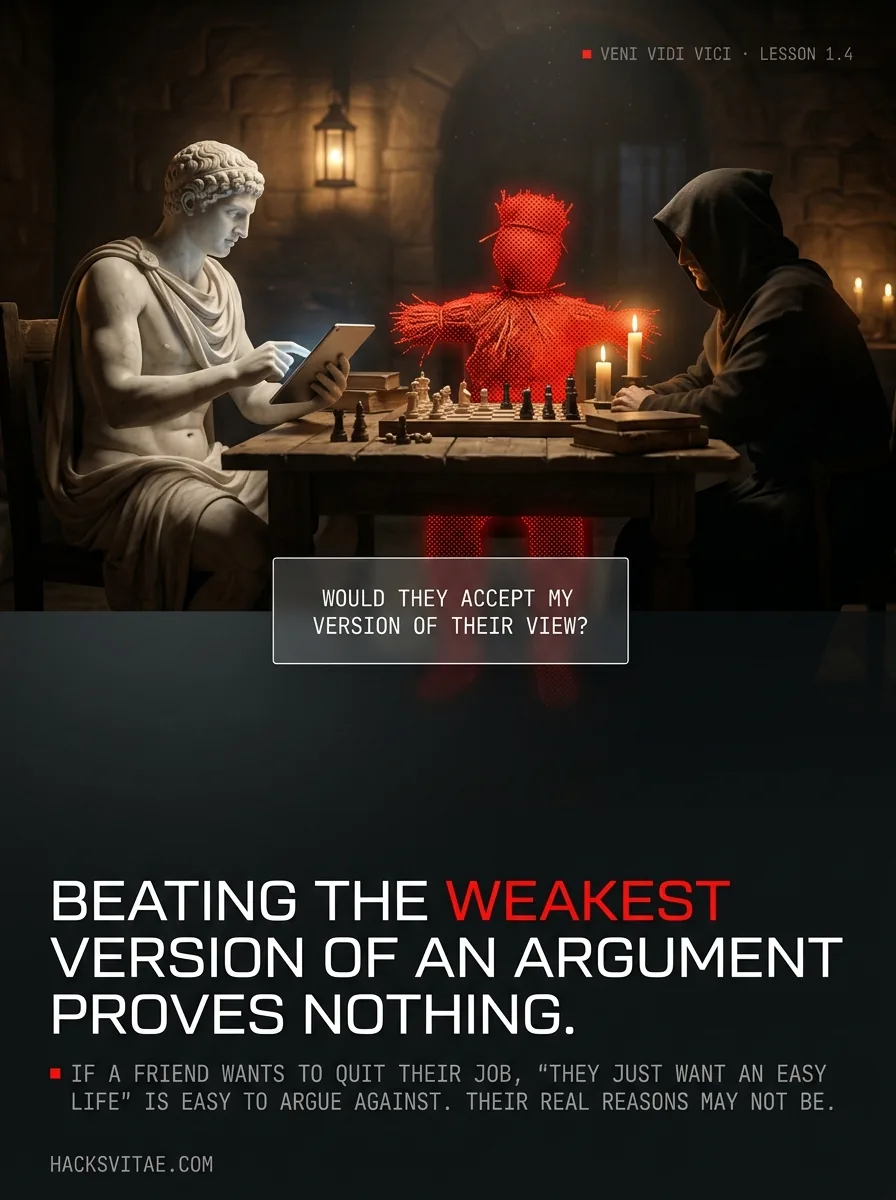
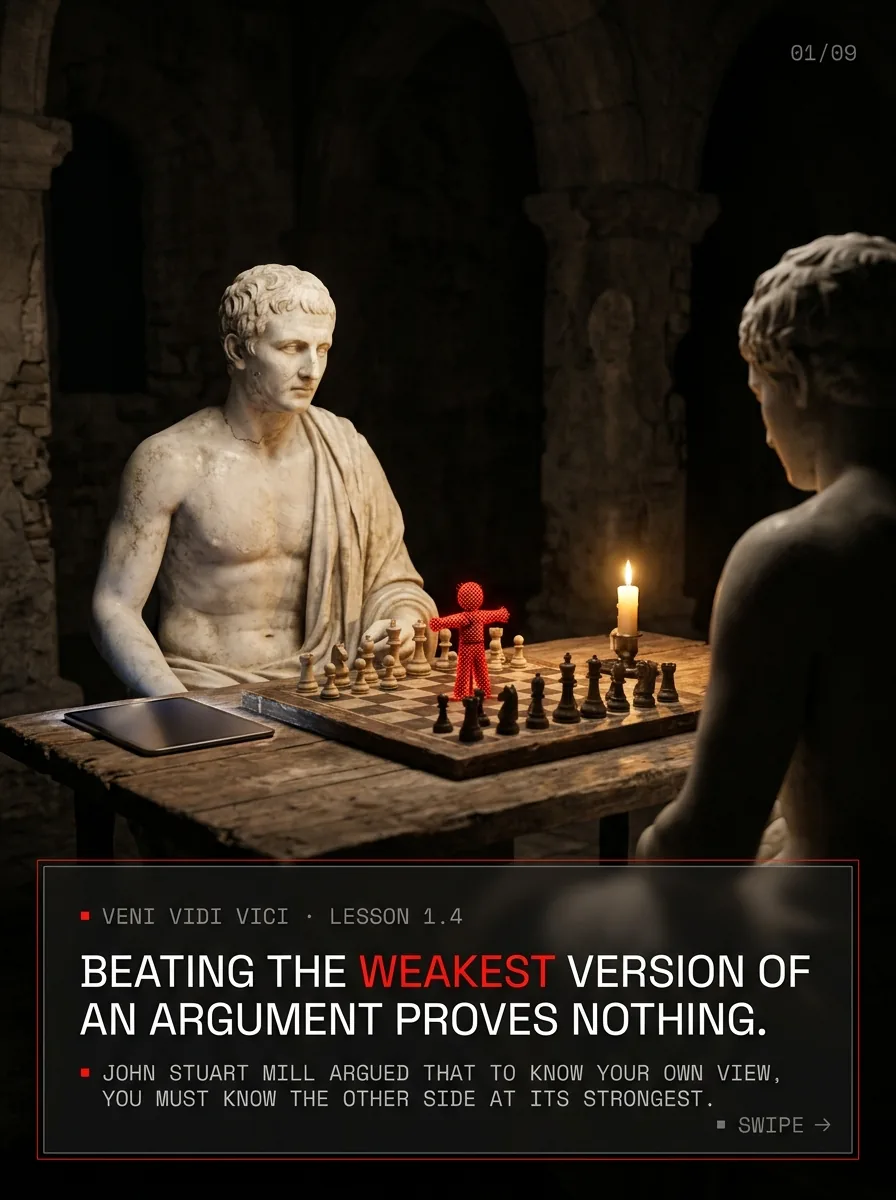
In his book On Liberty (1859), the philosopher John Stuart Mill wrote: "He who knows only his own side of the case, knows little of that". He meant meeting the other side's arguments at their most plausible and persuasive.
Today, making the other side's best case is sometimes called steelmanning. One definition comes from OpenStax, a free university textbook series. Its Introduction to Philosophy calls it making the strongest possible case for an argument. Its opposite is a straw man.
A straw man is a well-known fallacy, or mistake in reasoning. It means pinning an easily refuted position on someone, one they would not endorse. Then that weaker position gets attacked instead of theirs.
A related idea is the principle of charity. It started as a rule for working out what people mean. The philosopher W. V. O. Quine put it this way: "silliness, beyond a certain point, is less likely than bad translation". So if someone seems to say something very silly, a misunderstanding is the likelier explanation. Today the idea is also used, more loosely, for reading an opponent's argument at its strongest.
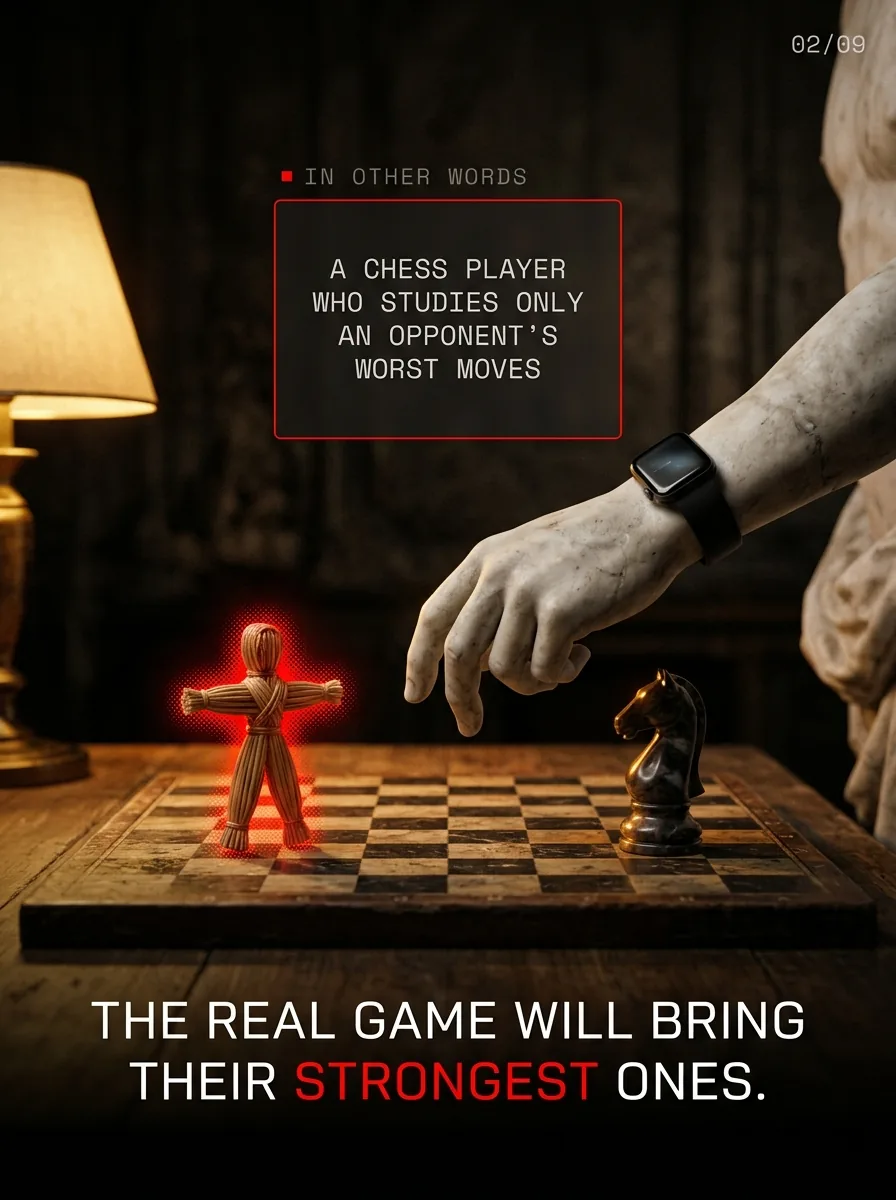
What you study is not what you will face.
In other words
Picture a chess player who studies only an opponent's worst moves. The real game will bring their strongest ones.

A playground quarrel that ends once someone listens.
Explain like I’m 5
Two kids want the same swing. One shouts, 'You just want to be bossy!' The other says, 'I haven't had a turn yet.' They only sort it out once the real reason is heard.
Four moves between hearing a view and answering it.
How it applies
Put together, these ideas suggest four moves. The first is stating the other view fairly, in a form its holder would accept. Next is finding its strongest point. Then comes answering that point, not the person or their tone. Last is seeing if your own view still holds.
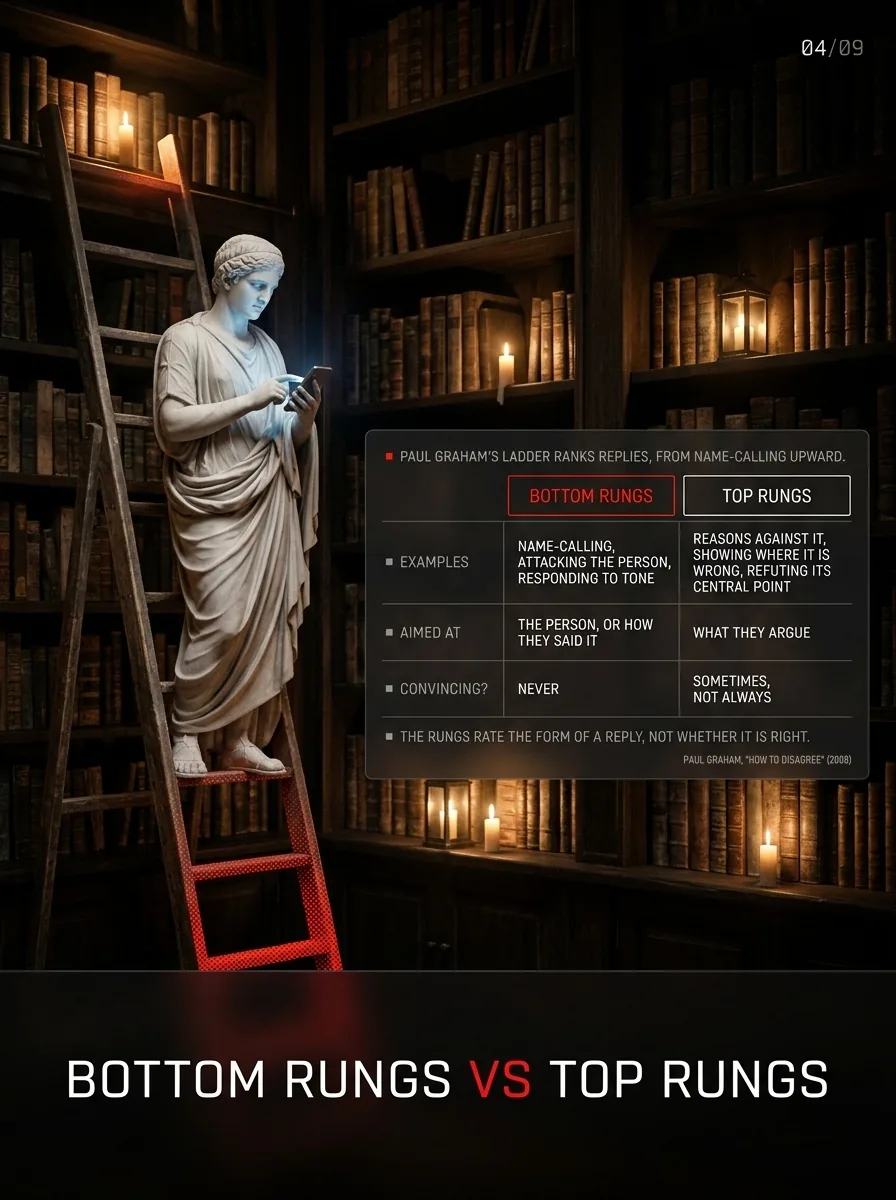
Bottom rungs vs top rungs
| Compared | Bottom rungs | Top rungs |
|---|---|---|
| Examples | Name-calling, attacking the person, responding to tone | Reasons against it, showing where it is wrong, refuting its central point |
| Aimed at | The person, or how they said it | What they argue |
| Convincing? | Never | Sometimes, not always |
The essayist Paul Graham's "How to Disagree" (2008) ranks replies on seven rungs. They run from name-calling at the bottom to refuting the central point at the top. The rungs rate the form of a reply, not whether it is right.
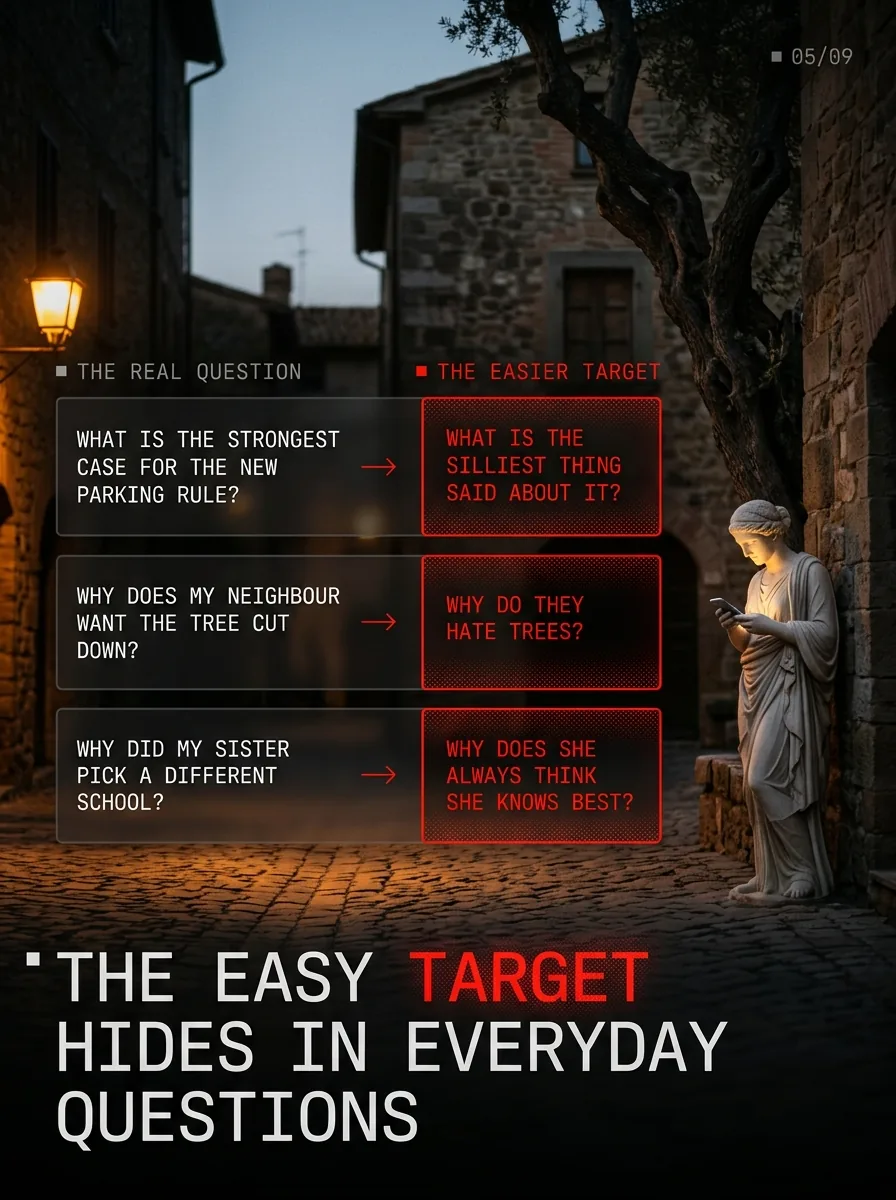
If… then…
Examples (ours)
- If the real question is 'What is the strongest case for the new parking rule?', the easier target is often 'What is the silliest thing said about it?'
- If the real question is 'Why does my neighbour want the tree cut down?', the easier target is often 'Why do they hate trees?'
- If the real question is 'Why did my sister pick a different school?', the easier target is often 'Why does she always think she knows best?'
Online, at work and at home.
Where you’ll see it
Everyday examples (ours)
- Online: a reply that quotes the weakest line of a post and skips the rest.
- At work: a proposal judged by its one weak slide.
- At home: "I'm tired tonight" answered with "You never want to go out."
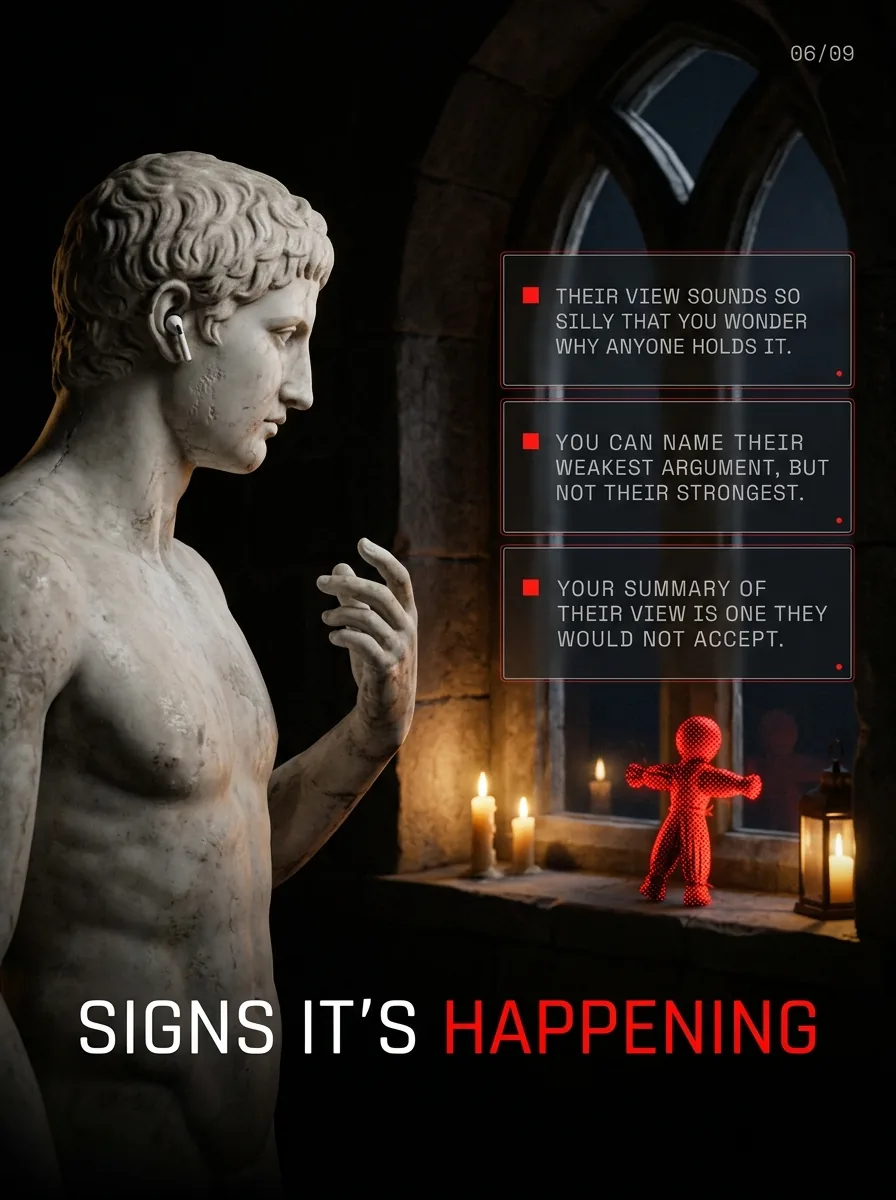
The clues are inside your own head.
Signs it’s happening
- Their view sounds so silly that you wonder why anyone holds it.
- You can name their weakest argument, but not their strongest.
- Your summary of their view is one they would not accept.
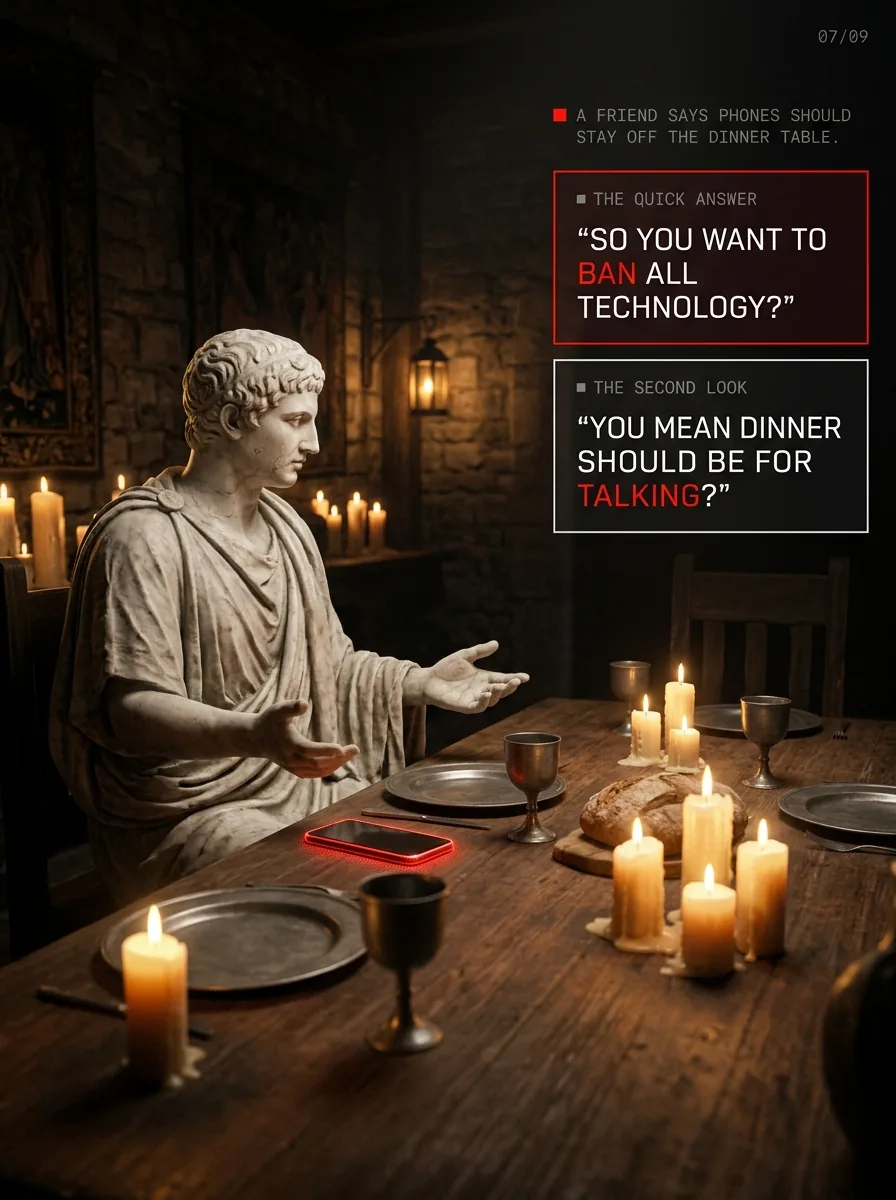
Before and after
A friend says phones should stay off the dinner table.
"So you want to ban all technology?" argues with a view they do not hold.
"You mean dinner should be for talking?" states their point first, then answers it.

Example from history: Franklin's 'I conceive'
- Benjamin Franklin was born in Boston in 1706 and died in Philadelphia in 1790. Late in life he wrote his memoir, the Autobiography.
- In it he describes a change in how he put forward his opinions.
- He dropped words like "certainly" and "undoubtedly".
- In their place he used "I conceive" (meaning "I think") and "it so appears to me at present".
- He says his opinions then met "a readier reception and less contradiction": people took them up more readily and argued back less.
"At present" tells the listener a view could still change, which leaves room for their side.
Two common worries, and what others have said.
What if…?
- What if I've already made up my mind?
- The investor Charlie Munger noted that people hold on to the first conclusion they reach. In court, he said, judges and juries must hear long, skilful presentations of the side they would not naturally favour. Hearing the other side's best case works as a check on a first conclusion.
- What if the other person won't listen?
- In his book *Think Again*, the psychologist Adam Grant describes motivational interviewing. It is a counselling method built on open questions and reflecting back what you hear. The book's description says Grant makes it a guiding principle to "argue like he's right but listen like he's wrong." Studies of the method find some support, mostly for short-term change. Most of the evidence is rated low or very low quality.
Three words worth knowing.
Key terms
- steelmanning
- Making the strongest possible case in favour of an argument, often the opposing one; the opposite of a straw man. Glossary →
- straw man
- A mistake in reasoning: attributing to someone an easily refuted position they would not endorse, then attacking that position instead of theirs. Glossary →
- principle of charity
- A rule for interpreting what people say: read a speaker as holding beliefs you yourself would count as true, wherever that is plausible. Glossary →
Quick check3 questions · nothing is saved
1. In Paul Graham's ladder of disagreement, what is the top rung?
2. What does steelmanning mean?
3. Which words did Franklin drop?
For more: the research behind it
Optional. Everything above stands on its own; these are the full articles, with every source.
- Information Is Power: Who to Listen To, and How to Choose What You Feed Your MindMindset · 17 min
- Mental Models from Philosophy: 11 Thinking Tools Checked Against the TextsPhilosophy · 11 min
- Logical Fallacies Cheat Sheet: 16 Common Ones, and When They Are Not FallaciesMindset · 11 min
- Think Again Summary: The Key Ideas, What Holds Up, and How to Use ThemMindset · 8 min
- The Autobiography of Benjamin Franklin Summary: The Key Ideas, What Holds Up, and How to Use ThemSelf-Improvement · 6 min

One question worth keeping.
In one line
An argument worth having is with the strongest version of a view, aimed at its central point.
Whose view have you argued against without ever hearing its strongest case?
All slides
This lesson as images, to save or share. Tap one to download it.