

Start hereIn a 1978 study of English speakers learning Dutch in Holland, teenagers and adults made the fastest progress in the first few months. Yet a 2018 study of 669,498 native and non-native English speakers found grammar-learning ability declining from about 17.4 years. Can both be true?
A new language comes from many small, steady habits. Review words over several days, and try to recall each one before you check. Listen and read a lot at a level you mostly understand. Speak early, and ask people to correct you.
Below: what holds up, what holds up less well, how many hours a language takes, and a 30-day plan.
1. The short list
Four habits have research behind them in language learning itself.
| Habit | What you do | How it holds up |
|---|---|---|
| Space your reviews | Review the same words over several days, not all at once | Holds up |
| Recall before you check | Try to say the word from memory, then check | Holds up |
| Lots of input at your level | Listen and read a lot of material you mostly understand | Holds up |
| Speak and get corrected | Talk with people and ask them to fix your mistakes | Holds up |
| An app on its own | Use one app as your only teacher | Partly |
| Input with nothing else | Only listen and read, with no grammar study or speaking | Partly |
Our guide to learning faster covers the general research on study habits. A 2013 review of ten study techniques gave its highest rating to two: practice testing and spaced practice. This page looks at what is known about languages in particular.
2. What holds up
These four habits have been tested with language learners; the “How sure” line under each says how much.
Space your reviews
Holds up Spreading language practice over several sessions works better than cramming it into one. The same practice, spread out over days, helps you remember for longer. Researchers call this the spacing effect.
How sure: Strong a 2022 meta-analysis of 48 language experiments found a medium-to-large effect.
A 2022 meta-analysis of 48 experiments with 3,411 learners found that spacing had a medium-to-large effect on second language learning. Longer gaps did better than shorter ones on later tests. Gaps that grew longer did no better than even gaps.
For example, review ten new words on Monday, again on Wednesday, and again the next Monday. Ten minutes on three separate days is spaced practice; thirty minutes in one go is not.
Recall before you check
Holds up Trying to say a word from memory teaches it better than repeating it after someone. Try first, then hear the answer: it beat simple repetition in tests. Researchers call this retrieval practice.
How sure: Moderate two experiments on spoken words agree, and the wider research on testing yourself points the same way.
In two experiments, learners saw pictures of objects and either repeated each name after hearing it or tried to say it before hearing it. Trying first gave better understanding of the words, better ability to say them, and no loss of pronunciation quality. The second experiment tested learners after a two-day delay.
For example, look at a picture of a cup, say the word out loud, then play the recording and compare.
Listen and read a lot, at your level
Holds up A lot of listening and reading that you mostly understand builds your language. Plenty of understandable listening and reading improves reading and teaches new words, a few at a time. The researcher Stephen Krashen called this comprehensible input.
How sure: Moderate two meta-analyses find real gains, but each text teaches only a small share of its new words.
A 2015 meta-analysis of 34 studies found that extensive reading improved reading proficiency, with a medium effect. A 2023 meta-analysis of 24 studies found large overall gains in vocabulary from reading or listening for meaning.
On average, learners picked up 9 to 18% of the target words on tests right after, and 6 to 17% on later tests. Reading, listening, and reading while listening gave similar gains; watching video gave smaller ones on tests right after.
How much should you understand? Nearly all of it. Two researchers suggested two thresholds for adequate reading: knowing 98% of the words in a text as the optimal one, and 95% as the minimum. In plain terms, 98% means about one unfamiliar word in every 50.
An influential 98% figure came from a 2000 study by Hu and Nation of 66 university students in New Zealand. A 2023 replication with 104 adult learners in Sri Lanka could not fully replicate it. So treat the figure as a rough guide.
For example, if a short news story has a new word in almost every line, switch to something easier, such as a book written for learners.
Speak early, and ask to be corrected
Holds up Getting feedback on your mistakes helps you learn a language. Correction helps, and its effects last. Our reading: you can only be corrected on what you say, so it makes sense to start speaking early, in short sentences.
How sure: Moderate two reviews agree, though the effects were larger in lab studies than in classrooms.
A 2010 review of 15 classroom studies with 827 learners found that spoken correction had significant and durable effects. A 2010 meta-analysis of 33 studies found a medium effect for corrective feedback that held over time. The effect was larger in lab-based studies than in classroom-based ones.
Not everyone agrees. Stephen Krashen argued that speaking fluency “cannot be taught directly” and “emerges” over time with enough input. In an introduction to the book’s internet edition, he listed the inefficacy of error correction among predictions he said later research had confirmed. Our reading: the two reviews above point the other way on correction.
For example, tell a tutor or a language partner, “Please correct my mistakes,” then add each correction to your review cards.
3. Popular ideas, checked
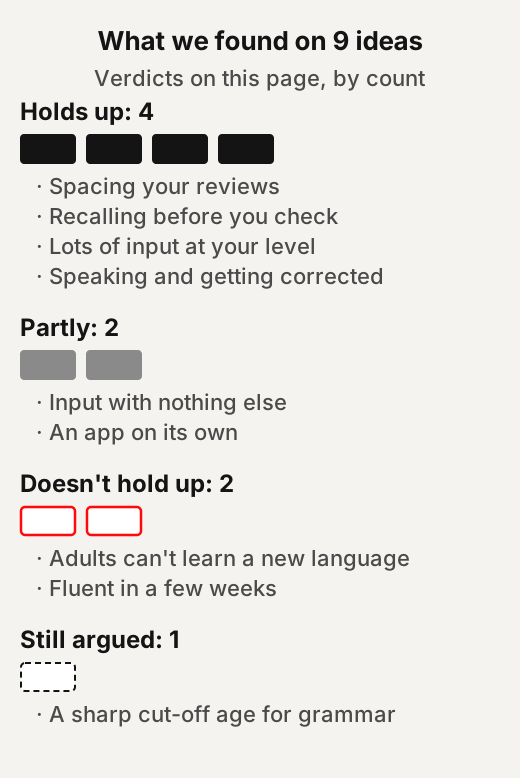
Of these five ideas, two partly hold up, two don’t, and one is still argued.
“Just listen and read, and the rest will come”
Partly Listening and reading are all you need; grammar study and speaking practice add nothing. Input builds reading and vocabulary, but taught grammar and correction add to it in many studies.
How sure: Moderate large reviews find that taught grammar helps, though their authors say the research is hard to generalise.
Stephen Krashen wrote that we acquire a language by understanding language that contains structure a little beyond our current level. He called understanding such input a “necessary (but not sufficient)” condition.
A 2000 meta-analysis of 49 studies found that focused teaching led to large gains, and that explicit teaching worked better than implicit teaching. Its authors added that the findings were hard to generalise, because the research had not been rigorously replicated.
A 2010 meta-analysis of 41 studies found larger effects for explicit than implicit teaching, for both simple and complex features of English grammar. A 2019 meta-analysis of 54 studies found a large effect for teaching overall, with only a minor difference between explicit and implicit teaching.
Our reading: keep listening and reading as the bulk of your time, and add short, focused grammar study and speaking with feedback.
For example, if one verb ending keeps tripping you up, read a one-page explanation, then listen for it in your next episode.
“An app is all you need”
Partly One language app, on its own, can teach you a language. Apps can take beginners a real distance, but the studies are few, often linked to an app’s maker, and mostly about beginners. Several of the studies below are of one app, Duolingo; naming it is not a recommendation.
How sure: Limited a meta-analysis rated the evidence low quality, and two key studies of one app were written or funded by its maker.
A 2022 meta-analysis of 23 results found a moderate-to-strong advantage for mobile language apps over traditional teaching. It also found a high risk of bias and low quality of evidence across the studies it included. In that meta-analysis, 43% of the apps tested were made or designed by the studies’ own authors. A 2021 review of 35 studies of Duolingo found that most of the research focused on the app’s design rather than on learning outcomes.
In a 2021 study, 225 US adults had finished the app’s beginner course in Spanish or French, using it as their only tool. They scored about as well in reading and listening as university students at the end of their fourth semester. Only reading and listening were tested, and four of its five authors worked for Duolingo.
In a 2026 study, 16 weeks on the app alone, in a first-semester French class, or both, gave beginners similar gains on nearly all measures. That study was funded by the company’s research programme, learners chose their own group, and the app-only group was much older on average.
Our reading: an app suits daily spaced review and early vocabulary; pair it with listening, reading and real conversation.
For example, use an app for ten minutes of review each day, and spend the rest of your time on audio, reading and talking.
“Adults can’t really learn a new language”
Doesn't hold up After childhood the window closes, and adults can’t really learn a new language. Adults learn languages all the time; the age debate is about how fast grammar learning slows, and how close to native-like adults get.
How sure: Moderate a 1978 study and a government language school’s own timelines agree. The age studies below are about how fast grammar is learned, not whether adults can learn.
In a 1978 study of English speakers learning Dutch in Holland, teenagers and adults made the fastest progress in the first few months. By the end of the first year, children aged 8 to 10 and teenagers aged 12 to 15 had the best control of Dutch.
For example, set your goal as ordering a meal, chatting with a neighbour or reading the news, rather than passing for a native speaker.
“There’s a sharp cut-off age for learning grammar”
Still argued The ability to learn a new language’s grammar drops sharply at a set age. Large studies find a decline from the late teens; whether the drop is sharp is still argued. Researchers call such a window a critical period.
How sure: Unsettled two teams read the same data differently; both find a decline with age, and they differ on how sharp it is and why.
A 2018 study of 669,498 native and non-native English speakers found grammar-learning ability preserved to about 17.4 years, then declining steadily. Its authors read this as support for a sharply defined critical period, ending much later than once thought. A 2021 follow-up added 466,607 people and again found a sharp decline starting at the tail end of adolescence.
A reanalysis of the 2018 data said the single sharp age of 17.4 rested on artificial results, and found a gradual decline fitted several groups better. It suggested the later breaks could be schooling effects rather than a limit of the mind.
These studies estimate how fast people learn the grammar of English as a new language, from an online grammar quiz. A slower rate means a longer road, not a closed door. The 2018 study itself notes that in the first months, adults do better than children, perhaps because they use conscious strategies and what they know of their first language.
In practice, a later start may mean a slower road to the fine points of grammar; it does not stop you learning to use a language.
“Fluent in a few weeks”
Doesn't hold up You can become fluent in a new language in a few weeks. Fluency takes hundreds of hours by official estimates; a few weeks is a first step toward simple conversation. The CEFR, a European scale used for many languages, has six levels from A1 to C2.
How sure: Moderate two official estimates agree on the scale, but they are guides for particular learners, not studies.
Cambridge English, which sets English exams, suggests about 90 to 100 guided learning hours (lessons and supervised study) for a learner of English to reach A1 from scratch. It suggests 500 to 600 hours to reach B2. It calls these figures a guideline only.
At B2, the CEFR describes interacting “with a degree of fluency and spontaneity” with native speakers. At A1, it describes interacting “in a simple way”, provided the other person talks slowly and clearly and is prepared to help.
Our arithmetic: 30 days at an hour a day is 30 hours, about a third of Cambridge’s estimate for A1 in English. Also, hours alone are not the same as hours with a teacher.
For example, a fair 30-day target is to introduce yourself and ask and answer simple questions about where you live and people you know.
4. How many hours a language takes
As its page read in October 2026, the US State Department’s language school expects its students to take 24 to 88 weeks of full-time study, depending on the language.
Its timelines show the time usually expected for a student to reach a score of 3 in speaking and listening on the Interagency Language Roundtable scale. That scale calls level 3 “General Professional Proficiency”. A typical week is 23 hours in class and 17 hours of self-study.
| Group | Examples from the page (October 2026) | Weeks | Class hours |
|---|---|---|---|
| I: languages close to English | Spanish and French (30 weeks); Dutch and Italian (24 weeks) | 24 to 30 | 552 to 690 |
| II | German, Indonesian, Swahili | About 36 | 828 |
| III: “hard languages” | Russian, Hindi, Turkish, and many more | About 44 | 1,012 |
| IV: “super-hard languages” | Arabic, Mandarin, Cantonese, Japanese, Korean | 88 | 2,200 |
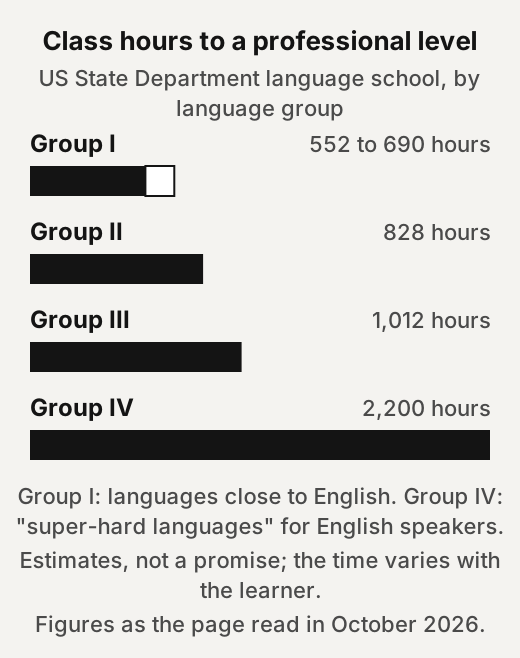
These are estimates for English speakers, not a promise. The page says the actual time varies with the learner’s natural ability, prior language-learning experience and time spent in the classroom.
If you see different numbers elsewhere, check the date. An earlier version of the page, archived in January 2023 under the heading “FSI’s Experience with Language Learning”, gave 600 to 750 class hours for the first group.
That version measured speaking and reading, not speaking and listening. FSI stands for the Foreign Service Institute, the name used on that older version.
Our arithmetic: 552 class hours, at 30 minutes a day, would take about three years. Hours with a teacher are not the same as hours alone, so treat this as a sense of scale.
5. A 30-day plan
This is our suggestion, not a tested programme. It uses only the habits above that hold up. It assumes about 30 to 60 minutes a day, and a first goal at the A1 level.
| Week | Focus | What to do |
|---|---|---|
| 1 | Goal and words | Pick a goal, such as introducing yourself. Learn common words and phrases on cards; say each one before you flip it. Listen to beginner audio daily. |
| 2 | More input | Add short listening and reading where you know nearly every word. Keep the daily card review, spread over the days. |
| 3 | Speak | Have short conversations with a tutor or language partner. Ask to be corrected, and add each correction to your cards. |
| 4 | Check | Use the CEFR self-assessment grid to see what you can do. Record yourself. Plan the next month in hours, not days. |
The CEFR’s self-assessment grid is meant to help learners profile their main language skills.
If it isn’t working
If the plan stalls, try one of these.
- You understand almost nothing you hear. The material is likely too hard. Go back to something written for learners.
- The cards pile up. Keep only the words you meet often. Even gaps between reviews are fine; they don’t need to grow.
- You keep putting off speaking. Start with one short message or a five-minute call, and ask for one correction.
Quick answers
How long does it take to learn a language?
It depends on the language and the level you want. As of October 2026, the US State Department's language school expects 24 to 88 weeks of full-time study to reach a professional level. For learners of English, Cambridge English suggests about 90 to 100 guided learning hours to reach A1, the first CEFR level.
What is the fastest way to learn a language?
Four habits have research behind them in language learning. Space your reviews, recall before you check, listen and read a lot at your level, and speak with someone who corrects you. None of them makes you fluent in a few weeks.
Can adults learn a language as well as children?
Adults learn languages all the time; in a 1978 study, teenagers and adults made the fastest progress in the first few months. Whether the ability to learn a new grammar drops sharply in the late teens is still argued.
Are language apps enough to become fluent?
The evidence is thin. A 2022 meta-analysis found an advantage for apps over traditional teaching, but found a high risk of bias and low quality of evidence across the studies. Key studies of one app looked only at beginners.
What is comprehensible input?
It is listening and reading that you mostly understand. The researcher Stephen Krashen wrote that we acquire a language by understanding language that contains structure a little beyond our current level.
Use this
Our suggestion, built only from the habits above that hold up, over your first 30 days.
Did I recall it, hear it and say it this week?
Quick quiz
Nothing is scored or saved. Recalling it once now is what makes it last.
1. In the experiments on spoken words, what worked better than repeating a word after hearing it?
Answer: Trying to say it before hearing it.Read it again ↑
2. What did a 2022 meta-analysis find about gaps between reviews that grow longer?
Answer: They do no better than even gaps.Read it again ↑
3. As of October 2026, how long does the State Department school expect its hardest group of languages to take?
Answer: 88 weeks.Read it again ↑
How we checked this · Last checked October 2026
- We read the abstracts of the studies and reviews through PubMed, OpenAlex and Crossref, and the full text where it was open, including the funding statement of the 2026 app study.
- We read Stephen Krashen's 1982 book in the author's free internet edition.
- The State Department page does not open for scripts, so we read it in a browser. Its figures differ from a January 2023 copy of the page, and both are shown.
- Joshua Hartshorne's 2022 reply on the critical period is a preprint; we found no journal version.
- Our wording on spacing and testing yourself matches our guide to learning faster.
Sources
- J. Dunlosky and colleagues, “Improving Students’ Learning With Effective Learning Techniques”, Psychological Science in the Public Interest 14(1), 2013.Scholarly
- S. K. Kim and S. Webb, “The Effects of Spaced Practice on Second Language Learning: A Meta-Analysis”, Language Learning 72(1), 2022.Scholarly
- S. H. K. Kang, T. H. Gollan and H. Pashler, “Don’t just repeat after me: Retrieval practice is better than imitation for foreign vocabulary learning”, Psychonomic Bulletin & Review 20(6), 2013.Scholarly
- T. Nakanishi, “A Meta-Analysis of Extensive Reading Research”, TESOL Quarterly 49(1), 2015.Scholarly
- S. Webb, T. Uchihara and A. Yanagisawa, “How effective is second language incidental vocabulary learning? A meta-analysis”, Language Teaching 56(2), 2023.Scholarly
- B. Laufer and G. C. Ravenhorst-Kalovski, “Lexical threshold revisited: Lexical text coverage, learners’ vocabulary size and reading comprehension”, Reading in a Foreign Language 22(1), 2010.Scholarly
- B. Kremmel, B. Indrarathne, J. Kormos and S. Suzuki, “Unknown Vocabulary Density and Reading Comprehension: Replicating Hu and Nation (2000)”, Language Learning 73(4), 2023.Scholarly
- R. Lyster and K. Saito, “Oral Feedback in Classroom SLA: A Meta-Analysis”, Studies in Second Language Acquisition 32(2), 2010.Scholarly
- S. Li, “The Effectiveness of Corrective Feedback in SLA: A Meta-Analysis”, Language Learning 60(2), 2010.Scholarly
- S. D. Krashen, Principles and Practice in Second Language Acquisition (1982), the author’s free internet edition.Primary
- J. M. Norris and L. Ortega, “Effectiveness of L2 Instruction: A Research Synthesis and Quantitative Meta-analysis”, Language Learning 50(3), 2000.Scholarly
- N. Spada and Y. Tomita, “Interactions Between Type of Instruction and Type of Language Feature: A Meta-Analysis”, Language Learning 60(2), 2010.Scholarly
- H. Kang, S. Sok and Z. Han, “Thirty-five years of ISLA on form-focused instruction: A meta-analysis”, Language Teaching Research 23(4), 2019 (online 2018).Scholarly
- M. Mihaylova, S. Gorin, T. P. Reber and N. Rothen, “A Meta-Analysis on Mobile-Assisted Language Learning Applications: Benefits and Risks”, Psychologica Belgica 62(1), 2022. Full text on PubMed Central.Scholarly
- M. Shortt and colleagues, “Gamification in mobile-assisted language learning: a systematic review of Duolingo literature from public release of 2012 to early 2020”, Computer Assisted Language Learning 36(3), 2023 (online 2021).Scholarly
- X. Jiang and colleagues, “Evaluating the reading and listening outcomes of beginning-level Duolingo courses”, Foreign Language Annals 54(4), 2021.Scholarly
- Y. Kim, C. Payant, S. Skalicky and Y. Namkung, “Comparing the effectiveness of Duolingo, Classroom instruction, and Classroom + Duolingo instruction conditions on beginner-level French language development”, Studies in Second Language Acquisition 48(3), 2026.Scholarly
- C. E. Snow and M. Hoefnagel-Höhle, “The Critical Period for Language Acquisition: Evidence from Second Language Learning”, Child Development 49(4), 1978.Scholarly
- J. K. Hartshorne, J. B. Tenenbaum and S. Pinker, “A critical period for second language acquisition: Evidence from 2/3 million English speakers”, Cognition 177, 2018. Author manuscript on PubMed Central.Scholarly
- T. Chen and J. K. Hartshorne, “More evidence from over 1.1 million subjects that the critical period for syntax closes in late adolescence”, Cognition 214, 2021.Scholarly
- F. W. P. van der Slik, J. J. Schepens, T. Bongaerts and R. W. N. M. van Hout, “Critical Period Claim Revisited: Reanalysis of Hartshorne, Tenenbaum, and Pinker (2018) Suggests Steady Decline and Learner-Type Differences”, Language Learning 72(1), 2022 (online 2021).Scholarly
- J. K. Hartshorne, “No evidence that age affects different bilingual learner groups differently: Rebuttal to van der Slik, Schepens, Bongaerts, and van Hout (2021)”, PsyArXiv preprint, 2022.Scholarly
- US Department of State, “Foreign Language Training”, National Foreign Affairs Training Center, and a January 2023 Internet Archive copy of the earlier page.Primary
- Interagency Language Roundtable, “ILR Skill Level Descriptions for Speaking”.Primary
- Cambridge English, “Guided learning hours”.Primary
- Council of Europe, CEFR “Global scale” and “The CEFR Levels”.Primary
- American Psychological Association, APA Dictionary of Psychology, “critical period”, “spacing effect” and “testing effect”.Scholarly
Plan for months, not a sprint
A new language comes from small, steady habits over many hours. So the smartest move is a routine you can keep for months. Set your goals as things you can do, such as ordering a meal.
Get more from a tutor or partner
- Agree on corrections first. Ask them to correct your mistakes, and say how: during the talk, or in a list at the end.
- Bring a few sentences you prepared. Our view: say them early in the session. You get corrected on what you actually want to say.
- Write each correction down at once. Then add it to your review cards, so it comes back on later days, not just once.
- Swap time with a partner. If they're learning your language, split the session. Each of you gets practice and corrections.
This week: record a one-minute introduction
Record yourself saying who you are and where you live. Keep it untouched. After a month, record it again and listen to both. You'll hear for yourself what, if anything, changed.
Turn a language you know into work
- If you speak a language well, offer conversation sessions to learners, with corrections written down for them.
- Make reading or listening material for beginners: short texts where nearly every word is common.
- Run a language café where learners speak in short sentences and each leaves with one correction.
- Build toward translation work: translate short texts, then have a fluent speaker check them.
Ideas to explore, not financial or business advice. No result is promised.
Keep going
- How to learn fasterThe wider research on spacing, recall and study habits.
- How to remember what you readA recall routine for texts, which you can try on reading in a new language.
- How to study for an examIf you're sitting a language exam, a plan counted back from the date.
- Toma meaningOne Spanish word, and how its meaning shifts with context.
- GlossaryPlain meanings for the spacing effect, retrieval practice and other terms.