

Start hereRereading, Robert and Elizabeth Bjork note, can give a sense of familiarity that we take for understanding. In four experiments with textbook chapters or a magazine article, reading twice rarely improved scores over reading once. So what does help?
To remember what you read, close the text after each part and recall what it said, then check what you missed. That habit has the strongest research behind it. Rereading and highlighting do less. Below: why reading slips away, what helps, and a short routine for after you read.
1. The short list
Only one habit clearly holds up for remembering a text: recalling it with the text closed.
| Habit | What you do | How it holds up |
|---|---|---|
| Recall with the text closed | Close it, recall the main points, then check | Holds up |
| Summarise in your own words | Write about what you read | Partly |
| Highlight | Mark the key lines yourself | Partly |
| Reread after a gap | Read it again days later | Partly |
| Reread straight away | Read the same text again at once | Doesn’t hold up |
| Take notes by hand | Write notes by hand, not on a laptop | Still argued |
| Read on paper | Use paper for texts you must understand | Partly, a small edge for paper |
| Use a speed-reading app | Read words flashed one at a time | Doesn’t hold up |
Each row is explained below, with how sure the evidence is.
2. Why we forget what we read
Memory fades fast at first, then more slowly, and a text you have just read can feel better known than it is.
Forgetting is steepest just after learning, then slows down. Hermann Ebbinghaus measured it on himself, learning lists of nonsense syllables. Our guide to learning faster covers that research in more detail.
Reading adds a second problem. Rereading, Robert and Elizabeth Bjork note, can give a sense of familiarity that we take for understanding. In one study, rereading raised students’ confidence that they would remember the material, while practice tests did more for their memory days later.
For example, a chapter you read last night can feel clear this morning, until you try to explain it without looking.
“You remember 10% of what you read”
Doesn't hold up People remember about 10% of what they read. No credible research has been found behind this figure or the chart it comes from.
How sure: Strong four papers, from 2007 to 2020, found no research behind the percentages.
The figure usually comes from a “learning pyramid” that ranks ways of learning by how much people keep. A 2018 history of these charts quotes versions that say students “retain 10% of what they read”. It found that versions have been around for more than 160 years and did not come from empirical research.
A 2007 review found no credible research to support the pyramid. It is loosely linked to Edgar Dale’s Cone of Experience of 1946, which showed a range of teaching methods, not a ranking. A 2020 review concluded that the statistics “do not come from Edgar Dale”.
The 2007 review also found that every method on the pyramid led to some retention, with none consistently better than the others. Our reading: how much you keep from a text depends on what you do with it, not on a fixed share for reading.
3. What to do after reading
These five habits run from the most strongly supported to the least.
Close the text and recall
Holds up Recalling what you read, with the text closed, helps you remember it better than reading it again. Recalling a text from memory, then checking, beats rereading it for a text you need days later. Researchers call this retrieval practice.
How sure: Strong several experiments with real texts agree; researchers still argue about very complex material.
In a 2006 study, students who reread prose passages did better on a test five minutes later. On tests two days or a week later, the students who had taken practice tests remembered substantially more.
In two 2009 experiments, college students tried a read-recite-review routine: read a text, recite what they remembered, then review it. It improved their recall of fact-based passages, straight away and a week later, compared with rereading or taking notes. On longer engineering texts, the routine matched note-taking on test questions and took less study time.
A 2011 study found that practising recall after reading science texts produced more learning than drawing concept maps, including on questions that needed inferences. Other researchers questioned its methods in a published comment, and the authors replied.
There is one open question. A 2015 article argued that the benefit shrinks, or even disappears, as the material gets more complex. Two researchers replied that recall practice still works for meaningful learning of complex materials.
For example, after each section of a report, look away and say its two or three main points out loud. Then glance back to see what you missed.
Summarise in your own words
Partly Writing a summary in your own words helps you understand and remember what you read. Writing about a text helped students understand it, but a major review rated summarising of low use.
How sure: Moderate a meta-analysis supports writing about texts, but a 2013 review rated summarising of low utility.
A 2011 meta-analysis of true and quasi-experiments found that writing about material read improves students’ comprehension of it. A 2013 review of ten study techniques gave summarizing a low utility rating.
Our reading: a summary written from memory doubles as recall practice, which has the stronger evidence.
For example, after a long article, write three sentences about it without looking, then check them against the text.
Highlight
Partly Highlighting helps you remember what you read. Highlighting your own text helped memory but not understanding, and helped college students but not school students.
How sure: Moderate a 2022 meta-analysis of 36 articles found a memory benefit; a 2013 review rated highlighting of low utility.
A 2022 meta-analysis of 36 published articles, from 1938 to 2019, looked at students who highlighted texts themselves. Their highlighting improved memory but not understanding. It helped college students but not school students. Text that an instructor had already highlighted helped both memory and understanding.
The 2013 review rated highlighting and rereading of low utility.
For example, in a textbook, start with what the author has already marked, such as terms in bold. If you highlight yourself, follow it with a quick recall.
Reread after a gap
Partly Reading a text again after a gap of days helps you remember it longer. A gap helped college students in two studies, but not seventh-graders in a classroom; spaced self-tests have stronger support.
How sure: Moderate two studies with college students and a classroom study disagree; spaced self-testing is backed by a 29-study meta-analysis.
In a 2005 study, 423 college students read a text once, twice in a row, or twice with a week between readings. Two days later, those who had reread after the gap did better than those who had read once. A 2024 study with 186 psychology students had some read the same text on three consecutive days, and others read it once. The repeat readers did better on a test a week later, though not on a test a day later.
A 2019 classroom study with 191 seventh-graders found no such benefit, not even on the later test. Students who reread after a week showed no forgetting between the two tests, but in the end did no better than those who reread straight away.
Spreading out reviews has firmer ground when each review is a self-test. Researchers call this the spacing effect. A 2021 meta-analysis found a strong benefit when self-tests were spaced out rather than massed together. Our guide to learning faster sets out how long to wait between reviews.
For example, read a chapter on Monday, then quiz yourself on it on Wednesday and again the next Monday.
Reread straight away
Doesn't hold up Reading a text again straight away helps you remember it later. Rereading at once can help on a test right after, but adds little or nothing days later.
How sure: Moderate one study found no gain two days later; another found rereading rarely helped; a major review rated it of low utility.
In four experiments with textbook chapters or a magazine article, reading twice rarely improved scores over reading once. The authors concluded that immediate rereading “may have little or no benefit”.
In the same 2005 study, reading a text twice in a row raised scores on an immediate test. Two days later, it was no better than reading once.
For example, when you finish a chapter and feel like reading it again, try recalling it first. Then reread only the parts you could not recall.
4. Notes, screens and speed
These three are about how you take in a text, rather than what you do afterwards.
Notes by hand or on a laptop
Still argued Notes taken by hand help you learn more than notes typed on a laptop. Handwriting may give a small edge, but the studies disagree.
How sure: Unsettled a direct replication and a newer meta-analysis disagree; the evidence leans to a small edge for handwriting.
In three studies published in 2014, students who took notes on laptops did worse on conceptual questions than students who wrote by hand. A 2021 direct replication again found that laptop users took more word-for-word notes. But its authors concluded that the results “do not support the idea that longhand note taking improves immediate learning via better encoding of information”. A 2024 meta-analysis of 24 studies of college students found that taking and reviewing notes by hand led to higher achievement.
These studies tested notes on lectures, not on reading. For notes on a text, the read-recite-review study above is the closer test. Our guide to learning faster sets out the note-taking disagreement in full.
For example, whichever you use, write the author’s point in your own words rather than copying it word for word.
Screen or paper
Partly You understand less when you read on a screen than on paper. Paper has a small edge, mostly for informational texts; for stories there was little or no difference.
How sure: Strong meta-analyses in 2018, 2019 and 2024 found a small effect in the same direction.
A 2018 meta-analysis of 54 studies from 2000 to 2017 found a small advantage for paper. It was larger when reading was timed, appeared with informational texts but not with stories, and grew over the years. A 2019 meta-analysis of 33 experiments found much the same. Readers on paper were also better at judging how well they had understood.
A 2024 meta-analysis of studies with tablets and other handheld devices found a small effect in favour of print. Our summary of The Shallows looks at screen reading in more depth.
For example, print a long report you need to understand, and keep the screen for news where the main point is enough.
Speed-reading apps
Doesn't hold up Apps that flash one word at a time let you read much faster with the same understanding. When readers could not glance back at earlier words, they understood less.
How sure: Moderate one experiment mimicked the app method, and a 2016 review finds a trade-off between speed and understanding.
A 2014 experiment mimicked apps that show one word at a time: each word was masked once the reader’s eyes moved past it. Readers who could not go back over words understood less. A 2016 review found it unlikely that readers can double or triple their speed and still understand the text as well. Skimming gets you through faster with moderate comprehension, if full understanding is not the goal.
For example, skim a news story for its main point, but read instructions or a contract word by word.
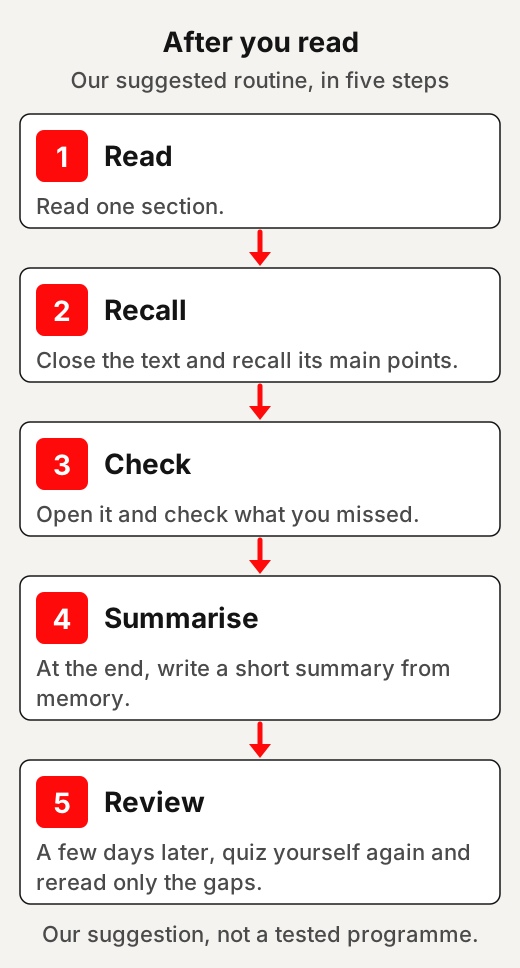
5. A routine for after you read
This is our suggestion, built from the habits above that hold up or partly hold up; it is not a tested programme. It follows the read-recite-review routine from the 2009 study, then adds self-tests spread over days.
If it isn’t working
If the routine stalls, try one of these.
- You recall almost nothing after a section. Try shorter sections, or read the section once more before you recall.
- There is too much to review. Keep only the points you need, and quiz yourself on those.
Quick answers
Why do I forget what I read?
Forgetting is steepest just after learning, then slows down. A text you have just read can also feel familiar, which is easy to take for understanding.
Is highlighting a waste of time?
Not entirely. A 2022 meta-analysis found that highlighting your own text improved memory but not understanding, and helped college students but not school students. A 2013 review rated highlighting of low utility.
Is it better to read on paper or on a screen?
Paper has a small edge, mostly for informational texts; for stories there was little or no difference. Meta-analyses in 2018, 2019 and 2024 found a small effect in the same direction.
Do we only remember 10% of what we read?
No credible research has been found behind that figure. A 2007 review found no credible research to support the "learning pyramid" it usually comes from.
Use this
Our suggestion, built only from the habits above that hold up or partly hold up.
Could I explain this without looking?
Quick quiz
Nothing is scored or saved. Recalling it once now is what makes it last.
1. In the 2009 read-recite-review experiments, what did students do after reading a text?
Answer: Recited what they remembered, then reviewed the text.Read it again ↑
2. What did a 2022 meta-analysis find about highlighting your own text?
Answer: It helped memory but not understanding.Read it again ↑
3. In a 2019 classroom study, did rereading after a week's gap help seventh-graders?
Answer: No benefit, not even on the later test.Read it again ↑
How we checked this · Last checked October 2026
- For the studies and reviews we read the abstracts through PubMed, ERIC, Crossref and OpenAlex, and read the 2011 Bjork chapter, the 2018 history of the learning pyramid and the 2024 rereading study in full.
- We could not open the full text of the 2013 review of ten study techniques, so the page does not say why it rated summarising and highlighting low.
- The abstract of the 2005 rereading study compares each rereading schedule with reading once, not with each other, so the page does the same.
- Our wording on recall, spacing, note-taking and speed reading matches our guide to learning faster, and on screens and paper our summary of The Shallows.
- The routine in section 5 is our suggestion. No study tested this exact routine.
Sources
- H. Ebbinghaus, Memory: A Contribution to Experimental Psychology (1885), translated by H. A. Ruger and C. E. Bussenius (1913), chapter 7.Primary
- E. L. Bjork and R. A. Bjork, “Making things hard on yourself, but in a good way”, in Psychology and the Real World, 2011.Scholarly
- H. L. Roediger and J. D. Karpicke, “Test-enhanced learning: taking memory tests improves long-term retention”, Psychological Science 17(3), 2006.Scholarly
- J. P. Lalley and R. H. Miller, “The Learning Pyramid: Does It Point Teachers in the Right Direction?”, Education 128(1), 2007.Scholarly
- K. Masters, “Edgar Dale’s Pyramid of Learning in medical education: a literature review”, Medical Teacher 35(11), 2013.Scholarly
- K. Letrud and S. Hernes, “Excavating the origins of the learning pyramid myths”, Cogent Education 5, 2018.Scholarly
- K. Masters, “Edgar Dale’s Pyramid of Learning in medical education: Further expansion of the myth”, Medical Education 54(1), 2020.Scholarly
- American Psychological Association, APA Dictionary of Psychology, “testing effect” and “spacing effect”.Scholarly
- M. A. McDaniel, D. C. Howard and G. O. Einstein, “The read-recite-review study strategy: effective and portable”, Psychological Science 20(4), 2009.Scholarly
- J. D. Karpicke and J. R. Blunt, “Retrieval practice produces more learning than elaborative studying with concept mapping”, Science 331, 2011.Scholarly
- J. J. Mintzes and colleagues, “Comment on ‘Retrieval practice produces more learning than elaborative studying with concept mapping’”, Science 334, 2011.Scholarly
- T. van Gog and J. Sweller, “Not New, but Nearly Forgotten: the Testing Effect Decreases or even Disappears as the Complexity of Learning Materials Increases”, Educational Psychology Review 27, 2015.Scholarly
- J. D. Karpicke and W. R. Aue, “The Testing Effect Is Alive and Well with Complex Materials”, Educational Psychology Review 27, 2015.Scholarly
- S. Graham and M. Hebert, “Writing to Read: A Meta-Analysis of the Impact of Writing and Writing Instruction on Reading”, Harvard Educational Review 81(4), 2011.Scholarly
- J. Dunlosky and colleagues, “Improving Students’ Learning With Effective Learning Techniques”, Psychological Science in the Public Interest 14(1), 2013.Scholarly
- H. R. Ponce, R. E. Mayer and E. E. Méndez, “Effects of Learner-Generated Highlighting and Instructor-Provided Highlighting on Learning from Text: A Meta-Analysis”, Educational Psychology Review 34, 2022.Scholarly
- A. A. Callender and M. A. McDaniel, “The limited benefits of rereading educational texts”, Contemporary Educational Psychology 34, 2009.Scholarly
- K. A. Rawson and W. Kintsch, “Rereading Effects Depend on Time of Test”, Journal of Educational Psychology 97(1), 2005.Scholarly
- P. Seban, K. Urban and R. Šikl, “Comparing the effectiveness of multiple text reading and rereading on knowledge retention and metacognitive accuracy”, Instructional Science 53(3), 2025 (online 2024).Scholarly
- C. E. Greving and T. Richter, “Distributed Learning in the Classroom: Effects of Rereading Schedules Depend on Time of Test”, Frontiers in Psychology 9, 2019.Scholarly
- A. Latimier, H. Peyre and F. Ramus, “A Meta-Analytic Review of the Benefit of Spacing out Retrieval Practice Episodes on Retention”, Educational Psychology Review 33, 2021.Scholarly
- P. A. Mueller and D. M. Oppenheimer, “The pen is mightier than the keyboard: advantages of longhand over laptop note taking”, Psychological Science 25(6), 2014.Scholarly
- H. L. Urry and colleagues, “Don’t Ditch the Laptop Just Yet: A Direct Replication of Mueller and Oppenheimer’s (2014) Study 1 Plus Mini Meta-Analyses Across Similar Studies”, Psychological Science 32(3), 2021.Scholarly
- A. E. Flanigan and colleagues, “Typed Versus Handwritten Lecture Notes and College Student Achievement: A Meta-Analysis”, Educational Psychology Review 36, 2024.Scholarly
- P. Delgado, C. Vargas, R. Ackerman and L. Salmerón, “Don’t throw away your printed books”, Educational Research Review, 2018.Scholarly
- V. Clinton, “Reading from paper compared to screens”, Journal of Research in Reading, 2019.Scholarly
- L. Salmerón and colleagues, “Reading comprehension on handheld devices versus on paper: A narrative review and meta-analysis of the medium effect and its moderators”, Journal of Educational Psychology 116, 2024.Scholarly
- E. R. Schotter, R. Tran and K. Rayner, “Don’t believe what you read (only once): comprehension is supported by regressions during reading”, Psychological Science 25(6), 2014.Scholarly
- K. Rayner and colleagues, “So Much to Read, So Little Time: How Do We Read, and Can Speed Reading Help?”, Psychological Science in the Public Interest 17(1), 2016.Scholarly
Spend the last minute on recall
A text you've just read can feel better known than it is. So the most useful last minute is closing it and saying what it said. Of the habits on this page, that one has the strongest support.
Fit recall into the reading you already do
- Keep a log of what you recalled. Our view: write your recall, then mark what you missed in another colour. Over time, the gaps become your notes.
- Turn highlights into questions. Beside each line you mark, write a question it answers. Days later, answer the questions before you look.
- Explain it to someone. Recall out loud counts. Telling a friend what a chapter said, without the book open, is the same habit with company.
- Put the points where you'll need them. For a report at work, write its main points from memory into the notes for your next meeting. Then check them.
This week: test your own habit
Read one article your usual way and one with recall after each part. A few days later, write what you remember of each. It's a test of one reader, not research, but it shows you whether recall helps you.
Turn careful reading into work
- Run a reading group where everyone recalls the chapter aloud before anyone opens the book.
- Give short workshops on reading for study, at libraries or workplaces: recall and check, rather than reread.
- Write recall questions, in your own words, for book clubs and classes reading a set book.
Ideas to explore, not financial or business advice. No result is promised.
Keep going
- How to learn fasterHow long to wait between reviews, and the wider research on study habits.
- How to study for an examThe same habits turned into a revision plan, counted back from the exam date.
- The Shallows, summarisedA closer look at reading on screens.
- GlossaryPlain meanings for retrieval practice, the spacing effect and other terms.