

Start hereIn a flashcard study, spacing beat massing for 90% of the participants. Yet after the first session, 72% believed massing had worked better. Why does the method that feels better lose?
Good exam revision comes down to three habits: test yourself with practice papers, spread each topic across several weeks, and plan backwards from the exam date. Below: what the research found on each, on sleep and nerves before an exam, and a week-by-week plan you can copy.
Our guide to learning faster covers the study methods in general. This page is about putting them to work for one exam.
1. The short list
Practice papers and spread-out revision have the most support; the rest help less or are still argued.
| Habit | What you do | How it holds up |
|---|---|---|
| Practice papers | Answer questions from memory, then mark them | Holds up |
| Spread revision out | Return to each topic over several weeks | Holds up; cramming only partly works |
| Plan backwards | Start from the exam date and work back | Partly, one paper |
| Mix topics | Switch between topics in one session | Partly |
| Late-night study before the exam | Trade sleep for extra hours | Doesn’t hold up |
| Writing about your worries | A few minutes of writing just before the exam | Still argued, leans against |
| Seeing nerves as useful | Reading a racing heart as readiness | Partly, small effect |
| Changing unsure answers | Rechecking answers you doubted | Changing helps more often than it hurts |
The sections below give the evidence for each row, and how sure it is.
2. Start with practice papers
Answering questions from memory is the core of good revision, and past papers are the closest copy of the exam.
Practice papers beat rereading
Holds up Taking practice tests helps you learn more than reading your notes again. Practice tests beat rereading in a large meta-analysis, and a classroom review agrees. Researchers call this retrieval practice.
How sure: Strong a 2017 meta-analysis and a 2021 review of 222 classroom studies both found a benefit.
A 2017 meta-analysis found practice tests more beneficial for learning than restudying and every other comparison it looked at. A 2021 review of 222 classroom studies, covering 48,478 students, found that quizzing raised achievement to a medium extent.
In a 2006 study, students who reread prose passages did better on a test five minutes later. On tests two days or a week later, the students who had taken practice tests remembered substantially more. That is the trap of rereading: it feels better on the day and holds up less well by the exam.
The NHS’s exam tips suggest looking at past exam papers to get familiar with the layout and type of questions. They also suggest practising papers in the set time limit.
For example, for a biology exam, answer last year’s questions on cells with your notes closed, then mark them against the answer scheme.
Keep testing what you think you know
Taking a card out of the pile because you think you know it can cost you. In four experiments, letting students drop flashcards they thought they knew had small but consistently negative effects on learning.
In a 2016 lab study, people who had learned by restudying remembered less when put under stress. People who had learned by taking practice tests did not show that drop. Our reading: it was one lab study, but it suggests that practising recall may also help memory hold up under exam stress.
For example, keep the card for “the capital of Australia” in the pile even after you get it right, and just see it less often.
Explain each mistake
When you mark a paper, explaining why the right answer is right may help more than ticking it off, though the evidence is mixed. Researchers call this self-explanation. A 2018 meta-analysis of 64 research reports found self-explanation prompts “a potentially powerful intervention” across a range of teaching conditions. Our learning guide rates it as partly holding up, for two reasons. It has been tested less in real classrooms. And a 2023 maths meta-analysis found that adding self-explanation prompts to worked examples made them less effective.
For example, next to each wrong answer, write one line on why the right answer works and where your reasoning went off.
3. Build the timetable backwards
Start from the exam date, give each topic several visits, and leave more time than you think you need.
Plan backwards from the exam date
Partly Planning from the deadline back to today works better than planning forwards. One paper supports it, mainly for complex goals.
How sure: Limited one 2017 paper of five studies, with a correction published in 2018.
In 2017, three researchers compared planning the steps in time order with planning them in reverse, starting from the goal. Over five studies, groups of students planned for schoolwork, tests, exams or job interviews. Compared with forward planning, backward planning led to more motivation, higher expectations of success and less time pressure. It also led to better goal-related performance.
For relatively simple goals there was no difference, and the paper was corrected in 2018. Our guide from big goal to today looks at this paper and at planning in more depth.
For example, if your exam is on 20 June, write the date at the bottom of a page, then fill in the weeks above it, last week first.
Leave more time than you think you need
People tend to underestimate how long their own tasks will take, so a timetable needs slack. Psychologists call this the planning fallacy. In a 1994 paper, people’s predictions of how long their tasks would take were too optimistic, for academic and nonacademic tasks alike. In one of its studies, the optimistic bias disappeared when people were told to connect relevant past experiences with their predictions.
For example, before you fill in the timetable, look at how long your last round of revision took, not how long you planned.
Cramming vs spreading out
Partly Cramming the night before is enough for an exam. Cramming can carry you through a test soon after, but in one study spacing beat cramming even on the test, and crammed material fades fast.
How sure: Moderate controlled experiments agree spacing wins for later tests; for a test within a week the gap can be small.
Researchers call the benefit of spreading study out the spacing effect. In a 2006 experiment with college students, doing ten maths problems in one session or across two sessions a week apart made no difference for students tested one week later. For students tested four weeks later, the benefit of spreading them out was extremely large.
In a flashcard study, spacing was also more effective than cramming, meaning massing study on the last day before the test. Spacing beat massing for 90% of the participants, yet after the first session 72% believed massing had worked better. So massed study can feel more effective than it is. Robert and Elizabeth Bjork write that massing practice, for example cramming for exams, supports short-term performance, while spacing supports long-term retention.
In a 2008 study of more than 1,350 people, the best gap was about 20 to 40% of the time until a test a week away. For a test a year away, it was about 5 to 10%. Our reading: for an exam a few weeks off, the gaps between visits to the same topic are days long, not minutes or hours.
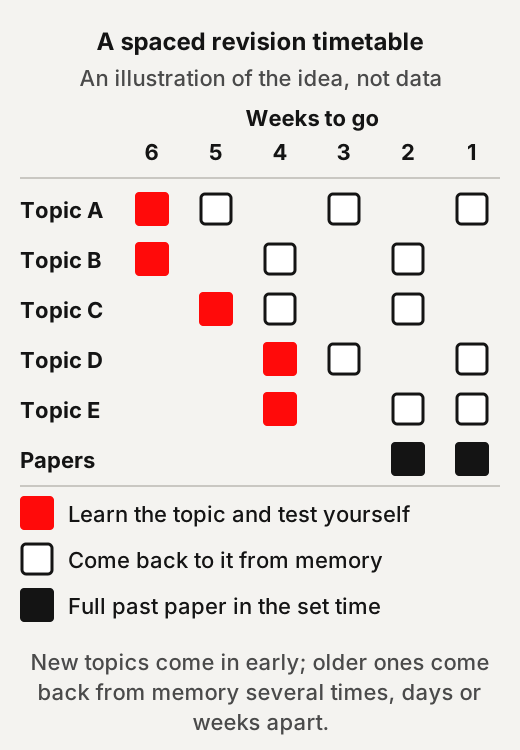
For example, learn the French Revolution in week 6, then come back to it in weeks 5, 3 and 1, not on six evenings in a row.
Mix topics in each session
Partly Switching between topics in one session helps with some material, not all. Mixing problem types helped in maths classrooms, but results depend on the material. Researchers call this interleaving.
How sure: Moderate a large randomised controlled trial in classrooms supports it, but a 59-study review found the benefit varies with the material.
In a randomised trial in 54 seventh-grade maths classes, the classes given interleaved assignments scored 61% against 38% on an unannounced test a month after a review. The authors add that important caveats remain. The 59-study review found the benefit small for maths tasks. Our learning guide covers the limits, including word lists, where practising one kind at a time did better.
For example, a maths session can mix questions on fractions, angles and graphs, so each one makes you decide which method fits, as an exam does.
4. Sleep before an exam
In the studies we found, sleep across the weeks of revision, not only the last night, went with better results. This section describes research only. It is not advice about sleep.
Staying up late to study
Doesn't hold up Trading sleep for extra study before an exam pays off. In a diary study, students who gave up sleep to study more than usual struggled more the next day.
How sure: Moderate a diary study of 535 students and a lab study point the same way; neither tested exam cramming directly.
A study followed 535 high-school students, who kept daily diaries for 14 days in three school years. It looked at how nightly changes in study and sleep time were linked with problems the next day. When students gave up sleep to study more than usual, they had more trouble understanding class material the next day. They were also more likely to struggle on a test or assignment. In a 2007 study, people kept awake for a night remembered less of what they learned the next day.
For example, picture two students revising for the same Friday test. One keeps a usual bedtime all week; the other stays up past midnight on Thursday to read more notes. The diary study looked at nights like the second student’s.
The single night before may matter less than the weeks before it. A study gave activity trackers to 100 students in a college chemistry class; 88 completed it. It found no relation between sleep on the single night before a test and the score. Sleep duration and quality over the week and the month before a test went with better grades. These studies show links, not proof of cause.
Our Why We Sleep summary looks at sleep and memory in more depth.
5. Exam nerves
Many people find exams hard to deal with; research has tested a few short exercises, with mixed results. This section describes research only. It is not medical advice.
Test anxiety goes with lower scores
Holds up People with more test anxiety tend to score lower. A review of 238 studies found a link between test anxiety and lower results, small to moderate in size. Psychologists call the tension and worry around tests test anxiety.
How sure: Strong a review of 238 studies found the link, though it shows a link, not a cause.
A 2018 review of 238 studies found test anxiety linked with lower results on standardised tests, university entrance exams and grade point average. It described the size of the links as in the small to moderate range. For example, a student who answers practice questions easily at home may feel tense in the exam hall and do worse than in practice. That is the kind of experience psychologists call test anxiety.
A 2019 meta-analysis of 44 randomised trials with 2,209 test-anxious university students found that programmes for test anxiety did better than control groups at reducing it and improving results. In plain terms, anxiety fell by a fairly large amount and results rose by a small-to-medium amount. Behaviour therapy had the most support, but the authors found signs of publication bias and said confidence in the results should be moderated.
Writing about your worries
Still argued Writing about your worries just before an exam raises your score. Some studies found a boost, but two large attempts to repeat one, a classroom study across four real exams and a 2026 meta-analysis found little or none. Researchers call this expressive writing.
How sure: Unsettled , leaning against — a 2026 meta-analysis, two pre-registered repeats and a 2021 classroom study found little or no benefit; some studies did.
In two lab and two classroom experiments published in 2011, a brief writing task just before an important test improved scores, especially for students who were usually anxious about tests. Another 2011 study found higher scores after writing, but only for students taking the MCAT or LSAT.
A 2021 study tried it across four real exams in a college psychology class and found it neither reduced test anxiety nor improved exam performance. Its authors said they could not find a clear difference between earlier studies that would explain the conflicting results. The same paper reports that a large replication project tried twice to repeat one of the 2011 experiments and found no benefit on test scores. A 2026 meta-analysis pooled 21 studies with 1,457 participants of a single session of writing about worries just before a test, and found only a negligible effect on anxiety. Its effect on test scores was very small, and no longer significant once one extreme result was removed. Our reading: so far the evidence leans against a reliable boost.
For example, someone who wants to try it might spend a few minutes before a mock exam writing down what they are worried about, and see whether it helps them.
Seeing nerves as a sign you’re ready
Partly Learning that nerves can help you perform improves your results. Reframing nerves as useful helped a little on average, and less on written tasks.
How sure: Limited a 2024 meta-analysis of 44 results found a small effect that shrank after allowing for missing studies; its authors say more evidence is needed.
In a 2010 study, people told that arousal improves performance scored higher on the maths part of a practice GRE and, later, the real GRE. A 2024 meta-analysis of 44 results found a small improvement in performance overall. The effect tended to be smaller on written thinking tasks than on tasks performed in public. After allowing for studies that may be missing, it was smaller again but still significant. The authors add that more evidence is necessary to confirm a true effect.
For example, a racing heart before a test can be read as your body getting ready to work, rather than as a sign that things will go wrong.
When to get help
If worry about exams stays with you most of the time, talk to someone. The NHS’s exam tips say that if you are feeling stressed, it is important to talk to someone you trust, such as a family member, teacher or friend. Where worry is there most of the time and affects everyday life, talk to a doctor or a counsellor. The NHS has a page on generalised anxiety disorder (GAD) in adults. It says it is more likely to be GAD if you feel anxious most of the time and it affects your everyday life.
6. The day before and the day of
Test yourself lightly, prepare what you need, and read the paper before you start.
The NHS’s exam tips suggest giving yourself plenty of time to get to the exam hall and taking everything you need, such as pens and a calculator. They also suggest taking a few minutes to read the instructions and questions first.
Our suggestion for the day before: a short round of your question cards, not a new topic. The sections above explain why.
Changing answers you doubted
Doesn't hold up On a multiple-choice test, sticking with your first answer is the safer bet. Changing answers more often helps than hurts.
How sure: Moderate a 2005 summary of the research and a 2015 study of real college exams point the same way.
A 2005 paper summed up the research on changing answers. In its words, “Most answer changes are from incorrect to correct, and people who change their answers usually improve their test scores.” It suggested why the belief survives: a wrong change leaves a stronger “if only” memory than a wrong decision to stay.
A study of real college exams, published in 2015, found that both changing and sticking produced more right than wrong outcomes. Students’ confidence in each answer predicted which was the better choice. Our Think Again summary covers this research too.
For example, mark the questions you were unsure about as you go, then go back to those first if you have time at the end.
7. A week-by-week revision plan
This is our suggestion, not a tested programme. It uses only the habits above that hold up or partly hold up. It assumes about six weeks; with less time, keep the order and shorten each stage.
| When | Focus | What to do |
|---|---|---|
| Six weeks out | Plan | List every topic, collect past papers, and fill in a timetable from the exam date backwards. Leave spare days. |
| Weeks 6 to 4 | Learn and test | Learn one or two new topics a week. After each, close your notes, write what you remember, then check. Turn gaps into question cards. |
| Weeks 4 to 2 | Space and mix | Go back to each earlier topic every few days. Mix topics and question types in one session. Do past-paper questions topic by topic. |
| Last two weeks | Rehearse | Sit full past papers in the set time. Mark them, explain each mistake, and revisit the weak topics. |
| Day before | Light review | A short round of question cards. Pack what you need. |
| Exam day | Read, then answer | Read the instructions and questions first. Go back to the answers you were unsure of. |
If it isn’t working
If the plan stalls, adjust it rather than starting over.
- You are behind. Cut the number of topics you revisit, not the practice papers.
- You get most practice questions wrong. Go back to your notes on that topic, then test yourself again a day later.
- Worry is taking over. See “When to get help” above.
Quick answers
What is the best way to revise for an exam?
Answer practice questions from memory instead of rereading, and spread each topic over several weeks. A 2017 meta-analysis found practice tests more beneficial for learning than restudying and every other comparison it looked at.
Does cramming work?
It can carry you through a test soon after. In one experiment, spreading maths practice over two sessions made no difference for students tested a week later, but a large difference for students tested four weeks later. In a flashcard study, spacing was also more effective than cramming.
Is it better to sleep or study the night before an exam?
In a diary study, students who gave up sleep to study more than usual struggled more the next day. One study found sleep over the week and month before a test went with better grades, more than the single night before. This is research, not advice about sleep.
Should you change your answer on a multiple-choice test?
Changing answers more often helps than hurts. A study of real college exams found that students' confidence in each answer predicted whether changing or sticking was the better choice.
Does writing about exam worries help?
The evidence is mixed and leans against it. Studies published in 2011 found a boost, but two large attempts to repeat one of them found no benefit on scores, and a 2021 study across four real exams found no effect on anxiety or scores. A 2026 meta-analysis of 21 studies found only a negligible effect on anxiety and a very small, uncertain effect on scores.
Use this
Our suggestion, built from the habits above that hold up or partly hold up, counted back from the exam date.
Could I answer this from memory, in the exam's own format, a week from now?
Quick quiz
Nothing is scored or saved. Recalling it once now is what makes it last.
1. In the flashcard study, how did spacing compare with cramming on the test?
Answer: Spacing was more effective.Read it again ↑
2. What did a 2021 study of four real exams find about writing about worries just before each exam?
Answer: It neither reduced test anxiety nor improved performance.Read it again ↑
3. On a multiple-choice test, what does the research say about changing answers?
Answer: Changing answers more often helps than hurts.Read it again ↑
How we checked this · Last checked October 2026
- We read the abstracts of the studies and reviews through PubMed, ERIC and OpenAlex, and the full text where it was open, including the 2021 expressive-writing study and the 2024 reappraisal meta-analysis.
- The NHS exam tips and the APA Dictionary of Psychology entries were read on their own pages.
- Findings shared with our learning guide, From Big Goal to Today, Think Again and Why We Sleep pages use the same wording and sources as those pages.
- The 2017 backward-planning paper has a 2018 correction we could not open. The 2011 expressive-writing paper has a 2014 erratum and a published comment, which we did not open.
- The two failed repeats of a 2011 expressive-writing experiment are as reported in the 2021 classroom study; we read the replication project's abstract, not its supplement on that experiment.
- The week-by-week plan is our suggestion, built from the evidence on this page. It has not been tested as a programme.
Sources
- O. O. Adesope, D. A. Trevisan and N. Sundararajan, “Rethinking the Use of Tests: A Meta-Analysis of Practice Testing”, Review of Educational Research 87(3), 2017.Scholarly
- C. Yang and colleagues, “Testing (quizzing) boosts classroom learning: A systematic and meta-analytic review”, Psychological Bulletin 147(4), 2021.Scholarly
- H. L. Roediger and J. D. Karpicke, “Test-enhanced learning: taking memory tests improves long-term retention”, Psychological Science 17(3), 2006.Scholarly
- NHS, “Tips on preparing for exams” and “Overview: generalised anxiety disorder in adults”.Popular
- N. Kornell and R. A. Bjork, “Optimising self-regulated study: the benefits - and costs - of dropping flashcards”, Memory 16(2), 2008.Scholarly
- A. M. Smith, V. A. Floerke and A. K. Thomas, “Retrieval practice protects memory against acute stress”, Science 354, 2016.Scholarly
- C. A. Barbieri and colleagues, “A Meta-Analysis of the Worked Examples Effect on Mathematics Performance”, Educational Psychology Review, 2023.Scholarly
- K. Bisra and colleagues, “Inducing Self-Explanation: a Meta-Analysis”, Educational Psychology Review 30, 2018.Scholarly
- J. Park, F.-C. Lu and W. M. Hedgcock, “Relative Effects of Forward and Backward Planning on Goal Pursuit”, Psychological Science 28(11), 2017, and the Association for Psychological Science’s news summary.Scholarly
- American Psychological Association, APA Dictionary of Psychology, “planning fallacy” and “test anxiety”.Scholarly
- R. Buehler, D. Griffin and M. Ross, “Exploring the ‘planning fallacy’: Why people underestimate their task completion times”, Journal of Personality and Social Psychology 67(3), 1994.Scholarly
- D. Rohrer and K. Taylor, “The effects of overlearning and distributed practise on the retention of mathematics knowledge”, Applied Cognitive Psychology 20(9), 2006.Scholarly
- N. Kornell, “Optimising learning using flashcards: Spacing is more effective than cramming”, Applied Cognitive Psychology 23(9), 2009.Scholarly
- E. L. Bjork and R. A. Bjork, “Making things hard on yourself, but in a good way”, in Psychology and the Real World, 2011.Scholarly
- M. Brunmair and T. Richter, “Similarity matters: A meta-analysis of interleaved learning and its moderators”, Psychological Bulletin 145(11), 2019.Scholarly
- N. J. Cepeda and colleagues, “Spacing effects in learning: a temporal ridgeline of optimal retention”, Psychological Science 19(11), 2008.Scholarly
- D. Rohrer and colleagues, “A randomized controlled trial of interleaved mathematics practice”, Journal of Educational Psychology 112, 2020.Scholarly
- C. Gillen-O’Neel, V. W. Huynh and A. J. Fuligni, “To study or to sleep? The academic costs of extra studying at the expense of sleep”, Child Development 84(1), 2013.Scholarly
- S.-S. Yoo and colleagues, “A deficit in the ability to form new human memories without sleep”, Nature Neuroscience 10, 2007.Scholarly
- K. Okano and colleagues, “Sleep quality, duration, and consistency are associated with better academic performance in college students”, npj Science of Learning 4, 2019.Scholarly
- N. von der Embse and colleagues, “Test anxiety effects, predictors, and correlates: A 30-year meta-analytic review”, Journal of Affective Disorders 227, 2018.Scholarly
- C. D. Huntley and colleagues, “The efficacy of interventions for test-anxious university students: A meta-analysis of randomized controlled trials”, Journal of Anxiety Disorders 63, 2019.Scholarly
- G. Ramirez and S. L. Beilock, “Writing about testing worries boosts exam performance in the classroom”, Science 331, 2011.Scholarly
- J. Frattaroli, M. Thomas and S. Lyubomirsky, “Opening up in the classroom: Effects of expressive writing on graduate school entrance exam performance”, Emotion 11(3), 2011.Scholarly
- S. J. Myers, S. D. Davis and J. C. K. Chan, “Does expressive writing or an instructional intervention reduce the impacts of test anxiety in a college classroom?”, Cognitive Research: Principles and Implications 6, 2021.Scholarly
- P. O’Meara and B. J. Lovett, “Single-session expressive writing interventions for test anxiety: a meta-analysis”, Anxiety, Stress & Coping 39(1), 2026.Scholarly
- C. F. Camerer and colleagues, “Evaluating the replicability of social science experiments in Nature and Science between 2010 and 2015”, Nature Human Behaviour 2, 2018.Scholarly
- J. P. Jamieson and colleagues, “Turning the knots in your stomach into bows: Reappraising arousal improves performance on the GRE”, Journal of Experimental Social Psychology 46(1), 2010.Scholarly
- M. Bosshard and P. Gomez, “Effectiveness of stress arousal reappraisal and stress-is-enhancing mindset interventions on task performance outcomes: a meta-analysis of randomized controlled trials”, Scientific Reports 14, 2024.Scholarly
- J. Kruger, D. Wirtz and D. T. Miller, “Counterfactual thinking and the first instinct fallacy”, Journal of Personality and Social Psychology 88, 2005.Scholarly
- J. J. Couchman and colleagues, “The instinct fallacy: the metacognition of answering and revising during college exams”, Metacognition and Learning 11 (published online 2015).Scholarly
Judge a session by what you could answer
Rereading feels better on the day and holds up less well by the exam. So end each session by asking what you could answer with your notes closed. That one question sorts most of the study habits on this page.
Get more from every practice paper
- Keep a mistakes page. Our view: for each wrong answer, note the topic and the one-line reason. Test those topics first next time.
- Let the page steer your timetable. A topic that keeps appearing on your mistakes page needs more visits. One that never appears still gets a visit, just less often.
- Write questions when papers run out. Turn your notes into questions in the exam's own format, then answer them from memory a few days later.
- Quiz each other, don't reread together. If you revise with friends, take turns asking questions with notes closed. Mark answers against the scheme.
This week: time one topic for real
Revise one topic as you planned, and note how long it actually took. Use that real time to fill in the rest of your timetable. In one study here, the optimistic bias disappeared when people were told to link past experience to their predictions.
Turn revision skills into work
- Tutor a subject you know well, building sessions around practice questions and spaced returns to each topic.
- Run a weekly revision group where members quiz each other on earlier topics, not just the newest one.
- Write practice questions with model answers for a subject you teach or know well, in your own words.
Ideas to explore, not financial or business advice. No result is promised.
Keep going
- Pre-mortem decision helperBefore you start, imagine your revision plan has failed and list the likely reasons.
- From big goal to todayMore on planning backwards from a deadline.
- How to remember what you readA short recall routine for textbooks and set reading.
- How to learn fasterThe study methods behind this plan, and their limits.
- GlossaryPlain meanings for interleaving, self-explanation and the planning fallacy.