

Start hereIn a 1987 experiment, people asked not to think of a white bear could not stop. Afterwards they thought about it more than people told to think about it from the start. So what does help when a thought won't leave you alone?
Overthinking is an everyday word. Psychologists use more exact words, and two of them come up again and again: worry and rumination. Below: what each one is, and how to tell useful thinking from the loop. Then what the research says about the usual tips, what the Stoics offered, and when to talk to a professional.
1. What overthinking is
Overthinking is an everyday word; psychologists study it under names such as repetitive thought, worry and rumination. A 2013 review calls rumination and worry key parts of conditions such as depression and anxiety.
A 2008 review groups them under the term repetitive thought, which it describes, quoting earlier work, as thinking “attentively, repetitively or frequently about one’s self and one’s world”. The review found that repetitive thought can have helpful or unhelpful results. The unhelpful ones include depression and anxiety; the helpful ones include recovering from upsetting events and planning ahead.
Our reading: thinking a lot is not the problem in itself. The question is what the thinking does for you.
Worry
Worry looks ahead, at what might go wrong. The APA Dictionary of Psychology defines worry as “a state of mental distress or agitation due to concern about an impending or anticipated event, threat, or danger”.
In a 1983 paper, Thomas Borkovec and colleagues called worry “a chain of thoughts and images, negatively affect-laden and relatively uncontrollable”, as the 2008 review quotes it. They also called it an attempt at mental problem-solving on an issue whose outcome is uncertain and could turn out badly. The review gives “What if they have an accident?” as a typical worry.
For example, lying awake running through everything that could go wrong at tomorrow’s meeting is worry.
Rumination
Rumination dwells on distress that is already here, its circumstances and what it might mean. In a definition the 2008 review quotes, Susan Nolen-Hoeksema and colleagues described rumination as “passively and repetitively focusing on one’s symptoms of distress and the circumstances surrounding these symptoms”. The review quotes a questionnaire item, “Why do I always react this way?”, as an example.
For example, replaying an argument for an hour and asking yourself why you always say the wrong thing is rumination.
Our reading: a rough way to tell them apart is the question each one asks. Worry asks what if?; rumination asks why?
2. Worry or problem-solving? How to tell them apart
Worry often includes problem-solving; one diary study suggests it may loop when that never settles on a solution.
In a 2006 diary study, 39 university students rated their everyday worry episodes for seven days. A large share of what they reported was attempts at problem-solving, and these sometimes ended in a solution they were satisfied with. Students who felt their worry was more uncontrollable reported choosing a solution less often.
Worry does not seem to come from being bad at solving problems. In a 1994 study, how much people worried was unrelated to their ability to solve social problems, but it was linked to low confidence in solving them. A small 1998 study found that knowledge of problem-solving skills did not differ with the level of generalised anxiety symptoms.
What does differ is how concrete the thinking is. The 2008 review reports that people’s descriptions of problems they worry about were rated, blind, as more abstract and less concrete than problems they did not worry about.
Our reading: three questions sort a worry from a problem. Is there something I can do about it? What is the very next step? When will I do it? If you can answer all three, you are problem-solving. Write the step down and stop. If you can’t answer the first, it is worry, and the tools below are for that.
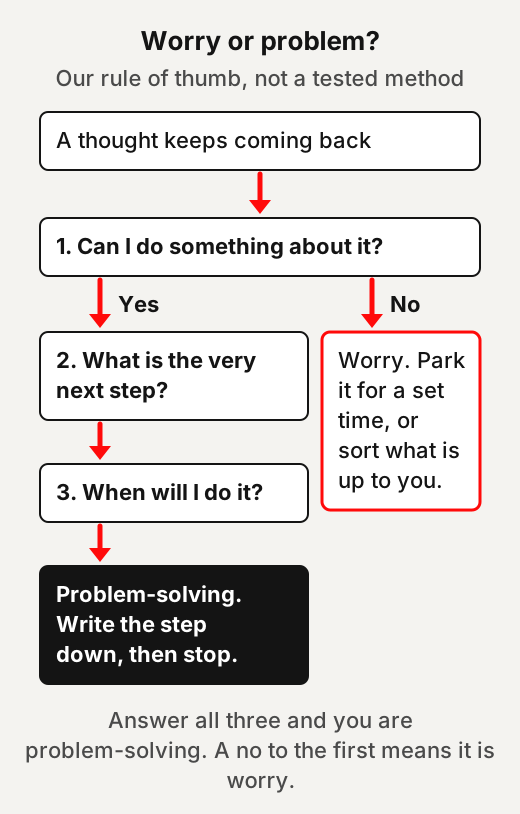
For example, What if I fail the driving test? turns into book two more lessons on roundabouts this week. The fear may not vanish, but now it has a job.
3. The common tips, checked
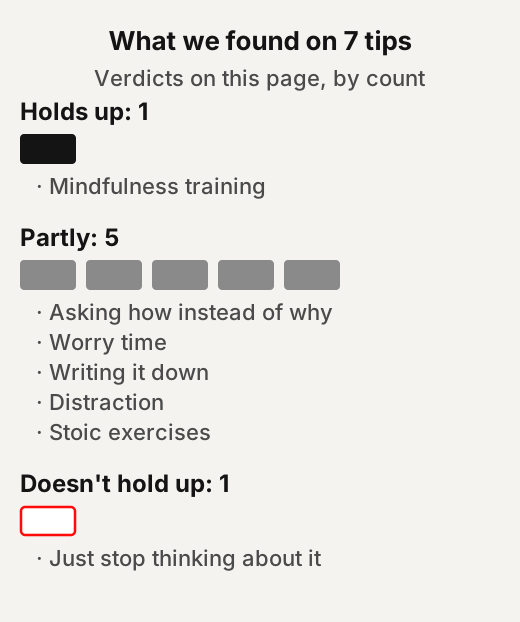
Of the six tips below, one holds up, four partly hold up and one doesn’t. The Stoic tool follows in section 4; the tally counts it too.
Ask how, not why
Partly Thinking about how to act on a problem helps more than asking why it happened. Focusing on how helped problem-solving in small studies of people with low mood.
How sure: Limited a few small studies, mostly from one research team, in people with low mood.
In a 2002 study, depressed patients solved social problems better when prompted with questions about how they would decide what to do. In people who had recovered from depression, questions about why they had a problem made problem-solving worse than how-questions did.
In a 2009 trial with 60 people with low mood, training them to think more concretely helped. It reduced depressive symptoms more than a fake version of the training or a waiting list. In a 2012 trial with 121 people with major depression in primary care, adding concreteness training to usual care improved depression more than usual care alone. It did no better than relaxation training on symptoms, but reduced rumination more.
Our reading: why is not banned. It helps when it leads somewhere. For example, swap Why did the presentation go so badly? for What will I change in the first two minutes next time?
Worry time
Partly Saving your worries for a set time each day cuts how much you worry. Worry time helped in some small trials, but an online version did not.
How sure: Limited small trials disagree, and the largest test, run online, found no benefit.
The idea is to note a worry when it comes up, then think it through later at a fixed time and place. The earliest study of it we found is a 1983 paper by Thomas Borkovec and colleagues, “Stimulus control applications to the treatment of worry”. Researchers now call it worry postponement.
In a 2013 trial with 53 people who worried a lot, some kept a daily 30-minute worry period in one time and place. It reduced worry, anxiety and insomnia more than instructions simply not to avoid worry. It did not do better on measures of depression.
In a 2024 trial, two sessions of worry postponement, aimed at the belief that worry is uncontrollable, reduced worry in people with generalised anxiety disorder, compared with a waiting list. Its authors note that earlier research in people with that diagnosis had not supported the simpler version. The effect in people with hypochondriasis seemed limited, possibly because that group was small.
An online version tested in 2016 did not reduce worry compared with simply recording worries. Of 996 people who signed up, 361 finished, and participants reported that postponing worry was hard.
In a 2025 trial with 186 people over 14 days, some added an if-then plan for when and how to worry. That cut daily worry time by about 15 minutes, compared with postponement alone. None of the approaches significantly improved sleep compared with the control groups.
For example, make the plan specific: If a worry comes up before six, I’ll jot it down and look at it at six, at the kitchen table.
Write it down
Partly Writing your worries down helps. Writing can help, but the average effect is very small and depends on what you write.
How sure: Moderate many randomised studies, but the average benefit is very small and varies with the kind of writing.
In a 2020 study, 29 people with generalised anxiety disorder recorded their worries and then tracked the outcomes; 91.4% of the predictions did not come true. A 2026 randomised trial with 117 people with the same diagnosis found that 89.14% of feared outcomes did not come true. Tracking outcomes reduced worry more than simply recording thoughts. Both studies are of a clinical group over a few weeks, using the participants’ own records, so they do not give a figure for everyone. Our Letters from a Stoic summary links these studies to Seneca.
In a 2018 sleep-lab study of 57 healthy young adults, some spent five minutes writing a to-do list at bedtime. They fell asleep faster than people who wrote about tasks they had finished. The more specific the to-do list, the faster they fell asleep.
For writing about worries just before a test, a 2026 meta-analysis of 21 studies found only a negligible effect on anxiety. Its effect on test scores was very small, and no longer significant once one extreme result was removed. Our exam revision guide looks at writing before a test in more detail.
Our reading: writing seems to help most when it turns a worry into something specific, such as a next step or a prediction you can check later. For example, before bed, write tomorrow’s tasks as actions (email Sam about the invoice), not as sort out work.
“Just stop thinking about it”
Doesn't hold up Pushing an unwanted thought away makes it go away. Trying hard not to think about something tends to bring it back.
How sure: Moderate two meta-analyses found a rebound, but a 2023 trial of practised suppression found no rebound and some benefit.
Researchers call this thought suppression. The APA Dictionary describes it as trying “to rid oneself of undesired thoughts or images”, and adds that it often “only serves to make the unwanted thoughts more intrusive”.
In a 1987 experiment, people asked not to think of a white bear could not stop. Later they thought about it more than people told to think about it from the start. A second experiment found that giving people a specific thing to think about instead made the later preoccupation less likely.
A 2001 meta-analysis of controlled studies found a small to moderate rebound, which varied with the kind of thought and how it was measured. A 2020 meta-analysis of 31 studies again found the rebound after suppression; a rise during suppression showed up only when people were also given extra mental work. A 2023 trial pointed the other way: 120 adults practised suppressing fearful or neutral thoughts for three days online. Suppressed fears became less vivid and less anxiety-provoking, and participants reported less anxiety and depression afterwards. Our reading: that trial trained a skill over several days. That is not the same as telling yourself to stop thinking about something, and researchers still debate when suppression helps.
Our reading: instead of fighting the thought, give your attention a specific job, or park the worry for later. For example, rather than stop thinking about the exam, decide for the next ten minutes I’m going to cook dinner.
Distraction
Partly Distracting yourself breaks a spiral of overthinking. A distraction lifted low mood in experiments, but evidence from everyday life is weaker.
How sure: Moderate dozens of experiments agree; studies of everyday life are less consistent.
A 2008 review reports that dozens of experiments show positive distractions relieve depressed mood. In correlational studies, though, using positive distractions has not consistently gone with fewer depressive symptoms.
In a 1995 study, people with low mood who were given a distraction were as optimistic and as good at solving problems as people whose mood was not low. Those who ruminated instead came up with less effective solutions.
Our reading: treat distraction as a break that lets a mood settle, then come back with a how question. For example, take a walk or phone a friend, then ask what the next step is.
Mindfulness
Holds up Mindfulness training can reduce rumination. Mindfulness programmes reduced rumination in many trials, and did not differ significantly from cognitive behavioural therapy.
How sure: Moderate a meta-analysis of 61 randomised trials found a medium effect; very short courses show much smaller effects.
A 2023 meta-analysis of 61 randomised trials with 4,229 people found that mindfulness-based programmes reduced rumination by a medium amount. The difference between mindfulness programmes and cognitive behavioural therapy was not significant. A 2013 review of 19 studies concluded that mindfulness-based and cognitive behavioural approaches may both help reduce rumination and worry.
For brief mindfulness training of up to two weeks, a 2018 meta-analysis found a small effect on negative feelings and thinking, measured as depression, anxiety, stress and rumination. Allowing for unpublished studies with no effect, it shrank to almost nothing.
For example, sitting for a few minutes, noticing a thought, naming it worry and returning to your breath is one simple version of the idea. Our Stoicism vs mindfulness page compares the two traditions. Naming a feeling before acting on it is also the first step in our Use emotion honestly guide.
4. The Stoic tools
The Stoics offered a sorting tool for worry: separate what is up to you from what is not.
Epictetus’s Enchiridion opens with the split, in Thomas Wentworth Higginson’s translation: “There are things which are within our power, and there are things which are beyond our power” (chapter 1). In Higginson’s translation, chapter 1 goes on: within our power are “opinion, aim, desire, aversion”; beyond it are “body, property, reputation, office”.
It does not mean you should stop caring. In our reading, he asks you not to stake your peace of mind on what is beyond your power, while still doing your duties to the people around you. Our Enchiridion summary and our guide to Stoicism go further.
Seneca made a related point, in Richard M. Gummere’s translation: “we suffer more often in imagination than in reality” (Letters 13.4). Our page Your fears, answered by the Stoics gives the full passage.
A Buddhist text makes a related point. The Buddhist monk Shantideva lived between the late 7th and mid-8th century. In his Bodhicaryāvatāra (6.10), he asks why be dejected if there is a remedy, and what use being glum is if there is none. Our Older Than You Think page follows that line.
Partly Stoic exercises have been shown to improve well-being. Tests of Stoic exercises are few, small and mixed.
How sure: Limited a few small trials, one only a preprint; none tests the handbook itself.
A 2025 scoping review found 28 studies of Stoic teachings in nursing and allied health, only 2 of the 28 interventional. In a 2026 trial posted as a preprint, not yet peer reviewed, 98 undergraduates did eight days of online Stoic training or read literary fiction. The Stoic group reported less fear of negative evaluation afterwards, but the groups did not differ on resilience, self-efficacy or rumination. Two other small studies, listed in our Enchiridion summary, were more positive.
For example, before a job interview, sort it on paper. Your preparation and how you answer are up to you; the interviewer’s decision is not.
5. When to talk to a professional
If worry is hard to control on most days, disturbs your sleep or gets in the way of daily life, talk to a doctor. The NHS describes worry that affects daily life and is difficult to control as the main symptom of generalised anxiety disorder.
The US National Institute of Mental Health says a diagnosis of generalised anxiety disorder requires finding worry difficult to control on most days for at least 6 months. It also requires at least three symptoms from a list that includes trouble concentrating, irritability and problems with sleep. It advises anyone who thinks they have symptoms to talk to a health care provider, such as a primary care doctor, psychiatrist, psychologist or clinical social worker.
The NHS says it is more likely to be generalised anxiety disorder if you feel anxious most of the time and it affects your everyday life. Its list of other symptoms includes difficulty sleeping, and low mood or depression.
This page describes research. It is not a treatment, and it does not replace a doctor’s advice for your own situation.
If you are struggling or thinking about suicide, please reach out now. findahelpline.com lists free, confidential helplines worldwide. In the US and Canada, call or text 988. In the UK and Ireland, call Samaritans on 116 123. In Australia, call Lifeline on 13 11 14. In India, call Tele-MANAS on 14416. In the Philippines, call the National Center for Mental Health crisis line on 1800-1888-1553 (or 1553 from a Luzon landline). If you are in immediate danger, call your local emergency number.
6. Putting it together
This is our suggestion, not a tested programme. It uses only the tips above that hold up or partly hold up.
| If the thought is… | Try | See |
|---|---|---|
| A problem with a next step | Write the step and a time, then stop | Section 2 |
| A worry you can’t act on yet | Note it and save it for a set worry time | Worry time |
| A replay of what went wrong | Swap why for how | Ask how, not why |
| Keeping you awake | Write a specific to-do list | Write it down |
| About something outside your control | Sort what is up to you | Section 4 |
| Still going round | Take a short break, then come back with a how question | Distraction |
| There most days, for months | Talk to a doctor | Section 5 |
Quick answers
What is the difference between worry and rumination?
Worry looks ahead, at what might go wrong. Rumination dwells on distress that is already here and the circumstances around it. Both are kinds of repetitive thought.
Does worry time work?
It partly does. Small trials in 2013 and 2024 found it reduced worry, but an online version tested in 2016 did not, and a 2025 trial found no effect on sleep.
How do I stop overthinking at night?
In one sleep-lab study, people who wrote a specific to-do list for five minutes at bedtime fell asleep faster than people who wrote about tasks they had finished. If worry often disturbs your sleep, talk to a doctor.
Is overthinking a mental illness?
No, overthinking is an everyday word, and the US National Institute of Mental Health notes that occasional anxiety is a normal part of life. Worry that is hard to control on most days for at least 6 months is part of how generalised anxiety disorder is diagnosed.
Can Stoicism help with overthinking?
It offers a sorting tool. Epictetus split things into what is within our power and what is not. Direct tests of Stoic exercises are few, small and mixed.
Use this
Our suggestion, built only from the tips above that hold up or partly hold up.
Is there a next step I can take, and when will I take it?
Quick quiz
Nothing is scored or saved. Recalling it once now is what makes it last.
1. In a 1994 study, what was worry linked to?
Answer: Low confidence in solving social problems.Read it again ↑
2. What happened to people asked not to think of a white bear?
Answer: They could not stop, and later thought about it more.Read it again ↑
3. What did the 2016 online test of worry time find?
Answer: No reduction compared with simply recording worries.Read it again ↑
How we checked this · Last checked October 2026
- We read the abstracts of the studies and reviews through PubMed and OpenAlex, the full text of the 2008 review of repetitive thought, and the APA Dictionary entries.
- The 1983 definition of worry and the definition of rumination are quoted as the 2008 review quotes them. We did not open the originals.
- The 1983 worry-time paper has no abstract online, so we give only its title and year.
- The 2026 Stoic-training trial is a preprint and has not yet been peer reviewed.
- Our wording on Epictetus, Seneca and the worry-outcome studies matches our Enchiridion, Letters from a Stoic and Stoic fears pages.
Sources
- E. R. Watkins, “Constructive and unconstructive repetitive thought”, Psychological Bulletin 134(2), 2008.Scholarly
- D. Querstret and M. Cropley, “Assessing treatments used to reduce rumination and/or worry: a systematic review”, Clinical Psychology Review 33(8), 2013.Scholarly
- American Psychological Association, APA Dictionary of Psychology, “worry”, “thought suppression” and “mindfulness”.Scholarly
- National Institute of Mental Health, “Generalized Anxiety Disorder: What You Need to Know”.Scholarly
- NHS, “Generalised anxiety disorder in adults”.Scholarly
- S. Nolen-Hoeksema, B. E. Wisco and S. Lyubomirsky, “Rethinking Rumination”, Perspectives on Psychological Science 3(5), 2008.Scholarly
- M. Szabo and P. F. Lovibond, “Worry episodes and perceived problem solving: A diary-based approach”, Anxiety, Stress & Coping 19, 2006.Scholarly
- G. C. Davey, “Worrying, social problem-solving abilities, and social problem-solving confidence”, Behaviour Research and Therapy 32(3), 1994.Scholarly
- R. Ladouceur, F. Blais, M. H. Freeston and M. J. Dugas, “Problem solving and problem orientation in generalized anxiety disorder”, Journal of Anxiety Disorders 12(2), 1998.Scholarly
- E. Watkins and S. Baracaia, “Rumination and social problem-solving in depression”, Behaviour Research and Therapy 40(10), 2002.Scholarly
- E. R. Watkins, C. B. Baeyens and R. Read, “Concreteness training reduces dysphoria: proof-of-principle for repeated cognitive bias modification in depression”, Journal of Abnormal Psychology 118(1), 2009.Scholarly
- E. R. Watkins and colleagues, “Guided self-help concreteness training as an intervention for major depression in primary care: a Phase II randomized controlled trial”, Psychological Medicine 42(7), 2012.Scholarly
- T. D. Borkovec, L. Wilkinson, R. Folensbee and C. Lerman, “Stimulus control applications to the treatment of worry”, Behaviour Research and Therapy 21(3), 1983.Scholarly
- S. K. McGowan and E. Behar, “A preliminary investigation of stimulus control training for worry: effects on anxiety and insomnia”, Behavior Modification 37(1), 2013.Scholarly
- C. Krzikalla and colleagues, “Worry Postponement From the Metacognitive Perspective: A Randomized Waitlist-Controlled Trial”, Clinical Psychology in Europe 6(2), 2024.Scholarly
- A. Versluis, B. Verkuil and J. F. Brosschot, “Reducing worry and subjective health complaints: A randomized trial of an internet-delivered worry postponement intervention”, British Journal of Health Psychology 21(2), 2016.Scholarly
- D. McCarrick, A. Prestwich, E. Ferguson and D. B. O’Connor, “Effects of worry postponement on daily worry and sleep: a randomised controlled trial”, Psychology & Health, 2025.Scholarly
- J. Frattaroli, “Experimental disclosure and its moderators: a meta-analysis”, Psychological Bulletin 132(6), 2006.Scholarly
- L. S. LaFreniere and M. G. Newman, “Exposing worry’s deceit: percentage of untrue worries in generalized anxiety disorder treatment”, Behavior Therapy 51, 2020.Scholarly
- J. T. Schwob and M. G. Newman, “A brief ecological momentary intervention for generalized anxiety disorder”, Journal of Anxiety Disorders 120, 2026.Scholarly
- M. K. Scullin and colleagues, “The effects of bedtime writing on difficulty falling asleep: A polysomnographic study comparing to-do lists and completed activity lists”, Journal of Experimental Psychology: General 147(1), 2018.Scholarly
- P. O’Meara and B. J. Lovett, “Single-session expressive writing interventions for test anxiety: a meta-analysis”, Anxiety, Stress & Coping 39(1), 2026.Scholarly
- D. M. Wegner, D. J. Schneider, S. R. Carter and T. L. White, “Paradoxical effects of thought suppression”, Journal of Personality and Social Psychology 53(1), 1987.Scholarly
- J. S. Abramowitz, D. F. Tolin and G. P. Street, “Paradoxical effects of thought suppression: a meta-analysis of controlled studies”, Clinical Psychology Review 21(5), 2001.Scholarly
- S. Lyubomirsky and S. Nolen-Hoeksema, “Effects of self-focused rumination on negative thinking and interpersonal problem solving”, Journal of Personality and Social Psychology 69(1), 1995.Scholarly
- D. A. Wang, M. S. Hagger and N. L. D. Chatzisarantis, “Ironic Effects of Thought Suppression: A Meta-Analysis”, Perspectives on Psychological Science 15(3), 2020.Scholarly
- Z. Mamat and M. C. Anderson, “Improving mental health by training the suppression of unwanted thoughts”, Science Advances 9(38), 2023.Scholarly
- D. F. Stramaccia and colleagues, “Memory suppression and its deficiency in psychological disorders: A focused meta-analysis”, Journal of Experimental Psychology: General 150(5), 2021.Scholarly
- L. Mao and colleagues, “The effectiveness of mindfulness-based interventions for ruminative thinking: A systematic review and meta-analysis of randomized controlled trials”, Journal of Affective Disorders 321, 2023.Scholarly
- M. C. Schumer, E. K. Lindsay and J. D. Creswell, “Brief mindfulness training for negative affectivity: A systematic review and meta-analysis”, Journal of Consulting and Clinical Psychology 86(7), 2018.Scholarly
- Epictetus, The Enchiridion, translated by Thomas Wentworth Higginson (Project Gutenberg #45109).Primary
- Seneca, Moral Letters to Lucilius, Letter 13, translated by Richard M. Gummere (Wikisource).Primary
- Stanford Encyclopedia of Philosophy, “Śāntideva”.Scholarly
- Shantideva, Bodhicaryāvatāra 6.10, translations compared on the Tsadra Foundation’s Bodhicitta site.Primary
- A. Boostani, S. A. Vahhabzadeh Mousavi, K. Momeni and M. Arab-Zozani, “Application of Stoic philosophy teachings in nursing and allied health: a scoping review”, SAGE Open Nursing, 2025.Scholarly
- M. W. Lewis, C. Kalarchian and A. MacLellan, “Effects of Stoic Training on Fear of Negative Evaluation and Responses to Social-Evaluative Stress: A Randomized Controlled Trial”, PsyArXiv preprint, 2026.Scholarly
Ask where the thought is going
Thinking a lot isn't the problem in itself. A thought heading for a next step is doing its job. One going round in circles can be set down for later.
Set up a worry plan before you need it
- Keep one place for parked worries. Our view: a single notes page means nothing feels lost while it waits.
- Now and then, look back. In one trial with people with generalised anxiety disorder, tracking whether worries came true reduced worry more than recording them.
- Close each worry time with a step. Our view: end it by writing any next step you found, then put the page away.
This week: sort one worry in two columns
Pick one worry. Write two columns: what's up to you, and what isn't. Choose one small action from the first column, and give it a time.
When to reach out
- The helplines come first. If you are struggling or thinking about suicide, use the helplines in the box on this page now.
- Talk to a doctor if worry is hard to control on most days. Do the same if it disturbs your sleep or gets in the way of daily life.
Keep going
- Stoic journalA checked Stoic line each day, with a question to write about.
- The Enchiridion, summarisedEpictetus's split between what is up to you and what is not.
- Your fears, answered by the StoicsThe full Seneca passage on suffering in imagination.
- Use emotion honestlyNaming a feeling before you act on it.