

A business model is how a business creates value and makes money from it: who pays, for what, and how. Below are 20 common ones, grouped by who is buying, how the money comes in, and how the goods reach you. Each has an everyday example and something to try.
1. Who sells to whom
The first question about any business is who the buyer is, and who the seller is. Five short labels cover most cases.
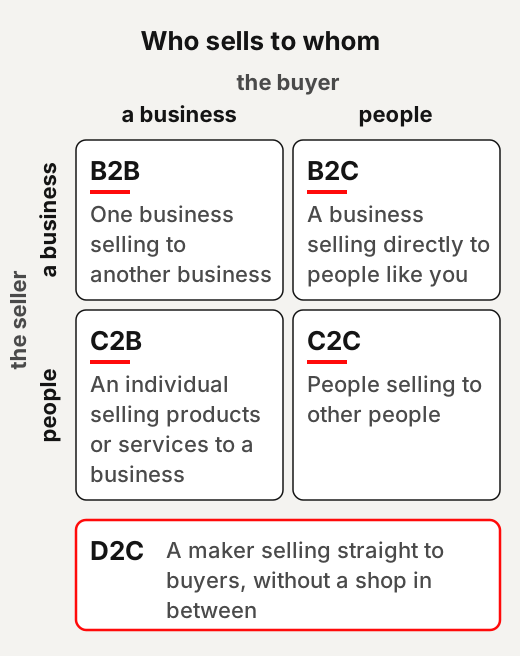
B2B (business to business)
One business selling to another business.
Example: a firm that makes cash registers sells them to cafés, not to the public.
How it works: An open eMarketing textbook describes B2B eCommerce as online transactions between businesses, such as between a manufacturer and a wholesaler, or a wholesaler and a retailer. It adds that B2B can include business services, such as printing or outsourced marketing.
Try this: next time you buy something, think of one business that sold to the seller first.
B2C (business to consumer)
A business selling directly to people like you.
Example: a bookshop selling a novel to a reader.
How it works: The OpenStax marketing textbook describes the B2C market as companies that sell products or services directly to a final consumer or end user. The buyer is the person who will use the product.
Try this: list three businesses you paid this week and note which ones also sell to other businesses.
C2C (consumer to consumer)
People selling to other people, usually through a platform that takes a fee.
Example: selling your old bike to a neighbour through a classified-ads app.
How it works: The eMarketing textbook says a C2C business generally provides the platform for users to interact with each other. It says users either pay a fee to use the platform, or the platform takes a percentage of each transaction; if it is free for everyone, it often earns through advertising.
Try this: before you list something, check what share of the price the platform keeps.
C2B (consumer to business)
An individual selling products or services to a business.
Example: a freelance photographer selling pictures to a magazine.
How it works: The eMarketing textbook describes C2B as consumers selling products or services to businesses, with the business paying the consumer. Its examples include freelancer hiring websites and sites that pay people to complete online surveys.
Try this: think of one skill you have that a business might pay for.
D2C (direct to consumer)
A maker selling straight to buyers, without a shop in between.
Example: a small sock brand that sells only from its own website.
How it works: The OpenStax textbook describes a direct channel as one where companies sell and distribute their products directly to consumers. It calls removing an intermediary from a marketing channel “disintermediation”. The maker keeps the shop’s share, but also takes on the shop’s work.
Try this: when you buy direct, check who handles returns and how.
2. How the money comes in
These eight are about what the customer pays for, and when. The same product can be sold in several of these ways.
Subscription
Customers pay a regular fee for ongoing access.
Example: a monthly plan for a language-learning app.
How it works: The OpenStax textbook on entrepreneurship describes a business model that offers subscriptions rather than a payment for an item purchased. It notes that subscriptions give the seller cash up front, with the buyer receiving benefits throughout the year.
Try this: set a reminder a few days before any free trial turns into a paid plan.
Freemium
A free basic version, with richer features for people who pay.
Example: a photo editor that is free, with extra filters for paying users.
How it works: A 2014 Harvard Business Review article explains that users get basic features at no cost and can access richer functionality for a subscription fee. It calls freemium the dominant business model among internet start-ups and smartphone app developers over the decade before.
Try this: use the free version for a month before deciding whether the paid one is worth it.
Advertising-based
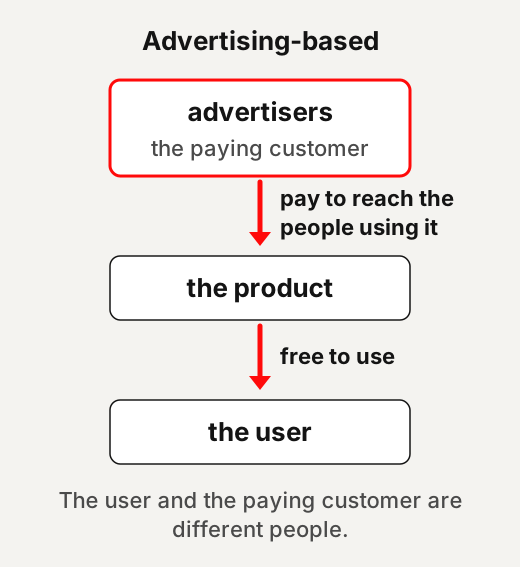
The product is free to use, and advertisers pay to reach the people using it.
Example: a free weather app that shows ads between forecasts.
How it works: The OpenStax entrepreneurship textbook describes ad-based models as ones where the products are free to users, and their value is monetised by a different customer base. The user and the paying customer are different people.
Try this: for any free app you use, ask who the paying customer is.
Razor and blades
Selling the main item cheaply and earning on the refills it needs.
Example: a printer sold at a low price, with ink cartridges that cost more over time.
How it works: The OpenStax marketing textbook calls this captive product pricing, with a core product, like a printer, and a captive product, like ink. The Legal Information Institute at Cornell notes that printers and video game consoles are often sold at a loss and profit later from ink or games.
Try this: before buying a device, add up a year of its refills.
Licensing
Letting another business make and sell your product, or use your brand, in return for a fee called a royalty.
Example: a cartoon studio lets a toy maker put its characters on lunchboxes.
How it works: The OpenStax entrepreneurship textbook defines licensing as a contract in which one enterprise gives another permission to manufacture and sell its products for a royalty. With a licence, the owner keeps ownership and gets paid for the use.
Try this: look at a licensed product and find the small print saying whose brand it is.
Affiliate
Earning a commission by sending customers to another seller.
Example: a cooking blog links to a pan and earns a small cut when a reader buys it.
How it works: The OpenStax marketing textbook defines affiliates as people or companies that earn a commission for driving traffic to another company’s website where they make a purchase. In the US, the FTC’s guidance says an affiliate should disclose the relationship to the retailer clearly and conspicuously.
Try this: look for a line saying the writer earns from links before you trust a “best of” list.
Brokerage
Bringing buyers and sellers together, and taking a commission.
Example: an estate agent who matches a house seller with a buyer.
How it works: The OpenStax textbook defines brokers as individuals or businesses that bring buyers and sellers together, usually for a commission. The broker earns from making the match.
Try this: ask a broker who pays their commission, the buyer or the seller.
On-demand
A service delivered when the customer asks for it, through a platform whose workers choose their own hours.
Example: booking a cleaner through an app for this afternoon.
How it works: A 2017 study describes platforms that offer service to consumers through self-scheduling providers, who decide for themselves how often to work. Their prices and pay may both adjust with demand, which is the idea behind surge pricing.
Try this: compare the price at a busy time with a quiet one before you book.
| Subscription | Customers pay a regular fee for ongoing access. |
| Freemium | A free basic version, with richer features for people who pay. |
| Razor and blades | Selling the main item cheaply and earning on the refills it needs. |
| Affiliate | Earning a commission by sending customers to another seller. |
| Brokerage | Bringing buyers and sellers together, and taking a commission. |
| Licensing | Letting another business make and sell your product, or use your brand, in return for a fee called a royalty. |
| Franchise | Running your own branch of another company's business, under its name and rules, for a fee. |
3. How the goods reach you
These seven are about who makes the thing, who holds the stock, and who sells it.
Manufacturing
Making new products from materials or parts.
Example: a workshop that turns timber into chairs.
How it works: The US Census Bureau’s industry classification says manufacturing establishments are engaged in the mechanical, physical or chemical transformation of materials, substances or components into new products. A manufacturer may sell to the public, or to a wholesaler or retailer, as in the B2B section above.
Try this: check the label of something you own to see where it was made, and by whom.
Retail
Buying goods in and selling them to the final customer.
Example: a corner shop that buys snacks from a wholesaler and sells them one at a time.
Try this: next time you shop, notice what the store adds that the maker could not, such as choice or quick returns.
Dropshipping
Selling items you never stock, so a supplier ships them straight to the buyer.
Example: an online shop lists phone cases, and each order goes straight from a supplier’s warehouse to the customer.
How it works: The OpenStax textbook describes drop shippers as a business model in which retailers use suppliers to ship products directly to the end consumer. In the US, the FTC’s guide to its mail-order rule says the person soliciting the order, not the agent fulfilling it, is the seller under the rule. The same guide says that with no shipping time stated, the seller must have a reasonable basis for believing it can ship within 30 days (50 days if the order includes a credit application).
Watch for: under that US rule, the shop that took your order is the seller, even if someone else ships it. Check the stated delivery time before you order.
Franchise
Running your own branch of another company’s business, under its name and rules, for a fee.
Example: a local owner runs a sandwich shop under a national brand’s sign and recipes.
How it works: The Legal Information Institute describes a franchise as a relationship in which a business, for a fee and with its guidance, allows another business to operate under its trade name and offer its products or services. The FTC’s consumer guide says that under its Franchise Rule you must receive the franchise disclosure document at least 14 days before you are asked to sign any contract or pay any money to the franchisor.
Try this: if you ever look at a franchise, read the disclosure document and talk to current owners, not only the seller.
Marketplace
A platform where many sellers meet many buyers.
Example: a craft website where hundreds of makers list their goods.
How it works: The OpenStax entrepreneurship textbook describes marketplace models as a variant of multisided models made up of two customer groups, buyers and sellers. It needs both buyers and sellers to work.
Try this: on a marketplace, check whether you are buying from the platform itself or from a separate seller.
Aggregator
A service that gathers many suppliers’ offers in one place and owns the relationship with the user.
Example: a hotel-search site that shows rooms from hundreds of hotels side by side.
Where it comes from: The analyst Ben Thompson named the idea “Aggregation Theory” in 2015. He argued that aggregators win by providing the best user experience, which earns them the most users, which attracts the most suppliers. That is one analyst’s framework, not a settled rule.
Try this: after comparing on an aggregator, check the supplier’s own site for the same offer.
Hybrid
Mixing two or more of the models above.
Example: a news site with free articles paid for by ads, plus a paid subscription with no ads.
How it works: our reading is that many businesses combine models. Freemium already mixes a free tier with a subscription, and the eMarketing textbook notes that free C2C platforms often earn through advertising.
Try this: pick a business you use and name every way it makes money.
| Retail | Buying goods in and selling them to the final customer. |
| Dropshipping | Selling items you never stock, so a supplier ships them straight to the buyer. |
| Marketplace | A platform where many sellers meet many buyers. |
| Aggregator | A service that gathers many suppliers' offers in one place and owns the relationship with the user. |
Where to learn more
- OpenStax, Entrepreneurship, chapter 11, “Business Model and Plan”: a free, open textbook on how business models are planned and tested.
- OpenStax, Principles of Marketing, chapters 17 and 18: distribution, retail and wholesale.
- The FTC’s consumer guide to buying a franchise: what the disclosure document must contain and what to ask.
- Our summaries of The Lean Startup and Start with Why look at how new businesses are built and tested.
- Related idea guides: 20 pricing strategies, 20 marketing strategies and industries built on lasting needs.
Quick answers
What is the difference between B2B and B2C?
B2B is one business selling to another, such as a manufacturer selling to a wholesaler. B2C is a business selling directly to a final consumer or end user.
What is dropshipping?
Selling items you never stock, so a supplier ships them straight to the buyer. In the US, the FTC's mail-order rule treats the person soliciting the order, not the agent fulfilling it, as the seller.
What is the razor and blades business model?
Selling the main item cheaply and earning on the refills it needs. The OpenStax marketing textbook calls this captive product pricing, with a printer as the core product and ink as the captive one.
What should I know before buying a franchise in the US?
The FTC's consumer guide says that under its Franchise Rule you must receive the franchise disclosure document at least 14 days before you are asked to sign any contract or pay any money to the franchisor.
Use this
Our suggestion, built from the models above, for any business you use or are thinking of starting.
Who is paying here, and what are they paying for?
Quick quiz
Nothing is scored or saved. Recalling it once now is what makes it last.
1. In a C2B model, who pays whom?
Answer: The business pays the individual.Read it again ↑
2. Under the US mail-order rule, who is responsible for a late shipment from a drop shipper?
Answer: The seller who took the order.Read it again ↑
3. What does the OpenStax textbook call the printer-and-ink model?
Answer: Captive product pricing.Read it again ↑
How we checked this · Last checked November 2026
- Definitions come from free textbooks read on Business LibreTexts, OpenStax Principles of Marketing, OpenStax Entrepreneurship and Rob Stokes's eMarketing, and from the Legal Information Institute at Cornell and the US Census Bureau.
- The franchise and mail-order rules come from the US Federal Trade Commission's own guides, read in November 2026. They describe US rules only and are not legal advice.
- The aggregator idea is credited to the analyst who named it in 2015, as his framework.
- The textbooks name real companies as examples. We left them out and used everyday examples of our own.