

Start hereThe goldfish figure has appeared in newspapers, magazines, on radio and in a management book. Yet the sources listed for it could find no research behind it. So where did it come from?
You have probably heard that people now have shorter attention spans than goldfish. The numbers behind it lead back to a website, and the sources it listed could find no research behind them. Below: where the claim came from, what attention researchers measure instead, and what the research says helps you focus.
The verdicts
1. Where the 8-second figure came from
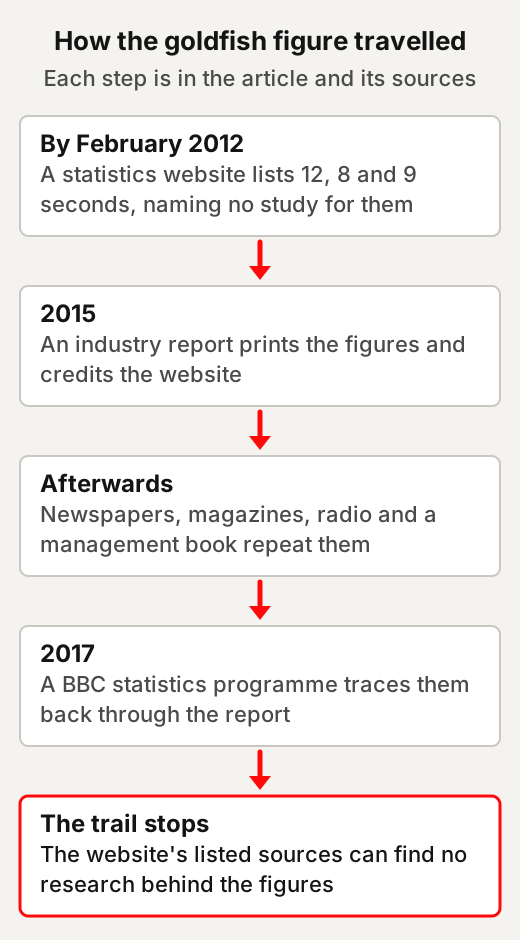
The figure spread from a 2015 industry report, which credited it to a statistics website, and the trail stops there.
“Our attention span is now shorter than a goldfish’s”
Doesn't hold up The average attention span fell from 12 seconds to 8, less than a goldfish’s 9. No research has been found behind these numbers. Our reading: the comparison is vivid and the figures sound exact, which may help them travel.
How sure: Moderate the trail ends at a website whose listed sources found no research; a search cannot prove none exists.
The claim says the average attention span fell from 12 seconds in 2000 to 8, less than a goldfish’s 9. It had appeared in newspapers, magazines, on radio and in a management book. The BBC statistics programme More or Less traced it in 2017. The figure led back to a 2015 industry report, which credited it to another website. The sources that website listed could find no research behind it.
The report itself shows the hand-off. In it, the three figures sit under the heading “We know human attention is dwindling”, credited in one line to the statistics website. It gives 8 seconds as the average for 2013.
The report’s own research measured something else. It surveyed 2,000 Canadians and studied the brain activity of 112 people. It split attention into three kinds, because “we don’t think that attention can be simply characterized as how long people can concentrate”.
We followed the credit back one more step. The earliest archived copy of the website’s page that we found, from February 2012, already lists the three figures. There, 8 seconds is the average for 2012. By 2015 the same line said 2013. The only study the page names sits under its web-browsing figures, not under the attention-span lines.
That is where the trail stops. We found no earlier copy, and no study that measured these numbers.
For example, before you repeat a striking number, ask what was measured, in whom, and by whom. If nobody can say, treat it as a story rather than a statistic. Our SIFT guide shows a quick way to trace a claim like this one.
2. What researchers mean by “attention span”
Researchers measure attention for a task, not as one number for a person.
“Everyone has an attention span you can count in seconds”
Doesn't hold up Each of us has one attention span that can be measured in seconds. How long people pay attention depends on the task and the situation. An attention span is always an attention span for something.
How sure: Moderate the field’s dictionary and attention researchers describe it task by task; we found no measure of a single, general span.
The APA Dictionary of Psychology defines attention span as the time a person can concentrate on “one specific task or other item of interest”. An attention researcher at the Open University told the BBC that attention is “very much task-dependent”. She called the idea of an “average attention span” “pretty meaningless”.
Lectures are a good test case. A 2016 review found that the primary data do not support a 10- to 15-minute limit on students’ attention in lectures. Its most consistent finding was that student attention varied most between teachers, not between teaching formats.
For example, the same person can drift off in a dull meeting after a few minutes and stay absorbed in a film for two hours.
“Our attention spans are shrinking”
Still argued People’s attention spans are getting shorter. Some narrow measures have shortened; whether attention itself has is still argued. The answer depends on what you count.
How sure: Unsettled screen-switching at work got faster, but we found no long-run measure of a general attention span, and children’s data point both ways.
| What was measured | What changed | Whose attention |
|---|---|---|
| Time on one screen before switching, at work | About two and a half minutes in 2004, about 47 seconds in recent years | Office workers, in one research group’s studies |
| How long a hashtag stayed in Twitter’s top 50 | 17.5 hours on average in 2013, 11.9 hours in 2016 | The public’s, as a crowd |
| Attention problems on a children’s behaviour checklist, 1981 to 2019 | More by parents’ reports, fewer by teachers’ reports for boys in middle childhood | Children’s, rated by adults |
Gloria Mark studies how long office workers stay on one screen before switching. She told the American Psychological Association in 2023 that the average fell from about two and a half minutes in 2004 to about 47 seconds in recent years. She added that others have replicated this result to within a few seconds. Mark uses “attention span” for this time on one screen.
A 2019 study found that topics gain and lose the public’s attention faster than they did in earlier decades. Its authors say this collective attention is distinct from attention as cognitive psychology defines it, in one person.
A 2026 meta-analysis of 175 studies of children and teenagers found contradicting results for attention problems over four decades. Its authors advise caution, partly because the checklist’s attention scale became less reliable over time.
The BBC programme concluded there was no evidence that human attention spans are shrinking.
Our reading: people switch screens faster at work, and topics fade faster online. That is a change in habits and in what competes for us. It does not show that anyone’s ability to concentrate has shrunk. For example, flicking to email between paragraphs of a report is the kind of switch these workplace studies count.
3. What goldfish memory research found
Goldfish are a poor symbol for a short memory: in experiments they learn tasks over weeks, and they are reported to keep memories for months.
“Goldfish only remember for a few seconds”
Doesn't hold up Goldfish have a memory of only a few seconds. Goldfish learn and remember far longer than seconds. So the comparison in the claim was never fair to goldfish either.
How sure: Moderate lab studies show goldfish learning tasks over weeks; we read one study and two expert accounts, not the whole field.
In a 1994 study, eight goldfish learned to press a lever for food. When the lever worked for only one hour in every 24, the pattern of their presses suggested they anticipated feeding time. After the food stopped, the pattern lasted for a limited number of days.
BBC Wildlife magazine says goldfish can keep memories for at least three months. A fish-behaviour researcher told the BBC that goldfish “can perform all the kinds of learning that have been described for mammals and birds”. She said there have been hundreds of scientific papers on goldfish learning and memory.
For example, a goldfish that comes to the front of its tank at its usual feeding time may be doing what the fish in that study learned to do. Our real or myth page covers the three-second memory claim too.
4. Switching tasks and interruptions
Switching between tasks has a real cost in time and mistakes, though one popular number for it is unconfirmed.
“Switching between tasks costs you time”
Holds up Moving from one task to another slows you down and makes mistakes more likely. People are slower, and often less accurate, just after a switch. Researchers call the loss a switch cost.
How sure: Strong many lab experiments find it, and a 2003 review sums them up.
A 2003 review found people “substantially slower and, usually, more error-prone immediately after a task switch”. A chance to prepare reduced the cost, but did not remove it. In four experiments published in 2001, the time lost grew as the rules got more complex. Each switch may cost only a few tenths of a second, but the costs add up when people switch back and forth.
Even very short interruptions count. In a 2014 study, interruptions averaging 2.8 seconds doubled the rate of mistakes about where people were in a sequence of steps. In a 2008 study, people finished interrupted tasks faster, with no loss of quality, but reported more stress, frustration, time pressure and effort.
In two experiments published in 2009, Sophie Leroy found it was hard for people to pull their attention away from an unfinished task. Their performance on the next task suffered. A 2018 paper reporting four studies found that a brief plan for returning to an interrupted task reduced the effect. Its studies looked at people who expected to go back to the interrupted work under time pressure. Most of this evidence comes from Leroy and her co-authors. Our Deep Work summary covers these studies in detail.
For example, answering one message in the middle of a paragraph means rebuilding your train of thought when you come back.
“Switching can cost you 40% of your productive time”
Can't confirm Switching between tasks can eat up 40% of your productive time. The figure is a researcher’s remark reported by the APA; we found no study that measured it.
How sure: Limited it appears as a quoted remark, not as a result in the papers we read.
A 2006 APA article reports that one of the researchers “has said” that brief mental blocks from switching “can cost as much as 40 percent of someone’s productive time”. The abstract of his team’s 2001 paper describes switching-time costs but gives no such percentage.
“As much as” is a ceiling, not an average. For example, treat it as a picture of how small costs can add up, not as a measure of your own working day.
“Heavy media multitaskers are worse at ignoring distractions”
Partly People who juggle many media at once are worse at ignoring distractions. There is a small to moderate link, found by comparing groups, not proof of cause.
How sure: Moderate meta-analyses find a small link, a replication pair found a weaker one, and none shows cause.
A 2009 Stanford study found heavy media multitaskers more easily distracted by irrelevant information. A 2017 pair of replications found only five of 14 tests significant, and its meta-analysis found a weak link that “turned nonsignificant after correction for small-study effects”. A 2021 meta-analysis of 118 tests found the link between heavy media multitasking and poorer attention small. A 2025 meta-analysis of 33 studies found a correlation of 0.19 between more media multitasking and poorer attention. All of these studies compare groups; none shows that multitasking causes the difference.
In practice, this describes groups of people. It cannot tell you what multitasking will do to you. Our Deep Work summary lists the later meta-analyses as well.
5. Phones and notifications
A buzz can pull attention away, but a silent phone on the desk may matter little.
“A notification you don’t answer still breaks your focus”
Partly Just hearing or feeling a notification hurts your focus, even if you ignore it. In one study it did; in another, notifications felt distracting but did not change performance on a response task.
How sure: Limited a few lab studies using different tasks reach different results.
In a 2015 study, phone notifications alone significantly disrupted performance on an attention-demanding task, even when people did not interact with their phones. The effect was comparable to that of actively using a phone for calls or texts.
In a preregistered 2019 study, a visible phone and its notifications made students feel more distracted. But those feelings were unrelated to their performance on a task that measured holding back a response.
For example, a phone buzzing face down during revision may cost you more on some tasks than others. The research has not settled which.
“Just having your phone nearby drains your brainpower”
Still argued A phone on the desk, even switched off, lowers how well you think. One 2017 study found this, but a direct replication did not, and the reviews of presence alone find little or no effect.
How sure: Unsettled the evidence leans against a general effect; one meta-analysis found a smaller effect on working memory only.
In two experiments published in 2017, the mere presence of people’s own smartphones reduced their available cognitive capacity. A preregistered direct replication of the second experiment, in 2022, found that the effect did not replicate.
A 2023 meta-analysis found a negative effect on working memory only, and called it smaller than the theory predicted. It also found generally poor statistical power in the studies. A 2024 meta-analysis of 33 studies with 4,368 participants found no significant effect of a phone’s mere presence. A 2023 meta-analysis that pooled studies of phone use and phone presence together found a negative effect overall.
Our reading: the evidence leans against a large effect from a silent phone that is simply nearby. Using it, or being interrupted by it, is a different matter. For example, a phone left face down and silent may matter less than one that keeps lighting up.
“Turning off alerts helps you focus”
Partly Switching off notifications makes you less distracted. In a two-week experiment, people reported fewer attention problems with alerts off, but it measured feelings, not performance.
How sure: Limited one experiment with 221 people, based on what they reported about themselves.
In a 2016 experiment, 221 people spent one week with alerts on and their phones close, and another week with alerts off and their phones away. They reported more inattention and hyperactivity when alerts were on. Higher inattention in turn predicted lower productivity and well-being.
For example, you could silence everything except calls from a few people for a week and see whether your days feel different. Our Digital Minimalism summary looks at the wider case for using your phone on purpose.
6. What helps you focus
The habits with the most support cut down on switching and interruptions, and leave room for breaks.
“Short breaks help you stay focused”
Partly Taking short breaks keeps your focus up. Short breaks lift energy and ease tiredness; their effect on performance is less clear.
How sure: Moderate a 22-sample meta-analysis found small benefits for energy and tiredness, but no clear overall gain in performance.
A 2022 meta-analysis of 22 study samples found that micro-breaks gave a small boost to vigour and a small drop in fatigue. Their effect on overall performance was not significant, and it was significant only for less demanding tasks. Longer breaks went with a bigger boost to performance.
On a long watching task, people tend to spot fewer targets after a while; researchers call that the vigilance decrement. In a 2011 lab study, briefly switching to another goal now and then prevented that drop. Gloria Mark suggests taking breaks at a natural stopping point, such as the end of a section, so there is less to rebuild when you return.
For example, finish the paragraph, then stand up for a few minutes, rather than stopping mid-sentence.
A short focus checklist
This is our suggestion, built from the findings above, not a tested programme.
- One thing at a time. Each switch costs a little, and the costs add up.
- Silence alerts while you work. In the one experiment we found, people felt less scattered with alerts off.
- Write where you stopped. Before you switch, note the next step; in one research group’s studies, a brief plan reduced the drag of an unfinished task.
- Break at a natural stopping point. Then there is less to rebuild when you come back.
- Check the source of striking numbers. A precise figure is not the same as a measured one.
Three of our book summaries go further. Deep Work is about protecting long stretches for one task. Digital Minimalism is about using your phone on purpose. The Shallows is about the web and reading.
Quick answers
Is the human attention span 8 seconds?
No research has been found behind that figure. It spread from a 2015 industry report, which credited a statistics website, and the sources that website listed could find no research behind it.
What is the attention span of a goldfish?
No research has been found behind the nine-second figure. In a 1994 study, goldfish learned to press a lever at feeding time, and BBC Wildlife magazine says goldfish can keep memories for at least three months.
Are attention spans getting shorter?
It is still argued. In one research group's workplace studies, time on one screen before switching fell from about two and a half minutes in 2004 to about 47 seconds, but we found no long-run measure of a general attention span.
Does multitasking make you less productive?
Switching between tasks has a cost; people are slower, and usually make more mistakes, just after a switch. The popular claim that it costs 40% of your productive time is a remark reported by the APA, not a measured result we could find.
Does having your phone nearby hurt concentration?
The evidence leans against a large effect from a silent phone that is simply nearby. A 2017 study found one, but a direct replication did not, and a 2024 meta-analysis of 33 studies found no significant effect.
Use this
Fewer switches and fewer interruptions have the most support; short breaks help energy, and a natural stopping point is a researcher's suggestion for when to take them.
Before I repeat a number, can I say what was measured, in whom, and by whom?
Quick quiz
Nothing is scored or saved. Recalling it once now is what makes it last.
1. Where does the 8-second figure in the 2015 report come from?
Answer: A statistics website the report credited.Read it again ↑
2. In the 1994 study, what did the goldfish learn?
Answer: To press a lever around feeding time.Read it again ↑
3. What did a 2022 direct replication find about a phone simply sitting nearby?
Answer: The effect did not replicate.Read it again ↑
How we checked this · Last checked October 2026
- We followed the 8-second figure from the 2017 BBC investigation to the 2015 report itself, read in full in an Internet Archive copy, and to the statistics website's page in Internet Archive copies from 2012 and 2015.
- We do not name the company or the website, or link to their documents; the BBC's 2017 article describes both.
- For the research we read abstracts through PubMed, OpenAlex and Crossref, and the full text of the 2019 collective-attention study; dictionary entries and APA pages were read in a browser.
- The trail stops at the website. A search cannot prove that no earlier source exists.
- Our wording on the BBC trail, goldfish memory and media multitasking matches our information-is-power, real-or-myth and Deep Work pages.
Sources
The 8-second figure
- S. Maybin, “Busting the attention span myth”, BBC News (More or Less), 10 March 2017.Popular
- The 2015 industry report “Attention spans” (Spring 2015), pages 6, 9, 11 and 12, read in an Internet Archive copy of 2 February 2017 (described in the BBC article above).Primary
- The statistics website’s “Attention Span Statistics” page, read in Internet Archive copies of 8 February 2012 and 2 February 2015 (described in the BBC article above).Primary
What attention span means, and whether it is shrinking
- American Psychological Association, APA Dictionary of Psychology, “attention span”, “switch cost” and “vigilance decrement”.Scholarly
- N. A. Bradbury, “Attention span during lectures: 8 seconds, 10 minutes, or more?”, Advances in Physiology Education 40(4), 2016.Scholarly
- American Psychological Association, Speaking of Psychology, “Why our attention spans are shrinking, with Gloria Mark, PhD”, February 2023.Popular
- P. Lorenz-Spreen and colleagues, “Accelerating dynamics of collective attention”, Nature Communications 10, 2019.Scholarly
- B. Vekety, Z. K. Takacs and colleagues, “Kids These Days! A Cross-Temporal Meta-Analysis of Changes in Emotional and Behavioral Problems of Population-Based Samples Over the Past Decades”, Clinical Child and Family Psychology Review, 2026.Scholarly
Goldfish
- P. Gee, D. Stephenson and D. E. Wright, “Temporal discrimination learning of operant feeding in goldfish (Carassius auratus)”, Journal of the Experimental Analysis of Behavior 62(1), 1994.Scholarly
- Discover Wildlife (BBC Wildlife), “Do goldfish really only have a 3 second memory?”.Popular
Switching and interruptions
- S. Monsell, “Task switching”, Trends in Cognitive Sciences 7(3), 2003.Scholarly
- J. S. Rubinstein, D. E. Meyer and J. E. Evans, “Executive control of cognitive processes in task switching”, Journal of Experimental Psychology: Human Perception and Performance 27(4), 2001.Scholarly
- American Psychological Association, “Multitasking: Switching costs”, 20 March 2006.Popular
- E. M. Altmann, J. G. Trafton and D. Z. Hambrick, “Momentary interruptions can derail the train of thought”, Journal of Experimental Psychology: General 143(1), 2014.Scholarly
- G. Mark, D. Gudith and U. Klocke, “The cost of interrupted work”, Proceedings of CHI 2008.Scholarly
- S. Leroy, “Why is it so hard to do my work?”, Organizational Behavior and Human Decision Processes 109, 2009.Scholarly
- S. Leroy and T. M. Glomb, “Tasks interrupted”, Organization Science 29, 2018.Scholarly
- E. Ophir, C. Nass and A. D. Wagner, “Cognitive control in media multitaskers”, PNAS 106(37), 2009.Scholarly
- W. Wiradhany and M. R. Nieuwenstein, “Cognitive control in media multitaskers: two replication studies and a meta-analysis”, Attention, Perception, & Psychophysics, 2017.Scholarly
- D. A. Parry and D. B. le Roux, ““Cognitive control in media multitaskers” ten years on: a meta-analysis”, Cyberpsychology 15, 2021.Scholarly
- H. Chen et al., “The relationship between media multitasking and attention”, Current Psychology 44 (2025).Scholarly
- M. R. Uncapher and A. D. Wagner, “Minds and brains of media multitaskers”, PNAS, 2018.Scholarly
Phones, notifications and breaks
- C. Stothart, A. Mitchum and C. Yehnert, “The attentional cost of receiving a cell phone notification”, Journal of Experimental Psychology: Human Perception and Performance 41(4), 2015.Scholarly
- N. Johannes, H. Veling, T. Verwijmeren and M. Buijzen, “Hard to Resist? The Effect of Smartphone Visibility and Notifications on Response Inhibition”, Journal of Media Psychology 31, 2019.Scholarly
- A. F. Ward, K. E. Duke, A. Gneezy and M. W. Bos, “Brain Drain: The Mere Presence of One’s Own Smartphone Reduces Available Cognitive Capacity”, Journal of the Association for Consumer Research 2, 2017.Scholarly
- A. C. Ruiz Pardo and J. P. Minda, “Reexamining the “brain drain” effect: A replication of Ward et al. (2017)”, Acta Psychologica 230, 2022.Scholarly
- D. A. Parry, “Does the Mere Presence of a Smartphone Impact Cognitive Performance? A Meta-Analysis of the “Brain Drain Effect””, Media Psychology 27 (online 2023).Scholarly
- A. Hartanto and colleagues, “The effect of mere presence of smartphone on cognitive functions: A four-level meta-analysis”, Technology, Mind, and Behavior 5, 2024.Scholarly
- T. Böttger, M. Poschik and K. Zierer, “Does the Brain Drain Effect Really Exist? A Meta-Analysis”, Behavioral Sciences 13(9), 2023.Scholarly
- K. Kushlev, J. Proulx and E. W. Dunn, ““Silence Your Phones””, Proceedings of CHI 2016.Scholarly
- P. Albulescu and colleagues, ““Give me a break!” A systematic review and meta-analysis on the efficacy of micro-breaks for increasing well-being and performance”, PLoS One 17(8), 2022.Scholarly
- A. Ariga and A. Lleras, “Brief and rare mental “breaks” keep you focused: deactivation and reactivation of task goals preempt vigilance decrements”, Cognition 118(3), 2011.Scholarly
Ask what pulls you off the task
How long people pay attention depends on the task and the situation. So 'is my attention span short?' isn't a useful question. 'What keeps pulling me off this task?' is one you can act on.
Cut the switches you choose
- Check messages at set times. Our view: pick a few points in the day for email and chat. Each switch costs a little, and the costs add up.
- Say when you'll reply. Our view: a line such as 'I check messages at noon and four' makes set times easier to keep.
- Group the small jobs. Our view: do quick replies, forms and calls in one block, so they don't break up longer work.
- Keep one window open. Our view: close the inbox and extra tabs while you work. Flicking to email mid-report is the kind of switch counted.
This week: count your switches
For one hour of work, make a tick each time you change screen or task. Then try an hour with alerts silenced and count again. It's a test of your own habits, not research.
Turn focus and source-checking into work
- Offer number-checking for writers and presenters: trace each striking figure back to who measured it, and how.
- Help small teams write a short agreement on quiet hours and when messages get answered.
- Write explainers that follow one popular statistic back to its source, step by step.
Ideas to explore, not financial or business advice. No result is promised.
Keep going
- The SIFT methodA quick way to trace a claim before you share it.
- Deep Work, summarisedProtecting long stretches for one task, and the switching studies in detail.
- Digital Minimalism, summarisedThe wider case for using your phone on purpose.
- Real or myth? 14 popular claimsMore claims traced to their sources, including goldfish memory.