

Start hereNear its end, the talk says "It only takes 20 hours." Earlier in the same talk, the 20 hours is the time it takes to get "reasonably good". Which one is the claim?
Not to mastery. The 20-hour claim is about getting “reasonably good” at a new skill, in its author’s own words. Below: where it comes from, what learning research says about the first hours, and a 20-hour plan you can try.
1. Where the 20-hour claim comes from
The number comes from a 2013 TEDx talk and book by Josh Kaufman, about the first steps of a skill. Kaufman is an author of books on business and on learning new skills.
His talk, “The first 20 hours — how to learn anything”, was posted on the TEDx Talks YouTube channel on 14 March 2013. In it, he asks how long it takes to go from knowing nothing to being “reasonably good”. His answer is 20 hours. He adds that 20 hours is “about 45 minutes a day for about a month”.
His book, The First 20 Hours, was published in June 2013. The book’s website described the result as going “from knowing absolutely nothing to performing noticeably well”. Its publisher describes it as learning “the basics of any new skill in 20 hours or less”.
The shorter version comes from the same sources. The book’s website asked: “what if it’s possible to learn any new skill in 20 hours or less?” Near its end, the talk says: “It only takes 20 hours.” Read in full, both set the bar at the start of a skill, not the top.
For example, “reasonably good” at cooking might mean making five weeknight dinners without a recipe, not running a restaurant kitchen.
2. The claim, checked
Twenty hours aims at the basics, not mastery, and we found no study that tested the number.
Twenty hours is enough to master any skill
Doesn't hold up Twenty hours is enough to master any skill. The claim’s own author set the bar at “reasonably good”, not mastery.
How sure: Strong its author limits it to the basics; the best violin students in a classic study averaged 10,000 hours.
In the book, Kaufman writes that expert-level performance takes, on average, ten thousand hours of deliberate practice, citing the research of K. Anders Ericsson. The book’s contents list for its chapter on Go includes: “You don’t have to master everything you ever learn.”
So the full claim is narrower than the slogan. For example, 20 hours on the guitar aims at strumming a few songs for friends, not at playing in a professional band.
Twenty hours gets a beginner to a usable level
Can't confirm Twenty hours of focused practice gets a beginner to a usable level in any skill. We found no study that tested a 20-hour mark; the figure comes from one author’s reading of the research and his own tests.
How sure: Limited one author’s tests on six skills, and no controlled study of a 20-hour mark that we found.
The book follows Kaufman as he tests his method on six skills: programming, the ukulele, yoga, touch typing, windsurfing and the board game Go. In the talk, he says he hit his twentieth hour on the ukulele while playing a medley of pop songs on stage.
We searched for a study that measured progress at 20 hours of practice and did not find one. Our reading: learning-curve research, below, fits the idea that the first hours count most, but it does not give a number of hours.
For example, to test the claim on yourself, write down what you can do at hour zero, then check the same thing at hour 20.
The first hours of practice bring the biggest gains
Holds up Early practice brings the fastest improvement. On most tasks studied, people improve fastest early on, then more and more slowly.
How sure: Strong reviews covering many tasks agree on the shape; researchers still debate which curve fits and how it starts.
Researchers who study practice describe the same pattern across many kinds of task. The learning researchers Frank Ritter and Lael Schooler wrote that “the most dramatic improvements happen first”. Their examples range from reading upside-down text and rolling cigars to manufacturing machine tools.
This pattern is called the learning curve, and it is often described by a formula called the power law of practice. In his talk, Kaufman points to the same kind of graph from studies of skill learning.
A 2000 study of 40 data sets found that an exponential curve fitted individual learners better than a power curve. Averaging people together favoured the power curve. Either way, both kinds of curve show gains that keep coming, but with diminishing returns.
A 2018 study by some of the same researchers found that, in most kinds of task it tested, the best-fitting curve allowed for a slow start. Learning went slower, then faster, then slower again. So the fastest gains come early, though not always from the very first try.
Most of these studies plot the time a task takes against the amount of practice. Our reading: they show the shape of learning, not how many hours a whole skill needs.
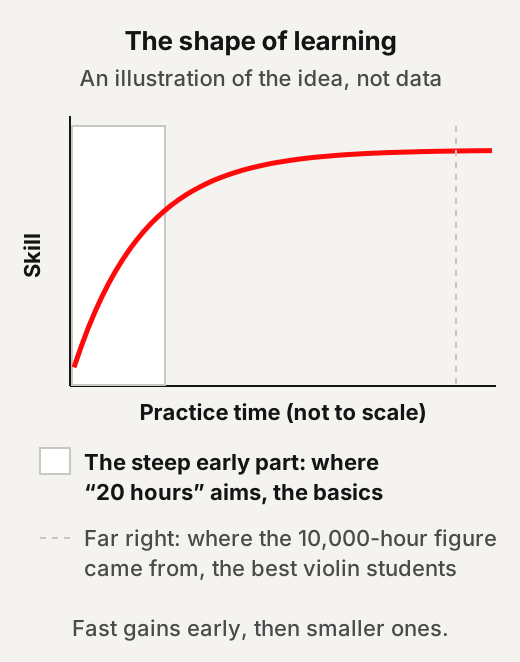
For example, your first evenings of typing practice might cut a lot off the time a line takes, while your fiftieth evening shaves off much less.
After the early gains, you stop improving
Partly After the early gains, you hit a plateau and stop improving. Progress slows a lot, but small gains can keep coming with practice.
How sure: Moderate one review of practice research describes gains continuing for over 100,000 trials on some tasks.
In the talk, Kaufman describes reaching a plateau, after which later gains take more time. Ritter and Schooler write that the plateau can hide continuing small improvements, and that for some tasks improvement continues for over 100,000 trials.
So a plateau is mostly a slowdown, not a wall. For example, once a chord change feels easy, timing yourself on it each week can show small gains you would not otherwise notice.
3. Where 10,000 hours fits
The two numbers answer different questions: 10,000 hours was about the best violin students, 20 hours about getting started.
In the talk, Kaufman says the 10,000-hour figure is about reaching “the top of an ultra competitive field in a very narrow subject”. He describes the message being retold, step by step, until it became “it takes 10,000 hours to learn something”.
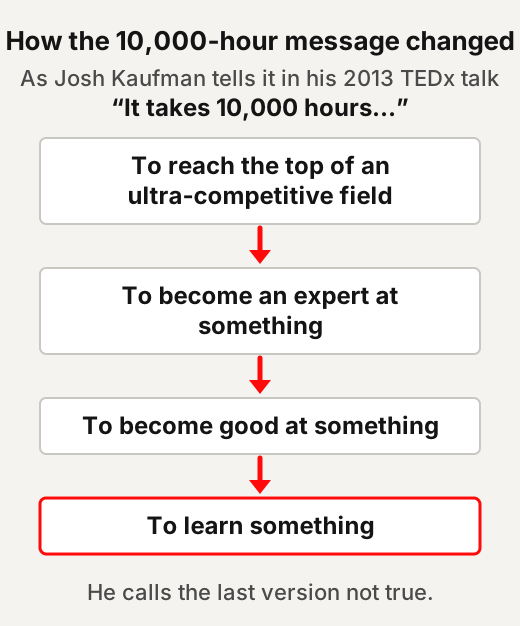
The figure comes from a 1993 study of violin students in Berlin, in which the best group had practised an average of 10,000 hours by age 20. Anders Ericsson, its lead author, later wrote that half of those ten violinists had not reached 10,000 hours at that age. He added that there is “nothing special or magical about ten thousand hours”.
Practice matters, but 10,000 hours is an average from one study of violin students, not a rule. Our summaries of Outliers, Range and Grit cover that debate in full.
For example, playing at a friend’s birthday and winning a national competition are very different points on the same curve.
4. The four steps, and the research behind them
Breaking a skill down and getting feedback have research behind them; the other two steps are practical advice.
| Step | What Kaufman says | What we found |
|---|---|---|
| 1. Deconstruct the skill | Decide what you want to do, break the skill into pieces, practise the most important first | Partly: practising parts did no harm when they come in sequence, but hurt when they happen together |
| 2. Learn enough to self-correct | Use three to five resources, but don’t let them delay practice | Holds up: feedback helps, more so the more information it gives |
| 3. Remove barriers to practice | Clear distractions such as television and the internet | Not tested as a step, as far as we found |
| 4. Practise for at least 20 hours | Commit in advance to get past the frustrating start | The number is untested |
In the talk, the four steps are: deconstruct the skill, learn enough to self-correct, remove barriers to practice, and practise for at least 20 hours. The book adds two lists of ten principles, one on picking up a skill and one on effective learning. The learning list includes spaced repetition, and predictions and tests.
Those two match the study habits with the strongest support in our guide to learning faster. A 2013 review of ten study techniques gave its highest rating to two: practice testing and spaced practice.
Break the skill into parts
Partly Breaking a skill into parts and practising them separately speeds up learning. Practising parts separately did no harm when they come one after another, but generally hurt when they happen at the same time.
How sure: Moderate one meta-analysis of 37 training studies, with results that depend on the task.
Kaufman’s first step is to decide exactly what you want to be able to do, then break the skill into smaller pieces and practise the most important first. Researchers call practising separate pieces part-task training.
A 2013 meta-analysis of 37 transfer studies covered this and one other training method. Practising parts separately generally hurt when the parts happen at the same time, but not when they come in sequence. Practising the whole task while shifting which part gets priority was a successful technique. Experienced learners gained less from these methods, or did worse. A 2014 opinion article on training principles recommends practising parts separately when they come in sequence, not when they happen together.
For example, a dance routine is a sequence, so learning it eight counts at a time fits. Steering and pedalling a bike happen together, so they belong in the same practice, done slowly.
Learn enough to correct yourself
Holds up Feedback on what you are doing helps you learn a skill. Feedback helps learning, and more so the more information it gives.
How sure: Moderate a 435-study meta-analysis found a medium effect, but results varied a lot, and some were negative.
Kaufman’s second step is to gather three to five resources and learn just enough to notice your own mistakes. He warns against using the reading to put off practice.
A 2020 meta-analysis of 435 studies found a medium effect of feedback on student learning. It found more impact on thinking and movement skills than on motivation and behaviour. Its authors conclude that feedback is more effective the more information it contains. About one in six of the results it pooled were negative, so feedback does not always help.
In the study, rewards or punishment alone helped least, and feedback that also helped learners keep track of their own attention, emotions or motivation helped most.
For example, record yourself playing a song and compare it with the original, or check each practice sentence in a new language against an answer key.
Remove what gets in the way
Clearing distractions is sensible advice, but we did not find a study testing it as part of this method.
Kaufman’s third step is to remove barriers to practice, such as distractions, television and the internet. In the talk, he says his first couple of hours on the ukulele went on getting ready, such as putting the strings on and learning to tune it.
Setting up before your first session keeps the 20 hours for practice. Our Deep Work summary looks at the research on switching between tasks.
For example, leave the instrument out of its case, or put the language app on your home screen and move the games off it.
Practise for at least 20 hours
Committing to 20 hours in advance is meant to carry you past the frustrating start.
Kaufman’s fourth step is to commit in advance to at least 20 hours, to get past what he calls the “frustration barrier”. He argues that the main barrier to learning something new is emotional, not intellectual.
That fits a finding from learning research. The methods that work often feel harder, so they can seem less useful than they are. Our stretch zone guide looks at how hard practice should feel.
For example, decide before you start that you will not judge the skill until hour 20, and log each session’s minutes.
5. When 20 hours is the wrong yardstick
Where safety, a licence or a high standard sets the bar, 20 hours is only a start.
In the US, a private pilot certificate for a single-engine plane generally needs at least 40 hours of flight time. At least 20 of them must be training with an instructor. Even in the book, the yoga chapter includes the advice “Work with an instructor”.
Our reading: if your goal is to perform, compete or work in a field, other people set the bar, and the hours run far longer. And if you cannot yet tell good work from bad, you need a teacher, a model or an answer key before practice can correct itself.
For example, 20 hours of chess can teach you the rules and a few openings, while a club rating is a different goal.
6. A 20-hour plan
This is our suggestion, built from the four steps and the research above, not a tested programme. At about 45 minutes a day, it fills about a month.
| Hours | Focus | What to do |
|---|---|---|
| Before you start | Target | Write one sentence on what you want to be able to do at hour 20. Pick three to five resources. |
| 0 to 2 | Set up | Get your tools ready and clear distractions. |
| 2 to 8 | Core parts | Practise the few parts you will use most. Practise parts that happen together as one, slowly. |
| 8 to 16 | Feedback | Check each session against a teacher, a recording or an answer key. Fix one weak spot at a time. Test yourself instead of rereading. |
| 16 to 20 | Put it together | Do the whole thing as you would for real, and compare it with your target sentence. |
If it isn’t working
If the plan stalls, try one of these.
- You can’t tell what’s wrong. Find a teacher, a recording to compare with, or a solved example.
- Hour 10 feels worse than hour 2. Harder practice can feel like slower progress. Judge by a test against your target, not by how it feels.
- Your target was too big. Shrink it to one song, one dish or one conversation.
Quick answers
Is the 20-hour rule true?
Not as a route to mastery. Josh Kaufman, who set it out, says 20 hours of focused practice gets you to "reasonably good", not to mastery. We found no study that tested a 20-hour mark, but on most tasks studied people improve fastest early on.
Who came up with the 20-hour rule?
The author Josh Kaufman, in a TEDx talk posted on 14 March 2013 and in his book The First 20 Hours, published in June 2013.
What are the steps of the 20-hour method?
Kaufman lists four. Deconstruct the skill, learn enough to self-correct, remove barriers to practice, and practise for at least 20 hours.
Is the 10,000-hour rule true?
Practice matters, but 10,000 hours is an average from one study of violin students, not a rule. Its lead author, Anders Ericsson, wrote that there is "nothing special or magical about ten thousand hours".
How long does it take to learn a new skill?
No single number fits every skill. On most tasks studied, people improve fastest early on and then more slowly, and the hours you need depend on the level you want.
Use this
Our suggestion, built from Kaufman's four steps and the research on this page.
What exactly do I want to be able to do at hour 20?
Quick quiz
Nothing is scored or saved. Recalling it once now is what makes it last.
1. In his 2013 talk, what level did Kaufman say 20 hours of practice gets you to?
Answer: Reasonably good.Read it again ↑
2. In a 2013 meta-analysis, when did practising the parts of a task separately tend to hurt?
Answer: When the parts are done at the same time.Read it again ↑
3. Where does the 10,000-hour figure come from?
Answer: The best students in a 1993 study of violinists.Read it again ↑
How we checked this · Last checked October 2026
- We read the 2013 TEDx talk's English captions and quote them with timestamps.
- We read the book's own website (an Internet Archive copy from February 2014), its publisher's page, and short passages of the book through Open Library's search-inside. We did not read the whole book.
- For the research we read the abstracts on PubMed, the full text of the 2020 feedback meta-analysis, and the authors' draft of the 2001 learning-curve encyclopedia entry.
- We searched PubMed and OpenAlex for a study that measured progress at 20 hours of practice and found none. A search cannot prove there is none.
- Our wording on 10,000 hours matches our Outliers summary, and our wording on study methods matches our guide to learning faster.
Sources
- J. Kaufman, “The first 20 hours — how to learn anything”, TEDxCSU talk, TEDx Talks channel on YouTube, posted 14 March 2013 (English captions, transcribed by Gustavo Rocha, reviewed by Marssi Draw).Primary
- J. Kaufman, The First 20 Hours: How to Learn Anything… Fast! (Portfolio, 2013): the book’s website, first20hours.com (Internet Archive copy of February 2014), and the book’s text, read in short passages through Open Library’s search-inside.Primary
- Penguin Random House, “The First 20 Hours by Josh Kaufman”, book page.Primary
- Josh Kaufman, author’s website.Primary
- F. E. Ritter and L. J. Schooler, “The learning curve”, in International Encyclopedia of the Social and Behavioral Sciences, 2001 (authors’ draft).Scholarly
- A. Heathcote, S. Brown and D. J. Mewhort, “The power law repealed: the case for an exponential law of practice”, Psychonomic Bulletin & Review 7(2), 2000.Scholarly
- K. A. Ericsson and R. Pool, excerpt from Peak, “Malcolm Gladwell got us wrong”, Salon, 2016.Primary
- J. Dunlosky and colleagues, “Improving Students’ Learning With Effective Learning Techniques”, Psychological Science in the Public Interest 14(1), 2013.Scholarly
- N. J. Evans, S. D. Brown, D. J. K. Mewhort and A. Heathcote, “Refining the law of practice”, Psychological Review 125(4), 2018.Scholarly
- A. F. Healy, J. A. Kole and L. E. Bourne, “Training principles to advance expertise”, Frontiers in Psychology 5, 2014.Scholarly
- C. D. Wickens, S. Hutchins, T. Carolan and J. Cumming, “Effectiveness of part-task training and increasing-difficulty training strategies: a meta-analysis approach”, Human Factors 55(2), 2013.Scholarly
- B. Wisniewski, K. Zierer and J. Hattie, “The Power of Feedback Revisited: A Meta-Analysis of Educational Feedback Research”, Frontiers in Psychology 10, 2020.Scholarly
- E. L. Bjork and R. A. Bjork, “Making things hard on yourself, but in a good way”, in Psychology and the Real World, 2011.Scholarly
- US Code of Federal Regulations, Title 14, ”§ 61.109 Aeronautical experience”.Primary
Use 20 hours as a fair trial
The claim's own author set the bar at 'reasonably good', not mastery. Our view: that makes 20 hours a fair trial of a skill. Kaufman meant it to carry you past the frustrating start, and it's short enough to commit to.
This week: time one small task
Pick one small task in your skill, such as typing a line or changing a chord. Time it in each session this week. On most tasks studied, people improve fastest early on, so watch how the times change.
Choose what to try for your next 20 hours
- Check who sets the bar. Where safety, a licence or a high standard applies, 20 hours is only a start. Plan for an instructor.
- Pick a skill you'll keep using. Our view: a skill you'll use each week keeps getting practice after hour 20, with no extra plan.
- Decide now what happens at hour 20. Write it down: carry on, change the target, or stop.
Turn a skill you have into work
- Make a starter guide for a skill you know: the few parts beginners use most, and what to check.
- Review beginners' recordings or work in a skill you know, pointing out one thing to fix at a time.
- Keep a dated public log of your own 20 hours. Show what you could do at the start and the end.
Ideas to explore, not financial or business advice. No result is promised.
Keep going
- Find your stretch zoneHow hard each practice step should feel.
- Pick a hobby that fits your lifeIf you're not sure which skill to try first.
- How to learn fasterTesting yourself and spacing your practice, in more depth.
- Range, summarisedThe debate over practice hours and trying many things.