

Start hereBefore Icarus took off, his father warned him about the sun. In the same breath, he warned him about the sea. So why do we only remember half of the advice?
Many myths people quote as life lessons say more than the lesson they are used for. In Ovid, Icarus is warned against flying too low as well as too high. In Hesiod, Pandora opens a jar, not a box, and Hope stays inside. Below: 11 popular lessons from Greek and Roman myths, what the oldest texts we could read say, and what each can still teach you.
Here myth means the old stories themselves, not “a false belief”. Our page on myth, legend and folklore explains the difference.
The verdicts
1. At a glance
Most of these lessons go back to one main ancient text each, and in several the text says something wider than the lesson.
| Story | The popular lesson | What the text says | Where |
|---|---|---|---|
| Icarus | Don’t fly too high | Don’t fly too low either | Ovid, Metamorphoses 8 |
| Midas | A golden touch is a gift | It became a curse he begged to lose | Ovid, Metamorphoses 11 |
| Narcissus | He loved his own looks | At first he did not know the face was his | Ovid, Metamorphoses 3 |
| Prometheus | Punished forever | Heracles kills the eagle; Hesiod still has him bound | Hesiod, Theogony; Apollodorus |
| Pandora | She opened a box | She opened a great jar | Hesiod, Works and Days |
| Hope in the jar | A comfort left for us | Scholars disagree | Hesiod, Works and Days |
| Achilles | Only his heel could be hurt | Homer’s Achilles bleeds from the arm | Homer, Iliad 21 |
| The Trojan horse | A story from the Iliad | Told in the Odyssey and the Aeneid | Homer, Odyssey 8; Virgil, Aeneid 2 |
| Laocoön | Beware of Greeks bearing gifts | He guessed the trick and was not believed | Virgil, Aeneid 2 |
| Cassandra | A gloomy forecaster | Always right, never believed | Aeschylus, Agamemnon |
| Sisyphus | Punished for cheating death | Homer gives no reason | Homer, Odyssey 11 |
We quote old translations in short, credited passages, and give book numbers so you can find each passage in any edition. The line numbers are in the Sources list.
2. Warnings with two sides
Three of Ovid’s stories carry a second warning that the popular lesson leaves out.
Icarus: “Don’t fly too close to the sun”
Partly Daedalus warned Icarus not to fly too close to the sun. He did, and in the same breath he warned him not to fly too low.
How sure: Strong the Latin and an old translation say the same thing, in four lines.
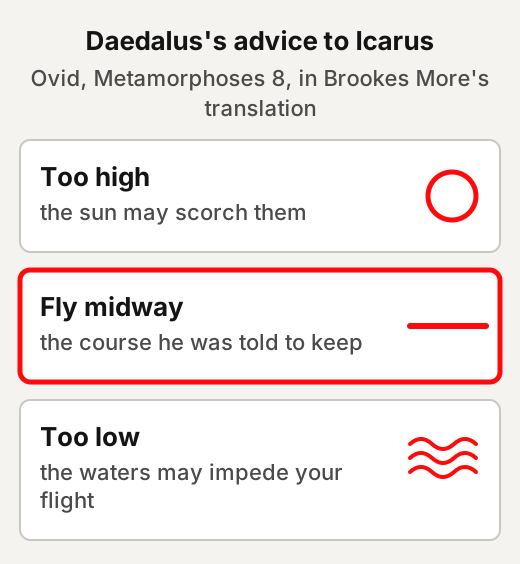
In Ovid’s Metamorphoses, Daedalus makes wings for himself and his son, and warns him before they fly. In Brookes More’s 1922 translation: “if your pinions dip too low the waters may impede your flight; and if they soar too high the sun may scorch them. Fly midway”. The Latin ends the warning with inter utrumque vola: fly between the two.
Our reading: the warning names two ways to fail, overreaching and playing so safe that the sea drags you down. For example, a plan for a new project can fail by promising too much, or by being so cautious that it never gets started.
Midas: “the Midas touch”
Doesn't hold up In the myth, the golden touch is a blessing. In Ovid it is a wish Midas comes to hate, and he begs the god to take it back.
How sure: Strong Ovid tells the story plainly, and the Latin matches the translation.
In Ovid, the god Bacchus lets King Midas choose a reward, and Midas asks that whatever he touches should turn to gold. His bread turns to gold when he touches it, and so does the wine in his mouth. Ovid says he “hated all he had so lately longed for”, and Midas prays to be saved “from this curse that looked so fair”. Bacchus sends him to wash at the source of the river that flows by Sardis, and the gold leaves him for the stream.
Ovid is not done with him. Midas, “abhorring riches”, goes to live in the woods and fields. When he calls the verdict of a music contest in Apollo’s favour unjust, Apollo gives him the ears of an ass. The servant who cuts his hair whispers the secret into a hole in the ground, and the reeds that grow there repeat it.
Today “the Midas touch” means a knack for large profits or for getting good results. Our reading: as a compliment, the phrase works. The story itself is a warning about getting exactly what you asked for. For example, before you set a goal that is a single number, ask what it would cost you if you hit that number and nothing else improved.
Narcissus: “He fell in love with his own looks”
Partly Narcissus is a story about a young man who loved his own looks. In Ovid he does love what he sees, but for most of the story he does not know the face is his.
How sure: Strong for Ovid’s text — though ancient writers already told the story in more than one way.
In Ovid, a seer tells Narcissus’s mother that he may live long “if he but fail to recognize himself”. The nymph Echo, whom the goddess Juno has punished so that she can only repeat the last words of others, falls in love with him and is turned away. After he scorns many others, the goddess Nemesis grants one rejected lover’s prayer that he too should love and be denied.
At a spring he sees his reflection and, Ovid says, “He knows not what he there beholds”. Only later does he say, “‘Tis I in thee—I love myself”. He wastes away, and a flower grows where his body had been.
The Greek travel writer Pausanias called it “utter stupidity” to think a young man could not tell a person from a reflection. He reports a less popular story in which Narcissus grieves for a twin sister and knows that he is looking at himself.
Our reading: in Ovid the tragedy turns on not recognising yourself, which is close to the opposite of plain vanity. For example, when a description of your habits sounds like it is about someone else, it can be worth asking whether it is you after all.
3. Fire, a jar and Hope
Hesiod tells Prometheus and Pandora as one story: fire stolen for humans, and a price paid for it.
Prometheus: “Punished forever for giving us fire”
Partly Prometheus was punished forever for giving fire to humans. In Hesiod he steals fire and is chained; Heracles kills the eagle, but the same poem says strong bonds still hold him.
How sure: Moderate Hesiod’s own lines pull two ways, and a later mythographer frees him outright.
In Hesiod’s Works and Days, Zeus hides fire, and Prometheus steals it back for humans “in a hollow fennel-stalk”. Zeus answers: “I will give men as the price for fire an evil thing”.
In Hesiod’s Theogony, Zeus binds Prometheus and sends an eagle to eat his liver, which grows back each night. Then Heracles kills the eagle and releases him, “not without the will of Olympian Zeus”. Yet the poem ends the story by saying that Prometheus did not escape Zeus’s anger, and “strong bands confined him”. In Apollodorus’s Library, Heracles shoots the eagle “and he released Prometheus”.
Today Promethean can mean “boldly creative” or “defiantly original”. Our reading: Hesiod’s story is less about heroic defiance than about cost: a great gain arrives with a price attached. For example, when a new app saves you an hour a day, it is worth asking what it takes in return, in attention, data or money.
Pandora’s box
Partly Pandora opened a box and let the world’s troubles out. In Hesiod she lifts the lid of a great jar and the troubles scatter; the “box” came much later.
How sure: Strong Hesiod’s word means a jar, and a scholarly review traces the box to Erasmus.
In the Works and Days, the gods make a woman at Zeus’s command, and she is called Pandora “because all they who dwelt on Olympus gave each a gift”. Epimetheus, Prometheus’s brother, accepts her, although Prometheus had told him never to take a gift from Zeus. Then “the woman took off the great lid of the jar”, and troubles scattered among men. Hesiod’s Greek word for the jar is pithos.
A review in Bryn Mawr Classical Review calls the box “Erasmus’s well known mistake”. The review says Erasmus wrote that the vessel was a pyxis, a box, and adds: “hence today’s notion of ‘opening a Pandora’s box’”. In Hesiod’s other telling, in the Theogony, the woman made “as the price of fire” is not named, and there is no jar at all.
Our reading: Hesiod tells it as Zeus’s punishment for the stolen fire. The detail people skip is Epimetheus, who took a gift he had been warned about. For example, if you were once told to be wary of a certain kind of offer, that warning is worth remembering on the day the offer looks attractive.
Hope in the jar
Still argued Hope was left in the jar to comfort us. Hope did stay inside, but scholars still disagree on whether that is good news.
How sure: Unsettled readers have argued over this passage since ancient times, and no single reading has settled it.
In Hesiod: “Only Hope remained there in an unbreakable home within under the rim of the great jar”, because the lid was shut “by the will of Aegis-holding Zeus”. The Bryn Mawr review lists the questions still argued over, starting with whether the jar held goods or evils. The others are whether Elpis (Expectation or Hope) is good or evil, and whether the jar keeps her away from people or stores her for them.
One scholar notes that most modern scholars have seen her as a “deluded hope”. The same abstract notes that many of these scholars also find something uplifting in her, such as “a bright spot”. Another reading, held by the ancient critic Aristarchus and some modern scholars, takes her as the expectation of ills. The abstract’s own argument is that Hope and her enclosure in the jar “hold no positive connotation” in Hesiod’s story.
Our reading: we cannot settle this, and the open question is more useful than a neat moral. The same word can mean hope or expectation. For example, when a plan rests on “it will probably be fine”, ask which one you are leaning on. Is it hope that keeps you working, or an expectation that stops you checking?
4. Stories from Troy
Four lessons from the Trojan War come from different texts, and two of them are not where people expect.
Achilles’ heel
Doesn't hold up In Homer, Achilles could be wounded only in his heel. Homer’s Achilles bleeds when a spear grazes his arm; the dip in the Styx and the heel come from later writers.
How sure: Strong the wound is in the Iliad itself, and the later texts show where the other parts come from.
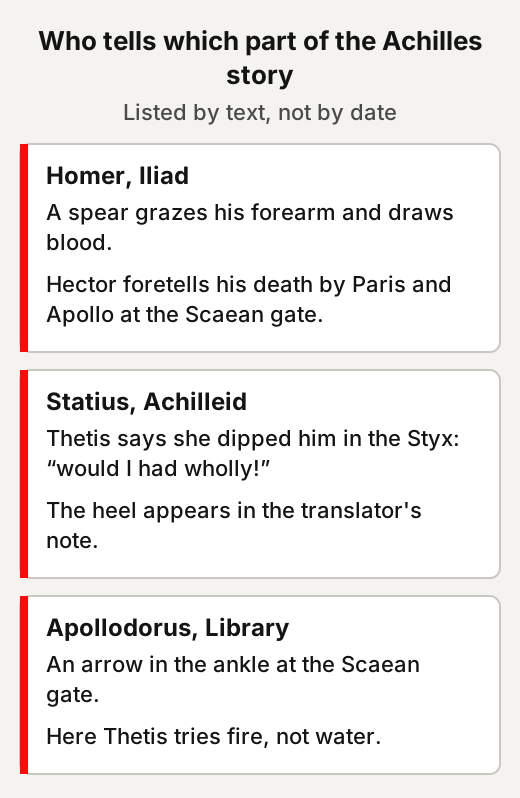
In the Iliad, a spear “smote the right forearm of Achilles a grazing blow, and the black blood gushed forth”. Homer does foretell his death: the dying Hector warns of the day “when Paris and Phoebus Apollo shall slay thee” at the Scaean gate.
In the Achilleid, a Latin poem by Statius, his mother Thetis says she fortified him at birth “with the stern waters of Styx”, and wishes she had done it “wholly”. Statius does not name the heel; his 1928 translator’s note does: “all except the left heel by which she held him”. Servius, an ancient commentator on Virgil, says Thetis dipped him in the Styx and his whole body could not be wounded, except the part by which she held him. In the Latin Fabulae credited to Hyginus, Apollo, disguised as Paris, shoots him in the ankle, “which he is said to have had mortal” (our translation). The classicist Jonathan Burgess concludes that the Styx story “probably did not exist in early Greek myth”. He also finds evidence of an early story in which Achilles was brought down by “a lower wound”.
The arrow in the ankle is also told by Apollodorus, whose Library retells the Greek myths; a writer like this is called a mythographer. He writes that “Achilles was shot with an arrow in the ankle by Alexander and Apollo at the Scaean gate”. Elsewhere in his Library he says Paris was afterwards surnamed Alexander. And in his account, Thetis tries to make her baby immortal with fire, not water, and is stopped by the child’s father.
Today an Achilles’ heel means “a seemingly small but actually crucial weakness”. Our reading: Homer’s Achilles is not invulnerable with one secret flaw; he is a mortal who has been told he will die. For example, instead of hunting for your one fatal weakness, it can help to list the ordinary ways a plan could go wrong.
The Trojan horse
Doesn't hold up The Trojan horse story comes from Homer’s Iliad. There is no wooden horse in the Iliad; it is sung about in the Odyssey and told at length in Virgil’s Aeneid.
How sure: Strong a search of a full English Iliad finds no wooden horse, and the Odyssey names it.
We searched Samuel Butler’s English translation of the Iliad: the wooden horse never appears, and its builder Epeius appears only as an athlete at funeral games. In the Odyssey, Odysseus asks the singer Demodocus to “sing of the building of the horse of wood, which Epeius made with Athena’s help”. The singer tells how the Greeks “poured forth from the horse” and sacked the city. Virgil’s Aeneid tells it from inside Troy, as the Trojans haul the horse through a breach in their own walls.
Our reading: the story is ancient, but naming the right book matters when you quote it. For example, “as the story goes” is a safe way to tell it; “as Homer wrote in the Iliad” is not.
Laocoön: “Beware of Greeks bearing gifts”
Holds up “Beware of Greeks bearing gifts” comes from the story of the Trojan horse. It comes from the priest Laocoön in Virgil’s Aeneid, who guessed the trick and was not believed.
How sure: Strong the line is in Virgil’s Latin; the English proverb is a translation of it.
In the Aeneid, the priest Laocoön runs down from the citadel to warn the Trojans. His first guess is the right one: “The Achaean hides, caged in yonder beams”. He names other dangers too, and ends: “Trust not this horse, O Troy, whate’er it bode! I fear the Greeks, though gift on gift they bear”. In Latin: quidquid id est, timeo Danaos et dona ferentis. The Phrase Finder translates it “Whatever it is, I fear the Greeks even when they bring gifts”, and notes that the English version is a translation.
He hurls a spear into the horse’s side, and its hollow belly rumbles. Then two serpents kill him and his two sons, and the Trojans take it as his punishment for striking the “blessed wood”.
Our reading: the sting is in what happened next. Laocoön was right, and the Trojans read his terrible death as proof that he was wrong. For example, if someone warned against a plan and then had bad luck of their own, their warning can still be right.
Cassandra: “Don’t be such a Cassandra”
Doesn't hold up In the myth, Cassandra is a pessimist whose warnings come to nothing. In the plays and poems, Cassandra is right; her curse is that nobody believes her.
How sure: Strong a tragedy gives the curse in her own words, and Virgil repeats it.
In Aeschylus’s Agamemnon, Cassandra says that Apollo gave her the gift of prophecy and that she broke her promise to him: “I consented to Loxias but broke my word”. Since then, she says, “I could persuade no one of anything”. In the Aeneid, she foretells the city’s fall as the horse is set up in the citadel, but the Trojans are “doomed to unbelief”.
In the Iliad, she appears as the fairest of Priam’s daughters, and as the first to see her father bring Hector’s body home. Neither of the Iliad’s two passages about her mentions prophecy.
The American Heritage Dictionary’s sense stays close to the myth: “One that utters unheeded prophecies”. Our reading: calling any gloomy person a Cassandra drops the point of the story, which is that she was right. For example, when a warning keeps being waved away, ask how often the person giving it has been right before.
5. Endless work
The image of Sisyphus is ancient; the reason for his punishment, and its meaning, depend on who tells it.
Sisyphus: “Punished for cheating death”
Partly Sisyphus was punished for cheating death. Some later commentators do blame his escape from death, others give other crimes, and Homer gives no reason at all.
How sure: Moderate Homer’s silence is plain, but the other reasons reach us through a translator’s notes and later writers.
In the Odyssey, Odysseus sees Sisyphus in the underworld “seeking to raise a monstrous stone with both his hands”; each time it nears the top, it rolls back down. The translator James Frazer notes that “Homer does not say why Sisyphus was thus punished”. Apollodorus says it was for telling a father that Zeus had secretly carried off his daughter Aegina. Frazer adds that Hyginus gives impiety as the cause, and that an old commentary on Homer tells how Sisyphus “laid Death himself by the heels”. Smith’s Dictionary of Greek and Roman Biography and Mythology says the reasons “are not the same in all authors”. In one version, it says, his refusal to go back to the underworld “is said to be the cause of his punishment”.
Today Sisyphean means “endlessly laborious or futile”. Albert Camus ended his essay The Myth of Sisyphus with a different reading: “One must imagine Sisyphus happy”. Our page on existentialism looks at what Camus meant.
Our reading: the myth supplies the labour, and each teller supplies its meaning. For example, when a task comes round again and again, such as the dishes or a weekly report, the story you tell yourself about it is yours to choose.
6. How to check a myth’s source yourself
You can trace most of these lessons in an evening, with translations you can read online and a dictionary.
- Write down the lesson as you heard it, and the story it comes from.
- Find which ancient text tells the story: a dictionary entry or a translator’s notes often name it.
- Read the passage in a primary source, the ancient text itself in a translation, and note the book and line numbers.
- Read the lines before and after: for Icarus, Midas and Laocoön, the part that changes the lesson is only a few lines away.
- Check whether the detail you care about is in the oldest text or was added later, as the heel was.
- If two ancient writers disagree, say so, as Pausanias did about Narcissus.
For example, Icarus took us two steps: an old translation of Ovid gave the warning about flying too low, and the Latin confirmed it says “between the two”.
Quick answers
What is the real lesson of Icarus?
In Ovid, Daedalus tells Icarus to fly midway, because the sea may weigh down his wings if he flies too low and the sun may scorch them if he flies too high. The story warns against both extremes, not only against aiming high.
Was it Pandora's box or Pandora's jar?
A jar. In Hesiod's Works and Days, Pandora lifts the lid of a great jar, and Hesiod's Greek word is pithos. A scholarly review calls the box Erasmus's well known mistake.
Is Achilles' heel in Homer?
No. In the Iliad, Achilles bleeds when a spear grazes his forearm. The dip in the Styx is in Statius's Achilleid, the arrow in the ankle is in Apollodorus and Hyginus, and the commentator Servius says only the part his mother held could be wounded.
Who said "Beware of Greeks bearing gifts"?
The priest Laocoön, in Virgil's Aeneid. His first guess was that Greeks were hiding inside the horse, and the English proverb is a translation of his Latin line.
Why was Sisyphus punished?
Homer does not say. Apollodorus says it was for revealing that Zeus had carried off Aegina, and Frazer's notes add that Hyginus gives impiety. Other stories have him trick Death and escape the underworld, and some later commentators give that escape as the reason for the stone.
Use this
Before you lean on a myth's lesson, read the ancient passage it comes from, and the lines around it.
Does the story say what the lesson says, or only part of it?
Quick quiz
Nothing is scored or saved. Recalling it once now is what makes it last.
1. In Ovid, what else did Daedalus warn Icarus about, besides flying too high?
Answer: Flying too low, near the sea.Read it again ↑
2. In Hesiod's Works and Days, what did Pandora open?
Answer: A great jar.Read it again ↑
3. What was Laocoön's first guess about the wooden horse?
Answer: Greeks were hiding inside it.Read it again ↑
How we checked this · Last checked October 2026
- We read each story in an online translation of the ancient text, on the Perseus Digital Library, Project Gutenberg or the Internet Archive, and checked key lines against the Latin or Greek where we could.
- For the Iliad's silence on the wooden horse and on Cassandra's prophecy, we searched a full English translation; an absence is only as good as the search, so the How sure lines say what we searched.
- The debate about Hope in Pandora's jar rests on a scholarly book review and a conference abstract that survey the positions; we did not read the books they discuss.
- We did not read every ancient version of these myths, so "in Hesiod" or "in Ovid" means that text, not every telling.
- Our wording on Camus's Sisyphus matches our existentialism page.
Sources
Ovid
- Ovid, Metamorphoses 3.339–510 (Narcissus and Echo), 8.183–235 (Daedalus and Icarus) and 11.85–193 (Midas), trans. Brookes More (1922), Perseus Digital Library; Latin text of books 3, 8 and 11 at The Latin Library.Primary
- Pausanias, Description of Greece 9.31.7–8, trans. W. H. S. Jones (Loeb, vol. 4, 1935), Perseus Digital Library.Primary
Hesiod and Pandora
- Hesiod, Works and Days 42–105 and Theogony 507–616, trans. H. G. Evelyn-White (1914), Perseus Digital Library (Works and Days, Theogony); Greek text of Works and Days; the same translation in full at Project Gutenberg #348.Primary
- E. F. Beall, review of I. Musäus, Der Pandoramythos bei Hesiod und seine Rezeption bis Erasmus von Rotterdam (2004), Bryn Mawr Classical Review 2006.07.16.Primary
- K. Cheshire, “Pandora’s Pithos and the Hope of Fools”, paper abstract, Society for Classical Studies annual meeting.Scholarly
Troy
- Homer, Iliad 13.361–369, 21.161–170, 22.337–366 and 24.677–702, trans. A. T. Murray (1924), Perseus Digital Library; full text searched in Samuel Butler’s translation (Project Gutenberg #2199).
- Homer, Odyssey 8.469–520 and 11.593–600, trans. A. T. Murray (1919), Perseus Digital Library.
- Statius, Achilleid 1, trans. J. H. Mozley (Loeb, 1928), vol. 2, Achilleid 1.269–270 (Internet Archive scan); Latin text at The Latin Library.Primary
- Servius, commentary on Virgil’s Aeneid 6.57, ed. G. Thilo, Perseus Digital Library.Primary
- Hyginus, Fabulae 107 (“Armorum iudicium”), Latin text at The Latin Library.
- J. Burgess, “The Death and Afterlife of Achilles”, Rorotoko interview (2009).
- Apollodorus, The Library 1.9.3, 2.5.11, 3.12.5, 3.13.6 and Epitome 5.3, trans. J. G. Frazer (1921), with Frazer’s notes, Perseus Digital Library.Primary
- Virgil, Aeneid 2.40–56, 199–233 and 234–249, trans. T. C. Williams (1910), Perseus Digital Library; Latin text at The Latin Library.Primary
- Aeschylus, Agamemnon 1202–1212, trans. H. W. Smyth (1926), Perseus Digital Library.Primary
- Sophocles, Ajax 664–665, ed. and trans. R. C. Jebb (1893), Perseus Digital Library.Primary
- Phrase Finder (G. Martin), “Beware of Greeks bearing gifts”.Popular
Words and later readings
- The American Heritage Dictionary of the English Language, 5th edition, entries “Achilles’ heel”, “Cassandra”, “Midas touch”, “mythographer”, “Promethean” and “Sisyphean”.Scholarly
- W. Smith (ed.), A Dictionary of Greek and Roman Biography and Mythology, “Sisyphus”, Perseids.
- R. Aronson, “Albert Camus”, Stanford Encyclopedia of Philosophy.Scholarly
Use a myth as a question, not a slogan
Three of Ovid's stories here carry a second warning that the popular lesson leaves out. Our view: these stories are most useful as questions you ask before a decision. A slogan tells you what to think; a question makes you look.
Three checks drawn from Ovid's stories
- Name both ways to fail. Daedalus told Icarus to fly midway, between sea and sun. Our suggestion: for your next plan, write one sign of overreaching and one of playing too safe. Check both halfway through.
- Add a second measure. Midas got his golden touch, then begged to lose it when his bread turned to gold. Our suggestion: pair any number goal with one thing that must not get worse.
- Ask for an outside view. For most of Ovid's story, Narcissus does not know the face is his. Our suggestion: ask someone you trust how one of your habits looks from outside.
This week: price one gain
In Hesiod, fire came with a price. Our suggestion: pick one thing you took on this year, such as a tool, a habit or a commitment. Write what it gives you and what it asks of you each week. At the week's end, decide whether to keep it as it is.
Keep a record of the warnings you hear
- Write the warning down. In Aeschylus, Cassandra is right and nobody believes her. Our suggestion: note who warned you, what they expected, and the date.
- Look again once it's settled. Our suggestion: when you know how things went, mark whether the warning came true.
- Log your own warnings too. Our suggestion: add the warnings you give others. The same record shows how often you were right.
Put myth-checking to paid use
- Offer to check the myths in talks, slides or articles, naming the ancient text and book for each.
- Make short posts or videos that set a popular lesson beside a short line from the ancient text. Credit the author and the translator.
- Draw simple charts of which ancient text tells which part of a story, for writers' posts or presentations.
Ideas to explore, not financial or business advice. No result is promised.
Keep going
- Pre-mortemA free worksheet for a big decision: how it could fail, and what you would regret. Stays in your browser.
- Quotes that change when you read the next sentenceFamous lines read together with the sentence that follows them.
- Myth vs legend vs folkloreThree kinds of traditional story, and two meanings of the word myth.
- Existentialism, checkedWhat Camus wrote about Sisyphus, read beside Kierkegaard and Sartre.
- GlossaryPlain meanings for terms on this page, such as mythographer and primary source.