

Start hereIn the Greek fable, the hare loses because he lies down to sleep. Townsend's 1867 English ends: "Slow but steady wins the race." So which lesson is the story teaching?
Famous teaching stories change as they are retold. The morals get rewritten, the animals get swapped, and some stories pick up a famous name they never had. Below: 11 fables, parables and animal stories, the oldest versions we could read, and what each one can still teach you.
The verdicts
1. Where these stories come from
Most of these stories are older than their famous morals, and the old versions are easy to read for free.
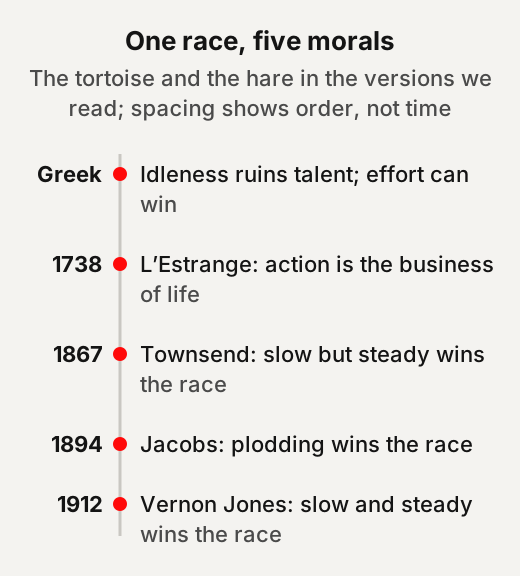
The dates are the editions we read, not the first time anyone told these stories. Older tellings can still turn up.
| Story | The oldest version we read | What changed |
|---|---|---|
| The tortoise and the hare | A Greek fable that blames idleness and praises effort | The moral was shortened to “slow and steady” |
| The fox and the grapes | The fox calls the grapes unripe | “Sour grapes” can also mean anger at losing |
| The boy who cried wolf | The flock is lost | Little; the moral holds |
| The ant and the grasshopper | A cicada in the Greek | English made it a grasshopper |
| The golden eggs | A hen in the Greek prose; a goose in Latin, and in Greek verse as a dictionary reads it | The goose won |
| The frog and the ox | A poor man aping the powerful | Little; the moral holds |
| The scorpion and the frog | A scorpion and a tortoise, in a Persian collection of the late 1400s | Now credited to Aesop |
| The Emperor’s New Clothes | A Spanish tale of the 1330s | Andersen added the child |
| The blind men and the elephant | Rival teachers likened to blind men who come to blows | “Everyone is partly right” |
| Lemmings | Lemmings move on, and some drown | A film showed “mass suicide” |
| The five monkeys | No experiment we could find | Told as a real study |
2. Aesop’s animals and the lessons pinned on them
The plots stay much the same from version to version, but the animals and the lesson at the end can change.
A fable is a usually short story that makes a moral point, often with animals that talk. We read the Greek versions in English and checked the old Latin ones where they differ.
“Slow and steady wins the race”
Partly The tortoise and the hare teaches that slow and steady wins the race. The Greek moral says two things: idleness ruins talent, and steady effort can win; “slow and steady” is later English wording.
How sure: Strong the Greek fable and several old English editions can all be read side by side.
In a Greek prose version, the hare lies down to sleep, sure of his fast feet, and wakes to find the tortoise has won. Laura Gibbs’s translation of its moral reads: “many people have good natural abilities which are ruined by idleness; on the other hand, sobriety, zeal and perseverance can prevail over indolence”.
George Fyler Townsend’s 1867 translation ends with the line “Slow but steady wins the race”. Roger L’Estrange’s 1738 edition says “Action is the Business of Life”. Joseph Jacobs’s 1894 retelling says “Plodding wins the race”, and Vernon Jones’s 1912 translation says “Slow and steady wins the race”.
The useful part: the hare did not lose because he was fast. He lost because he stopped. For example, if you are quick at something, the lesson is not to slow down; it is to finish before you rest.
“Sour grapes”
Partly “Sour grapes” means being bitter about something you did not get. In the fable it is more exact: the fox runs down the thing she failed to reach.
How sure: Strong Phaedrus’s fable and a current dictionary agree on the fox’s move.
In Henry T. Riley’s translation of the Latin poet Phaedrus, the fox cannot reach the grapes and leaves, saying: “They are not ripe yet; I don’t like to eat them while sour”. Phaedrus’s moral, in Riley’s words: “Those who disparage what they cannot perform, ought to apply this lesson to themselves”.
The American Heritage Dictionary still defines sour grapes as “Denial of the desirability of something after one has found out that it cannot be reached or acquired”. The Cambridge Dictionary describes someone who is “angry because they have not got or achieved something that they wanted”.
Our reading: the anger is a wider use; the fox’s trick is talking herself out of the wish. For example, if you hear yourself saying a job you missed “wasn’t that good anyway”, ask whether you thought so before you applied.
“The boy who cried wolf”
Holds up The moral is that liars are not believed even when they tell the truth. That is what the old versions say, and the whole flock pays for it.
How sure: Strong the Greek-based translations we read state this moral almost word for word.
In Townsend’s translation, the shepherd boy raises false alarms “three or four times”, and when the wolf really comes, no one helps. The wolf “at his leisure lacerated or destroyed the whole flock”, and the moral reads: “There is no believing a liar, even when he speaks the truth”. In Gibbs’s translation, too, “The whole flock was eaten by the wolf”.
The American Heritage Dictionary defines to cry wolf as “To raise a false alarm”. Our reading: the story is also about the flock. A false alarm costs the people who depend on you, not only you. For example, if you mark every email “urgent”, the real urgent one may be the one nobody opens.
“The ant and the grasshopper”
Partly The fable is about an ant and a grasshopper. It is in Townsend’s English, but the Greek insect is a cicada, and so is the French one.
How sure: Strong the Greek and French texts and two dictionaries agree.
The Greek prose title is “Τέττιξ καὶ μύρμηκες”, and the poet Babrius uses the same word, τέττιξ. The Greek–English Lexicon of Liddell and Scott defines τέττιξ as “cicala, Cicada plebeia or allied species”. Townsend’s English calls it a grasshopper, which the ants mock: “you must dance supperless to bed in the winter”.
Jean de La Fontaine’s fables open with “La Cigale et la Fourmi”. The Cambridge French–English dictionary translates cigale as cicada. His ant asks what the cicada did in the warm weather, then says: “Vous chantiez! j’en suis fort aise. / Hé bien! dansez maintenant”. Our plain English: “You sang! I’m very glad. Well then, dance now.”
Our reading: the story praises saving for winter; it does not make the ants kind. For example, put a little aside in a good month, and decide for yourself how you would answer the singer at your door.
“Killing the goose that lays the golden eggs”
Partly The golden eggs came from a goose. The bird changes by version: the translations we read have a hen, a Latin poem has a goose, and a dictionary reads a Greek verse version as one.
How sure: Moderate the texts are clear, but the bird changes from one version to the next.
The Greek prose title is “Ὄρνις χρυσοτόκος”, and Townsend’s translation calls the fable “The Hen and the Golden Eggs”. Liddell and Scott give ὄρνις as “bird, including birds of prey and domestic fowls”, give “hen” for the feminine word, and read it as “goose” in Babrius’s verse version. The Latin poet Avianus titles his version “de ansere ova aurea pariente”. The American Heritage Dictionary gives the Latin word anser as goose.
In Gibbs’s translation, the owner kills the hen expecting treasure and finds nothing. Her version’s moral is that “people often grasp for more than they need and thus lose the little they have”. The Cambridge Dictionary defines killing the goose as “to destroy something that makes a lot of money for you”.
The useful part: the bird changes, the lesson does not. For example, before you squeeze more out of something that pays a little every week, ask what happens if it stops paying at all.
“The frog that puffed itself up”
Holds up The frog and the ox warns against trying to match someone much bigger. Phaedrus says so in his first line, and he names envy as the frog’s reason.
How sure: Strong the Latin text and an old translation say it plainly.
Phaedrus’s version opens with the line “Inops, potentem dum vult imitari, perit”. Riley translates it: “The needy man, while affecting to imitate the powerful, comes to ruin”. The frog is “moved with envy at his vast bulk”, keeps puffing herself out, and bursts.
Townsend’s Greek-based version is a little different: a mother frog puffs herself out to ask how big the beast was. Her son warns that she “would, I assure you, sooner burst than successfully imitate the hugeness of that monster”. For example, if you notice you are buying something mainly to keep up with a richer friend, the frog is a good picture to keep in mind.
3. Stories credited to the wrong source
Two famous stories carry a label that is not theirs: one is not Aesop’s, and one was not Andersen’s idea.
“The scorpion and the frog, Aesop’s fable”
Doesn't hold up The scorpion and the frog is one of Aesop’s fables. It is not in the Aesop collections we searched; the closest story we found is in a Persian collection of the late 1400s.
How sure: Moderate the Aesop lists we searched lack it; we could not open the earliest frog versions.
Townsend’s 300 Aesop fables include no scorpion-and-frog story; the only scorpion is in “The Boy Hunting Locusts”. Laura Gibbs’s online list of Perry’s numbered Aesop fables, up to number 584, has one scorpion title: “The Boy and the Scorpion”.
The Persian Anwar-i-Suhaili is a collection that its translator, Arthur Wollaston (1877), dates to the end of the fifteenth century. In it, a tortoise carries his friend the scorpion across a river. The scorpion starts stinging, and explains: “my nature leads me to sting whether the wound be upon the back of my friend, or the bosom of my enemy”. The tortoise is safe, because the sting “will take no effect on my stone-like back”.
Aesop does have a cousin: in Townsend’s “The Farmer and the Snake”, a frozen snake revives, and “resuming its natural instincts, bit its benefactor”. Our reading: in the Persian version the scorpion’s nature still shows, as the story says, but the shell means it does no harm. For example, if you help someone with a known habit of letting people down, help in a way that a let-down cannot sink you.
“The Emperor’s New Clothes”
Doesn't hold up The Emperor’s New Clothes was Hans Christian Andersen’s own idea. Andersen said the whole idea came from a Spanish tale by Prince Don Juan Manuel, and the child was a late change.
How sure: Strong Andersen’s own 1837 note, as quoted by a scholar, and a 1949 facsimile of his manuscript both show it.
In a note in the 1837 booklet, Andersen wrote: “Hele den morsomme Idee skylde vi Prinds Don Juan Manuel”. Our plain English: “We owe the whole amusing idea to Prince Don Juan Manuel.” The source is a tale in Don Juan Manuel’s El conde Lucanor, which Chávez Vaca dates to 1330–1335.
In that tale, tricksters weave a cloth that only a man who is truly his father’s son can see. The one who speaks up is “un negro que guardaba el caballo de Rey et que non había que pudiese perder”. Our plain English: a Black man who looked after the king’s horse and had nothing to lose. He tells the king: “que yo so ciego, o vos desnudo ides”. Our plain English: “either I am blind, or you are going naked.”
A 1949 facsimile of Andersen’s manuscript shows his first ending, in which the emperor plans to wear the suit at every procession and the whole town talks about his splendid new clothes. In the final ending, “Men han har jo ikke noget paa!” are a little child’s words. Our plain English: “But he has nothing on!” Chávez Vaca, citing the biographer Jackie Wullschlager, writes that Andersen sent the new ending to the proofreader shortly before the book came out.
Our reading: in both versions the truth comes from someone with no standing to lose. For example, when you want honest feedback on a plan, ask the person who gains nothing by flattering you.
4. A parable with more than one teller
The blind men and the elephant is told in several traditions, and each telling points its lesson somewhere slightly different.
A parable is a simple story that teaches a moral or religious lesson. We describe what each text says, not which view of it is right.
“The blind men and the elephant”
Partly The parable teaches that every side holds part of the truth. The famous English poem says each was “partly in the right”; the older versions point at the quarrel, or at the darkness, not at who was right.
How sure: Strong the Buddhist, Persian and English texts can all be read in English.
In the Udāna, a Buddhist text, rival teachers argue, and some say of their view: “This is the only truth, anything else is futile”. In the story told about them, a king has people blind from birth each shown one part of an elephant. They describe it as a pot, a winnowing fan, a pillar and more, then “punched each other with their fists”. The closing verse, in Bhikkhu Sujato’s translation, reads: “Arguing, they dispute, / the folk who see just one part”.
In Rumi’s Masnavi, in R. A. Nicholson’s translation from the Persian, people feel an elephant in a dark house. Rumi adds: “If there had been a candle in each one’s hand, the difference would have gone out of their words”.
John Godfrey Saxe’s English poem on the story was printed in an 1872 edition of his poems. In it, the lines “Though each was partly in the right, / And all were in the wrong!” close the story. Our reading: even the poem’s line about being partly right goes on to say all were wrong. For example, in a disagreement, ask which part of the problem you have actually touched before you describe the whole thing.
5. Animal “facts” that are really stories
Two stories about animals are told as facts, but one was spread by a film and the other rests on no study we could find.
“Lemmings jump off cliffs together”
Doesn't hold up Lemmings follow each other off cliffs in mass suicide. Lemmings move on when food runs short, and some drown crossing water; they do not kill themselves.
How sure: Moderate two wildlife biologists, quoted by Alaska’s wildlife department, say so plainly.
An article from the Alaska Department of Fish and Game opens with the sentence “Lemmings do not commit mass suicide”. A state wildlife biologist, Thomas McDonough, called it “a complete urban legend” and said he thought it grew out of proportion because of a nature documentary of the 1950s. The article names the film as “White Wilderness” of 1958 and reports that a 1983 Canadian television investigation found the lemming scenes were faked.
The article explains that lemmings disperse when they have used up the local food. It adds that they “can swim and will cross bodies of water in their quest for greener pastures”. It also says: “Sometimes they drown”. Our reading: “like lemmings” describes a film more than an animal. For example, before you use an animal as a lesson about people, ask where the footage or the fact came from.
“The five monkeys and the ladder”
Can't confirm An experiment showed caged monkeys stopping newcomers from climbing a ladder to bananas. We could not find any published study that describes it.
How sure: Limited not finding a study is not proof there never was one.
A search of the medical research database PubMed for “monkeys ladder bananas” returned a single paper, about scalp surgery. A search of Europe PMC, another research database, found no report of it either.
Our reading: the story works as a parable about habits nobody questions, and it can be told as one. For example, when someone says “we have always done it this way”, ask what the rule was first for; you do not need a monkey study to do that.
6. Stories we have looked at elsewhere
A few more teaching stories are covered on other pages, so they get one line each here.
- “God helps those who help themselves” is not in the King James text; the idea appears in an Aesop fable, and the wording in Franklin’s sayings. See lines people think are in the Bible.
- For the boiling frog, the evidence is old and mixed, and it turns on how slowly the water is heated. See animal mindsets, checked.
- The two wolves story is on our page about proverbs credited to other cultures.
- Icarus, Pandora, Midas, Achilles and the Trojan horse are on our page about myths used as life lessons.
More pages like this one are gathered on Quotes, sayings and stories, checked.
7. How to trace a fable yourself
You can check most fables in a few minutes with a free translation and one older text.
- Write down the story and the moral as you heard them.
- Find the fable in a free translation, such as Townsend’s Aesop, and read its ending.
- Look for the older Greek or Latin version, and compare the animals and the moral.
- Check who is credited: a numbered list of Aesop’s fables shows what is in the main collection.
- Ask whether a translator, a poet or a film added the part you remember best.
- When you pass it on, say “the oldest version we found”, not “the original”.
For example, the golden eggs took four steps: Townsend’s hen, the Greek word, a dictionary that reads one Greek version as a goose, and a Latin goose.
Quick answers
Is the scorpion and the frog one of Aesop's fables?
It is not in the Aesop collections we searched. Townsend's 300 fables have no scorpion-and-frog story, and the closest story we found is a Persian fable about a scorpion and a tortoise, from a collection made in the late 1400s.
What is the original moral of the tortoise and the hare?
In a Greek prose version, the moral is that good natural abilities can be ruined by idleness, while sobriety, zeal and perseverance can win. "Slow but steady wins the race" is the moral in Townsend's 1867 English translation.
Where does The Emperor's New Clothes come from?
Andersen credited the whole idea to Prince Don Juan Manuel, whose El conde Lucanor has a tale of tricksters weaving a cloth that only a true son can see. There, a Black man who looked after the king's horse speaks up; Andersen's child was a late change.
Do lemmings really jump off cliffs?
No. Lemmings move on when food runs short, and some drown crossing water, but they do not kill themselves. An Alaska wildlife article reports that the lemming scenes in a 1958 nature film were faked.
What does sour grapes mean in the fable?
The fox cannot reach the grapes and says they are not ripe anyway. The American Heritage Dictionary defines sour grapes as denying you wanted something once you find you cannot have it.
Use this
Before you lean on a fable's moral, read the oldest version you can find.
Does this moral come from the story itself, or from the person who retold it?
Quick quiz
Nothing is scored or saved. Recalling it once now is what makes it last.
1. In the Greek fable, why does the hare lose the race?
Answer: He lies down to sleep.Read it again ↑
2. What insect is in the Greek version of the ant fable?
Answer: A cicada.Read it again ↑
3. Who did Andersen credit with the idea of The Emperor's New Clothes?
Answer: Prince Don Juan Manuel.Read it again ↑
How we checked this · Last checked October 2026
- We read the fables in Townsend's 1867 translation from the Greek, in Laura Gibbs's translations and Chambry's Greek texts on her Aesopica site, in Riley's Phaedrus with the Latin, and in La Fontaine's French.
- We read Andersen's two endings on the H. C. Andersen Centre's manuscript page, his 1837 note as quoted in Chávez Vaca's 2021 article, and the Spanish tale in a 1920 edition of El conde Lucanor.
- We read the elephant parable in the Udāna (Sujato's translation), Rumi's Masnavi (Nicholson's 1930 translation) and Saxe's poem. We did not find a Jain version we could open, so it is left out.
- We could not open the 20th-century novels and the 1955 film usually named for the scorpion and the frog, so we make no claim about when it was first printed.
- For the five monkeys we searched PubMed and Europe PMC on 27 October 2026 and found no study. Not finding one is not proof there never was one.
- The translations marked as our plain English are ours. Gibbs's translations are in copyright, so we quote them only briefly.
Sources
Aesop and the old fable collections
- Three Hundred Æsop’s Fables, literally translated from the Greek by G. F. Townsend (London: Routledge, 1867) (Project Gutenberg #21).Primary
- L. Gibbs, Aesopica: Perry index, with her translations from Aesop’s Fables (Oxford World’s Classics, 2002) for Perry 226, Perry 210 and Perry 87; Greek texts from Chambry’s edition (Chambry 336, Chambry 287); Latin text of Avianus (fable 33).Scholarly
- D. L. Ashliman, “The Tortoise and the Hare and other races between unequal contestants”, University of Pittsburgh (L’Estrange 1738, Jacobs 1894 and Vernon Jones 1912 versions).Scholarly
- The Fables of Phædrus, trans. H. T. Riley (Project Gutenberg #25512), I.24 and IV.3; Latin text of Book I at The Latin Library.Primary
- J. de La Fontaine, Fables I.1, “La Cigale et la Fourmi” (Paris: Garnier, 1868) (Project Gutenberg #56327).Primary
- H. G. Liddell and R. Scott, A Greek–English Lexicon, entries “τέττιξ” and “ὄρνις” (Perseus Digital Library).Scholarly
Andersen, Don Juan Manuel and the scorpion
- H. C. Andersen Centre, University of Southern Denmark, “Keiserens nye Klæder” (the manuscript and its two endings).Scholarly
- W. A. Chávez Vaca, “La deuda de H. C. Andersen”, Impossibilia 21 (2021), pp. 135–155.Scholarly
- Don Juan Manuel, El conde Lucanor, ejemplo XXXII, ed. F. J. Sánchez Cantón (Madrid: Calleja, 1920) (Project Gutenberg #65738).Primary
- The Anwár-i-Suhailí, or Lights of Canopus, trans. A. N. Wollaston (London: W. H. Allen, 1877), Book I, Story XVI (Internet Archive scan).Primary
The elephant, the lemmings and the monkeys
- Udāna 6.4, trans. Bhikkhu Sujato (SuttaCentral).Primary
- Jalaluddin Rumi, The Mathnawi, Book III, trans. R. A. Nicholson, vol. 4 (1930) (Internet Archive scan).Primary
- J. G. Saxe, “The Blind Men and the Elephant”, in The Poems of John Godfrey Saxe (Boston: Osgood, 1872) (Internet Archive scan).Primary
- R. Woodford, “Lemming Suicide Myth”, Alaska Fish & Wildlife News, Alaska Department of Fish and Game, September 2003.Popular
- PubMed search for “monkeys ladder bananas”, run 27 October 2026.Scholarly
- Europe PMC search for monkeys, ladder, banana and water, run 27 October 2026.Scholarly
Dictionaries
- The American Heritage Dictionary of the English Language, 5th edition, “sour grapes” and “cry wolf”.Scholarly
- Cambridge Dictionary, “sour grapes”, “kill the goose that lays the golden egg” and French–English “cigale”.Scholarly
A moral is one teller's reading
The same tortoise-and-hare story ends with a different lesson in each version we read. Our view: a moral is one teller's reading of the story. Read the story itself, then choose the lesson you can use.
Turn a fable into a question you use
- Pick one that fits now. Our suggestion: choose the fable closest to a problem you have this month.
- Write it as a question. Our suggestion: turn its moral into a yes-or-no question, such as "Am I resting before I finish?"
- Put it where you decide. Our suggestion: write it where you make that choice, such as your calendar or to-do list.
- Keep the ones that work. After a month, keep the questions that changed a decision, and drop the rest.
Goes with: 2. Aesop’s animals and the lessons pinned on them ↑
Say where your ideas came from
- Note it the same day. Our suggestion: when an idea comes from a book, talk or post, note where on the day you find it.
- Credit the source. Andersen credited the whole idea of The Emperor's New Clothes to Prince Don Juan Manuel. Our suggestion: when you reuse an idea, name its source.
- Say what you added. In the Spanish tale, a man who looked after the king's horse speaks up; Andersen's child was a late change. Our suggestion: say which part of your version is yours.
This week: bring a candle to one disagreement
In Rumi's Masnavi, as Nicholson translates it, people feel an elephant in a dark house. With a candle each, he says, their words would not have differed. Our suggestion: this week, in one disagreement, ask each person what they have seen before anyone describes the whole.
Put fable-tracing to paid use
- Offer to check fables and animal stories in drafts for writers and speakers, naming the oldest version you found.
- Retell old fables in your own words for books, audio or posts, and say which old version each follows.
- Draw simple charts of how one story's moral or animal changed across versions, for posts or videos.
Ideas to explore, not financial or business advice. No result is promised.
Keep going
- Who really said it?Search the lines we have checked, with what we found and a link to each full check.
- How to spot a fake quoteWhy quotes get pinned on famous names, and how to trace a line to the earliest copy you can find.
- Origin stories that are better than the truthEveryday words and phrases, the stories told about them, and what the oldest records show.
- Quotes that change when you read the next sentenceFamous lines read together with the sentence that follows them.
- GlossaryPlain meanings for terms on this page, such as fable and parable.