Start hereAt the start of the 1800s, a year of evening light from candles would have cost an average American worker almost one thousand hours of work. In the 1990s, the same light from a compact fluorescent bulb took about ten minutes' work. What happened in between?
Flip a switch and a room fills with light. For most of history, light after dark took fire, money and work. Below: what light was like before electricity, how it changed, what the numbers say now, three half-truths about it, and one small way to use it better.
1. Before electric light
Before electricity, light after dark was dim and cost hours of work.
A wax candle gives about 13 lumens, and a 100-watt filament bulb about 1,200. Lux measures how much light falls on a surface: one lux is one lumen spread over a square metre. The economist William Nordhaus estimated that in the candle age, a room lit by two candles had about five lux. An ordinary home had about one hundred when he wrote.
The cost is the striking part. Nordhaus worked out the price of light in hours of work. His example is one 100-watt bulb lit for three hours each night, which gives 1.5 million lumen-hours of light a year. At the start of the 1800s, getting that much light meant burning seventeen thousand candles. An average American worker would have toiled almost one thousand hours to buy them, Nordhaus estimated, using US wage records. When he wrote, in the 1990s, the same light from a compact fluorescent bulb took about ten minutes’ work.
In plain words, a year of evening light went from nearly a thousand hours of pay to about ten minutes. Nordhaus’s wider point was that ordinary price statistics missed most of that fall. He wrote that traditional price indexes “vastly overstate the increase in lighting prices over the last two centuries”.
For example, picture reading this page by two candles: about a twentieth of the light in an ordinary room.
2. How it changed, from gas lamps to LEDs
Light moved from flames to electricity in about two centuries, and each new kind was a big step up.
Nordhaus found that each new lighting technology was a major improvement over the one before. Between 1800 and 1992, he estimated, lighting became about nine hundred times more efficient. In his telling, progress in lighting was extraordinarily slow for most of human history, then extraordinarily rapid from about the Industrial Revolution until the early 1900s.
Gas, oil and the first electric light
Gas and oil lamps lit the 1800s; the first electric lights, arc lamps, were too glaring for most homes.
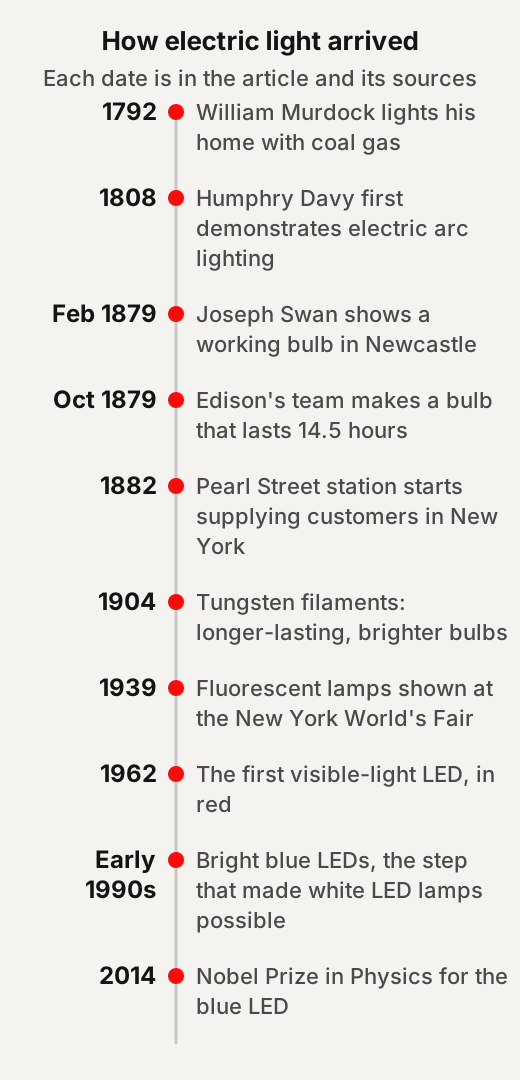
William Murdock, usually thought of as the father of gas lighting, tried it in his own home in 1792. In the first quarter of the 1800s, the great cities of Europe were lit by gas. Once petroleum was found in Pennsylvania, kerosene became a strong rival to gas.
Electric arc lighting, an open electric arc leaping between two carbon electrodes, was first demonstrated in 1808 by the chemist Humphry Davy. Its brilliant, glaring light was best suited to outdoor use or very large indoor spaces.
Sources give different dates for the first electric light. IEEE’s history dates Davy’s demonstration to 1808. The US Department of Energy says the first constant electric light was shown in 1835. Nordhaus dates the first lighting by arc lamp to as early as 1845. Our reading: they partly count different things, a demonstration, a steady light and light in use.
For example, an arc lamp suited a street or a large hall; a small sitting room still needed a flame.
Swan, Edison and the power station
Several inventors made electric bulbs; Edison’s team made a long-lasting one and the system to power it.
On 3 February 1879, Joseph Swan showed his incandescent lamp to more than seven hundred people in Newcastle, England. By October 1879, Edison’s team had a bulb with a carbonised cotton-thread filament that lasted 14.5 hours. A bamboo filament later gave Edison’s lamps a life of up to 1,200 hours.
Two inventors, two countries, the same year. Newcastle University’s library describes Edison’s work as “similar but independent”. In 1883 the two men went into business together as Edison and Swan United Electric.
An incandescent bulb is a glass bulb with a thin thread inside, the filament, that gives off light when electricity heats it. Edison’s bigger step was everything around the bulb. He modelled his lighting technology on the existing gas lighting system. To track how much electricity each customer used, he developed the first electric meter.
On 4 September 1882, his Pearl Street station in New York began supplying electricity to customers in a district of about a quarter of a square mile. On the first day there were some 85 customers with about 400 lamps. Within a year it served 513 customers and about 10,000 lamps. From January 1882, an Edison installation under the Holborn Viaduct in London had already shown that a central station worked.
Our reading: the bulb on its own mattered less than the network that fed it. For example, a bulb with no wires and no power station is only a glass ornament.
Fluorescent tubes and the blue LED
Fluorescent tubes and then LEDs gave far more light for the same electricity.
In 1904, European inventors made tungsten filaments, which lasted longer and gave brighter light than carbon. American lighting companies showed fluorescent lamps at the 1939 New York World’s Fair; they were about three times more efficient than incandescent bulbs. In 1962, Nick Holonyak Jr., working for General Electric, invented the first visible-light LED, in red.
An LED, or light-emitting diode, is a small semiconductor that turns electricity straight into light, with no filament. Red and green diodes had been around for a long time, but without blue light, white lamps could not be created. Isamu Akasaki, Hiroshi Amano and Shuji Nakamura produced bright blue light from their semiconductors in the early 1990s. They shared the 2014 Nobel Prize in Physics “for the invention of efficient blue light-emitting diodes which has enabled bright and energy-saving white light sources”.
For example, a white LED bulb in your kitchen exists because of that blue step.
3. What the numbers say now
Most people now have electricity, but 655 million people still had none in 2024.
In 2024, 92 per cent of the world’s people had electricity, leaving 655 million without it. Sub-Saharan Africa accounts for 86 per cent of the people without electricity. Since 2020, average yearly gains have fallen to around 0.35 percentage points, half the pace of 2010 to 2020. In low-income countries, 48.8% of people had electricity in 2024.
Put another way, about 8 in every 100 people still live without it, and progress has slowed. Our Factfulness summary uses the World Bank’s figures for the same year. The UN report says off-grid solar and mini-grids are especially suited to the low-income and remote areas where the gap remains.
Where light is everywhere, its scale is easy to miss. In 2020, almost 11 billion lamps were in use in Europe, more than 24 for every person in the EU. Among the products the EU’s ecodesign rules cover, lighting was the third-largest energy user in 2020. In 2014, announcing the prize, the Royal Swedish Academy of Sciences wrote that about one fourth of the world’s electricity was used for lighting.
For example, count the bulbs, tubes and lamps in your home and divide by the people who live there; the 2020 European figure was more than 24 each.
4. Half-truths people repeat
The common stories about light hold a real point, but each leaves part of the picture out.
“Thomas Edison invented the light bulb”
Partly Edison invented the light bulb. Edison’s team made a practical, long-lasting bulb and the system to power it, but others made electric lamps first.
How sure: Strong the US Department of Energy, IEEE’s history and the economist William Nordhaus all share the credit out.
The US Department of Energy says the light bulb “can’t be credited to one inventor”. IEEE’s history calls Edison, who turned to electric light in mid-1878, “a relative late-comer in the quest for practical incandescent lighting”. Nordhaus wrote that the first practical “glow lamps” were invented at the same time by Swan in England and Edison in the United States. The Department of Energy also names William Sawyer and Albon Man, who received a US patent for the incandescent lamp.
What holds up is the system. The Department of Energy says Edison’s contribution stands out because he developed a whole suite of inventions that made light bulbs practical. The earliest version found of his famous line about “several thousand things that won’t work” comes from his storage-battery work, not the bulb, as our comeback stories page shows.
For example, “Swan and Edison, building on earlier inventors” tells the story more fully than one name.
“It’s cheaper to leave a light on than to keep switching it off”
Partly Switching a light off and on costs more than leaving it on. It depends on the bulb; the guidance says to leave a light on briefly only for compact fluorescents.
How sure: Moderate this rests on one energy agency’s guidance, and its answer changes with the type of bulb.
The US Department of Energy says the cost-effectiveness of turning lights off depends on the type of bulb and the cost of electricity. It says incandescent lights should be turned off whenever they are not needed, because 90% of the energy they use is given off as heat. Switching shortens the life of compact fluorescent bulbs. For them, its rule of thumb is to leave the light on if you will be out of the room for 15 minutes or less. For LEDs, it says, the operating life is unaffected by turning them on and off.
The grain of truth is the fluorescent bulb: switching wears it out faster. The trade-off the Department describes is the cost of replacing bulbs worn out by switching, set against the electricity saved while they are off. It adds that, in general, the more energy-efficient a bulb is, the longer you can leave it on before switching it off pays.
For example, on the Department’s reading, switching a hallway LED off every time you leave does not shorten its life.
“LED bulbs give off no heat”
Partly LED bulbs produce no heat. LEDs give off far less heat than older bulbs, but they still make some.
How sure: Moderate two Department of Energy pages agree LEDs make some heat; how much depends on the lamp.
The Department of Energy says LEDs emit very little heat, while incandescent bulbs release 90% of their energy as heat and compact fluorescents about 80%. A 2007 Department of Energy fact sheet adds that “LEDs won’t burn your hand like some light sources, but they do produce heat”. Much of the electricity still turned into heat inside the lamp, the sheet explained, and it had to leave through the circuit board and heat sink rather than shining forward. For an incandescent bulb, the Department says, only about 10% of the energy becomes light.
For example, the Department notes that LED holiday lights are much cooler than incandescent ones, reducing the risk of burnt fingers.
5. One small way to use it better
When you buy a bulb, the lumens tell you how bright it is, not the watts.
The US Department of Energy says to compare lumens instead of watts to get the brightness you want. Its rule of thumb: to replace an old 60-watt bulb, look for one that gives about 800 lumens. In the US, the Federal Trade Commission requires a Lighting Facts label on bulb packages, showing brightness, yearly energy cost, lifespan and light appearance, from warm to cool. In the EU, light sources carry an energy label from A, the most efficient, to G, rescaled from 1 September 2021. The Department of Energy says residential LEDs, especially ENERGY STAR rated ones, use at least 75% less energy than incandescent lighting and last up to 25 times longer.
Lumens measure the light itself, so they let you compare any two bulbs. Watts only tell you how much electricity a bulb draws. And now and then, it is worth remembering what an evening of this light once cost.
For example, in a shop, choose between two bulbs by the lumens number on the box: the higher the number, the brighter the bulb.
Quick answers
Who really invented the light bulb?
No single person. Swan in England and Edison's team in the United States both made working incandescent bulbs in 1879, after earlier inventors had made electric lamps. Edison's team also built the power station, wires and meters around the bulb.
When did Edison's Pearl Street power station open?
Edison's Pearl Street station in New York began supplying customers on 4 September 1882. IEEE's history calls it the first permanent central power station for supplying incandescent lighting. An Edison installation in London had worked from January 1882.
How many people still live without electricity?
In 2024, 655 million people had no electricity, according to the UN's latest SDG report. Sub-Saharan Africa accounts for 86 per cent of them.
Do LED bulbs really use less energy?
Yes, according to the US Department of Energy: residential LEDs use at least 75% less energy than incandescent lighting and last up to 25 times longer. It also says LEDs emit very little heat, though they still make some.
Use this
Three small ways to notice the light you have and choose it well, drawn from the sources above.
What did this cost people before it became cheap?
Quick quiz
Nothing is scored or saved. Recalling it once now is what makes it last.
1. Who showed a working incandescent lamp in Newcastle in February 1879?
Answer: Joseph Swan.Read it again ↑
2. What did the 2014 Nobel Prize in Physics reward?
Answer: Efficient blue LEDs.Read it again ↑
3. According to the US Department of Energy, how does switching an LED on and off affect its life?
Answer: It does not affect it.Read it again ↑
How we checked this · Last checked October 2026
- We read William Nordhaus's study of the price of light in the NBER's copy of the chapter, and the US Department of Energy's history of the light bulb.
- The Department of Energy's Energy Saver pages no longer load at their old addresses, so we read the Internet Archive copies from May to July 2026.
- Sources date the first electric light differently, so the page gives all three dates and who gives each.
- The IEA publishes its own count of people without electricity, but its pages did not open for us, so we use the UN and World Bank figures; the World Bank figures are the ones our Factfulness summary uses.
- The Edison battery-work line comes from our reviewed comeback stories page.
- For LED heat we also read the Department of Energy's 2007 fact sheet on thermal management of white LEDs; we do not print its 2007 percentages, since LEDs have improved.
Sources
- William D. Nordhaus, “Do Real-Output and Real-Wage Measures Capture Reality? The History of Lighting Suggests Not”, in T. F. Bresnahan and R. J. Gordon (eds.), The Economics of New Goods (NBER and University of Chicago Press, 1996), pp. 27–70.Scholarly
- US Department of Energy, “The History of the Light Bulb” (22 November 2013).Primary
- US Department of Energy, Energy Saver pages: “LED Lighting”, “When to Turn Off Your Lights” and “Lumens and the Lighting Facts Label” (Internet Archive copies of May to July 2026; the pages no longer load at their old addresses).Primary
- US Department of Energy, Building Technologies Program, “Thermal Management of White LEDs” (fact sheet, February 2007).Primary
- IEEE History Center, Engineering and Technology History Wiki, “Milestones: Pearl Street Station, 1882”.Scholarly
- Newcastle University Special Collections, “Sir Joseph Swan – A Light that Never Goes Out” (27 June 2014).Popular
- Nobel Prize, “The Nobel Prize in Physics 2014: press release” (7 October 2014).Primary
- United Nations, The Sustainable Development Goals Report 2026, Goal 7.Primary
- World Bank, World Development Indicators, “Access to electricity (% of population)”.Primary
- European Commission, Energy-efficient products, “Light sources”.Primary
- Frank Lewis Dyer and Thomas Commerford Martin, Edison: His Life and Inventions (1910), Project Gutenberg, for the storage-battery story.Primary
Count the hours, not only the price
The economist William Nordhaus estimated the price of light in hours of an average American worker's pay. At the start of the 1800s, a year of evening candlelight would have cost almost a thousand hours. When he wrote, in the 1990s, a compact fluorescent bulb gave the same light for about ten minutes' work. Our view: when you compare past and present, count the hours of work, not only the price.
Look past the single inventor
- Name everyone involved. Joseph Swan showed a working lamp in Newcastle in February 1879. By October 1879, Edison's team had a bulb that lasted 14.5 hours.
- Ask what came before. IEEE's history calls Edison "a relative late-comer" to practical incandescent lighting. It dates Humphry Davy's first demonstration of arc lighting to 1808.
- Look for the system. The US Department of Energy says Edison modelled his lighting on the existing gas system. He also developed the first electric meter.
- Expect work done in parallel. Newcastle University's library describes Edison's work as "similar but independent". In 1883 Swan and Edison went into business together.
This week: learn which bulbs you have
Our suggestion: walk round your home and note each bulb's type: LED, compact fluorescent or incandescent. The US Department of Energy says whether switching off pays depends on bulb type and electricity cost. For compact fluorescents, it suggests leaving the light on for absences of 15 minutes or less. Our view: knowing your bulbs is the first step to using that guidance.
Read a bulb box in a minute
- Find the lumens. Our suggestion: check the old bulb before you shop. To replace an old 60-watt bulb, the US Department of Energy's rule of thumb is about 800 lumens.
- Read the US label. In the US, look for the Lighting Facts label, which the Federal Trade Commission requires on bulb packages. Our suggestion: read its yearly energy cost, lifespan and light appearance, not only brightness.
- Read the EU label. In the EU, light sources carry an energy label from A, the most efficient, to G. It was rescaled from 1 September 2021.
- Compare like with like. Our suggestion: hold two boxes side by side and compare the same lines, lumens first.
Keep going
- Factfulness, summarisedHans Rosling's ten instincts, his test of world facts, and which figures still hold.
- The printing pressWoodblocks in China, clay type, metal type in Korea, then Mainz: what Gutenberg added, and nine claims.
- Comeback stories from historySix well-loved comeback stories, checked against the record, with a verdict on each.
- Numbers that misleadTen ways true numbers tell a false story, with worked examples you can check.
- GlossaryPlain meanings of lumen, incandescent bulb and light-emitting diode, the terms used on this page.