Start hereIn 1800 a chemist wrote that a gas he had been breathing might be used during some surgical operations. More than forty years passed before ether was used in an operation. What happened in between, and since?
For most of history, an operation meant being awake for every moment of it. Below: what surgery was like before anaesthesia, how it changed in the 1800s, what the numbers say now, and one small way to appreciate it.
1. Surgery before anaesthesia
Before the 1840s, most patients were awake during surgery, so operations were rare and surgeons worked fast.
People did have remedies, but none made surgery painless. A history of pain relief in the Canadian Journal of Anesthesia lists alcohol, cannabis, mandrake and opium among the remedies used since ancient times. The same history says that before general anaesthesia, surgery was done only out of extreme necessity. A 2022 history of the first public ether operation says operations were generally done “with minimal or ineffective pain relief”.
Speed mattered. The Linda Hall Library describes surgery before anaesthesia as “carried out with the utmost speed”. Robert Liston, described as probably the best surgeon of his day, was “noted for his skill and his speed as an operator”.
For example, think of how a dentist’s numbing injection changes a filling, then imagine an operation with nothing like it.
2. How it changed
Pain relief for surgery arrived in a rush in the 1840s, after earlier steps in England and Japan.
Davy’s suggestion, 1800
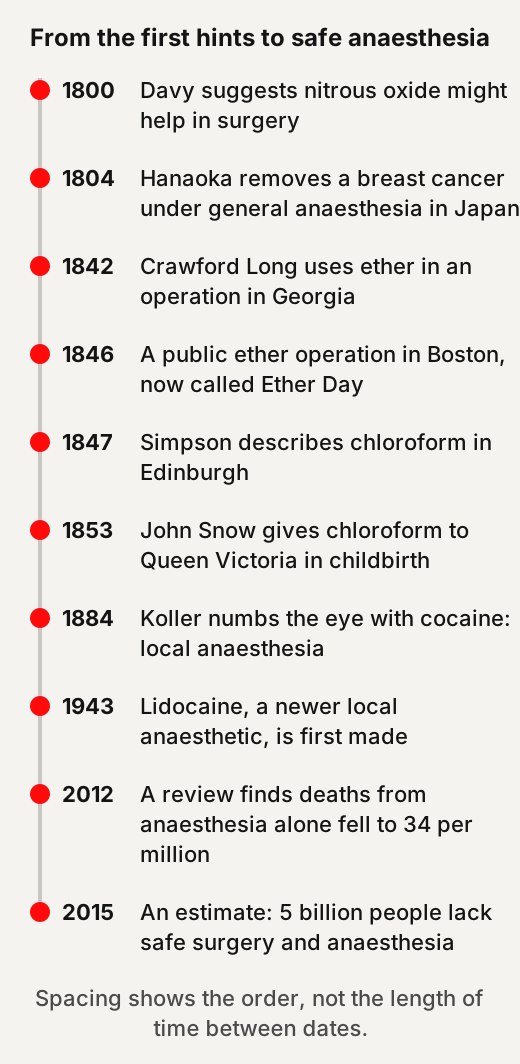
In 1800 the chemist Humphry Davy suggested that a gas he had been breathing might help in surgery.
Davy had been experimenting with nitrous oxide. In his 1800 book on the gas, he wrote that it “appears capable of destroying physical pain”. He added that it “may probably be used with advantage during surgical operations in which no great effusion of blood takes place”. More than forty years passed before ether, another vapour, was used in an operation.
Hanaoka’s operation in Japan, 1804
In 1804 the Japanese surgeon Hanaoka Seishū removed a breast cancer under general anaesthesia.
General anaesthesia means a temporary loss of feeling and a complete loss of awareness, like a very deep sleep. The Japanese Society of Anesthesiologists says Hanaoka removed a breast cancer under general anaesthesia on 13 October 1804. His drug, which he called tsūsensan, had a datura plant as its main ingredient. A 2004 history in the journal Breast Cancer says he spent almost 20 years working out the mixture.
It came 38 years before ether was first used in surgery. The Society notes that it was presented to the International College of Surgeons in Chicago in 1954.
Ether, from Georgia to Boston, 1842–1846
Ether was first used in surgery in 1842; a public operation in Boston in 1846 spread the news.
On 30 March 1842, in Jefferson, Georgia, the doctor Crawford Long removed a cyst from the neck of James Venable, who had breathed ether and felt no pain. Long did not publish his results until 1849.
Boston is where the news took off. On 16 October 1846, at Massachusetts General Hospital, the dentist William Morton gave ether to a patient, Gilbert Abbott, while the surgeon John Collins Warren operated on his neck. In the account in Morton’s authorised biography of 1859, Warren then told the audience: “Gentlemen! this is no humbug”. The 2022 history notes that this line first appears 13 years after the event, after Warren had died, and finds no convincing earlier evidence that he said it.
The date is still marked as Ether Day in Boston and as World Anaesthesia Day around the world. By the end of December 1846, ether had been used in surgery in Britain and France, and within a year in many countries.
Chloroform and childbirth, 1847–1853
Within a year came chloroform, and pain relief in childbirth, later taken up by a queen.
In January 1847 James Young Simpson of Edinburgh gave ether to a woman in labour. Simpson, a professor of midwifery, described chloroform as a new anaesthetic to a medical society in Edinburgh in November 1847. John Snow wrote in 1858 that Simpson “is justly considered” the person who introduced chloroform in place of ether.
Chloroform brought new dangers too. Snow’s book records the first death from chloroform: a girl of 15 having a toenail removed, near Newcastle, on 28 January 1848. He went on to study fifty such deaths.
The doctor John Snow built a wide reputation for his knowledge of anaesthetics. On 7 April 1853 he gave chloroform to Queen Victoria at the birth of Prince Leopold. By the account in the memoir published with his book, the Queen “expressed herself as greatly relieved”. This is the same John Snow who, in 1854, linked a London cholera outbreak to a public pump. Our page on clean tap water tells that story.
Numbing one part of the body, 1884 onward
From 1884, doctors could numb one part of the body while the patient stayed awake.
Local anaesthesia means a loss of feeling in one small area while the patient stays awake. In 1884 the Viennese eye doctor Carl Koller put a cocaine solution on the eye and made it numb. News of his discovery spread around the world in less than a month.
Cocaine was not safe, so chemists looked for something better. Its toxic effects were soon found, and a history of these drugs records many deaths among patients and addicted medical staff. Procaine followed in 1905, and lidocaine was first made in 1943.
3. What the numbers say now
Deaths caused by anaesthesia alone have become rare: about a tenth of the rate before the 1970s.
A meta-analysis pools the results of many earlier studies on one question; our page on trials, observational studies and meta-analyses explains how. A 2012 meta-analysis in The Lancet pooled 87 studies covering more than 21 million general anaesthetics. It found that deaths caused solely by anaesthesia fell from 357 per million before the 1970s to 34 per million in the 1990s and 2000s.
That is a fall of about 90%, by our arithmetic. For example, 357 per million is about one death in every 2,800 anaesthetics, and 34 per million is about one in 29,000.
Deaths around the time of surgery, from any cause, fell too. The same review found they dropped from 10,603 to 1,176 per million over the same decades. This happened even though patients arriving for surgery were, on average, at higher risk than before.
Not yet for everyone
Safe anaesthesia is still out of reach for a large part of the world.
The review found that deaths around the time of surgery fell most in developed countries, and linked the risk of dying to a country’s level of human development. A 2016 paper in BMJ Global Health, drawing on the Lancet Commission on Global Surgery, says 5 billion people lack access to safe, affordable surgical and anaesthesia care when needed. The 2015 modelling study behind that figure put it at at least 4.8 billion people, about two-thirds of the world.
In practice, an operation that is routine in one place can be unsafe or unavailable in another.
4. Half-truths people repeat
Most of these hold a grain of truth; the dates and details are what make them useful.
“Morton discovered anaesthesia”
Doesn't hold up William Morton discovered anaesthesia. Hanaoka (1804) and Long (1842) came first; the 1846 Boston operation, where Morton gave the ether, spread it.
How sure: Strong museum, professional-society and journal sources agree on the earlier dates.
Morton’s part was real, but he was not the first. The 2022 history says Long used ether in surgery on several occasions from 1842 onwards, and that Morton later campaigned for sole recognition. Morton patented the use of ether in November 1846; the patent was later ruled unenforceable.
“Ether Day was the first public demonstration”
Still argued The 1846 operation in Boston was the first public demonstration of anaesthesia. Sources disagree about “first”; they agree the Boston operations of October 1846 are what spread anaesthesia.
How sure: Unsettled the hospital’s plaque and one library say first; a 2022 history says not.
The answer depends on what counts as public. The plaque in the operating theatre, now called the Ether Dome, calls it “the first public demonstration of anaesthesia” during a serious operation. The Linda Hall Library calls it the first successful public demonstration. The 2022 history disagrees, because Long and the dentist Horace Wells had already shown their methods to colleagues.
On its impact they are closer. The Linda Hall Library calls 16 October 1846 the moment the wider medical world began to embrace anaesthesia. The 2022 history sees it as the first of a series of operations under ether that together started the modern era.
“The first public ether operation was painless”
Partly The patient at the 1846 demonstration felt and showed nothing. He moved and cried out near the end, and accounts differ on how much pain he felt.
How sure: Moderate the hospital record and Bigelow’s 1846 report agree he moved; they differ on the pain.
The records tell a messier story than the legend. A 2022 study of the hospital’s handwritten records found the patient did not react to the first cut, but moved and cried out during the later part of the operation. It concludes the operation was done under incomplete general anaesthesia. A retrospective account in the hospital record says he later reported no pain. Henry Bigelow’s 1846 report says he afterwards called the pain “considerable, though mitigated”.
“Before anaesthesia there was nothing for pain”
Partly Before anaesthesia, patients had nothing at all for pain. People used alcohol, opium and plants such as mandrake, but none made surgery painless.
How sure: Moderate histories agree on what was used; how well it worked is harder to measure.
The remedies in section 1 were real, and some were used before operations. In the Middle Ages, sponges soaked in mandrake juice were used before surgery to make patients sleep. How well they worked is hard to judge. A 2017 history calls mandrake a true anaesthetic of ancient times, while the 2022 history of Ether Day says operations were generally done with minimal or ineffective pain relief.
“Churches opposed pain relief in childbirth”
Still argued Religious leaders fought against pain relief in childbirth. Some patients and doctors objected on religious grounds; how much weight those objections carried is argued.
How sure: Unsettled later studies disagree on how much real opposition there was.
The sources agree that some objections were raised. In December 1847 Simpson wrote that he had “often heard patients and others strongly object” to anaesthesia in labour as contrary to religion. He answered them in a pamphlet that argued from Scripture.
The historian A. D. Farr argued in 1980 that the main objections rested on views about the role of pain, and that “religious opposition is no more than a myth of historiography”. He found that opposition to anaesthesia lasted less than 15 years.
A 2013 study of Simpson and religion found the attack on his use of chloroform “brief, sporadic and of little moment”, and suggests he exaggerated it. A 2016 study of an Edinburgh maternity case-book found anaesthesia in childbirth rose sharply after his pamphlet. It reads this as support for real opposition, though chloroform’s arrival may also explain it.
“Safe anaesthesia is available everywhere now”
Doesn't hold up Today anyone who needs an operation can have safe anaesthesia. About 5 billion people lack access to safe, affordable surgical and anaesthesia care, by a 2015 estimate.
How sure: Moderate a large international estimate, repeated in later papers; it is an estimate, not a count.
The gains in section 3 are real, but uneven. The 2022 history of Ether Day repeats the estimate that 5 billion people lack timely access to safe anaesthesia.
5. One small way to appreciate it
Before an operation, patients can ask the anaesthetist questions, and professional bodies of anaesthetists publish what to talk about.
An anaesthetist is a doctor trained to give drugs that prevent pain during surgery. The American Society of Anesthesiologists suggests bringing written questions to the meeting with the anaesthetist and writing down the answers. Its list of things to discuss includes your health, your medicines, any bad reaction to anaesthesia in you or your family, your fears and your recovery. The Australian and New Zealand College of Anaesthetists says its fact sheets are a guide, and that questions about your anaesthesia should go to your treating specialist.
For example, the next time you or someone close to you has an operation, notice the anaesthetist’s visit. Anaesthesia has been in wide use for less than two hundred years.
This page describes history and data; it is not medical advice. For anything about your own operation or anaesthetic, talk to your doctor or anaesthetist.
Other pages in this series look at clean tap water, vaccines, electric light, writing and literacy, calendar and clock time, maps and GPS, and refrigeration.
Quick answers
Who invented anaesthesia?
No single person. Hanaoka Seishū used general anaesthesia in Japan in 1804, Crawford Long used ether in Georgia in 1842, and the public ether operation in Boston in 1846, where William Morton gave the ether, is the one that spread the news.
What is Ether Day?
Ether Day is 16 October, the date of the 1846 public ether operation at Massachusetts General Hospital. It is still marked as Ether Day in Boston and as World Anaesthesia Day around the world.
Did Queen Victoria have chloroform?
Yes. On 7 April 1853 John Snow gave her chloroform at the birth of Prince Leopold, and, by his memoir's account, she "expressed herself as greatly relieved".
How safe is anaesthesia today?
A 2012 review of 87 studies found deaths caused solely by anaesthesia fell from 357 per million before the 1970s to 34 per million in the 1990s and 2000s. Deaths around surgery from any cause fell most in developed countries.
Was the first public ether operation painless?
Not entirely. The patient moved and cried out near the end. The hospital record says he later reported no pain; Bigelow's 1846 report says he called the pain "considerable, though mitigated".
Use this
Our suggestion: three small ways to see this history for yourself. None of them is medical advice.
Is this a question about history, or one for my doctor or anaesthetist?
Quick quiz
Nothing is scored or saved. Recalling it once now is what makes it last.
1. Who removed a breast cancer under general anaesthesia in 1804?
Answer: Hanaoka Seishū.Read it again ↑
2. What did Carl Koller do in 1884?
Answer: Numbed the eye with cocaine.Read it again ↑
3. How did deaths caused solely by anaesthesia change from before the 1970s to the 1990s and 2000s?
Answer: They fell to about a tenth.Read it again ↑
How we checked this · Last checked October 2026
- We read Humphry Davy's 1800 book, James Young Simpson's two 1847 pamphlets and John Snow's 1858 book on chloroform in their digitised texts.
- For Ether Day we used a 2022 study of the hospital's own handwritten records and the Linda Hall Library; for Hanaoka, the Japanese Society of Anesthesiologists.
- The Lancet Commission's own report was not open to us, so its 5 billion estimate is quoted from two later papers that cite it, alongside the 2015 modelling study behind it (at least 4.8 billion).
- Where sources disagree, about who was first or about religious objections, we show both sides. This page gives no medical advice.
Sources
Surgery before anaesthesia and how it changed
- G. R. Hamilton and T. F. Baskett, “In the arms of Morpheus: the development of morphine for postoperative pain relief”, Canadian Journal of Anesthesia 47 (2000), 367–374.Scholarly
- M. Mion, “From ‘Circe’s Root’ to ‘Spongia Soporifera’: the role of the mandrake as true anesthetic of ancient times”, Journal of Anesthesia History 3 (2017), 128–133.Scholarly
- R. Magee, “Robert Liston: surgeon extraordinary”, Australian and New Zealand Journal of Surgery 69 (1999), 878–881.Scholarly
- H. Davy, Researches, Chemical and Philosophical; Chiefly Concerning Nitrous Oxide (London, 1800) (Project Gutenberg #66955).Primary
- Japanese Society of Anesthesiologists, “History of anesthesiology”.Primary
- M. Izuo, “Medical history: Seishu Hanaoka and his success in breast cancer surgery under general anesthesia two hundred years ago”, Breast Cancer 11 (2004), 319–324.Scholarly
- Crawford W. Long Museum, “History”.Popular
- R. K. Thomas, “How ether went from a recreational ‘frolic’ drug to the first surgery anesthetic”, Smithsonian Magazine (from The Conversation, 2019).Popular
- P. G. Firth, “Ether Day revisited: the surgical records of Edward Gilbert Abbott”, Annals of Surgery Open 3 (2022), e166.Scholarly
- Linda Hall Library, Scientist of the Day, “Ether Dome”.Popular
- J. Y. Simpson, Account of a New Anaesthetic Agent, as a Substitute for Sulphuric Ether in Surgery and Midwifery (Edinburgh, 1847) (Internet Archive).Primary
- J. Y. Simpson, Answer to the Religious Objections Advanced against the Employment of Anaesthetic Agents in Midwifery and Surgery (Edinburgh, 1847) (Internet Archive).Primary
- J. Snow, On Chloroform and Other Anaesthetics, ed. B. W. Richardson, with a memoir of the author (London, 1858) (Project Gutenberg #68315).Primary
- J. Snow, On the Mode of Communication of Cholera, 2nd ed. (London, 1855) (Project Gutenberg #72894).Primary
- A. D. Farr, “Early opposition to obstetric anaesthesia”, Anaesthesia 35 (1980), 896–907.Scholarly
- E. A. Cameron and N. MacGillivray, “Sir James Young Simpson and religion: myths and controversies”, Journal of Medical Biography 21 (2013), 33–40.Scholarly
- A. G. McKenzie, “Another look at religious objections to obstetric anaesthesia”, International Journal of Obstetric Anesthesia 27 (2016), 62–65.Scholarly
- M. Goerig, D. Bacon and A. van Zundert, “Carl Koller, cocaine, and local anesthesia: some less known and forgotten facts”, Regional Anesthesia and Pain Medicine 37 (2012), 318–324.Scholarly
- Y. A. Ruetsch, T. Böni and A. Borgeat, “From cocaine to ropivacaine: the history of local anesthetic drugs”, Current Topics in Medicinal Chemistry 1 (2001), 175–182.Scholarly
- J. Biscoping and M. B. Bachmann-Mennenga, “Local anesthetics from ester to isomer” (in German, English abstract), Anästhesiologie, Intensivmedizin, Notfallmedizin, Schmerztherapie 35 (2000), 285–292.Scholarly
What the numbers say now
- D. Bainbridge et al., “Perioperative and anaesthetic-related mortality in developed and developing countries: a systematic review and meta-analysis”, The Lancet 380 (2012), 1075–1081.Scholarly
- J. S. Ng-Kamstra et al., “Global Surgery 2030: a roadmap for high income country actors”, BMJ Global Health 1 (2016), e000011, drawing on J. G. Meara et al., “Global Surgery 2030”, The Lancet 386 (2015).Scholarly
- B. C. Alkire et al., “Global access to surgical care: a modelling study”, The Lancet Global Health 3 (2015), e316–e323.Scholarly
Before an operation
- American Society of Anesthesiologists, Made for This Moment, “Preparing for surgery: checklist”.Primary
- Australian and New Zealand College of Anaesthetists, “Patient information fact sheets”.Primary
Newer, and more argued over, than it feels
Before the 1840s, most patients were awake during surgery, so operations were rare and surgeons worked fast. Alcohol, opium and mandrake were used, but none made surgery painless. How well they worked is hard to judge. Our view: anaesthesia has been in wide use for less than two hundred years. Even its first public demonstration is still argued over.
Read a "who was first" claim
- List every early date. The Japanese Society of Anesthesiologists says Hanaoka Seishū used general anaesthesia in Japan on 13 October 1804. The Crawford W. Long Museum says Long used ether in an operation in Georgia on 30 March 1842.
- Ask who published, and when. Long did not publish his results until 1849. Ask who could have known of a first at the time.
- Separate "first" from "spread". On 16 October 1846 in Boston, the dentist William Morton gave the ether while John Collins Warren operated. A 2022 history sees it as the first of a series of ether operations. Together, it says, they started the modern era.
- Show the dispute. The Ether Dome's plaque calls it "the first public demonstration of anaesthesia" during a serious operation. The 2022 history disagrees, because Long and Horace Wells had already shown their methods to colleagues.
- Check the famous line. The same history says the line credited to Warren, "this is no humbug", first appears 13 years later. It finds no convincing earlier evidence that he said it.
- Our suggestion. Before you credit one person, ask who came earlier, who published, and what made the news spread.
Three questions for a safety figure
- What does it count? The 2012 Lancet review counted deaths caused solely by anaesthesia separately from deaths around surgery from any cause. Anaesthesia-only deaths were 357 per million before the 1970s. By the 1990s and 2000s they were 34 per million.
- Which deaths fell most, and where? The same review found deaths around surgery, from any cause, fell most in developed countries.
- Is it a count or an estimate? The 5 billion people without safe, affordable surgical and anaesthesia care is an estimate. The 2015 modelling study behind it said at least 4.8 billion.
- Reuse the questions. Our suggestion: ask the same three questions of the next safety figure you read.
This week: read what anaesthetists tell patients
Our suggestion: this week, read one patient page from a professional body of anaesthetists. Section 5 names two, the American Society of Anesthesiologists and the Australian and New Zealand College of Anaesthetists. Note one point on it that you would not have thought to ask about. Treat this as learning, not a health check. For your own operation or anaesthetic, talk to your doctor or anaesthetist.
Keep going
- Things we take for granted: clean tap waterHow tap water went from dangerous to normal, including John Snow's cholera work.
- Things we take for granted: vaccinesWhat life was like before vaccines, how it changed, and what the numbers say now.
- Things we take for granted: electric lightWhat light cost before electricity, how it changed, and who still lives without it.
- Things we take for granted: writing and literacyWhen writing began, why reading stayed rare for so long, and how many people still cannot read.
- Things we take for granted: the calendar and clock timeHow the calendar and the clock came to be shared, and why the leap second is ending.
- Things we take for granted: maps and GPSHow people found their way before satellites, how it changed, and what a phone can do now.
- Things we take for granted: refrigerationHow food was kept before fridges, how mechanical cold arrived, and what food agencies say about it now.
- Things we take for granted: the internetHow messages travelled before the internet, how the network and the web arrived, and who is online now.
- Trial vs observational study vs meta-analysisThree ways to study a question, what each can show, and how to read a headline about one.
- GlossaryPlain meanings of general anaesthesia, local anaesthesia, anaesthetist and meta-analysis, the terms used on this page.