

Start hereFor thousands of years, the quickest way to send a detailed message far away was a rider on horseback. On 29 October 1969, two computers, at UCLA and SRI, managed two letters, "lo", before one crashed. What happened in between, and since?
Send a message across the world and it arrives before you put the phone down. For most of history, a detailed message travelled no faster than whoever carried it. Below: what came before, how the internet and the web arrived, what the numbers say now, and three things people often repeat. Then one small way to use it well.
1. Before: couriers, wires and the telephone
For thousands of years, a detailed message moved only as fast as a rider could carry it.
ITU is the United Nations agency for digital technologies. Its history says that for thousands of years, the quickest way to send complex messages over long distances was a courier on horseback. At the end of the 18th century, Claude Chappe opened a network of visual semaphore stations across France. Then came electricity. ITU dates the world’s first commercial telegraph service to London in 1839, using a system ITU credits to Charles Wheatstone.
On 24 May 1844, Samuel Morse sent a telegraph message over an experimental line from Washington, D.C., to Baltimore. The first transatlantic cable was completed on 5 August 1858, but it was dead by 18 September. A lasting link between the two sides of the ocean began on 27 July 1866, when a cable was landed at Heart’s Content, Newfoundland.
Each of these steps cut the wait between sending news and hearing it. Wires that crossed borders needed shared rules. On 17 May 1865, twenty founding members signed the first International Telegraph Convention in Paris, and the International Telegraph Union, today’s ITU, began. On 7 March 1876, the US Patent Office granted Alexander Graham Bell Patent No. 174,465 for the telephone. At its 1885 conference in Berlin, ITU added international telephone rules. Five minutes became the unit of charge, and a call was limited to ten minutes if others were asking to use the line.
For example, picture booking a turn on a shared line, and keeping your news short because others are waiting. Our printing press page covers an earlier leap in sharing information.
2. How it changed, from the ARPANET to the web
Computer networks grew from a 1969 experiment into a network of networks; the web came later, on top.
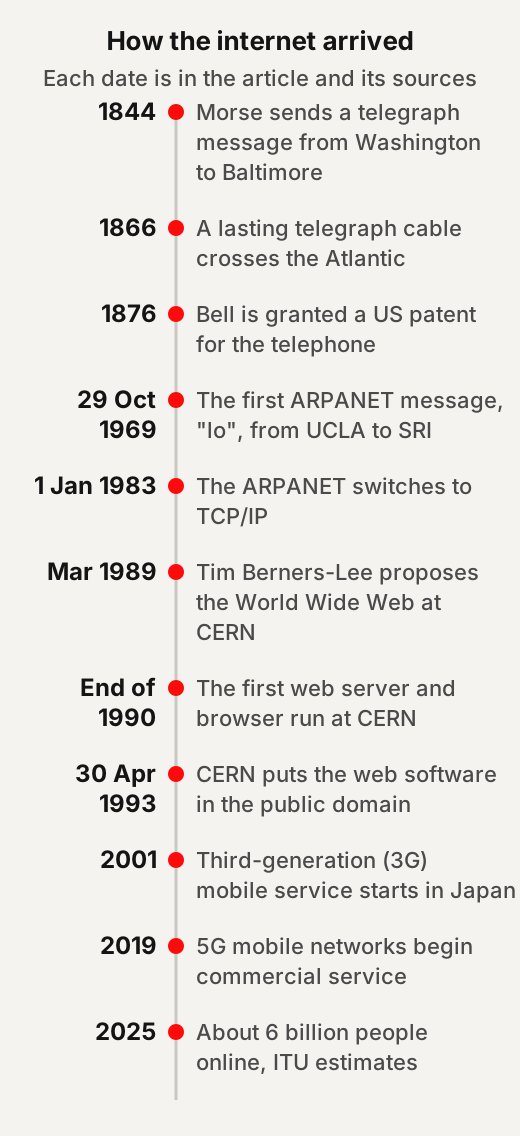
The timeline shows the pattern. The network’s core took about fourteen years, from the first message in 1969 to the switch to TCP/IP in 1983. The web was proposed six years after that.
Packets and the first message
The early network split messages into packets, and its first message was two letters long.
A packet is a chunk of data that carries its delivery addresses and its place in the sequence, a little like a numbered postcard. So a long message can travel as many packets and be put back in order. The Internet Society’s history, written by people who built the network, Kleinrock among them, says Leonard Kleinrock published the first paper on packet switching theory in July 1961. RAND’s history says Paul Baran conceived digital packet switching in studies published between 1960 and 1962, and that Donald Davies in Britain independently devised a very similar system. The Internet Society adds that the work at MIT, at RAND and at Britain’s National Physical Laboratory went on in parallel, without the researchers knowing of each other. Our reading: the packet idea had more than one parent, and accounts differ on who came first.
In September 1969, the first packet switch of the ARPANET was installed at UCLA, and the first host computer was connected. The ARPANET was a network funded by the US Advanced Research Projects Agency. On 29 October 1969, at 22:30, Kleinrock’s team tried to log in from UCLA to a computer at the Stanford Research Institute (SRI). In Kleinrock’s account, the “l” and the “o” went through, then the system crashed, and the full login worked about an hour later. The Computer History Museum notes that handwritten logs from UCLA record that first host-to-host connection. By the end of 1969, four host computers were connected.
Email came within a few years, and sources date it a little differently. ITU’s history says the ARPANET carried the first email in 1971. The Internet Society dates email’s introduction to 1972, when Ray Tomlinson wrote the basic send and read software. Our reading: either way, it was the early 1970s.
For example, “lo” is the whole of what reached SRI that night.
TCP/IP: a network of networks
TCP/IP let separate networks pass data to each other, and the ARPANET switched to it on 1 January 1983.
TCP/IP is the shared set of rules that lets different networks hand data to one another. MDN Web Docs defines the internet as a worldwide network of networks that uses this protocol suite. The Internet Society describes the move from the ARPANET’s old protocol to TCP/IP on 1 January 1983 as a “flag-day” switch, in which every host had to convert at the same time. It went surprisingly smoothly, the history says, and people handed out buttons saying “I survived the TCP/IP transition”.
In practice, your home network and your phone company’s network are separate networks, and a shared set of rules is what lets them pass your data along.
The web, from 1989 to 1993
Tim Berners-Lee proposed the web at CERN in 1989, and CERN gave the software away in 1993.
The World Wide Web is the system of linked pages you open in a browser. It runs on the internet. In plain words, the internet is the road network, and the web is one kind of traffic on it. CERN says Tim Berners-Lee wrote the first proposal for the web in March 1989. By the end of 1990, the first web server and browser were running at CERN, on a NeXT computer. The computer carried a hand-written label, “This machine is a server. DO NOT POWER IT DOWN!!”, so that nobody would switch it off by accident.
In August 1991, Berners-Lee announced the software on internet newsgroups, and interest spread around the world. Early in 1993, the NCSA at the University of Illinois released a first version of its Mosaic browser. On 30 April 1993, CERN put the basic web software in the public domain. Its statement read: “CERN relinquishes all intellectual property rights to this code, both source and binary”. By the end of 1994, CERN says, the web had 10,000 servers and 10 million users.
CERN says putting the software in the public domain, and later releasing it under an open licence, “allowed the web to flourish”. For example, you can still open the first web page CERN put online, as section 5 explains.
Cables under the sea and phones in pockets
Most traffic between countries runs through cables on the sea floor, and phones put the internet in pockets.
TeleGeography, a telecoms research firm, tracks more than 600 active and planned submarine cables as of 2026. It estimates more than 1.5 million kilometres of submarine cable in service in early 2026. Our reading: the internet feels wireless, but its longest journeys run through fibre-optic cable on the sea floor.
ITU’s history dates the first demonstration call on a handheld cell phone to 1973. It says commercial networks opened in Japan in 1979, digital 2G service launched in Finland in 1991, and 3G followed in Japan in 2001. ITU dates the early stages of 5G’s commercial service to 2019. Our reading: phones changed who could get online, because a phone needs no cable to the house.
3. What the numbers say now
About three in four people are online, but 2.2 billion are not, almost all in low- and middle-income countries.
ITU’s Facts and Figures 2025 estimates that 6 billion people, about three-quarters of the world’s population, are using the internet in 2025. It was the latest edition when we checked, in October 2026. It puts that at 74 per cent of the world’s population, up from 71 per cent a year earlier. It estimates that 2.2 billion people remain offline. Our dead internet theory page uses the same ITU estimate.
The gaps follow money and place. In high-income countries, 94 per cent of people use the internet, against 23 per cent in low-income countries. ITU estimates that 96 per cent of those offline live in low- and middle-income countries. It finds 85 per cent of people in urban areas online, against 58 per cent in rural areas. It finds 77 per cent of men online, against 71 per cent of women. Our reading: of the gaps ITU lists, the one between rich and poor countries is widest; in a low-income country, fewer than one person in four is online.
A signal is not the same as a connection people can use. ITU’s report says mobile broadband coverage is nearly universal. It estimates that 5G covers 55 per cent of the world’s people: 84 per cent in high-income countries and 4 per cent in low-income ones. It finds mobile broadband still unaffordable in around 60 per cent of low- and middle-income countries.
These are estimates, and they get revised. ITU first put 2024 at 5.5 billion people online, then revised it to 5.8 billion.
In plain words, picture the world as a room of 100 people: about 74 are online and about 26 are not.
4. Things people often repeat
Each of these is easy to believe, and the record gives a fuller picture.
“The internet and the web are the same thing”
Doesn't hold up The internet and the web are two names for the same thing. The web is one service that runs on the internet; email and many apps use the internet without it.
How sure: Strong CERN, the Internet Society and MDN’s reference guide all describe the web as built on the older internet.
MDN Web Docs puts it plainly: the web “is not the same as the Internet” but “one of many applications built on top of the Internet”. The web is younger, too. The ARPANET ran from 1969; the first web server ran at the end of 1990. CERN says that by late 1993, the web carried 1% of internet traffic; the rest was remote access, email and file transfer.
For example, an email or a video call can travel over the internet without ever opening a web page.
“The internet was built to survive a nuclear war”
Partly The internet was built to survive a nuclear war. The ARPANET was built to share computers; the survive-an-attack idea came from separate work at RAND.
How sure: Moderate the network’s builders, RAND and the man who says he signed most of its checks tell the link differently.
The Internet Society’s history calls the nuclear story a “false rumor” about the ARPANET; only the unrelated RAND study on secure voice considered nuclear war. It says a major motive for both the ARPANET and the internet was resource sharing, letting people use expensive computers far away. It adds that later work on connecting networks did stress robustness and survivability.
RAND’s history says Paul Baran designed a network with no central switches, so it could keep working after a nuclear attack. It calls the 1969 ARPANET the first large-scale test of this “distributed” concept. It also says the ARPANET was intended for researchers who wanted to share computers remotely.
Our reading: its builders remember a network for sharing computers, Lukasik’s account of why it was funded includes nuclear command and control, and the survivable design is one of the roots of the packet idea it used.
“Data between continents travels mostly by satellite”
Doesn't hold up Most internet traffic between continents goes by satellite. Cables under the sea carry far more; satellites mainly reach places cables do not.
How sure: Moderate one research firm’s figures, citing an undated US government statistic; worldwide totals are hard to count.
TeleGeography says cables can carry far more data than satellites, at a fraction of the cost. It says satellites carry only a very small percentage of international traffic, and cites an undated US Federal Communications Commission figure of 0.37% of US international capacity. Satellites, it adds, do an excellent job of reaching areas not yet wired with fibre.
For example, a ship at sea or a remote village may well connect by satellite, while a city’s link to another continent usually runs on cable.
5. One small way to appreciate it and use it well
Visit the first website, then take a few minutes for the free safety basics.
The world’s first website lives again at info.cern.ch, restored in a project CERN launched in 2013. The site also offers a line-mode browser simulator. That is the simpler browser CERN built for people without the NeXT computer the first one needed.
ITU’s figures suggest that most internet users have basic skills, while skills such as online safety are developing more slowly. The UK’s National Cyber Security Centre publishes free “Top tips for staying secure online”, from a strong separate password for your email to turning on 2-step verification. Our cybersecurity crash course lists five things to do first, starting with two-step verification on your email.
For example, open info.cern.ch, click one link, then turn on two-step verification for your email before you close the tab.
Other pages in this series look at electric light, clean tap water, vaccines, writing and literacy, refrigeration, calendar and clock time, maps and GPS and anaesthesia.
Quick answers
What is the difference between the internet and the web?
The internet is the worldwide network of networks; the web is a system of linked pages that Tim Berners-Lee proposed at CERN in 1989 and that runs on top of it. Email and many apps use the internet without the web.
What was the first message sent on the internet?
On 29 October 1969, Leonard Kleinrock's team at UCLA tried to log in to a computer at SRI. In Kleinrock's account, the "l" and the "o" went through, then the system crashed.
Was the internet built to survive a nuclear war?
Partly. The Internet Society's history says the ARPANET was built to share computers and calls the nuclear story a false rumor; RAND's history says Paul Baran designed a network to survive attack and calls the ARPANET the first large-scale test of that idea. Stephen Lukasik, who wrote that he signed most of the checks for its development, said one goal was survivable control of US nuclear forces.
How many people are not online?
ITU estimates that 2.2 billion people remain offline, more than a quarter of the world's population. Almost all live in low- and middle-income countries.
Use this
Three small ways to appreciate the internet and use it well, drawn from the sources above.
How did people manage this before it arrived, and who still manages without it?
Quick quiz
Nothing is scored or saved. Recalling it once now is what makes it last.
1. What did the first message on the ARPANET say, on 29 October 1969?
Answer: "lo".Read it again ↑
2. Which is older, the internet's ARPANET or the World Wide Web?
Answer: The ARPANET.Read it again ↑
3. According to TeleGeography, what carries most traffic between continents?
Answer: Submarine cables.Read it again ↑
How we checked this · Last checked October 2026
- We read the Internet Society's history, written by people who built the network, Leonard Kleinrock's own account of the first message, and CERN's pages on the web's birth and licence.
- The numbers come from ITU's Facts and Figures 2025, the newest edition on ITU's series page when we checked; ITU revises earlier years as new data arrive.
- Sources date the first email differently (1971 or 1972), so the page gives both.
- On the nuclear-war question, the Internet Society, RAND and Stephen Lukasik tell the link differently, so the page gives each account.
- The Library of Congress and RAND pages block automated reading, so we read their Internet Archive copies. We did not use pages we could not read.
- The ITU estimate of people online is the one our dead internet theory page uses.
- Sources credit the packet idea differently (Kleinrock, Baran, Davies), so the page gives each account.
- Stephen Lukasik's IEEE paper is behind a paywall; we read its abstract.
Sources
- International Telecommunication Union, “Facts and Figures 2025: Global connectivity…” (press release, Geneva, 17 November 2025), and Measuring digital development: Facts and Figures 2025, chapters “Internet use” and “Mobile network coverage”.Primary
- International Telecommunication Union, History Portal, “Overview of ITU’s History”: part 1, part 6 and part 7.Primary
- Library of Congress, “What Hath God Wrought?”, Today in History, 24 May.Primary
- IEEE History Center, Engineering and Technology History Wiki, “Milestones: Landing of the Transatlantic Cable, 1866”.Scholarly
- National Inventors Hall of Fame, “Alexander Graham Bell”.Popular
- Barry M. Leiner, Vinton G. Cerf, David D. Clark, Robert E. Kahn, Leonard Kleinrock, Daniel C. Lynch, Jon Postel, Larry G. Roberts and Stephen Wolff, “Brief History of the Internet”, Internet Society (1997).Primary
- Leonard Kleinrock, “The Day the Infant Internet Uttered its First Words”, UCLA.Primary
- Computer History Museum, “Internet History of 1960s”.Scholarly
- Stephen Lukasik, “Why the Arpanet Was Built”, IEEE Annals of the History of Computing 33, no. 3 (2011): 4–21, doi:10.1109/MAHC.2010.11 (abstract).Primary
- RAND, “Paul Baran and the Origins of the Internet” (22 March 2018).Primary
- CERN, “The birth of the Web”, “A short history of the Web” and “Licensing the Web”; and info.cern.ch, home of the first website.Primary
- MDN Web Docs glossary, “World Wide Web”, “Internet” and “Packet”.Popular
- TeleGeography, “Submarine Cable FAQs”.Popular
- UK National Cyber Security Centre, “Top tips for staying secure online”.Primary
Instant, and still not for everyone
For thousands of years, a detailed message moved only as fast as a rider could carry it. Today a message crosses the world in moments. Yet ITU estimates that 2.2 billion people are still offline. Our view: knowing how recent this is, and who it has not reached, makes it easier to notice.
Read a "who invented it" claim
- Name every parent. The Internet Society's history says Leonard Kleinrock published the first paper on packet switching theory in July 1961. RAND says Paul Baran conceived packet switching in studies published between 1960 and 1962. It adds that Donald Davies in Britain independently devised a very similar system.
- Ask who wrote the account. The Internet Society's history was written by people who built the network, Kleinrock among them.
- Separate the network from the web. The first ARPANET message went on 29 October 1969. CERN says Tim Berners-Lee proposed the web in March 1989.
- Count the hard switch-overs. The ARPANET moved to TCP/IP on 1 January 1983. The Internet Society says every host had to convert at the same time.
- Allow for different dates. ITU dates the first email to 1971. The Internet Society dates email's introduction to 1972.
- Our suggestion. Before you credit one inventor, ask who else worked on it, and who wrote the account you are reading.
One question, three accounts
- The builders. The Internet Society's history calls the nuclear story a "false rumor" about the ARPANET. It names resource sharing as a major motive.
- RAND. RAND says Baran designed a network with no central switches, so it could keep working after a nuclear attack.
- Stephen Lukasik. Stephen Lukasik says he signed most of the checks for the ARPANET's development. In 2011 he wrote that the goal included "survivable control of U.S. nuclear forces".
- Our suggestion. When accounts differ, note who tells each one and what each was placed to know.
This week: an old page and one new habit
Our suggestion: this week, open the first website at info.cern.ch and notice what it lacks compared with pages today. Then read the UK National Cyber Security Centre's free tips. Pick one you have not done yet, and do it before the week ends.
Goes with: 5. One small way to appreciate it and use it well ↑
Keep going
- Cybersecurity crash courseA plain-words cheat sheet for ordinary people and small businesses on scams, attacks and protections.
- The printing pressAn earlier leap in sharing information, and what Gutenberg added to what came before.
- The dead internet theoryIs the internet mostly bots and AI? Where the theory began, and what the figures count.
- Things we take for granted: electric lightWhat light cost before electricity, how it changed, and who still lives without it.
- Things we take for granted: clean tap waterHow tap water went from dangerous to normal, and where it still is not.
- Things we take for granted: vaccinesWhat life was like before vaccines, how it changed, and what the numbers say now.
- Things we take for granted: writing and literacyWhen writing began, why reading stayed rare for so long, and how many people still cannot read.
- Things we take for granted: refrigerationHow food was kept before fridges, how mechanical cold arrived, and what food agencies say about it now.
- Things we take for granted: the calendar and clock timeHow the calendar and the clock came to be shared, and why the leap second is ending.
- Things we take for granted: maps and GPSHow people found their way before satellites, how it changed, and what a phone can do now.
- Things we take for granted: anaesthesiaWhat surgery was like before anaesthesia, how it changed, and what the numbers say now.
- GlossaryPlain meanings of packet, TCP/IP and World Wide Web, the terms used on this page.
Goes with: 5. One small way to appreciate it and use it well ↑